The big news out of Sacramento this week, aside from the worsening budget situation, is movement on health care reform. As was liveblogged here yesterday, Sheila Kuehl’s Senate subcommittee held a public hearing and vote on AB 8, the less ambitious effort to reform health care by bringing more people into private insurance. As that hearing revealed, one of the most common statements from groups offering conditional support was that cost containment was a necessity – without it the bill was worthless, and many of the groups present would come out in opposition to it.
Cost containment is the key to AB 8. It’s the devil that lurks in the details. It’s worth a further look, if we are to believe that AB 8 is something that we who support real health care reform should help with our time and effort.
The basic problem with health care in America is that it is controlled by private insurers. In order to make massive profits, they have a clear interest in driving up the cost of premiums while at the same time denying or limiting what they pay out in actual coverage. Health care costs wind up bankrupting households and forcing businesses to either shed jobs, cut coverage (thereby hurting themselves through loss of work days due to greater frequency of illness), or close / leave the state.
As I noted back in February, universal mandate plans such as those offered by Arnold or by Mitt Romney fail because they force individuals to pay exorbitant costs with little care in return. For AB 8 to be a positive step for California, it would need to be able to bring California workers and businesses good coverage without leaving them vulnerable to soaring premiums or copays or deductibles.
Hence the focus on “cost containment” in so many of the comments yesterday. Unless there is language in AB 8 limiting costs, it could very well backfire badly on California workers and businesses, saddling them with soaring costs to help line the pockets of Blue Cross and their ilk.
So what exactly are the prospects for strong cost containment measures in AB 8? Depending on who you talk to, they’re unclear at best, dim at worst.
Nunez said he could not, at this time, accept the committee suggestion — which consumer groups supported — that total health care costs (including premiums, deductibles and other out-of-pocket costs) be limited to 5 percent of a family’s income. Right now, under AB8, only families in the purchasing pool under 300% of poverty ($62,000 for a family of four annually) are guaranteed to not have to pay more than 5% on just their premium….Nunez also did not accept amendments that would have established minimum package of benefits for private group coverage, with regard to preventative care and cost sharing. AB8 does have a basic HMO benefit (Knox/Keene and prescription drugs) in the purchasing pool. Nunez responded that AB8 does establish three standardized products in the overall private market, to help consumers better make comparisons between plans, allowing for “apples to apples” comparisons.
As Wright noted, Núñez’ explanation for the lack of a cap on costs for all consumers was that, while he “would love nothing more” than to achieve that, there was simply not enough money available to guarantee it. Given the Republican obstinacy on the budget that makes sense – but it does also raise the question of just how useful AB 8 will actually be, especially to middle class households that make more than 300% of the poverty line but who are squeezed by rising housing and other living costs.
Jerry Flanagan, of the Foundation for Taxpayer and Consumer Rights, is less enthused about how AB 8 is shaping up. In a column today on the California Progress Report Flanagan argues that as it stands now, AB 8 is no better than the individual mandate plan Arnold proposed at the beginning of the year. He provides damning stats on how donations from HMOs to Democrats Leland Yee and Gloria Negrete-McLeod may have led them to refuse to vote on cost containment measures in a separate but related bill, AB 1554, preventing its passage (he also provides excellent stats on how Republican legislators have also benefited from HMO cash). Combined with the failure of strong cost containment amendments to AB 8 itself, this suggests that the California Nurses Association may have been correct when they argued AB 8 was no better than Arnold’s own plan.
AB 1554 is not totally dead, it can be reconsidered before the end of the 2008 session. And the amendment process for AB 8 is by no means complete. But given the pragmatic realities of this year’s budget and the resultant inability of Speaker Núñez to embrace effective cost containment language, AB 8 may not be the good, stopgap solution to tide us over until we can get single-payer accomplished that many have claimed it to be. It might in fact make the present situation even worse, as it leaves open the possibility that insurers will be able to stick workers and businesses with dramatic cost increases and worsening levels of care.
Ultimately this situation shows the need to be assertive and bold in planning health care reform in California. The current political system, averse to taxes, hostage to an obstructionist Republican minority, in thrall to large corporate contributors, and unresponsive to the needs of Californians, is what has brought about the health care crisis. That system cannot be expected to produce useful reforms all on its own, no matter the good intentions of someone like Speaker Núñez.
That doesn’t mean we’re screwed. It instead reminds us that our approach has to be holistic – that we need changes in the way California politics operates if we are to revive the fortunes of progressive Democrats and finally start addressing the problems facing Californians. It’s a truth we’ve all known for some time now.
And it finally suggests that AB 8 isn’t any more or less pragmatic than SB 840 – they both seem to encounter similar obstacles, even as SB 840 is the clearly superior solution. Clearly a lot of work has to be done in California before we can get any meaningful health care reform. Why not mobilize, then, behind single-payer, and work to shorten the distance between it and its ultimate passage, than fighting over a flawed bill such as AB 8?
With Michael Moore’s SiCKO reaching more and more audiences, the traditional media have begun assessing the film’s criticisms of the collapsing US health care system. Today the SF Chronicle joins the act with a front-page piece. While it’s far better than CNN’s disreputable hatchet job, the Chron piece still employs some framing of the discussion that leads its readers away from a single-payer solution.
Because the media retains such a major role in shaping the way we discuss health care policy, it’s important for us to be attentive to the ways even a decent article can repeat misconceptions that might hurt the overall single-payer cause.
The article opens well, with a discussion of how health care polls as the top concern among Americans these days, as studies show that the US spends more money than other comparable countries – and yet receives worse quality in return. Victoria Colliver, the author of the piece, gets some great quotes about the “sick care system” here in the US and the staggering number of uninsured
Clearly, this suggests the public is hungry for reform – but what kind?
Moore’s film has been criticized for showing the positive side of health systems in other countries while glossing over negative aspects.
“There’s almost only positive attributes about the British, the French and Cuban system. Invariably, no system is perfect. I think this sort of detracts from his credibility on these comparisons,” said Stephen Zuckerman, health economist with the Urban Institute in Washington, D.C.
And yet the article does not detail what these supposed “negative aspects” of the French or British universal care systems are. The reader doesn’t get a chance to evaluate the pros and cons, because the cons are never really presented. One that is mentioned is wait times, but only in the context of Moore’s visit to an Ontario ER and hearing the Canadian patients saying they had no concerns about it.
Yet even this is misrepresented. The article notes that US waits for specialists or *elective* surgery (a distinction not made often enough) were the shortest in the world, along with Germany. But that is achieved only by strictly rationing who can have appointments with specialists or receive elective surgeries at all – whether it’s through the outright denial of health coverage, or by insurers keeping patients from those services. The full context of this supposedly positive aspect of US care suggests there’s nothing positive about it at all.
Colliver also repeats the flawed claim that Moore suggests socialized medicine “is free.” In reality SiCKO has a Labour MP reading from the NHS founding statement that says “this is not a charity.” She suggests that French care – whose positive aspects she does not discuss in detail – is accomplished only through crippling taxes and high unemployment.
The author does close the article with quotes from Americans living in France who praise that system. But this matter of taxes and economic activity is fundamental to the success of single-payer care in California and the US and so we should deal with it in some detail.
The impression given is that high taxes make for bad living. Unfortunately, Californians have drank deeply from this well over the last 30 years. If it was as simple as pointing out to Californians that, generally speaking, higher taxes levied in a progressive manner and spent on useful services are better for your wallet, we wouldn’t be in the mess we’re in today. All too few Californians make that kind of calculation – instead they tend toward a knee-jerk “all taxes are bad” view that brings us such joys as Prop 13 and the 2/3 requirement.
Behind this view is, in part, a belief that higher taxes will always cripple economic activity. This might have been true for a few years in the late 1970s. But when it comes to health care it is far from certain. As a recommended diary on Daily Kos today notes, health insurance costs are crippling American businesses. The only way businesses can survive is to make cuts to the coverages – so even though a worker might have some health benefits on the job (and are thus not counted as uninsured) they find that many of their health needs are not included.
The costs to American business and government of private health care are becoming well-known. They eat up an ever-growing chunk of state budgets and cut into corporate profits, leading to either less coverage or less hiring or less investment. The crippling of the American economy by the lack of single-payer health care should be at the core of any discussion of health care in the US, and its absence in this article is a significant omission.
As is the lack of any discussion of the flaws of private health insurance. As those who have seen SiCKO know, one of the powerful aspects of the film is its demonstration of the ways private insurers routinely deny care to people they have insured, often fudging the rules or breaking the law in the process. It’s not just the uninsured who are upset with the US “sick care system” but those who have insurance as well, those who pay high costs and find themselves facing less and less service in return.
Victoria Colliver should be credited for writing a better article than most on the subject, and surely we cannot expect her to write an article calling for single-payer outright. But neither does an incomplete look at the US system or an incomplete comparison with other systems that lacks details provide readers with the useful information they need when judging health care reform proposals. A full airing of the facts suggests single-payer is the best answer. Someday, I hope, the media will provide it. Until they do, we will.
Over the last few months I’ve been writing about high speed rail and the ongoing legislative efforts to save the project from Arnold’s efforts to kill it. As the budget negotiations reach their climax in Sacramento, the future of California’s high speed rail project – and of transportation funding itself – remains as uncertain as ever.
As the BayRail Alliance notes, the legislative budget conference committee didn’t resolve differences between the chambers on what to do about overall public transportation funding or about high speed rail funding itself. As I noted last month Arnold is looking to gut public transportation funding to the tune of $1.3 billion. Both the Assembly and the Senate want to restore some or all of this funding but disagreed on how much should be restored.
How does this impact HSR? And why is it critical that HSR get funding in this budget? Keep reading…
The California High Speed Rail Authority (CHSRA) has been working toward completion of necessary environmental studies, analysis of ridership, and final route/station selection ever since Gray Davis signed the original high speed rail bond act in 2002. Earlier this year the CHSRA requested $103 million to finish these studies and begin property acquisition.
Instead, Arnold only offered $1 million in his January budget, upped to $5 million in the May revise. Arnold and his advisers seem to believe that this will allow them to “keep the lights on” at the CHSRA until they can find private and federal commitments.
This thinking is flawed – private investors and the federal government simply do not commit to a project like this without the state taking the first step. That’s how these things always work. But without completed studies, even a state vote to fund HSR will not alone attract investment. Every major development needs to have all of its important environmental impact studies completed before it can be considered viable, and without a finalized route, including station selection, no private investor will be willing to take on such a project that still has some lack of certainty about it.
Both chambers of the legislature seem to recognize this – one chamber supported giving CHSRA $50 million, another supported $40 million. But as I noted above, the conference committee was unable to reconcile these numbers and, along with public transportation funding as a whole, chose to let the leadership decide. High speed rail funding is now in the laps of Senator Perata, Speaker Núñez, Senate Republican Leader Dick Ackerman, and Assembly Republican Leader Mike Villines.
The next two weeks, then, are critical for marshaling support for this project. The BayRail Alliance has created a contact page for getting in touch with these key legislators and, of course, the governor. State legislators need to know that the public takes this project seriously and expects to see it given enough funding to make it to the ballot.
Obviously to mobilize the public to save high speed rail, and to begin building support for it ahead of the November 2008 vote, we need to ramp up public outreach. There have been some significant positive steps in this direction – Fiona Ma’s trip to France to be a part of the TGV speed record event generated a lot of publicity and support for California’s project, with some in Sacramento believing that her actions helped push Arnold to make a public statement of support for HSR.
But certainly more must be done. The key may well be the Central Valley. As wu ming noted, inland Californians are used to seeing the Bay Area and SoCal hog all the infrastructure funding while highway 99 rots. One of the *main* beneficiaries of high speed rail will in fact be the Central Valley, which will be connected to the other major metro regions of the state, making it easier for residents of Fresno and Bakersfield to travel not only to SF or LA but to the rest of the country and the world (thanks to easier connections to major airports). Virtually every Chamber of Commerce along the line in the San Joaquin Valley supports HSR, but Assemblyman Mike Villines needs to hear this again.
With so much going on in Sacramento these days surrounding the state budget – especially on the health care issue – it can be easy for HSR to be lost in the shuffle, as it has been for the last few years. But this is the most important project California has considered in the last 45 years. Now is the time to help give HSR the final push over the top so that we can move on to the next phase – getting a successful vote on the bonds in November 2008.
In the long history of a California high speed rail plan there have been few more consistent and more effective supporters of the project than the BayRail Alliance. Their executive director, Margaret Okuzumi, has been active in the current fight to save high speed rail, and today offers a very insightful piece at the California Progress Report suggesting that underlying Arnold’s lack of support is a flawed perspective on the project – that he, influenced by his HSR advisor David Crane, is fundamentally misunderstanding the project. Instead of seeing it as a development, he’s seeing it as an investment banker would. Okuzumi explains:
The investment banker’s approach to making money is to first assemble the money, then figure out what investments to make.
The developer’s approach to making money is to design a building and determine if it will make a good return on the investment, then go out and assemble the financing to pull it off.
More on the other side…
Okuzumi goes into detail about how developers approach project financing:
Developers build “things”- buildings, subdivisions, theme parks and even highways and railways. They are used to having some unknowns initially about where the money is going to come from. If the project is economically sound, then they don’t worry about whether they have all the money in hand from the start; they know the investors will materialize as the project begins to become “real”, as the risks are reduced by that initial investment– the land acquired, the zoning and permitting attained, the environmental risk factors analyzed.
In other words, for a developer, getting the ball rolling is they key to project success. Someone has to take the first step, has to seed the project with startup funds – and once that is accomplished then the rest of the funding will typically materialize.
To hear Arnold tell it, we have no assurances that this other funding will appear. But this is not entirely true. As I noted on Wednesday, 2/3 of CA’s Congressional delegation signed a letter written by Jim Costa – including virtually all of the San Joaquin Valley Republicans – expressing strong support for HSR and a commitment to provide federal dollars. Okuzumi reports in her article this morning that every time she’s visited members of Congress to lobby on rail issues more broadly they tend to volunteer their support for HSR without prompting.
Yet Arnold still claims this is not enough. Why is he seeing this from and investment and not a development perspective?
Because, as Okuzumi notes, his liaison to the HSR project, the aforementioned David Crane, is himself an investment banker.
Who is David Crane, exactly?
He is a “San Francisco Democrat” who, like Susan Kennedy and Angela Bradstreet, has forsaken their nominal party affiliation to join Team Schwarzenegger. Since 1979 he worked for investment banking house Babcock & Brown, and today he is Arnold’s Special Advisor for Jobs and Economic Growth. Sunne Wright McPeak, Secretary of Transportation, Business, and Housing, is quoted in a January Capitol Weekly profile as saying that Crane “is involved in all of the key deliberations that I have been a part of.”
Crane is not only reputed to be a longtime and close friend and advisor to Arnold and Maria – but his philosophies are not particularly Democratic. According to the Capitol Weekly profile:
Crane’s economic philosophy sounds distinctly libertarian. He advocates against government intervention in private business and touts his admiration for conservative economist Milton Friedman.
“Governments don’t create jobs, and if they are not careful they can kill jobs,” Crane told an audience of business leaders at a San Francisco
luncheon last summer.
The profile goes on to detail Crane’s right-wing economic views, which hold that public pensions are “special privileges” and that the minimum wage hurts jobs. The Capitol Weekly claims his “abrasive” personality has alienated him from many Sacramento lobbyists and interest groups, which along with his right-wing economic views cost him a spot as a CalSTRS trustee earlier this year.
In spite of this, Crane has been delegated by Arnold to work on environmentally friendly business and development projects, including HSR. Last month he attended a symposium on Low Carbon Fuels Standards at Lawrence Berkeley Lab, where he spoke on a panel on international approaches to low carbon fuels standards. Surely he understands, then, that there are few better low carbon fuels than an electric, high speed train.
The combination of a right-wing approach to government’s role in jobs and infrastructure with an investment banking background makes it unlikely that Arnold will be getting the best advice on HSR from Crane. Of course, it’s still an open question whether Arnold actually supports the plan or whether he wishes to help out his Big Oil contributors by killing a rival plan.
HSR has widespread support among Californians of all kinds, especially those living on the route, their representatives, and in the Congress. They all understand that for job creation, a sustainable and environmentally friendly method of transportation is essential to California’s future. Arnold should show some leadership by supporting HSR instead of killing what is the most important project this state has debated in the last 45 years.
This summer is going to see a lot of intrastate travel in the Robert in Monterey household. Next week my fiance goes to San Diego for a 2-week training. The week after that, we’re both going back to OC for my sister’s wedding. In August is my 10-year high school reunion, also in OC.
Because there is no reliable train that connects Monterey County to SoCal, we’re going to drive each time – three round trips by the time September rolls around. We’re lucky that we can still do this – gas prices are high, but not yet crippling. There’s enough supply to fuel our new subcompact. But the environmental cost of these trips is already significant, and in the coming years, this easy galavanting around the Golden State will no longer be possible or desirable. Peaking oil supplies, crowded freeways, and unaffordable gas costs will mean that millions of summer trips like these – and the economic activity they collectively generate – will simply cease.
Happily, there is a plan to deal with this. As I’ve written about before, California has had a detailed plan to build a high speed rail line to connect the major metro areas of the state since 2002. Were it in place we could just hop a bus to Gilroy or San José and “Fly California” via the rails, arriving in SoCal in just a few hours, without using gas or adding carbon to the atmosphere.
As I’ve also written about, Arnold is trying to kill this plan. Democrats in the state legislature are trying to fight him off, and committees in both chambers have voted to give nearly $50 million for the project. But to hear some newspapers tell it, this plan is pretty much already dead. What gives?
Over the last week two San Diego papers have turned their attention to the high speed rail project, and both gave the very strong impression that what I believe to be the most important project debated by Californians in the last 45 years is “pretty much dead.” Their coverage misstates the situation and provides a false impression that high speed rail is not only dead, but not really worth fighting for. At the same time though, these articles DO suggest who some of the other forces in SoCal are that are trying to slow or kill the project.
First comes an article from Saturday’s North County Times headlined “High speed rail called dead”, quoting some government officials in the Temecula area as saying that high speed rail is “dead.” Temecula councilman – and head of the six-county Metrolink board – Ron Roberts says “A long time ago I thought it was dead. And I still think it is dead.” Bob Magee, Lake Elsinore’s mayor and Riverside County transportation official is quoted as saying “I don’t think we’re going to see high-speed rail in my lifetime.” And a Republican State Senator, Dennis Hollingsworth (CA-38), an avowed opponent of HSR, is allowed to spout this talking point: “The state’s finances are going to have to improve at a pretty remarkable clip to make it attractive to go out for a big bond for something that would be completely new.”
The article does also quote some HSR supporters, and we’ll have more to say about them later. But let’s parse the above quotes. Roberts, the head of the Metrolink board, calls HSR dead. Does Metrolink have full support for HSR, or do they worry that it might compete with them for funding, right-of-way, capital, and riders? If Magee, who sits on Riverside County’s transportation commission, says “we’ll never see it in our lifetimes,” was Riverside County ever really on board the HSR plan? Magee was later quoted by KCBS/2 news as saying Metrolink trains, not HSR was the solution to gridlock on the Interstate 15 corridor. As Magee also presided over a freeway and roads-centric transportation plan for Riverside County, it raises questions about whether he and the county were ever serious about HSR or whether they and local officials always preferred to work with Metrolink alone.
A few weeks back I noted that the CHSRA had voted to proceed with construction on the SF-LA portion of the line first, as mandated by the state legislature. This was seen as a “piecemeal” approach and at the CHSRA meeting in late May where this was decided, it was said that local government agencies such as SCAG (SoCal Association of Governments) and SANDAG (SD Association of Governments) were interested in other alternatives. Might it be the case, then, that local officials such as those quoted in this article had never been on board with HSR in the first place, and were all too happy to help try and kill it by withholding crucial support east and south of LA?
The other article comes in today’s San Diego Union-Tribune, wondering if Arnold’s opposition will “finally kill it,” as if the project has somehow been on life support. The text of the article itself suggests otherwise – that transportation issues remain a central focus of the budget negotiations and that Democrats remain committed to protecting local transit agency funding as well as the CHSRA plan, quoting Assemblymember John Laird (CA-27) to that effect.
Frank Russo recently bemoaned the lack of media coverage of important issues in our state. When a few articles DO appear on high speed rail, such as these two, they tend to emphasize the obstacles HSR faces, instead of emphasizing the popular support that exists for it.
In that NC Times article, State Sen. Christine Kehoe (CA-39) argues that the project is alive and well, but rightly points out that Arnold’s lack of leadership is endangering this vital proposal: “The governor is sending a very mixed message on the high-speed rail, unfortunately…We need leadership that says California is committed to this project. And we don’t have that yet.”
The article also closes with several quotes from locals about the project, including many who support it. Escondido’s mayor clearly gets why HSR is so valuable:
I think high-speed rail is the next generation of transportation, and it is critical to the economic success of California. I think it has to get built because, fundamentally, our highways are constrained, our airports are at capacity and our railroads are at capacity. If we want to keep moving people and goods, our next choice is going to be high-speed rail.
And just a few days ago we learned that ridership on California’s regional Amtrak routes has shattered all previous records, led by the extremely popular Capitol Corridor line between San José and Sacramento.
The desire for rapid, effective, and environmentally friendly rail transportation is quite clearly there. Support is there for the taking. But who will lead? Who in Sacramento, or who out there in California, will take up the cause? This project is clearly not dead. But without strong support, it could soon be.
Will California’s high speed rail project survive Arnold’s budget cuts – and if so, how will it get built? George Skelton’s Monday LA Times column turns its attention to the issue, with some important insights about the current status of the plan. With an excellent excoriation of Arnold Schwarzenegger’s unwillingness to lead on the issue, despite his public claims of support for the project, Skelton also questions some recent decisions of the California High Speed Rail Authority (CHSRA) regarding the implementation schedule of the project.
The first part of the column focuses on Arnold’s lack of support for the project. A few weeks back he published an op-ed in the Fresno Bee claiming to support the project. As I noted in response, this seemed to be a bit of smoke and mirrors, as Arnold continued to seek cuts for the plan behind the scenes.
Skelton’s column lays this point out further, noting that such an interpretation is prevailing wisdom in Sacramento, and that Arnold wants to preserve the funding capacity for more dams and freeways, despite the obvious environmental benefits of high speed rail. Quentin Kopp, the longtime San Francisco supervisor, state senator, and judge, who now runs the CHSRA, argues that if Arnold would come out and champion the project publicly, the battle would be “80% over.”
Skelton also correctly points out the flaws of Arnold’s claim that the CHSRA funding plan is inadequate – that there’s no way federal or private financers will commit until the state has indicated its support through a vote:
Most everybody outside the governor’s office considers this naive. Until California voters commit to the project, seasoned pols note, no private investors or government officials will. Besides, no one knows who’s going to be in charge in Washington after 2008. And about the only Sacramentan with the ability to coax Boxer, Feinstein and Pelosi into a negotiating room is Schwarzenegger, who isn’t lifting a finger for high-speed rail.
In short, Arnold himself is the key to the CHSRA funding plan – and he refuses to act in that capacity. What better place to get some of CA’s tax money returned from DC, as Arnold famously claimed he could do during the 2003 recall election, than to secure federal aid for the project?
The contrast between Arnold’s stated support and his actual efforts to kill the project led State Sen. Dean Florez, a Central Valley Democrat, to bitterly remark “Obviously, the governor’s budget writers don’t read his Op-Ed pieces.”
To Skelton, however, a bigger problem may be self-inflicted. He argues that the CHSRA’s decision to make an Anaheim-SF line the first phase of the project built is a recipe for political disaster. He quotes some important legislators who argue that by leaving Sacramento and San Diego to “some future lifetime” – implying that the plan to build to those cities is merely a vague promise – it will become more difficult for voters to support it, especially if their region is left out. Some of the quotes:
“If the project actually has a life, it’s going to have to include Sacramento,” says Sen. Darrell Steinberg (D-Sacramento)…
“I don’t see how they could leave out San Diego and have this make sense,” [Senate Budget Chair Denise Moreno] Ducheny says. “I can’t imagine why anybody in San Diego would vote for it.”
Given these alarmist quotes, what exactly happened at last week’s CHSRA board meeting? Clearly the board believes that the HSR system, like all other rail systems in the country as well as HSR systems around the world, cannot be built all at once. That seems a sensible point. They focused on Anaheim to SF via Merced for the following reasons, as defined in this report:
-This route is the “backbone of the network” which will likely bring in the most riders and the most private financing.
-The SD to LA route is plagued by “considerable uncertainty.” CHSRA argues that SCAG (SoCal Association of Governments) and SANDAG (SD Association of Governments) are more interested in Maglev technology to finish the route.
Granted, I’m somewhat new to this issue, but that doesn’t strike me as a very good reason to leave SD out. Someone need to coordinate CHSRA, SCAG, and SANDAG on finalizing a route and a technology. There’s no need to let local governments go their own way, and if we had leadership coming from Sacto, this might not be a problem (and I am not yet sure that it really is).
Arguments were made during the meeting by Commissioner Lynn Schenk that leaving out San Diego would cripple the potential for the project goals stated above, and probably bury that extension for a very long time. She “could not vote for the plan as proposed if San Diego were left out.”…
Jackson goes on to note that in the 1980s a plan to build a bullet train down the I-5 corridor along the San Diego County coast was killed for a number of reasons, including uncertain funding, lack of US Marine Corps approval to use Camp Pendleton land, and NIMBY opposition – but that CHSRA avoided that mistake by choosing an inland alignment, along Interstate 15.
It seems that not enough has been done to resolve these local issues. Why on earth is SCAG and SANDAG pushing for the expensive and untested maglev technology when CHSRA’s plan is much more solid, reliable, and utilizes existing and successful technology? And why hasn’t this dispute been resolved by now, some 7 years after the initial planning for the HSR project began?
Obviously no project of this scale can be built all at once. It might make sense to give voters a clear timeline – LA to SF by 2020, Sacto extension by 2022, LA to SD by 2025, something like that. But there must be a clear plan to tie the main metro regions into the network, something that can suggest to voters that the plans to get to their metro area are not just made out of thin air.
Voters – and interested members of the media – should also be reminded that the 2002 enabling legislation approving the CHSRA plan and scheduling a November 2004 vote on the bonds (pushed back twice) mandated that LA to SF be the first route funded (scroll to page 23). This would help justify the emphasis on LA to SF while also reminding folks that is just the start of a system, not its end.
For most rail systems, getting the first line built is the most difficult. Once a segment is in operation other regions clamor for inclusion. This was true of the LACMTA’s lines, it’s true here in Seattle, where a light rail system is a year or two away from its first segment completion, and it’s been true for European high speed rail networks as well.
However, without restoring CHSRA’s funding in this budget cycle, the questions over phasing are moot. Happily there seems to have been some improvements in the budget outlook. In a comment on a HSR diary at California Progress Report, John Shields claims “A California Senate subcommittee on the 22nd May approved a $45.2 million budget for Cal HSR”, which comports with some of the things I’ve heard as well. It’s not the full $103 million but it’s also a far sight better than the piddly $5 million Arnold had offered.
Russ Jackson of RailPAC offers this assessment, which I endorse:
In this writer’s opinion, by eliminating San Diego and not resolving the issue over Maglev with SCAG, not serving the Riverside area, without defining its route into the Bay Area, not serving Sacramento in the initial phase, and not serving the Bay Area to Sacramento segment, the CAHSRA has doomed itself to losing large blocks of votes for the $9 billion bond issue (if it ever gets on the ballot). As desirable as high-speed rail is for the state, it’s what the local folks think they want to approve for other areas to benefit from that will determine the project’s future.
Ultimately the CHSRA plan will require a champion. It took Al Gore to convince the world global warming was a fact, something that we should have realized over a decade ago. It will take Michael Moore to convince America that our health care crisis is real and that universal single-payer care is a viable solution, although Americans have been fighting for this for over a hundred years. Who will step up for high speed rail?
Around Earth Day, Newsweek ran a memorable cover of Arnold Schwarzenegger posing with a globe, to symbolize his supposedly environmentally aware political stance. It was an apt recognition of how Arnold had successfully “greenwashed” himself in 2006, glomming on at the last minute to a Democratic proposal to mandate cuts in greenhouse gases. In doing so Arnold sealed his reelection victory and had many Californians – even a lot of Democrats – convinced he really cared about the environment.
But underneath the green veneer, Arnold is still the same conservative Republican who seeks to destroy the environment. His recent budget includes $1.3 *billion* in cuts to California public transportation, from the high speed rail project to local bus and light rail services. Speaker Fabian Núñez aptly denounced these cuts:
There’s a bait and switch on transit funding here, too. You can’t pose for the cover of Newsweek as the savior of global warming one day and then turn around and slash funding for public transit the next. You can’t have a press conference urging commuters to take public transit after a highway collapses one day and then turn around and slash funding for public transit the next.
The link between widely available public transit and environmental health, and addressing climate change, should be obvious. As greenhouse gas emissions soar, Americans need to cut back on those emissions, and driving less is a core method of doing that.
It also has an added and obvious value in an age of soaring gas prices. Californians are bearing the brunt of the oil companies’ gouging, paying over $3.50 a gallon. As a result usage of public transportation in the state has SOARED over the last few months. California’s intercity trains, such as the Capitol Corridor and the Pacific Surfliner, are seeing record numbers of riders. The LACMTA’s Orange Line, a bus rapid transit system in the San Fernando Valley, hit its 2020 ridership projections…in 2007.
The combination of environmental awareness and soaring gas prices has led millions of Californians to turn to public transportation. Millions more want to make the change but aren’t yet served by the required frequency or capacity. An example:
Anyway, if we had decent, reliable, accessible public transportation to take, we’d sell every car but the toy car and take public transportation to work. We checked into it at one point. If [my partner] took the train, he’d have to shift his work hours to ridiculously early or ridiculously late. They designed the train schedule to suit those living in Santa Barbara (median cost of single family home $1.2M) and working in Ventura. Yeah, that makes sense. Because I know lots of people who want to live in one of the most expensive towns in the country so they can commute to where housing is about half that. And me? To get to my job, 9 miles away, I’d have to transfer three times, and it would take me almost two hours each way, vs. my current 15-20 minute commute. Hell no.
Our only realistic choice is to own cars and commute to work.
In addition, many local public transportation agencies are facing financial stresses of their own – added users are requiring more buses, more train cars, and more operators.
The main agencies facing this stress aren’t small suburban carriers, but instead at the major urban systems of the state – San Francisco MUNI and the LA County MTA. For them, Arnold’s cuts are truly devastating.
“It’s just going to add to the misery,” said Roger Snoble [head of the LACMTA], whose agency would lose $230 million under Schwarzenegger’s plan. “It’s going to affect everybody who moves in Los Angeles County.”
In other words – less public transportation means more people driving, meaning more traffic on SoCal’s already congested roads.
San Francisco’s MUNI system includes dozens of bus lines and several light-rail lines. All of them are heavily traveled. So heavily traveled, in fact, that they don’t have enough buses and streetcars and drivers to meet demand. So what is Arnold going to do to help? Cut a further $146 million from their budget too.
Finally there is the matter of high speed rail. In other diaries I have explained the importance of this project – a fully planned and detailed system to build high speed rail lines to link the state’s major metro areas – the Bay Area, Sacramento, the San Joaquin Valley, LA, OC, the Inland Empire, and San Diego.
Arnold claims to support the plan, and has written op-eds professing to want to see it built. But behind the scenes he continues to do all he can to kill it. The California High Speed Rail Authority needs $130 million in funding to complete its work and move ahead with a scheduled vote in November 2008 on $10 billion in bonds to start building the system. Arnold plans to give them only $3 million in funding, and that funding is to come out of the Orange County Transportation Authority’s budget.
I have written several diaries about the high speed rail project. The plan is fully developed. It’s all ready to go. All we need is $10 billion in state bond money to seed the project and convince private investors to contribute to it as well. But Arnold wants to kill that too, despite the fact that it is a green and sustainable technology that will get Californians out of their cars, out of the planes, and provide for the state’s growing transportation needs.
What explains Arnold’s desire to destroy public transportation? It’s two interrelated factors. The first is that Arnold simply is not an environmentalist. He is fixated on the automobile as a form of transportation. He thinks more freeways are the solution, not more public transportation. The screaming demand of millions of Californians for public transit don’t register with him.
The second is that Arnold is in the pockets of Big Oil. They have donated well over a million dollars to his various funds since November, even though he isn’t eligible for re-election in 2010. As their gouging of Californians continues, the oil companies know that a backlash is coming. They want to prevent that at all costs, want to ensure that they hold the line in California lest they set a trend for the rest of the nation.
If Arnold destroys California’s public transit systems, Californians will not have any alternative but to pay the exorbitant costs at the pump. The middle class will sink further into financial ruin.
Arnold’s public transportation cuts are a catastrophic disaster for the state of California. Not only will they make global warming worse, not only will they make our environment more polluted, more prone to fire, and mired deeper in drought, but his cuts will ruin family budgets, eventually causing lost jobs and further destroying the state’s middle class.
California Democrats must reverse these cuts. They are unconscionable and unaffordable.
Among the big news from today’s announcement of Arnold’s May Revise is the proposal to sell off EdFund for $1 billion. EdFund is a public non-profit that manages $27 billion in student loans. Arnold plans to sell it off for the one-time windfall it might provide, even while his revised budget takes even more money from public transportation and social services.
Why is this such a catastrophically bad idea? Because even as people complain about screwing us young folks over with state bond debt, privatized student loans put us in a FAR worse financial situation, crippling young folks and young families right when their entrepreneurial and creative energies are at their peak.
Sallie Mae provides the cautionary tale. Originally a public non-profit, Sallie Mae was privatized between 1997 and 2004, and remains the nation’s largest holder of student loan debt (EdFund is #2).
The privatization has led to financial stress for millions of Americans. Sallie Mae execs, as described by the excellent Student Loan Justice site, gave themselves massive payouts and sought to improve profits. How? By screwing borrowers.
Sallie Mae makes more money from a defaulted loan than from a borrower who is paying as agreed. Such a borrower must begin making larger payments, with interest capitalized and tens of thousands of dollars in penalties added. Since they make so much money this way, they have little incentive to help borrowers return to solvency. Instead they seek to inflate the collection debt. And since student loans cannot be discharged in bankruptcy, and can only be refinanced once, Sallie Mae has you over a barrel.
I have been on top of my loan from the start and it just keeps growing.
I too borrowed money for student loans and when I graduated in 1994 Sallie Mae called me and convinced me to consolidate my guaranteed student loans. I had one small loan of $2500.00 that was unsubsidized the rest of $35000.00 was subsidized. They told me nothing about this. It took me four years to get them to tell me what happened to my loan. See, I was a single mother of two and didn’t get a job right from college. In order to keep my certification I had 5 years to complete 18 more credits. So my plan was to accrue 2 years or so of interest until I got a job and could go back to school and be in deferment. The deferment would have put my loans on hold and I would not accrue interest. This is what they told me. In the third year I didn’t have a full time job, but I did start back at school half time. So my loans should have become defered without interest acrruing. Well that didn’t happen. When I called (which was often) Sallie Mae they told me “My loans were none of my business and why don’t you just get a job.” After several years I started to record the comments and rude remarks. They told me I wasn’t allowed to record the conversation. After 8 years Sallie Mae sends me another notice. This time the note has a place called Ombudsman. Ombudsman was supposed to be a go between. She was all supportive and ready to go after Sallie Mae and a week later she called and said “That is the nature of your loan, so pay it.” I have been paying a small amount for 2 years. I pay $100.00 a month. Edfund has my loan now and are threatening to garnish my wages. When they do this I will have to quit my job. I have my grandson and when they garnish my wages I won’t be able to pay for daycare. Your right, they don’t care about the human element. All I want to do is pay back my loan. The original loan of $37,000.00. I am now ordered to pay $86,000.00. I thought the same thing you did. That they would make an offer and I could begin to manage my loan. The Edfund person told me why would we do that. We wouldn’t make any money. I have been on top of my loan from the start and it just keeps growing. I am a teacher that works in a low income school and will never be able to do what they are demanding. I truly believe in my soul that Sallie Mae is just as responsible for this getting out of hand. They can’t tell me about ignorance isn’t an excuse. I didn’t have the knowledge to ask the right questions. I had to take their word and they told me all my loans were subsidized. Now they have a form that separates subsidized and unsubsidized loans. They didn’t have this when I signed their promissary note.
The horror stories are truly frightening, of wrecked lives and dashed dreams. Some on other state pages talk of committing suicide to get rid of the debt burden. And as the current kickbacks scandal involving Nelnet and other private lenders widens, the true danger of privatized student loans becomes even clearer.
California’s foolish refusal to make hard choices about taxes, choosing instead to balance its budgets on the backs of students, forced millions of students and their families to take out loans. Arnold’s desire to privatize EdFund will cause a serious financial crisis for millions more Californians. It is an unconscionable and indefensible act, one that California Democrats have no other choice to oppose.
Privatizing the lottery would be merely foolish. Privatizing EdFund would be a catastrophe. Let’s make sure it doesn’t happen.
Since then there has been a great deal of activity in the state, ahead of a crucial meeting in Sacramento this week on funding for the project. There now appears to be some significant movement from Arnold’s office toward a supportive position. However, there is still a long way to go, and your help is needed to ensure that California does the right thing and saves this project.
Note: For a full explanation of the California high speed rail plan, see my diary from last week
Is Democratic Pressure Bringing Arnold Around?
As of a few weeks ago it looked like Arnold was trying to kill the project outright. The CHSRA (California High Speed Rail Authority) plan was originally slated to go before voters in November 2004. That was postponed to November 2006 and again to November 2008. In Arnold’s initial budget proposal he suggested postponing the vote indefinitely and slashing CHSRA’s budget to a mere $1 million, barely enough to keep the office open.
Since news of this got a wider hearing, there has been a significant amount of pushback, especially from Democrats. The California Democratic Party, at its annual convention in San Diego two weekends ago, passed a resolution strongly supportive of the plan. Activists from around the state began calling their legislators and rallying support for the project.
But let me be clear: I strongly support high-speed rail for California, and especially for the San Joaquin Valley. Increasing the Valley’s transportation options, especially after voters passed Proposition 1B to repair Highway 99, would better serve the region’s growing population and enhance the Valley’s critical importance to our state’s economy.
The promise of high-speed rail is incredible. Looking forward to the kind of California we want to build 20 and 30 years from now, a network of ultra-fast rail lines whisking people from one end of the state to the other is a viable and important transportation alternative and would be a great benefit to us all.
On the surface this sounds great. Clearly Arnold understands that this project – the most important project proposed for California in the last 45 years – cannot be allowed to die. And that is a major victory for our side.
However, careful parsing of his letter indicates how much work we have left to do to truly save this project, and just how little faith we can have in Arnold’s apparent “support” at this time.
The Outstanding Issues: Funding
The bulk of Arnold’s letter to the Bee is a claim that the CHSRA does not have adequate funding identified. The proposal that will go before voters in November 2008 will provide $10 billion in bonds, out of a projected $40 billion cost. Arnold’s letter asks where the rest of this money will come from.
The CHSRA has always maintained that the $10 billion is necessary seed money to convince the federal government and private investors that they can invest in the project and provide for the remaining costs.
Steven T. Jones, a reporter for the truly excellent San Francisco Bay Guardian, notes that these claims are not totally correct, and that major bond houses like Lehman Bros believe that state seed money – in this case, $10 billion – WILL bring in private capital and convince the bond market that the project is worthy of their support.
Arnold’s letter to the Bee makes the CHSRA plan sound like another flawed and unfunded government project and posits a false “chicken and egg” problem. In fact this is by no means the case, as the necessary starting point – $10 billion in state bonds – has already been identified, and a whole lot of people, from venture capitalists to the aforementioned bond market are convinced this will break the logjam and produce the remaining $30 billion. In short, CHSRA has already identified where the remaining money will come from, although they understandably cannot get a firm commitment from the private sector until they get a firm commitment from the public sector.
Instead the letter to the Bee suggests Arnold wants to do with high speed rail what he’s done with climate change – adopt a posture of support for action, but in practice do nothing that will actually produce action. Arnold claims to “propose additional funding” in his budget for CHSRA but this is unspecified and probably an effort to claim his paltry $1 million proposal for the 2007-08 budget as “additional funding.” Nor does he commit to a 2008 vote, which everyone else involved agrees is key to the success of the high speed rail project. Reading Arnold’s letter carefully, one finds he talks a big game, but does not actually provide any firm assurances that high speed rail will go ahead. Instead he seems to want “more study,” which as anyone with knowledge of politics knows, is pretty much a statement of nonsupport.
What might be at the root of Arnold’s opposition? Last week I speculated that his millions in campaign contributions from oil companies might have something to do with it. Surely that plays a role. But as Steven T. Jones notes, it is also partly because wants to use the state’s bond capacity for other things – like more prisons, more dams, more freeways. In other words, things the state needs less of, instead of high speed rail, a transformative project that will add much more to the state’s economy and long-term needs than a prison or a dam or a freeway.
How YOU Can Help Save High Speed Rail
As I said at the beginning, there is a all-important hearing in Sacramento this week regarding the project. A State Senate Budget Subcommittee will meet to determine the fate of CHSRA funding – whether Arnold’s paltry $1 million sum will stand, or whether the full funding needs of $130 million to keep the CHSRA alive will be provided. The Bay Rail Alliance has provided the crucial contact information:
Senate Budget Subcommittee 4 hearing
Thursday, May 10
@ 10 AM or upon adjournment of the previous session,
Room 112, State Capitol
item 2665, the High Speed Rail Authority’s budget
Members of Senate Budget Sub 4 Committee
1) Senator Michael Machado (Chair)
Senate District 5 – Tracy, Manteca and Stockton in San Joaquin County; Suisun City, Fairfield, Dixon and Vacaville in Solano County; Davis, West Sacramento, Winters and Woodland in Yolo County; as well as Walnut Grove and a portion of Elk Grove in Sacramento County.
Phone: (916) 651-4005
Fax: (916) 323-2304
State Capitol, Room 5066
Sacramento, CA 95814
2) Senator Robert Dutton (Republican)
Senate District 31 – southwestern portion of San Bernardino County and the northwestern portion of Riverside County: all of Big Bear, Grand Terrace, Highland, Loma Linda, Rancho Cucamonga, Redlands, Upland, Yucaipa, Yucca Valley, Crestline, Lake Arrowhead, Mentone, Running Springs, An Antonio Heights and portions of San Bernardino and Colton; all of Riverside, Glen Avon, Highgrove, Mira Loma, Pedley, Rubidoux, Sunnyslope and all but a small portion of Woodcrest.
State Capitol, Room 5094
Sacramento, CA 95814
Phone: (916) 651-4031
Fax: (916) 327-2272
3) Senator Christine Kehoe – Democrat from San Diego
Phone: (916) 651-4039
Fax: (916) 327-2188 State Capitol, Room 4038 Sacramento, CA 95814
Location:
State Capitol building, room 112, Sacramento
If you live in these districts, by all means, CALL! Even if you don’t there may well be value in calling them to let them know of your strong support for high speed rail. Of course, if you can attend the hearing, by all means do so. I wish I could be there, but unfortunately I cannot.
Some overviews of why high speed rail is a good and necessary project can be found:
There may also be value in contacting Arnold’s office, to explain how valuable the project will be in terms of transportation alternatives, traffic relief, sustainable development, reducing pollution, slowing global warming, and providing jobs. To contact the governator:
Over the last few months more and more of the netroots have recognized the importance of upgrading our transportation infrastructure to meet our capacity demands while also providing a sustainable and green method of transit. Diaries by apsmith, BruceMcF, quaoar and A Siegel have all zeroed in on high speed rail as a particularly useful and desirable way to provide Americans with an effective, reliable, and green way to travel between our cities.
So far their work has been largely in explaining the theory of why high speed rail would be a good fit for America. While other states kick around abstract ideas, California has had since 2002 a complete plan for high speed rail – with the all important EIR/EIS finalized – to link the state’s major metro areas – San Francisco, Oakland, San José, Sacramento, Fresno, Los Angeles, OC, Riverside, and San Diego – with a true high-speed system.
The governor wants “to quietly kill this – and not go out and tell the people that high-speed rail isn’t in the future,” said state Sen. Dean Florez (D-Shafter). The lawmaker from the southern San Joaquin Valley is counting on the trains to help bring jobs to his district.
Schwarzenegger asked the Legislature in his 2007 budget to slash money for the California High-Speed Rail Authority. The governor also wants lawmakers to postpone indefinitely a $9.95-billion rail bond issue that is slated to appear on the November 2008 ballot.
Background
The California High Speed Rail Authority (CHSRA) was created in 1996 to devise a plan to link Northern and Southern California by high speed rail. In 2000 voters authorized the CHSRA to finalize a route and a construction plan, which was presented to the Legislature in 2002. The Legislature then automatically put it on the November 2004 ballot.
And then it was delayed. The early Zeroes were a period of fiscal crisis for California, costing Gray Davis his job and leading Arnold Schwarzenegger to seek to limit state spending. Tom McClintock, a notorious right-wing State Senator, authored a bill in 2004 to kill the project outright. A compromise was reached where the vote would be delayed to November 2006. However, that was the ballot where Arnold was pushing his various infrastructure bonds, for everything from roads to levees to dams, and worried that high speed rail might be a bridge too far and weigh down the vote of the other proposals. Another deal was cut, and now the CHSRA plan is slated to go before voters in November 2008. This is what Arnold is trying to stop.
The Plan
And it’s a shame, too, because the plan is really quite good. It’s worth spending a moment to examine it, to see just how good it is and therefore how awful its cancellation would be.
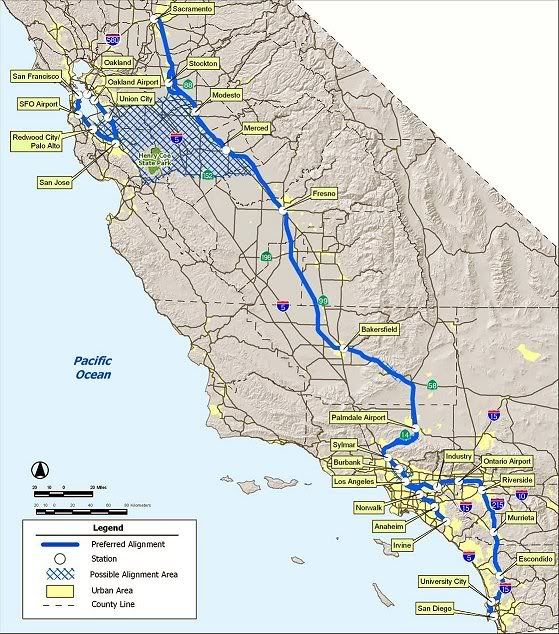
(From the CAHSR and assumed to be in the public domain)
As you can see, the planned line would link nearly all of the major population centers of California. And even those areas not included, like Monterey Bay (where I will soon be living) will benefit from the system – whereas it currently takes 6 hours to drive from Monterey to LA, it would likely take only 3-4 hours via a drive to San José and then the train to LA.
(A note: the shaded area between the Bay Area and the Central Valley is because the CHSRA hasn’t yet settled on whether to use the Pacheco Pass (along Highway 152) or the Altamont Pass (along I-580) to link the two regions.)
– 42 to 68 million passengers a year by 2020
– Fully grade-separated and built along existing highway corridors (to lower costs and minimize disruption to urban landscape)
– Trains capable of at least 220mph
– Powered by overhead electrical wires, providing a greener source of energy. Trains will also return power to the grid when they brake.
Scroll down to page 13 on the Implementation Plan, and you will see just how much time the high speed trains will save Californians on common trips within the state:
LA to SF: 7.5 hrs by car. 1 hour 20 by plane – but “door to door” (including getting to the airport, security checks, check-in lines, etc) it is nearly 3.5 hours. By high speed train it would be about 2.5 hours on the train and about 3.5 hours door to door – about the same as a plane, but at a much lower cost to our planet.
LA to SD: 2.5 hours by car (unless you hit traffic, then god knows how long!). 2.75 hrs by plane (but few people fly between LA and SD) and 2.25 hrs by train. A significant – and reliable – savings, considering that on the high speed line between LA and SD you won’t have to worry about the East LA Interchange, the bottleneck through Norwalk, the Orange Crush, the El Toro Y, the 5/805 merge.
The line will not be a single point-to-point route but a mixture of express, local, and semi-local trains. It will provide several levels of efficient and quick service to Californians.
What will it cost? The current estimate is around $30 billion. $10 billion of that will come from state bonds, which will seed the project and entice private investment to make up the other $20 billion. Ridership will help pay off these bonds.
Will the riders come? As every other high speed rail project has proven, absolutely. The Acela between Washington DC and Boston has already made a significant dent in air travel along the Northeast Corridor. The Spanish AVE line between Madrid and Barcelona is having a similar impact, even though the line currently only reaches Tarragona (just short of Barcelona, which will be linked by the end of the year). And even California’s existing slower-speed rail corridors are showing record numbers of riders. The demand is clearly there.
Why We Need High Speed Rail
CHSRA is the most important project facing Californians since Pat Brown built the California Aqueduct in 1960. It’s that simple. Here’s why.
First, the state’s existing oil-based transportation infrastructure is reaching the limits of its capacity. Although one can drive from LA to SF in about 6.5 hours (fast if you’re a leadfoot) this can take up to *10 hours* via I-5 on a holiday weekend. Within the megalopolis – SoCal or Bay Area – travel by car is becoming less and less possible, even when tanker trucks aren’t melting away the MacArthur Maze.
California’s airports are already stressed. LAX expansion plans have been frequently postponed because of soaring costs, and other SoCal airports from John Wayne to Burbank face similar limits. SFO cannot be expanded at all and OAK is nearing its limit. SAN (SD’s airport) is one of the nation’s worst, but efforts to move it to Miramar have been blocked by the US Navy. And yet more and more people are using California’s roads and airports – our population is pushing 40 million and may be nearing 50 million in a few generations. Clearly alternative capacity is needed.
And that doesn’t even take into account Peak Oil. As many of you know, the production of oil around the world is near or has reached its peak. From here on out we will not only be extracting less oil, but will be paying more for it because much of the remaining oil is harder to reach.
Already we are seeing soaring gas prices. Many Californians are now paying around $3.50 a gallon and will likely be the first in the lower 48 to hit $4 this summer. This will also make air travel even more costly.
To protect our environment, to slow global warming, to protect against peak oil, and to provide a less expensive way for residents of our great Golden State to connect with each other, we have NO OTHER CHOICE but to build high speed rail.
We have a solid plan. We have the clear need. We have pent-up demand.
WHEREAS, the CA High Speed Rail Authority has made significant progress since it was established in 1996 to create fast rail service between Southern CA and San Francisco, San Jose, Sacramento and the Central Valley to give the public a travel choice between HSR, automobiles and airplanes – thus relieving the growing highway and airport congestion in a state in which the population is expected to grow by 12 million to a total of 50 million by 2025; and
WHEREAS, high speed rail is already successful in Japan, Great Britain, France, Spain, Italy, Sweden, Australia, China, Taiwan and South Korea, and construction is underway in North Africa, Turkey, Mexico and South America – setting a standard for California, where HSR could carry passengers between downtown San Francisco and Los Angeles in about 2 1/2 hours in more comfort and safety and in less time than it takes to travel to and from and check in and out of airports, thus enabling airlines to better serve long-distance travelers; and
WHEREAS, high speed rail will be a significant weapon against air pollution and global warming as it uses much less energy per passenger than cars and airplanes – and HSR will be even more essential if, as expected, petroleum supplies diminish in the future;
THEREFORE BE IT RESOLVED, that the CDP asks that all CA elected officials give full support to establishing HSR in CA at the earliest possible date.
Why Arnold Is Trying to Terminate It
Given the obvious arguments in favor of the project, and its widespread political support (virtually all cities along the proposed line have been clamoring for a stop, and workers and unions eye the good middle-class wage paying work that will come with building the line), why on earth is Arnold Schwarzenegger trying to kill it?
Although Arnold has received a reputation lately for being an environmentalist, this is complete and utter nonsense. Arnold gutted many of the mandatory trading provisions of the global warming emissions cap proposal. The League of Conservation Voters gave Arnold a 50 rating (out of 100) and said his record remained “mediocre.” And he has received well over $1 million in campaign contributions from Big Oil.
In his infrastructure funding priorities Arnold is as Republican as it gets in his emphasis on freeways over public transportation. LA and the Bay Area are getting showered with money out of the infrastructure bond to build more freeway capacity, yet Arnold’s budget still projects a CUT in public transportation funds. (Look for a diary on specifically this issue soon.)
Further, Arnold personally has little interest in mass transit. He owns a Hummer, and thinks environmentally friendly transportation is converting the Hummer to hydrogen – finding non-auto based forms of transportation seems totally off his radar screen. When he goes on MTV’s “Pimp My Ride” he’s not there to explain how California needs to adapt to the 21st century, he’s there to tell viewers that the fantasies of the 20th century regarding endless gas supplies and a limitless car culture can somehow still remain viable.
Between his own blinders, his very real debt to the oil companies (who have a strong motive to see HSR killed) and his fraudulent rhetoric on the environment, it is unsurprising, yet all the more maddening, that Arnold wants to kill this important project.
What You Can Do
But so far as I can tell, California remains a democracy, whatever else has happened to it on the national level. And we the people can still push back against Arnold and protect this transformative and vital project against his efforts to Terminate it.
Perhaps the first thing to do is let Arnold know that you think he is totally and completely in the wrong on this. Contact him!
Write him a letter! Governor Arnold Schwarzenegger
State Capitol Building
Sacramento, CA 95814
Equally as important is the state legislature. We need to target Democrats to ensure they stand by us and by their party convention in protecting high speed rail. Important Democrats include the following (links are to contact pages):
Sen. Don Perata, President of the State Senate (510) 286-1333 or (916) 651-4009
Sen. Alan Lowenthal, chair of Senate Transportation Committee (562) 495-4766 or (916) 651-4027
Fabian Núñez (e-mail link), Speaker of the Assembly. (213) 620-4646 or (916) 319-2046
Assemblymember John Laird, head of Assembly Budget Committee (hence a powerful person). (831) 649-2832 or (916) 319-2027
There may also be value in going to the dark side – that is, Republicans. Assemblymember Bob Huff was quoted in the /LA Times/ as saying he thought this might be a good transportation alternative but worried about the cost. Pushing him into a pro-HSR camp might pay big dividends. His webpage is here (it loads poorly on my Firefox, though) and phone numbers are 909-860-5560 or (916) 319-2060.
I supposed you could try Sen. Tom McClintock, who has repeatedly tried to kill HSR and is one of CA’s most notorious right-wingers. If you want to, a Google search for his name should provide all the info you’ll need.
Finally, there is this video put out by the CAHSR on YouTube about the project:
Spread the information far and wide. Let’s build support for this vital and sensible project, and stare down Arnold Schwarzenegger and save California’s high speed rail.