Tag Archives: Yolo County

Yolo County Clerk Freddie Oakley Stands Up for Marriage Equality

(Many county clerks are standing up for equality today, here is Wu Ming’s story from Yolo County. – promoted by blogswarm)

As readers of surf putah may have noticed, I’m a big fan of Yolo County Clerk, Freddie Oakley. She has a very accessible elections site, has been vigilant in avoiding election-day glitches of the sort that bollox up voting in bigger and wealthier counties with great regularity. How many other county clerks even know about the problems with Diebold’s buggy and easily hackable voting machines, let alone have written op eds as cogent as this one about the need for verified voting? And while I disagreed with her decision to cancel early voting stations on UCD campus last election, I will give her credit for starting the early voting up in the first place.

But in addition to her work to protect the vote in Yolo County, Freddie Oakley will stand up for marriage equality this Valentine’s Day as well (Also covered in the Enterprise, as well as the Davis Vanguard. The Chronicle has a related story up about other Northern Californian County Clerks supporting marriage equality, albeit not in such a creative manner). Instead of just turning away same-sex couples who come every Valentine’s Day to protest their unequal treatment under California and federal marriage law, Oakley made up her own “Certificate of Inequality” to pass out in solidarity, made with her own money and passed out on her lunch break.

Oakley’s certificate will read:

“Whereas: The state of California arrogates the right to limit your freedom to marry based on the gender of your chosen spouse, and

“Whereas: Based on your choice of spouse I may NOT issue a license to marry to you, and

“Whereas: I am unable to divine any legitimate governmental purpose in the regulation of your marriage partner’s gender,

“Now, therefore: I issue this Certificate of Inequality to you because your choice of marriage partner displeases some people whose displeasure is, apparently, more important that principles of equality.

“Issued to: (a name here) and signed, this day, February 14, 2007

Freddie Oakley, Yolo County Clerk-Recorder.”

An evangelical Christian who strongly supports the separation of church and state – “[…] I’m not happy about enforcing a law that is discriminatory and based on religious principles,” […] “Religion has no place in government.” – Oakley confuses the standard media narrative that places religious folks on one side and those who support a religiously neutral secular state on the other. In reality, this is not solely an issue of religious versus secular values, but also a question of whether the state will enforce one side in a sectarian dispute; to wit, whether the state will tell Unitarians, Quakers and Congregationalists that the same sex couples that they marry are not married unless the Southern Baptists and Fundamentalists agree to it. Additionally, these laws conflict with the Fourteenth Amendment’s equal protection clause, which guarantees all citizens the same rights under law. As Rich Rifkin points out in the comments after the Davis Vanguard article, it is illegal to deny business licenses to a gay or lesbian owner because of their sexual orientation; how then can it be legally defensible to deny them the legal right to marry other consenting adults?

While the stunt is witty, the issue is anything but trivial. This country has made grave errors in the past by trying to write popularly-held prejudice into marriage law, in a perverse effort to “defend traditional marriage.” California had miscegenation laws until a California Supreme Court decision reversed them in Perez v. Sharp in 1948, and it took Loving v. Virginia in 1967 before the “traditional definition of marriage” was rightly thrown out as an embarassing relic of a hateful past at the national level. The current political momentum appears to be repeating history, as California’s Assembly and State Senate were once again the first state legislature to challenge a prejudicial status quo (although supposedly “moderate” Governor Schwarzeneggar vetoed the bill, on the bizarre rationale that the legislature is not democratic, and that only the people can pass such laws, via initiative).

As a straight, married citizen, to paraphrase Thomas Jefferson, it does me no injury for my neighbor to marry whom they love. It neither picks my pocket nor breaks my leg. My marriage was one of the best decisions I have ever made, and it has filled my life with joy; how could I ever deny that joy to someone else?

Good for Freddie Oakley, and may everyone have a great Valentine’s Day.

And It Begins – Cabaldon Announces for the 8th Assembly District

(This is better than the quick diary that I wrote. – promoted by Brian Leubitz)

Well, it’s not exactly a surprise, but the entry of Chris Cabaldon – West Sacramento five-time mayor and runner-up to current Assemblywoman Lois Wolk (D-Davis) in 2002 – into the race officially begins the campaign to succeed Wolk in 2008, who is term limited and will be running for State Senate to replace Mike Machado (D-Linden) in the fifth district. Ah, you gotta love the term limits-induced merry-go-round in Sacramento.

The 8th district includes most of Yolo and Solano Counties, minus the city of Vallejo and the rural parts of Yolo County north of Woodland; in a nutshell, the I-80 corridor. The district is strongly Democratic, ad the winner of the Democratic primary will be heavily, possibly prohibitively favored to win the general.

Cabaldon’s announcement, interestingly enough, was in Davis in front of the train station, not West Sacramento, and he was flanked by Democratic officeholders from all over Yolo County – from Davis, County Supervisor and former Assemblywoman Helen Thompson, City Councilman Don Saylor, and Mayor pro tem Ruth Asmundson; From Woodland, County Sheriff and mayor Dave Flory, Vice Mayor Skip Davies, and City Councilman Jeff Monroe; From West Sacramento, County Supervisor Mike McGowan, Vice Mayor Oscar Villegas and City Councilmen Wes Beers and Mark Johannessen. One notable absence was outgoing Assemblywoman Lois Wolk, who has not yet announced who she is endorsing, if any, in the race to replace her. Republican County Supervisor Matt Rexroad, while not endorsing anybody in the race (claiming that his endorsement would be “the kiss of death” anyways), looks to me to be endorsing Cabaldon between the lines in this post (which is currently down; I’ll re-link it when his site gets back up and running). Clearly, Cabaldon is trying to get himself out there early as the Yolo County candidate, before anyone else announces.

Cabaldon’s supporters and detractors tend to cite the same thing – building in West Sacramento – to support their opinions. Supporters tend to point to his bringing Ikea to West Sac and contruction of condo housing as part of the recent revitalization of the port city; detractors tend to view him as excessively pro-corporate and pro-sprawl, and Cabaldon’s current campaigning on the issue of controlling urban sprawl to be hypocritical. Not really ever having set foot in West Sacramento before or after Cabaldon’s tenure, I can’t really say one way or the other whether it helped or hurt the city, but that’s the discussion. I don’t suspect that Cabaldon’s having come out last year as gay will affect the race much either way, since the district and most of his competitors are pretty socially liberal.

Those rumored to be considering a run are Steve Hardy (D-Vacaville), a City Councilman from Vacaville who came in 3rd in the 2002 primary, and Yolo County Supervisor Mariko Yamada (D-Davis), who was involved with the short-lived Davis DFA meetup and is generally considered to be the progressive candidate in the race. Having gotten to know Mariko a bit during the Dean campaign (over before it began, sadly), I hope she runs.

For those interested, there are a couple good discussions simmering on over at The Davis Vanguard on Cabaldon (here and here), as well as potential challengers here.

If the California presidential primary is moved to February, the state races will be the second in a series of three elections in ’08, and will likely end up with pretty low turnout. Who this helps is anybody’s guess this far out.At any rate, it should be fun to watch, and if the rumored Wolk-Garamendi, jr. race in the 5th State Senate district also pans out, 2008 could be a very exciting year for Yolo politics.

related websites:

Christopher Cabaldon for Assembly
Mariko Yamada’s County Supervisor page
Steve Hardy’s City Council page (scroll down)

—–

originally at surf putah

A “Far-Left” Manifesto for Yolo County

(Surf Putah, which you will find in the California friends of our blogroll, is a great site for Yolo Cty. politics. – promoted by Brian Leubitz)

Well, I’ve made the cut, having been linked in the “Yolo Blogs” category over at Republican Yolo County Supervisor Matt Rexroad’s new website (which looks quite nice, really). Along with the link (a good web resource for Yolo County in its own right), Rexroad gave this site this little introduction:

If you want to know what the people at the far end of the spectrum in Davis are doing….surf Putah.  I really can’t explain this stuff. Generally, if you find an opinion expressed here Matt Rexroad will be on the other side.

Since I’ve been identified as the far end of the spectrum, I figure that it’s as good a time as any to lay out what us inexplicable far-out Davisites are thinking about Yolo County. Ironically enough, I find myself to the center, or at least in a slightly different direction, from many self-defined “progressives” here in Davis, especially on the issue of development, the axis which city politics seems, rightly or wrongly, to revolve around. Mostly, though, I find that the perpetual battle over political labels to be a fairly useless one, since it assumes a coherent binary political debate, when in fact things tend to be far more complex in real life. I believe that governments ought to balance their budgets responsibly, instead of borrowing and spending with bond measures; am I a conservative? I believe that people generally ought to mind their own business, and that government and religious beliefs are best kept separate where neither can mess the other up; am I a liberal? I believe that all people are created equal, and ought to be treated as such; am I a progressive?

So for the benefit of both Rexroad and those who might follow his link to my site I’ll toss out where this inexplicable far-left blogger would like to see Yolo County headed:

1. Making it possible for Yolo farmers and ranchers to make a decent living, so that they can grow crops instead of subdivisions. The reasons why it is getting harder and harder for small farmers and ranchers to get by are complex, and the roots of the problem more often than not lie well outside of Yolo County. And yet, preserving a healthy and locally-rooted agricultural industry is something that should be central to any vision of a future Yolo County. Protecting farmland from development by easements, or buyouts is one way to help curb development pressure on productive ag land, but it is perhaps more important to ease the market pressures of falling agricultural commodity prices and rising fuel and other operating costs. Encouraging fuel-intensive or alternate fuel usage, aided by ag research over at UC Davis, might help to insulate Yolo agriculture from rising gas prices. Requiring school lunches to preference local farmers and ranchers might help to provide more demand for those products. Teaching gardening in elementary school, as they do at Fairfield Elementary school out in the county, might help to diminish the urban-rural split as well, and give our kids more appreciation for the folks who grow their food.Encouraging new agricultural industries in the county to replace the loss of all those closed tomato canneries in the past decade would help too.

Ultimately, reversing the decades-long national policy of free trade deals that flood domestic markets with foreign imports, and national policies that encourage overproduction are the real key to saving the family farm. Food is one thing, like military technology, that is a bad idea to rely on foreign imports for. We shouldn’t be flying walnuts in all the way from China when we can grow them out perfectly well in Winters.

2. Keeping development off the floodplain, and strengthening the flood control measures where we have already built close to rivers. The Yolo Bypass is a sound approach to the long-term pressures of river systems and seasonal flooding, and Yolo County has been smarter than many counties in this regard. Woodland desperately needs some way of guarding against winter flooding on Cache Creek, and hopefully some hydraulically sound solution will be found in the next couple of years, whether it be stronger levees or some bypass channel upstream of town. While the pressure for more housing is and will continue to be acute because of population growth (more on that below), we need to be steadfast about avoiding Natomas-style floodplain sprawl, because the moment any houses are built there we will collectively be liable for paying for their protection, indefinitely. In places such as West Sacramento, where flooding will always be a problem, we need to make sure that their levees are hardened to withstand severe flooding.

3. Providing adequate housing so that the children of Yolo residents can afford to actually live in their hometowns. This is one area where I part ways with many Davis progressives, in that I do not believe that a no growth or even slow growth model is either smart or just. When a town limits its housing stock like Davis has done, it might preserve the population size of ther town, but the nature of the community cannot but change with the skyrocketing housing prices. As long as people continue to have children, as long as the university increases its student and professorial population (which it will, since it is tied to state demographic growth), and as long as people want to move into this county of ours, we are going to have to have reasonable housing options. Yolo County has both one of the higher rates of growth in the state as well as one of the higher birthrates. All those people are going to have to find somewhere to live.

My sense is that we’d be better off encouraging the cities of Yolo county to start urbanizing in their downtown cores, close to the highways and train stations, to at bare minimum a level of density that our cities reached at the turn of the 19th century (the tallest buildings in most Yolo towns are perversely often the oldest ones). Build up a couple stories, get some people in those downtowns, and then get the downtowns built up along walkable, new urbanist lines, so that people don’t have to drive everywhere just to go about everyday life. This will allow more housing to be efficiently defended by floodwalls where floods threaten, and it should make room for many Yoloites who are currently priced out of even renting here anymore, let alone own houses. Additionally, when suburban housing is built, aim for smaller lots and smaller two story houses the way you used to see in the 20s and 30s, instead of the spread-out ranch tract housing that uses land as if it’s still cheap. Land is expensive, and denser housing makes better and more economical use of that land. And enough already with the huge luxury mcmansion developments for out of towners.

4. Support more small businesses to fulfill city needs, avoid big box megastores. As I wrote during the Measure K debate last November, there is a need for more and better retail in Yolo County, especially here in luxury boutique-saturated downtown Davis, but that we ought to be encouraging small and locally owned businesses to fulfill those needs rather than inviting big box retailers in to suck up the whole market, and siphon that revenue out of the county to some out of state corporate headquarters. Far too often it is posed as a false choice between the status quo and big box megastores, when in fact a third way is possible. One of the problems is that commercial rent is far too high in Davis, but as best as can be done, the city governments and county government should work to ease whatever barriers to starting businesses exist for small local businesses.

5. While this might be seen by some as working at cross-purposes to #4, we really need a living wage for the county, to say nothing of the über-expensive city of Davis as well. People who work in town ought to be able to afford to live in the same communities, or failing that, in the county. While the statewide minimum wage hike of $7.50 goes partway, a hike to a living wage of $10 or higher would help a great deal, and lessen the class segregation that we get when rents get so rediculously high. Living wage ordinances in other towns have shown that they don’t destroy the local economy as predicted, and that the recipients of those wages tend to plough most of that money back into the local economy, creating a virtuous economic cycle. Finally, a living wage is simply the right thing to do, since anybody who works hard every day at a job, any job, deserves the dignity of being able to make ends meet.

6. Along with this, since the National and State governments seem incapable of getting universal health insurance passed, we need to find some way of at least covering children, from prenatal through delivery and child medical care. A significant number of the working poor in Yolo County either are children or have children, and helping to cover the often exorbitant costs of child healthcare would not only go a long way towards lessening that burden on those families (in effect, a net wage raise), it would also help to guarantee that those children got adequate health care, immunizations and so on. This in turn helps to limit problems for the county down the road dealing with epidemics and overtaxed emergency rooms. Disease does not recognize any difference between rich or poor, insured or uninsured, citizen or immigrant; we’ve all seen how quickly a cold or flu can move through an elementary school or a daycare.

Anyone who claims to be in favor of family values ought to be willing to help make sure that people don’t get bankrupted by the costs of giving birth, let alone raising a kid. It is in our best interest personally as well as as a societally to make sure that these kids are covered, at least until the state and federal government get their acts together and get something funded. Since Yolo is a fairly poor county government-wise, this will have to be a fairly bare bones plan without accompanying state funding, not unlike any serious levee solutions. Assemblywoman Wolk, we’re counting on you to help talk some sense into the Governor.

7. More state parks. We have in this county both beautiful hiking up in the hills to the west of us, as well as a beautiful river to the east. Why there aren’t more state parks or recreational infrastructure helping people to get to them is beyond me.

8. The reestablishment of the old interurban train network in the Central Valley. The Capitol Corridor has been a great success since its inception a decade ago, but relatively little work has been done to apply the same logic to the Valley itself, and try and link the cities and towns of the Sacramento Valley together like they once were abnout a century ago, before the rise of auto-fueled sprawl. The old train lines are still there, connecting most cities up and down the valley to Sacramento, and yet they sit virtually unused for commuter traffic. Fixing them up a bit and running basic commuter lines on them would help to take traffic pressure off the highway system, and help us to accomodate what population growth the region will see in the decades to come. It also uses a lot more fuel, which brings us to the next point:

9. Countywide efforts at conservation and alternative energy. As our populations grow, and global warming gives us hotter, dryer summers, we will see increased stresses on our water and electric usage. As peak oil runs hard into increasing global demands for fuel, gasoline and natural gas are going to persistantly rise in price, hurting commuters, farmers and businesses alike. We should be getting ahead of the curve by working to lower our communities’ water and energy footprints, and thus our exposure to price increases and shortages. Having UCD’s stellar environmental engineering research at the ready is a huge advantage; let’s take advantage of it.

10. A justice system that treats all Yolo residents as equal members of their communities, that serves and protects Black and Latino citizens as well as White citizens. Doug Paul Davis over at the Davis Vanguard has done such great reporting on this issue that I won’t try to duplicate it, but rest assured our police forces and justice system need serious revamping on the issues of racial profiling and how we combat crime in general. While gang violence is real, criminalizing an entire neighborhood, as was done in West Sacramento, seems to me to violate the rights of the very citizens that our justice system is ostensibly supposed to protect. Likewise, while out of towners commit crimes in town, treating huge swathes of our community as perpetual suspects does real and lasting harm to the community as a whole. We can do better.

—–

So there you have it, one Yoloite’s “far-left” take on things. While I expect that Matt and I disagree on several of these issues, i’m not sure that he and I are diametrically opposed on all of them. Statewide and nationally, however, I suspect that our political differences are clearer and less common ground possible to reach. I leave the question of whether the above opinions are way off the end of the spectrum up to the reader.

(originally posted at surf putah

Still Working On Those Levees…

(The levees should see some money out of the bond packages. Problem is that we have to wait for the legislature and governor to allocate those funds. That must be the top priority. Also, check out wu ming’s blog, Surf Putah – promoted by SFBrianCL)

An article in yesterday’s Chronicle suggests that we could be in for another nail-biter of a winter storm season. While the bond measures thankfully passed, the funds won’t be available until next June, while repairs on last year’s erosion damage are still ongoing, and running out of time before the rains start:

More than one month into California’s flood season, engineers are scrambling to repair 71 deeply eroded spots that water officials worry could lead to collapse of the delta’s levee system, which protects more than 500,000 people and property valued at $47 billion.

The nearly unprecedented repair efforts — such work is generally not done this close to winter, when weather is bad and water levels high — come after the state spent the summer and $176 million strengthening 33 other sites it feared could lead to levee breaches when battered by winter storms.

“I expected at this point in time to be patting everybody on the back saying we solved the erosion problems for the year,” said Les Harder, deputy director for public safety for the state Department of Water Resources. “Instead, we now have another 71 to do. We’re actually further behind than when we started.”

High floodwater levels in both the Sacramento and San Joaquin watersheds lasted well into the late spring, making both surveys below the waterline and repairing storm damage difficult. To make things worse, we still don’t really know what the levee system is actually made of, although the state hs begun frantically taking core samples from urban levees (the government of West Sac had the sense earlier this fall to start doing the job on its own, instead of waiting for the state to get around to it).

At least Lois Wolk is looking a bit ahead to dealing with the root cause of the problem (ie. sprawl in the floodplain), with land use restrictions:

Assemblywoman Lois Wolk, D-Davis, whose district includes major parts of the delta, favors a similar distribution formula where areas of highest population and risk get first attention. But she also insists land-use rules need to change.

“We need to create good policies that don’t put more people at risk,” Wolk said. “Development continues where it should not be — behind these eroding piles of dirt. No one should be under the illusion that everything is fine.”

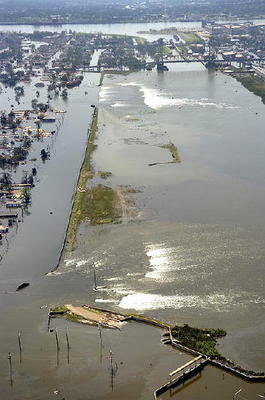
Of course, the Water Reclamation Board got fired by Schwarzeneggar last summer when they made the same suggestions on reining in development in the floodplain, and were replaced with developer-friendly types. Here’s hoping Arnold v. 5.0 will pay attention a little better than v 3.0 did, before Natomas or Rio Vista looks like this:

In related news, the Sacramento Area Flood Control Agency is considering charging fees on urban development and using the revenue to purchase development rights on adjacent ag land in Yolo and Sutter counties to prevent development in the floodplain, in hopes of preserving the current hydraulic system in a manner similar to the Yolo Bypass. By preserving ag land adjacent to the Sacramento River, floodwaters past a certain level would be drawn away by weirs and other waterworks, and allowed to flood fields in exchange for payments to farmers. The idea sounds good, and the fact that Sacramento is pursuing it is great news for Yolo County, which as a small county simply doesn’t have the resources to fund the same sort of easements or flood protection. In the future, if we’re smart, government will do more of this sort of thing, thinking in terms of hydrological watersheds instead of artificial county boundaries.

In his book The Retreat of the Elephants about Chinese premodern environmental history, Historian Mark Elvin makes a strong case for the dangers of relying upon massive levee systems to defend urban centers, and the problems that occur when manmade defenses against water encourage more development behind  levees, when combined with the inevitable decline of those hydraulic systems over time, and the natural propensity for rivers to silt up, change course, erode their banks, etc. Before an area is developed and levees established, it is easier to set aside open areas such as the Yolo Bypass to lessen water bottlenecks during a flood, but that once those areas are built in, the whole economy ends up locked into a system that is expensive to maintain, and which tend to get underfunded and neglected until the next disasterous system failure.

We cannot change the way that the Sacramento River drains through the Central Valley, and we can’t do much about the cities that already exist, but getting smarter about developing on higher ground, concentrating growth in well-defended urban centers, and hardening the levees we have, are well within our grasp, should there be the political will to resist selling out to developer interests for short term political gain. While “no growth” is not a reasonable solution, smart growth, especially in a region so vulnerable to flooding, should be a no-brainer.

Now let’s all cross our fingers and hope that this winter doesn’t send us a pineapple express to rain on the snowpack, like has happened in past El Niño years.

Originally posted at Surf Putah

Election 2006 – The View From the Valley

(Another excellent regional recap. – promoted by SFBrianCL)

I figured I’d wait until all the votes were counted before I gave my rundown of the election, but they’re still counting absentee and provisional ballots as we speak, so  this could end up a bit off.

Nationally, things went strongly for Democrats, unseating Republican incumbants left and right, shifting control of both the House and (narrowly) the Senate, and pushing the Democratic caucus leftwards a bit (media narrative to the contrary). Here in California, things look a bit different, although Jerry McNerney’s grassroots upset in the 11th CD was a fantastic victory, Lou Correa’s narow win in the 34th State Senate District race down in OC looks solid enough to count on now, and Charlie Brown’s run in the 4th CD is a sign that no seat is safe when incumbants are corrupt and Democrats are willing to run hard with great candidates and local grassroots support. With some effort, similar challenges could be made, esp. in the 3rd CD and most of the so cal suburban seats as well in 2008. If McNerney and the new Democratic leadership in the House and Senate can start to work out a better deal for the delta and Central Valley agriculture, an alternative to the pro-corporate farm, anti-environmental, suburban sprawl, “free” trade, and commodity price depressing policies of Pombo’s old status quo, Calfornia Democrats might find that parts of Inland California might be less forbidding political territory than they assume. Here’s hoping McNerney gets the support to make it happen.

Here on the left coast, with our expensive media market and special incumbant-protection gerrymandering, incumbants and the status quo largely ruled the day, with nary a change in seats save McPherson’s losing to state senator and SoS-elect Debra Bowen. Schwarzeneggar held the statehouse, and the Democrats took everything else, except for Bustamante’s loss to Steve Poizner. Basically, California showed itself once again to be a Democratic state, as long as you don’t have an egregiously bad candidate (Bustamante), or the Democratic Party and its sources of income decide not to support you (Angelides). The old coastal/inland divide was in full effect for many of the races, although the 1E water bond reversed the usual pattern by pulling high numbers from the delta counties, somewhat unsurprisingly seeing as we’re the most likely to end up underwater if the levees go. The Courage Campaign has an interesting analysis of why the blue wave seemingly missed california here, and jules from Alliance for a Better California has another keen perspective here as well that’s worth a read as well. While the initial reports of the election harped on how low turnout is, the final results that are trickling in as elections boards muddle through the absentees and provisionals are showing turnout numbers in the low 50s. Which suck compared to 2004’s 76% turnout, but are still better than the low 40s numbers that were being trumpeted.

Here in Yolo County H and I were narrow votes, with H passing but I failing by an incredibly narow margin (it was moot anyways, since Sacramento County pounded Measure J), and with West Sac and Woodland buying the arguments in PG&E’s heaping mounds of flyers while Davis fought in vain to balance them out. sigh, Better luck next time, I guess. There is a thoughtful analysis by doug paul davis over at the davis vanguard on H and I as well. In the 3rd Supervisor District, Matt Rexroad beat Frank Sieferman 54-46, largely divided along urban-rural lines. Rexroad’s Woodland First strategy paid off well, and Sieferman was clearly outmatched in terms of fundraising and the mechanics of campaigning. It will be interesting to watch how Rexroad does as County Supe, and whether he forgets his protestations that he has no ambition for higher office in two years. A tip of the hat to Matt, though, for sending my traffic through the roof on election day. Let it not be said that I am ungrateful.

In Davis, choice voting passed easily 55-45, and Target passed with a narrower 52-48 a razor-thin margin of 674 votes, once the absentees came in, with No votes clustering in the old neighborhoods of downtown Davis, Old North Davis, North Davis (not the newer bird streets), East Davis,  Village Homes and part of Stonegate, whereas it gained support from South Davis, West Davis, North Davis and the rest of Stonegate. I’d bet that student votes played a deciding role, but then again they usually do, as part of the 20% of the town that isn’t really on one factional side or the other in the Mod-Prog turf wars. The No on X people assumed, I think, that the 60% there reflected a solid Progressive consensus in the city, something that the passing of K seems to disprove. My sense is that these elections are decided by a 20% in the middle who just don’t obsess about city politics the way that activists on either side do, and tend to tune in to the discussions towards election day, but don’t really have an emotional stake like the folks who put up yard signs or table at farmer’s market, or write impassioned letters to the Enterprise. My hunch is that the promise of cheaper stuff and the appeal of not having to drive out of town for basic shopping carried the day, and that the “Remember why you live in Davis” wasn’t convincing to people whose reason for living here has more to do with the location of their school or job than an ideological committment to a progressive community per se. Doesn’t mean that they can’t be convinced, just that I’m not so sure that they were really reached by the No on K folks all that well. I agree with Lamar that K was no mandate for further big box development; basically, both K and H&I suggest that elections can be bought with enough glossy mailers, but not landslide victories.

Personally, I think K presents a pretty clear way forward for the progressive camp; namely, that it is necessary to think about where we want the city to go, and how to solve problems that the city has, if we want to inspire or convince enough of the city to actually make that happen. If we want a healthy, thriving downtown, we need to work out how we’re going to preserve what we have while finding non-big box or non-chain options for buying basic goods not provided by the boutique shops that make up much of the downtown businesses. If we don’t want sprawl, we have to find a way for regular people to afford housing in town, and that probably means accepting a denser multistoried downtown. Lamar Heystek’s living wage suggestion is a good start, but a citywide living wage would be another interesting thing to move on. Mostly, I get the sense that the city is sort of floating, with both sides of the discussion defining their visions in strikingly conservative ways, preserving what is “unique” about Davis* as if our community were a fossil or work of art instead of talking about making it an interesting place and a healthier, more inclusive community.

*as if a bedroom comunity/college town with good schools and safe streets, and the occasional parade/farmer’s market is really as unique as all that.

cross-posted from surf putah