All posts by Robert Cruickshank

Stop the Raids

Up in Bellingham, Washington, a town just a few miles from the Canadian border, Immigration and Customs Enforcement conducted a “raid” on an engine plant, arresting 28 workers. The raid stirred outrage among many progressives who had hoped that the secret police tactics of the Bush-era ICE (and I’m sorry, but that’s really the best way to describe it) would end with the new administration.

These “raids”, several of which have hit California communities, making temporary orphans of children whose parents go to work and are thrown into prison camps with no warning or provision made for care of the children (or in cases in Texas, the children themselves are thrown into the camps), have been a prime target of immigrant rights and human rights groups.

These groups point out that immigration law can be enforced without destroying communities or violating basic rights. They also note that the raids rarely catch criminals. A New York Spanish-language paper, El Diario La Prensa, called the raids “a runaway program that has ruthlessly persecuted undocumented families” and demanded Obama and Napolitano stop them.

The outrage at these raids reached DHS Secretary Janet Napolitano, who claimed she did not know about the raids and would investigate them:

Homeland Security Secretary Janet Napolitano told lawmakers during a Wednesday hearing in Washington, D.C., that she did not know about the raid before it happened.

She has asked ICE for answers.

“In my view,” she said, “we have to do workplace enforcement, and it needs to be focused on employers who intentionally and knowingly exploit the illegal labor market. I want to get to the bottom of this as well.”

Some Latino bloggers are not sure they buy the Sgt Schulz defense:

The original Know Nothings were a nativist party in the 1800’s. Call me cynical, pero I have a hard time buying that the new Secretary of of Homeland Security, Janet Napolitano, didn’t know anything about the ICE raid yesterday that arrested 28 undocumented workers….

As ICE raids continue while the Obama administration keeps telling us via Spanish language media that they care about immigration, is this administration going to be the new Know Nothings?

It’s good for immigrant rights activists to keep up the pressure on the Obama Administration. Whether the problem is Bush-era holdovers or an administration not yet willing to break with a policy that violated the human rights of thousands on a massive scale, these raids must stop.

Also, AG Eric Holder is promising to end the raids on medical marijuana clubs. This is a big victory for California and might signal a shift in Obama’s approach to the failed war on drugs, although it’s worth noting this is a small step forward. Let’s hope that Napolitano and Holder are both serious about ending these raids.

UPDATE: “These raids are not a long-term solution” says the White House. A good start, but I’d cut out the words “long-term” – the raids don’t solve a damn thing.

UPDATE 2: Big rally last night in SF’s Mission District criticizing raids and other punitive and unjust methods of enforcing immigration law.

Arnold the Reformer? Surely You Can’t Be Serious.

I will be hosting the morning show on KRXA 540 AM from 8 to 10 this morning and will discuss this and other aspects of California politics

One of the most positive aspects of the Constitutional Convention Summit that was held on Tuesday in Sacramento is that those who put it together, and most of those who spoke on stage, were not Sacramento insiders. Whether it was the Bay Area Council or the Courage Campaign or Common Cause, they were groups that have some power and representation, whether it’s the corporate base of the BAC or the mass base of the Courage Campaign. But the “interested outsider” aspect of the Summit was, I believe, one of the things that made it so potent and effective an occasion to speak to our state’s future.

Of course, politicians know a popular idea when they see one, so it should come as no surprise that Arnold Schwarzenegger is now interested in a convention, as George Skelton’s latest column explains. And while Skelton shows his high Broderism in his desire to anoint Arnold as some kind of far-sighted reformer, the truth is much more mundane – he simply wants to destroy the Democratic Party.

Take a look at what Arnold’s proposing:

Gov. Arnold Schwarzenegger says he “absolutely” loves the idea of holding a constitutional convention to overhaul state government…

The Republican governor would like the convention to consider, among other things, eliminating some statewide offices — like treasurer, controller, superintendent of public instruction and, especially, lieutenant governor, all currently held by Democrats.

“It makes no sense that the governor is surrounded by constitutional officers who are trying to derail him,” Schwarzenegger says. “Look at the way the nation runs: The president appoints those Cabinet positions.”

Translation: “It makes no sense that I, a Republican, am surrounded by Democrats the people chose to balance out my power.” The governor of California is not the president of the United State and should not be treated as such.

Arnold’s also willing to consider lowering the 2/3 rule, but only on budgets, and only if it becomes a de facto spending cap:

Schwarzenegger has long defended the two-thirds majority vote requirement for budget passage. But after the just-concluded months-long struggle, he’s now willing to consider reducing the vote threshold to a simple majority if spending growth is kept under 5%.

And Skelton plays along with Arnold’s dreams of being remembered as anything other than an epic failure by suggesting that anti-Democratic solutions such as a top-two primary and the spending cap are decisive factors in determining his legacy as a reformer:

Schwarzenegger says he wants to make the parties “less relevant.” They’re already pretty irrelevant in California. But the governor says: “Right now, every [candidate] is like, ‘How can I win the primary? How can I kiss up to the party?’

This is nonsense, and should be read in the context of voters’ total unwillingness to give Arnold the complete control over the state that he has long sought. Arnold’s argument isn’t with the system but with the voters themselves who have quite deliberately chosen to populate Sacramento with Democrats precisely because they don’t want Arnold’s term in office to become a runaway train of conservatism.

It’s a shame that Skelton isn’t willing to actually be a reporter and question why Arnold is saying these things. Arnold’s versions of “reform” have always involved pursuit of anti-progressive options designed to concentrate power in the hands of Republican governors.

Whereas the Constitutional Convention Summit saw a diverse collection of groups from the center and the left openly discuss ways to increase democracy and make government work better. The contrast with Arnold’s concept of “reform” is striking.

If Californians ultimately decide to call a convention, it will be in recognition of Arnold’s failure to produce anything positive in the way of change in California government. If he likes the idea of a convention so be it, but it will happen to fix what he helped break, instead of to implement his desired “legacy” of destroying Democrats.

The Ghost of Tom Joad Visits the Central Valley

Recent rains have caused some flooding damage around the state, but have generally failed to dent the drought that now threatens to cripple the already stressed agricultural-based economy of the Central Valley, as a recent UC Berkeley study suggests (h/t to Aquafornia):

Substantial cutbacks in water deliveries from the delta to Central Valley farms will severely reduce the region’s income, employment, revenues and farm acreage, according to a new report from the University of California’s Giannini Foundation of Agricultural Economics.

The report projects potential economic impacts for 2009 as the state grapples with its third drought in the last 30 years…

Based on projected allocations, Central Valley farmers could sustain revenue losses from $1.2 billion to $1.6 billion this year, depending on their ability to increase groundwater pumping.

The economic impact is already being felt:

Across the valley, towns are already seeing some of the worst unemployment in the country, with rates three and four times the national average, as well as reported increases in all manner of social ills: drug use, excessive drinking and rises in hunger and domestic violence.

With fewer checks to cash, even check-cashing businesses have failed, as have thrift stores, ice cream parlors and hardware shops. The state has put the 2008 drought losses at more than $300 million, and economists predict that this year’s losses could swell past $2 billion, with as many as 80,000 jobs lost.

“People are saying, ‘Are you a third world country?’ ” said Robert Silva, the mayor of Mendota, which has a 35 percent unemployment rate, up from the more typical seasonal average of about 20 percent. “My community is dying on the vine.”

This is a double whammy hitting the Central Valley. They have been the hardest-hit region in the entire country, perhaps the entire world, by the housing bust. The economic crisis alone leads to reduced demand for farm products, but the drought is going to make a bad situation much, much worse.

The Central Valley is at the leading edge of the 21st century crisis, brought about by California’s overdependence on debt and sprawl. As I’ve explained before, the “debt” is not merely financial – California has lived beyond its natural resource means for some time, overpumping water to slake the thirst of new suburbs AND to water the fields to feed the suburban consumer.

This is much the same problem that hit the Dust Bowl in the 1930s. 50 years of farming the marginal lands of the Great Plains eroded the topsoil, creating an environmental catastrophe at the very moment that a collapse in farm prices and wages led to a massive foreclosure wave. The place they headed to escape the crisis was the Central Valley.

Some farmers would like to just keep pumping the water, and cut off fish (which are already in severe distress) or cities (which are already facing mandatory rationing), and others believe a Peripheral Canal is the solution. But if this is the leading edge of climate change, those solutions will be the deck chairs on the proverbial Titanic.

I personally believe it’s important to maintain agriculture as an industry in California. But we need to find a way to make it sustainable. Continuing the methods of the past is no longer an option, as the Steinbeckian scenes now unfolding in the Central Valley should make clear to us all.  

CSI: Sacramento

Yesterday’s Constitutional Convention Summit was actually an autopsy. For five hours both panelists and the audience dissected the reasons for the death of the California Dream and all agreed, even if they did not explicitly say this (though many more did than I ever expected), that California’s government was murdered by Prop 13 and its accomplices. A Legislature that in the late 1960s was rated as the nation’s best has now become one of the most unpopular and ineffective institutions in American politics.

What the Summit revealed is that at the core of California’s political crisis is that the people of this state have no way to hold anyone accountable for a system that has totally and deliberately failed. By completely eviscerating the method by which public services are financed, and by locking into place a conservative veto over state government, Prop 13 and the 2/3 rule in particular ensured that the Legislature would never be able to enact effective policy again. And that to produce solutions, voters would have to fill the Legislature with Democrats, something that isn’t possible given our self-segregating electorate.

The Chronicle’s John Wildermuth also noticed the centrality of the 2/3 rule to the discussions, and several folks, including Mark Paul of the New America Foundation emphasized how pathologically dysfunctional it has made our government.

It would be very wrong to say that the supporters of a convention in that room were solely motivated by the wreckage of 1978. Many attendees wanted to focus on the need to increase popular engagement with government. Proportional representation and smaller legislative districts (i.e. more legislators) were common proposals. Steven Hill of New America Foundation in particular has had some good ideas on reforming our democracy – you can find some of them on their Political Reform Blog.

But more important was the spirit of popular engagement that suffused almost every panelist’s comments. There was a recognition that if our state is to be fixed, and if a convention is the way it’s going to be done, the people themselves really do have to be empowered. A convention, and their government, have to be made relevant to the lived experience of Californians. They have to trust that they can control a convention, and that its outcomes will make their lives better.

Much more over the flip.

The lone conservative Republican who agreed to attend as a panelist, Michael Capaldi of the Orange County Lincoln Club, spent his time proving that the Zombie Death Cult literally has nothing to offer California other than the status quo. He kept talking about what “fiscal conservatives” want, as if anyone is still fooled by them. They had the run of the state for the last 30 years. Until last week the last time the Legislature agreed to a tax increase was 1992. They’ve had the governor’s office 22 out of the last 30 years.

The Zombie Death Cult, as witnessed by Bobby Jindal’s ridiculous joke of a speech, is particularly unaccountable. They use the 2/3 rule to shape policy, and then blame the result on the majority party, while they become more and more doctrinaire and cult-like. Hence their name – they’re a cult (deviance from the truth is not tolerated), they are producing death (that of the state and its residents) and they’re zombies (a political party that hasn’t had a hope of winning elections in this state since the mid-1990s, but somehow walks among the living).

Capaldi did, however, understand what was up. He said “fiscal conservatives have the most to lose from a convention” and this is of course true. The entire reason people are speaking of calling a convention is to fix what he and his ideological allies broke. The reason we need to make a convention and government relevant again to the people and their lives is because he helped make government irrelevant and in fact unable to help improve their lives.

Capaldi also made some revealing comments about public service – namely, he thinks it’s for saps. His attacks on elected officials motivated one woman, a former mayor of Morgan Hill, to rise in defense of local electeds. She pointed out that she had been one of the few women elected to local government, was there to speak for working mothers, and that she took it seriously and as a point of pride when constituents would talk to her about issues in the supermarket, or on the soccer field, or wherever else. Capaldi’s attitude is one of a man who has tried to destroy the ability of a community to improve itself, and to denigrate those who try to make things better through government.

I spend time on him to illustrate what is the second key outcome of the Summit – a de facto recognition that the right-wing no longer has a place in California politics. I may be quicker to see this than others in the room, but it’s true. The convention, and state politics in general, are becoming the domain of the center and the left.

The same thing is revealing itself in Washington DC. In federal and state politics the only thing keeping the right-wing relevant are supermajority procedural rules – the Senate filibuster and the 2/3 rule (although a media that has been trained to parrot whatever a Republican says has a role too, but the media is either dying or about to be rudely awakened by massive public support for Obama and his agenda).

For the last 30 years the center has seen the left as their primary threat, and seen the right as either useful idiots or desirable allies. I believe this is starting to change, as some in the center are starting to see the right as their primary threat and the left as either useful idiots or desirable allies. (As someone firmly on the left, I don’t take offense, since I’m not all that worried about the center dominating things anyway. They’re going to struggle to remain relevant too.)

Interestingly, the center and the left can work together because they both agree on something fundamental: good government is essential to social happiness and prosperity. The right-wing rejects all of that. But because Californians now demand good government to help solve this dire economic crisis, the right-wing is effectively cutting itself out of the conversation. Whether it’s Jindal attacking the notion of unemployment insurance or Zed Hollingsworth attacking the notion of funding public schools, the result is the same: marginalization and irrelevance.

Whether in a constitutional convention or state politics as a whole, debates between center and left are going to become of prime importance. On a convention, for example, a question is whether the convention should be limited or broad in scope. Most progressives don’t want the convention to address social issues. But many of us would like to use it as an opportunity to dramatically reshape the relationship of government and the people – and ideally to tear down those divides. Perhaps a unicameral legislature with 300 representatives, some picked by proportional representation. The center would want a more narrowly focused convention whose brief is confined to some structural fixes but that don’t really reshape how California’s democracy works.

Another potential divide is delegate selection. Most progressive organizations want to throw the doors open to the people, to allow them to elect their representatives – as many as 15-20 per district. Some centrist groups, like the League of Women Voters, seem to prefer an indirect method, where a Prop 11-style commission would pick through some arcane formula designed to produce a more neutral (but perhaps less accountable) set of delegates.

There will be other debates, and I know I’ve only scratched the surface of the specific proposals. And that’s partly deliberate. As several folks who spoke yesterday recognized, if this is to work it really must provide the people with meaningful and genuine empowerment. It has to be their convention. The people are, after all, sovereign. We can and should offer suggestions and ideas, but this can’t be a top-down affair. Of course, I’m happy to discuss specific ideas in the comments.

If you’ll forgive me, I want to close with a very good quote on this from my boss at the Courage Campaign, Rick Jacobs, who told the crowd:

What we have is so broken that I can’t even imagine that we get something worse…If we ever get to the point where there is a constitutional convention, I think it ought to be big, it ought to be broad, and we ought to trust the people.

Not surprisingly I agree, and I hope you all do as well. The next moves on this have to be a big and broad public conversation where we go directly to the people and say “we trust you to fix this state. what do you want to do, and how would you do it?”

Liveblogging the Constitutional Convention Summit

I’m here in Sacramento this morning for the Constitutional Convention Summit organized by the Bay Area Council. You can see the agenda here. It’s unfortunate that the BAC chose to maintain an $89 registration fee, but there will be other events much more open and accessible to the public in the coming weeks and months.

I’ll be liveblogging here and twittering at @cruickshank throughout the day.

The main purpose of this Summit is to gauge interest in calling a convention, bringing people together to think through the process of calling one, what issues a convention might consider, and ultimately start to generate support for the idea.

I really have no idea what’s going to be said or what will happen here today, although Lt. Gov. John Garamendi is going to speak in favor of replacing the 2/3 budget rule with a 55% vote, and is also apparently going to call for the abolition of the State Senate and the creation of a 120-member unicameral legislature. Looks like the damage Senate Republicans inflicted on the chamber with their four-day hostage crisis may be terminal.

California hasn’t seen a genuine constitutional convention since 1879, although our state’s voters have not been shy about amending the constitution since then. A convention opens up a lot of possibilities and brings with it certain risks. All of that has to be discussed by Californians and this is but the start of that effort.

Ultimately it has to be remembered that in American political theory, the people are sovereign. They hold power, not a king or a president or a Zombie Death Cult. If a convention is to be a success it must involve, engage, and empower the people at every way. This Summit is a start in that effort – and only a start. Where we go from here should be and must be up to Californians.

Updates over the flip.

• The room is pretty full. Showing a video now that the BAC put together explaining how the state is totally broken and unable to meet its obligations to the people, constitutional convention could solve it.

• Sorry for the lack of updates here. Calitics was loading slowly earlier today. Follow along at twitter: @cruickshank

Tom Ammiano: Legalize Marijuana, Regulate It and Tax It

A frequent topic of online discussion on the budget crisis in recent weeks has been a call to legalize and tax marijuana in order to help close the budget deficit. This would have two beneficial effects – reducing the prison population and increasing the revenue stream for state government. It was even the most popular question at Change.gov back in December.

Today Assemblymember Tom Ammiano announced he supports this basic concept, and to that end is introducing AB 390 – a bill number you’ll be hearing a lot about in coming months. From a press release sent via email:

Today Assemblymember Tom Ammiano (D-San Francisco) announced the introduction of groundbreaking legislation that would tax and regulate marijuana in a manner similar to alcohol. The Marijuana Control, Regulation, and Education act (AB 390) would create a regulatory structure similar to that used for beer, wine and liquor, permitting taxed sales to adults while barring sales to or possession by those under 21.

“With the state in the midst of an historic economic crisis, the move towards regulating and taxing marijuana is simply common sense.  This legislation would generate much needed revenue for the state, restrict access to only those over 21, end the environmental damage to our public lands from illicit crops, and improve public safety by redirecting law enforcement efforts to more serious crimes”, said Ammiano.  “California has the opportunity to be the first state in the nation to enact a smart, responsible public policy for the control and regulation of marijuana.”

Ammiano estimates this will bring in $1 billion in annual revenue. That could double when considering the impact of savings on prison spending.

This is clearly an idea whose time has come. I do not know of any recent polling on the topic, but I have to believe that support for regulating marijuana like alcohol has risen in recent years. 2009 offers an interesting moment, where long-time legalization advocates can now ally with Californians who want to solve the budget crisis and can no longer afford to ignore the high costs of a failed marijuana policy.

Ammiano is also following in the footsteps of other San Francisco legislators. In 1975 then-State Senator George Moscone got a bill passed and signed by Governor Jerry Brown to decriminalize possession of small amounts of marijuana. Ammiano’s proposed legislation is of a much larger scale, but it makes sense to treat marijuana, a drug that is already widely available in California, the same way we treat alcohol.

It’s good to see someone in Sacramento stand up and point out that there’s no reason we should maintain a policy that has failed so totally and completely, and at such an enormous cost, as marijuana prohibition.

The Gas Tax and Transit “Armageddon”

Crossposted from the California High Speed Rail Blog

One of my lingering concerns about the Obama Administration has been that they might be tempted to claim victory with the $8 billion in HSR funding added to the stimulus and not follow up on that money, which as we know merely pays for some initial costs. But Secretary of Transportation Ray LaHood made clear last week that in fact, the $8 billion in HSR stimulus really is intended as a signal to America that Obama is truly serious about building HSR:

LaHood said that for Obama building high-speed rail networks is, “if not his No. 1 priority, certainly at the top of his list. What the president is saying with the $8 billion is this is the start to help begin high-speed rail projects.” He added that the administration “is committed to finding the dollars to not only get them started but to finishing them in at least five parts of the country,” although he declined to elaborate on where these projects might ultimately be built.

And don’t worry about the right-wing freakout over the Vegas HSR project – California is in better position than any other HSR project in America to use that stimulus funding. We can begin construction in late 2010 or early 2011; no other project is anywhere close to that point.

This couldn’t be better news for us in California, where we have long known that at least $15 billion in federal aid, spread out over 10 years, will be needed to build the SF-LA line. Unfortunately the news is tempered by the fact that the Obama Administration’s support for HSR did not extend to mass transit as a whole. Here in California the state has decided to zero out the State Transit Assistance account, costing local agencies over $500 million in funding. The federal stimulus isn’t nearly enough to make up the difference. And as the San Jose Mercury News reports, that’s setting up a situation where HSR may be pit against local transit agencies:

The MTC meeting Wednesday in Oakland could turn contentious, as the current plan calls for allocating $75 million to help build the Transbay Terminal in San Francisco, which would serve as the final stopping point for a high-speed rail line and Caltrain (UPDATE: the MTC now plans to seek train box funds from the $8 billion HSR stimulus, not the general transit stimulus funds – see Transbay Blog for more info) and $70 million to build a BART spur to Oakland International Airport. Those two projects alone would take 43 percent of the $340 million headed to the area in stimulus funds for local transit.

Some want money for those new two projects scrapped or reduced – and redirected to cover the cost of paying for day-to-day transit needs.

But MTC officials counter that building the Transbay Terminal now will save millions of dollars in later costs, and combined with the $8 billion in stimulus funds set aside for high-speed rail could accelerate that program.

I support using that money for the Transbay Terminal, although I’m less certain about whether BART to OAK is all that necessary; the AirBART buses work pretty well (I used them on numerous occasions when I was an undergrad at UC Berkeley, although that was 10 years ago).

But I really hate it when HSR pitted against other forms of transit. I have said it before and I will say it again – HSR and other mass transit need each other to be successful. It should not and must not be an either/or choice. I don’t blame the MTC for being stuck in this position – that blame lies in Sacramento and Washington DC. But we transit advocates need to not fall out along modal lines.

I’d like to propose a solution, one that I don’t even know is possible under state law but makes a ton of sense to me. The nine-county SF Bay Area region should implement its own gas tax, which will solely be used to fund public transit. I haven’t penciled out the numbers so I don’t know exactly what the tax amount should be, but it should be indexed to the price of gas, and not a fixed cent number.

This money would initially be used to backfill the loss of STA funds, and allow the federal stimulus money to go to new transit infrastructure such as Transbay Terminal or BART to OAK. Ultimately the STA funds must be restored by a statewide gas tax increase, but it is much more politically possible to implement a gas tax in the Bay Area first than to try and get the Central Valley and the Southern California exurbs to buy into this (they can be brought on board later, once the 2/3 rule is eliminated).

It’s very difficult for folks living in the nine counties to evade the tax, with the possible exception of Gilroy residents who might drive to Hollister to fill up. Most folks will simply pay the increase rather than drive far out of their way to get a cheaper gallon of gas.

I’m not sure if this option has been explored by the MTC and the member counties, but it ought to be. It’s a sensible solution that would not only help spare transit agencies from “Armageddon” but would itself be a long overdue policy shift that would give a real boost to transit efforts in the SF Bay Area.

Time For A Constitutional Convention?

160 years ago a group of newly arrived Anglos and Spanish-speaking Californios met at Colton Hall here in Monterey (pictured at right in a flickr photo by fritzliess) and held California’s first Constitutional Convention. The document they produced was literally copied from the Iowa state constitution but had some elements of the Mexican system of government and justice grafted onto it, and included full protection of Spanish speakers’ rights in what was officially a bilingual state.

California’s constitution has undergone significant change since then. In 1878 the Workingmen’s Party rode an anti-Chinese backlash and the Long Depression to power, and rewrote the Constitution in an effort to undermine the power of wealthy interests. (Unfortunately they also ended the 1849 bilingual policy.) In 1911 the Constitution was essentially rewritten when Progressive Republican Hiram Johnson pushed through the initiative, referendum and recall. And in 1978 another dramatic set of Constitutional revisions was initiated by Prop 13.

Americans think of their constitutions as static and unchanging, but this has never been the case. Both the US and the California constitution have undergone frequent revision. Sometimes this comes in the form of actual amendments, but it can also take the form of significant changes in Constitutional interpretation. The only amendments that came out of the New Deal were the 20th and 21st (moving Inauguration Day to January 20 and ending Prohibition) but as most historians and political scientists agree, FDR nevertheless initiated major changes to the way the American government operated.

California’s constitution has been amended frequently – over 500 times by some accounts – and included an effort in the late 1960s to modernize the document. Still, it has become clear that California’s government is broken and unable to meet the needs of one of the worst crises our state has ever faced. The economic crisis, drought, an energy and environmental crisis that seem to have faded a bit from the public mind but are still very much here – all of these problems are dumped into the lap of a government hamstrung by a conservative veto and a series of rules, many of which date from the last 30 years, designed specifically to prevent government from meeting the people’s needs.

The spectacle of Abel Maldonado blackmailing the Legislature to accede to his demands as the price of passing a budget last week showed the need to eliminate the 2/3 rule. It is the first change, the tree that blocks the tracks, the door that opens that path to all other changes. But it has become clear that California needs even deeper reform to solve the present crisis and meet the  needs of a 21st century state. Periods of major economic change usually are accompanied by constitutional change – hell, even the US Constitution itself owes its existence to the severe economic crisis of the 1780s, one of the worst in American history.

That’s why the Courage Campaign, where I work as Public Policy Director, is joining the Bay Area Council and a diverse coalition of organizations to sponsor a Constitutional Convention Summit on Tuesday in Sacramento (you can register at Repair California).

It’s my own personal belief, and one shared by the Courage Campaign, that a Constitutional Convention can successfully fix California’s broken government. In a poll of our members last September over 90% said they supported a convention. And in December we launched CPR for California – a Citizens Plan to Reform California that included some major structural fixes for the state, including fixing the budget process and producing long-overdue initiative reform as well as empowerment solutions such as public financing of elections and universal voter registration.

But the key to success is that a convention must truly be “of the people.” A convention will fail – and may not even be approved by voters – if it is seen as a top-down effort. Remember of course that a Constitution is a social compact, the product of a sovereign people, a recognition that we must have government to survive but that it must also be accountable to the people. For a Constitutional Convention to have legitimacy it must include the people of California at every step of the journey – especially in setting the Convention’s priorities. Additionally, the delegates who attend the Convention must be representative of the state’s population, and not be selected from a small group.

It’s also worth noting some of the limits of a Constitutional Convention. The Courage Campaign believes that all social issues should be off-limits at a convention, such as marriage equality (that is best dealt with by the California Supreme Court, or by the voters if the Court upholds Prop 8). The Convention alone won’t solve our state’s financial woes.

But it’s time that California’s government once again adapted to the times. We need a constitution and a government responsive to the people and able to address the broad 21st century crisis, instead of a government that was deliberately broken and subject to a conservative veto. A Constitutional Convention won’t solve all our problems, but it’s a necessary step forward for California.

It doesn’t come without risks, of course. But the time has come for progressives to assert a new set of ideas and a new agenda for California’s future.

Over the flip I explain the process of calling, holding, and approving the proposals produced out of a Constitutional Convention.

The California Constitution currently only allows the Legislature to propose a convention to the voters – and that requires the usual 2/3 vote. Since the Zombie Death Cult won’t go for a convention as it would challenge the conservative veto they hold so dear, that means the people need to be empowered to call the convention themselves.

There would be two propositions on the ballot, likely in June 2010. The first would enable the people themselves to call a convention (perhaps with a time limit – no more than one convention every 20 years) and allow them to also limit the scope of what a convention could cover. The second proposition would actually call the constitution, limited to exclude social issues, and would provide for the election of delegates (perhaps 10-12 per Assembly district).

The convention itself would meet within 6 months of voter approval. The convention would set its own rules of deliberation (or those could be spelled out in the proposition). Ultimately the convention would propose a package of reforms to be voted on as a single proposition – up or down on the whole thing. Voters then get the final say over any proposed changes, as of course the people of California hold sovereign power over such Constitutional changes.

Because there are so many reforms needed, and because of the barriers to putting each reform on the ballot (the Legislature might not go for it, and no initiative has qualified for the ballot without using paid signature gatherers in over 25 years), a Constitutional Convention is the best path for allowing a package of reforms to be approved at once.

Maldonado’s Jungle Primary

The traditional media is fixated on framing the Maldonado Primary as an “open primary” – but that is misleading. Truly “open” primaries, where anyone can vote in a party primary, have been banned since California Democratic Party v. Jones and its offspring. Parties themselves can throw their primaries open to some or all voters not registered with them – as Dems have done with DTS voters in their primaries – but that is up to the parties themselves and cannot be mandated by the state.

CDP v Jones nuked ALL open “blanket” primary laws in the country, including that of Washington State, which had been in place since 1935. After several efforts to maintain the system, which all failed to meet the SCOTUS’s muster, Washington in 2006 adopted the Louisiana “top two” primary – the first full use was last summer – and it is that system which Maldonado has now forced onto the June 2010 ballot.

So what is this “jungle primary” and how might it affect us? Nate Silver at Fivethirtyeight.com takes a look today and suggests the outcome will be to turn California into the “Land of a Thousand Liebermans”. Silver argues that under the current primary system, the conservativeization of the GOP has produced a “death spiral” from which they are not likely to recover.

Silver then argues that the “jungle primary” would produce a very different outcome and his analysis is worth quoting at some length:

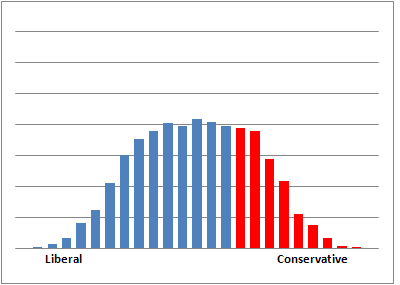
But now suppose instead that the state holds a jungle primary…The distribution of winners using that process looks more like this:

This is not quite a bell curve — it’s more like a bell curve with a buzzcut — but the salient feature is that it’s now all about the candidates in the middle of the political spectrum, the very candidates who were having trouble winning their partisan primaries before. If every state had a jungle primary, we’d have a Senate full of Susan Collinses — and Joe Liebermans. (Or think of all the weird candidates that tend to come out of Louisiana — very conservative Democrats like Mary Landrieu and very moderate Republicans like Joseph Cao).

This jungle primary also turns out not to be quite as favorable of an outcome to the majority party; a Democratic candidate won about 70 percent of the simulations using the jungle primary versus 75 percent under the traditional system. Moreover, the Democrats who did win tended on average to be more conservative (although the Republican winners were likewise more moderate). It’s not a surprise, then, that the legislator who was pushing this proposal in California was Abel Maldonado, a Republican.

And there you see why both Maldonado and Arnold Schwarzenegger want the jungle primary – it might well push the Democrats and therefore California as a whole to the right, which has been the persistent goal of so-called “centrists” all along.

The jungle primary also does NOT benefit the voter. Voter turnout dropped in WA in their August 2008 primary as opposed to the August 2004 primary. Voters felt confused by the system and also felt – correctly in some cases – that it was meaningless in LDs where one party or the other were dominant.

N in Seattle explained some of the other negative impacts of the jungle primary on Washington State:

The principal outcomes were:

   * Large expenditures on the general election, money that might otherwise have gone to statewide and/or national races

   * Bitter divisions within the LD’s Democratic organization, which will have longterm deleterious effects on the party

To go into more detail, the “large expenditures on the general election” refers to the effect in many Legislative Districts of the top two candidates being from the same party. The result was that the primary battles were pushed into the general election at great financial and organizational cost. Had it not been for the Obama effect, which helped focus energies, the jungle primary might have been even more destructive for progressive and Democratic politics in Washington.

And that’s the system that Maldonado wants to bring to California – a system that will set Democrats at war with themselves, that might empower “centrists” in the mold of Joe Lieberman and Mary Landrieu, and cost us a ton of money in the process. You’d almost think it was intended that way…

David Dayen makes some good criticisms of Silver’s methods, and I agree that Silver should look at actual data. Washington State is a goldmine for this, as its politics are very similar to California’s.

Maldonado’s Demands on Controller’s Office – Costly, Risky, Stupid

Abel Maldonado and his toady Brandon Gesicki have been all over the news pushing the frame that Controller John Chiang is wasting a million dollars on office furniture:

The same day the governor vetoed the Democrats’ budget proposal, the Controller’s office requested $924,500,000 worth of new office furniture from this fiscal year! How is that acceptable? Here is an elected official who is in the press every day talking about cutting services, stopping checks to welfare recipients and issuing IOUs to hardworking Californians. But at the exact same time, he is requesting new office furniture. This disgusting and disingenuous behavior has to end.

This is, quite frankly, bullshit. The money was approved by then-Controller Steve Westly, Governor Arnold Schwarzenegger, and the State Legislature in December 2006 not for “furniture” but to bring the C Street office complex up to code. From a presentation the Controller’s office sent out today:

• The current workstations were out of compliance with ADA, OSHA and SAM requirements.

• Current stations were 10-20 years old (80% were 20+ years old and replacement parts are no longer

manufactured).

• DGS confirms that there was not (and is not) enough used modular furniture available.

•In 2005, wires melted and smoked in one bank of cubicles, causing evacuation of the building, raising health and safety concerns.

So the office remodel isn’t being done for vanity, but to reduce a hazard AND the risk that the state of California will face lawsuits that will rack up legal bills. And the whole plan actually saves Californians money:

Bottom Line: $3,982,000 savings from purchasing efficiencies

$1,500,000 savings from less expensive rent, in future years

How did Maldonado vote when this funding came up in summer 2007?

August 21, 2007, Senate approves C Street BCP contained in SB 77 (Budget Act for FY 07/08) [vote was] 27-12, Maldonado votes “aye”

Abel Maldonado is a dishonest and self-interested politician who only wants to cut budget deals that advance his career – even when they cost the state $5.5 million.