Category Archives: Election 2010

Our First Boxer Virtual Fundraiser

( – promoted by shayera)

It’s great to be here blogging with you at Calitics!  I look forward to stopping by regularly and working with you in the weeks and months ahead.

As you probably know, I’m running for re-election in 2010, and our June 30th fundraising deadline is rapidly approaching.  It’s important that we post solid numbers at the end of each quarter to show our potential right-wing opponents that we’re ready for anything they throw at us. But this deadline is even more important than most.

Why? (Edit by Brian…See the flip)

Because we understand that former HP CEO Carly Fiorina is poised to jump in the 2010 Senate race any day now. She’ll be the best-funded opponent I’ve ever faced, with nearly unlimited personal resources to pour into the campaign. We need to be ready to match her deep pockets with the grassroots support of friends like you.

So at this critical juncture, we’re going to do something truly unique – and I hope you’ll be a part of it!

On Tuesday, June 30th, at 6:15pm PT / 9:15pm ET, we’ll be hosting our first ever Boxer Virtual Fundraiser. You don’t need to drive anywhere, or get dressed up, or find a babysitter for the kids. In fact, all you need to do is jump online to join us.

During next Tuesday’s Boxer Virtual Fundraiser, I’ll be speaking to you live via webcast from San Francisco. I’ll share the latest information about the campaign and answer some of your questions in real-time – and you can just tune in over the internet to watch, listen, and participate.

Plus, because this is a virtual fundraiser, we don’t need to rent a room or pay for food and drinks. So 100% of your contribution will go directly into our Media Fund, preparing us for the attacks that are sure to come.

We’ve made it easy and affordable for everyone to participate in this grassroots fundraiser – and I hope you will.

Please click here to RSVP for our first Boxer Virtual Fundraiser now — and join us online next Tuesday at 6:15pm PT!

We’re going to have to get creative and pull out all the stops to win in 2010 – and next Tuesday’s online virtual fundraiser is just the first step.

Thanks so much for your continued support. I look forward to speaking to you Tuesday night!

Does anybody support Carly Fiorina?

Granted, I know no one who reads Calitics with any sort of regularity would support Fiorina. Her voting record is abysmal. SFGate points out that Fiorina voting average is 1 in 4 elections. She voted in 5 of 18 elections. Hey! That’s better than Dick Cheney’s voting record! Whoo!

But that’s not really what I wanted to highlight. In reading her website, I ran across this gem from Steve Forbes:

Fiorina’s emergence on the political stage has revived debate over her HP legacy and created a backlash against the candidate by some high-tech workers. But Fiorina’s controversial tenure may make her more ready for politics than many other CEOs, who are often insulated from daily criticism, said Steve Forbes, the media magnate and two-time presidential candidate.

“She knows the treachery of internal politics from an entrenched circle,” he said.

It’s from an LA Times article: An ousted pioneer explores a new trail.

What’s that Steve? That article’s from last year you say? You’d like to modify those remarks?

Here’s Steve Forbes in an interview he’s done to promote his new book.

Q&A With Steve Forbes.

It’s not a very big quote, but it does raise questions about her decision making abilities.

So there’s real artistry involved, when to push, when to change, when to go along with what the people expect or particular cultures. And you see it all the time. Lou Gerstner goes into IBM  ( IBM –  news  –  people ), and he’s from American Express  ( AXP –  news  –  people ), to save a company on the verge of bankruptcy, very insular culture. How do you cope? Carly Fiorina goes into HP, does not cope as well. Not from a lack of ability but from a lack in the Xenophon sense of how you have the right antenna of knowing when to push and when to adjust to a culture.

bolding mine

Sounds, to me at least, that Steve Forbes doesn’t really think that Fiorina’s got any sort of admirable decision making skills.

And she’s considering running against Barbara Boxer? I think I’ve sprained my ribs from laughing so hard.

I think I tend to agree more with Portfolio’s assessment of Carly Fiorina:

Carly Fiorina

A consummate self-promoter, Fiorina was busy pontificating on the lecture circuit and posing for magazine covers while her company floundered. She paid herself handsome bonuses and perks while laying off thousands of employees to cut costs. The merger Fiorina orchestrated with Compaq in 2002 was widely seen as a failure. She was ousted in 2005.

THE STAT: HP stock lost half its value during Fiorina’s tenure.

20 Worst CEOs

Let her waste her fortune on an unsuccessful run. We’ll just continue to highlight her record.  

Latest on CA 44 – One of 3 Congressional Races to Watch!

Last week, the Rothenberg Political Report http://rothenbergpoliticalrepo… came out and listed our race as having moved from last year’s “Solid Republican” ranking to now “Leaning Republican”.

With that new ranking, we’ve been told we’re one of the three top races in the country to watch.

As encouraging as that is, I am also being told that I now need to immediately raise huge sums of money if I want to remain competitive.

I didn’t get within 2% last cycle by raising millions of dollars and sending out flashy ads.  Instead, I did it the old fashioned way.  I walked the district and I actually talked to voters one-on-one.  I was able to connect with thousands of families who have watched their jobs disappear and their homes lost to foreclosure – even though they always played by the rules.  In 2008, I did what I do best:  connect with voters one-on-one and discuss issues to explain exactly how I would be different than their current representative.  At the heart of each issue (the economy, health care, the environment), we all share the same basic beliefs that we want our children to grow up in a safe, secure, thriving community and to do better than we did.

Unfortunately, I know that this race will be different and that strategy alone won’t work in 2010 because the other side is so desperate to retain the seat.

The NRCC now realizes this seat is vulnerable and have made it clear they don’t want to lose it.  They’ve already set up a donation page for Calvert and Newt Gingrich is hosting a fundraiser tonight to help raise money for him.

It’s going to be difficult for me to raise money within the district given the fact that the Riverside portion of my district (which makes up 80% of the electorate) has the fourth largest foreclosure rate in the country and one of the highest unemployment rates.

Last year many of you missed out on the opportunity to help me capture this winnable seat because we were under just about everyone’s radar.  Now I’m asking you to support my effort to take this seat once and for all in 2010.  Go to our Act Blue page and donate:  http://www.actblue.com/page/he…

I won’t change my core belief that winning in Republican districts (where people have actually been voting  against their own interests) is only possible when candidates are out there talking to voters discussing the issues specific to the district rather than focusing solely on raising money hoping to buy votes with a media blitz.

However, without a combination of the two strategies (walking and raising money), my campaign cannot be successful.  That is why I’ve always been a proponent of public campaign finance which would allow candidates to spend more time talking to voters rather than fundraising.  But until that occurs, I hope I can count on the grassroots within our party to help a true progressive win a seat in Congress!

Tom Campbell: Same Old Hooverism, Same Old Flaws

California’s media likes to play up Tom Campbell as some sort of “moderate” or “sensible” Republican. As compared to Attila the Hun this might be plausible. But even a cursory glance at his alternative budget solutions shows that he is a typically conservative politician. Sure, his conservatism seems to be of the Ronald Reagan sort as opposed to the Grover Norquist sort. But there never was much difference between the two, except in tone, which is apparently all that matters to the media.

Campbell’s proposed budget claims to want to solve a “systemic” crisis in a way that doesn’t hurt our ability to recover from the economic crisis. Yet his budget merely offers a different method to achieve the same downward spiral that has afflicted the state – particularly Campbell’s total ignorance of the revenue drop and the negative impact of spending cuts on consumer spending.

Tom Campbell believes the budget can be balanced by hammering social services, even though there is unprecedented need for these services. An example of his proposals:

•15% salary reduction for state workers OR 15% layoffs of state workforce

• $156.7 million savings in Cal Works by implementing Federal work participation requirements.

• $248.5 million savings by reverting to federal minimums on Supplemental Security Income and the State Supplementary Payment.

• $114.1 million savings by reducing compensation to in-home supportive service workers to the state minimum wage.

• $882 million savings in Medi-Cal, provided California receives a federal waiver from terms of the American Recovery and Reinvestment Act.

In other words, he’s offering a mixture of attacks on the poor and attacks on Obama’s stimulus. His rationale:

1. California must, in large part, return to national standards on welfare and health care; we cannot afford to provide more than the national average in areas where we have long exceeded those levels;

2. California must ask those capable of taking care of themselves to do so;

3. California must not undercut its ability to bounce back when the national recession ends. This means being careful about cutting education, especially Community Colleges where much workforce retraining takes place.

This is complete bullshit. First, the national standards on welfare and health care are woefully insufficient. Campbell acts as if there is no national health care problem, as if there is no issue with the working-class finding and holding jobs. Campbell is a typical Republican – wealthy and totally ignorant of how everyone else experiences life in California.

Second, how the fuck are people supposed to “take care of themselves” in a recession like this?! Campbell is the sort of guy who drives through a poor community in his Jaguar and shakes his head saying “why don’t they just get a job?” That statement alone is proof that Campbell is intellectually unfit for office by virtue of his unwillingness to understand the challenges facing most Californians.

Campbell also proves he has no clue about modern economics – otherwise he wouldn’t so blithely ignore the work of Nobel Laureates who point out that if you cut social service spending, folks have to replace that lost money by curtailing consumer spending, hammering jobs and tax revenues.

Third, Campbell’s whole budget blueprint is designed specifically to prevent California from enjoying economic recovery. How are people who have no health care benefits supposed to find work? How are people supposed to find work period if you’re scaling back Cal-WORKS? How are small businesses supposed to open when the state is laying off workers or cutting their salaries?

Campbell’s also internally inconsistent. He states he wants to be “careful about cutting education” and then proposes:

$150 million unallocated cut to UC and CSU (I realize this would require further increases in student fees, or improved fund-raising).

Tom Campbell isn’t some kind of new Republican. He’s no moderate. Instead, he is the same exact kind of Republican that the party has offered dating back to Herbert Hoover. He is a man of the upper class, determined to protect the wealth and privileges of the upper class at the expense of everyone else.

Campbell’s economic policies are no different than Reagan’s, or Bush’s (either one, 41 or 43). Campbell offers the vast majority of this state only reduced services and less money in their wallets. His Hooverite policies would merely make the recession worse, and ensure that when economic recovery does come, only Campbell’s rich friends see any of its benefits, while everyone else is left behind. Which will apparently be just fine with Campbell, since everyone else should just take care of themselves anyway.

We’ve all seen this movie before. We know how it ends – we’re living through it right now. Californians will reject Campbell’s Hooverism. But will the media report on exactly what Campbell offers? Or will they continue to lie to their readers and claim he’s some kind of “moderate”? I’m not exactly holding my breath.  

On Judicial Empathy, Or, Random Roadblocks Aren’t Annoying. Really.

So a Supreme Court justice that hardly anyone noticed has announced his retirement and all of a sudden the lips of The Experts are all a-flutter with the word “Empathy”.

President Obama reports he wants his nominee to have it; and Republicans are convinced that the word is a secret code for something that eventually ends in the death of free speech, massive roundups of guns by the Secret United Nations World Police, and the Internment Of All The White People In Reeducation Camps Run By Americorps And ACORN And Gay People Who Want To Marry And Are Funded By George Soros.

It is suggested that Evil Activist Judges will trample the Constitution as they create Law out of whole cloth; and that only those who interpret the Constitution just as it was written can bring the proper attitude to the Court.

It sounds like somebody needs to come along and provide a couple of cogent thoughts about this whole empathy thing…and lucky for you, Gentle Reader, we have before us today specific examples of how the quality of empathy can express itself in Court Doctrine.  

So right off the bat, a few words about how cases are interpreted by the Supreme Court are in order:

A lot of the talking heads on the tee-vee frame the Court’s job as one of basically hearing the arguments in a case, reviewing the record, and deciding whether some action of Government violates someone’s constitutional rights.

That framing ignores two huge elements of the Court’s job: resolving the conflicts between the protected rights of two groups of private citizens (for example, does the right of all citizens to have access to the “public square” for purposes of political campaigning override the right of shopping center owners to control who has access to their private property?)…and creating rulings that attempt to discern what the mood or motivation of the public might be regarding aspects of potential Court Doctrine (for example, does a particular item of pornography violate “prevailing community standards”?).  

The obvious example of how all this can play out might be found in the way the Court saw things when they ruled in Plessy v Ferguson, followed later by Brown v Board of Education; in which the Supremes first ruled that “separate but equal”  was just fine and then ruled it wasn’t fine after all. Lots of others will examine these cases in detail, so, instead, we shall take a different tack.

The Fourth Amendment, in requiring that searches not be “unreasonable” and that warrants be justified by probable cause, guaranteed that Justices would forever be required to interpret without clear definitions to guide them.  

Let’s now examine how “empathy’ has affected those interpretations.

If you are driving north from San Diego to Los Angeles…and you’re not a Marine…you’ll be inspected by Customs and Border Protection officers manning an immigration checkpoint on I-5. It’s possible that you might be directed to a “secondary inspection” area for a search of the contents of your vehicle, based on nothing more than the hunch of the Inspector on duty.

In 1975, the Court, showing one kind of empathy, unanimously ruled that:

“The Fourth Amendment [is] held to forbid Border Patrol officers, in the absence of consent or probable cause, to search private vehicles at traffic checkpoints removed from the border and its functional equivalents…”

—United States v. Ortiz, 422 U.S. 891

However, Chief Justice Burger, who generally joined in the concurrences of the other Justices, had his own “empathetic” point of view:

“Like MR. JUSTICE WHITE, I can, at most, do no more than concur in the judgment. As the Fourth Amendment now has been interpreted by the Court, it seems that the Immigration and Naturalization Service is powerless to stop the tide of illegal aliens — and dangerous drugs — that daily and freely crosses our 2,000-mile southern boundary….Perhaps these decisions will be seen in perspective as but another example of a society seemingly impotent to deal with massive lawlessness.”

Amado Martinez-Fuerte, who had been arrested at the same checkpoint, probably thought that the Court would continue to see things as they had in 1975…but by 1976, the Court no longer felt as empathetic towards the concept that consent or probable cause…or even reasonable suspicion…was required for vehicle searches as they had the year before:

“To require that such stops always be based on reasonable suspicion would be impractical because the flow of traffic tends to be too heavy to allow the particularized study of a given car necessary to identify it as a possible carrier of illegal aliens.”

—United States v. Martinez-Fuerte, 428 U.S. 543

This ruling is particularly significant in that it allowed the checkpoint to operate under a general “warrant of inspection” (a device usually used only to allow building inspections and the like), and for the evidence obtained there to be admissible against individuals in criminal trials.

However, the plain text of the Fourth Amendment seems to take a different view, stating that:

“…no Warrants shall issue, but upon probable cause, supported by Oath or affirmation, and particularly describing the place to be searched, and the persons or things to be seized.”

By this time, Thurgood Marshall had left the Court (his empathy demonstrated perhaps best by the fact that in 1954 he had argued-and won—Brown v Board of Education before the Supreme Court); and the new Court ruled 7-2 in favor of the Government’s position in Martinez-Fuerte.

You’ll recall that we discussed the fact that the Court often has to determine the public mood. Here’s a very specific example:

The Court, in deciding that the immigration checkpoint was not an “unreasonable” search, felt no empathy toward the idea that being stopped every day would bother any commuter who was legally using I-5 several days a week, nor to the concept that the delay of legal commercial traffic would be bothersome. Their sole concern was that the motorist would view the checkpoint as “legitimate”:

“Routine checkpoint stops do not intrude similarly on the motoring public. First, the potential interference with legitimate traffic is minimal. Motorists using these highways are not taken by surprise as they know, or may obtain knowledge of, the location of the checkpoints and will not be stopped elsewhere….The regularized manner in which established checkpoints are operated is visible evidence, reassuring to law-abiding motorists, that the stops are duly authorized and believed to serve the public interest. The location of a fixed checkpoint is not chosen by officers in the field, but by officials responsible for making overall decisions as to the most effective allocation of limited enforcement resources. We may assume that such officials will be unlikely to locate a checkpoint where it bears arbitrarily or oppressively on motorists as a class. And since field officers may stop only those cars passing the checkpoint, there is less room for abusive or harassing stops of individuals than there was in the case of roving-patrol stops…”

(A quick Fun Fact: the location of the checkpoint near San Clemente appears to have been chosen specifically because it allows the stopping of virtually all traffic between San Diego and Los Angeles. You might think setting up a checkpoint to stop all traffic is a bit arbitrary…and I would agree with you. The Court, obviously, did not.)

The ruling in Martinez-Fuerte also does not display empathy with the Defendants’ assertions that being ordered to “Secondary Inspection” is intrusive…even if there for no reason at all to suspect the vehicle–or even if the reason for the stop is entirely race-based:

“The defendants arrested at the San Clemente checkpoint suggest that its operation involves a significant extra element of intrusiveness in that only a small percentage of cars are referred to the secondary inspection area, thereby “stigmatizing” those diverted and reducing the assurances provided by equal treatment of all motorists. We think defendants overstate the consequences. Referrals are made for the sole purpose of conducting a routine and limited inquiry into residence status that cannot feasibly be made of every motorist where the traffic is heavy. The objective intrusion of the stop and inquiry thus remains minimal. Selective referral may involve some annoyance, but it remains true that the stops should not be frightening or offensive because of their public and relatively routine nature. Moreover, selective referrals – rather than questioning the occupants of every car – tend to advance some Fourth Amendment interests by minimizing the intrusion on the general motoring public…

… Thus, even if it be assumed that such referrals are made largely on the basis of apparent Mexican ancestry…we perceive no constitutional violation…As the intrusion here is sufficiently minimal that no particularized reason need exist to justify it, we think it follows that the Border Patrol…officers must have wide discretion in selecting the motorists to be diverted for the brief questioning involved.”

And with that (and a few cases to supplement the concept), the idea that the police require an actual reason to stop people and then conduct searches and seizures has gradually faded into a quaint anachronism of history.

So where does all this leave us?

Well, how about this: it leaves us more aware of the fact that there are rarely “simple” interpretations of the Constitution. Rather than just relying on the plain text of the document, the Justices, using the sense of empathy they’ve developed throughout their lives, interpret and create new law in each and every case.

It should leave us more aware that the arguments made by those who support “strict constructionists” for the Court reflect less of a desire to remain pure to the principles of the Constitution, and more a desire to advance very specific, and often radical, policies that favor Government over the People who are supposed to be its master-policies that are often based more on a sense of fear than an appreciation of the strength of the system their new policies seek to “save”.

Mr. Obama is absolutely correct in seeking a Justice with “empathy”.

Let’s just hope the one he picks has the kind of empathy that, for a change, advances civil liberties, instead of sending them to the sort of “Guantanamo Chainsaw Massacre” that Justice Scalia finds so in keeping with his sense of empathy.

[poll id=”

281

“]

Newsom & Garamendi might be the high speed rail governor and BRT congressman

 (Cross posted at Living in the O.)

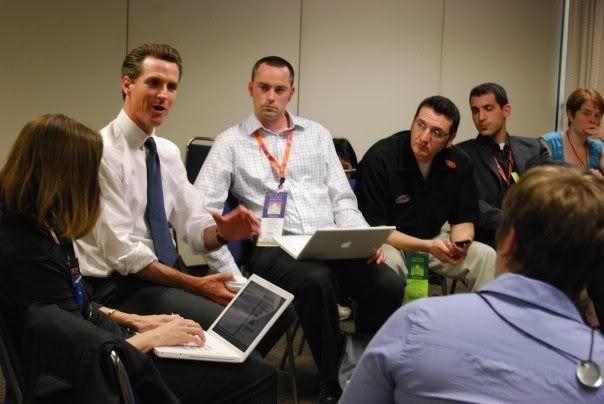
At the California Democratic Convention a couple weeks ago, Gavin Newsom met with a couple dozen bloggers to talk about his campaign for governor. I was excited going into this meeting, especially since I knew exactly what question I was going to ask. It was the same question that AC Transit Director Joel Young asked at a Newsom town hall in March: what are you going to do about the fact that the state has entirely stripped funding from local transit agencies? You might remember that Newsom basically dodged the question and launched into a speech about how great high speed rail is. So this time, I was determined to get a better answer.

And surprisingly, I was somewhat impressed with his answer. He explained that coming from a city and county, he understands the needs of public transit agencies. While stimulus funds are available for capital projects, none are available to run buses, which is problematic. (Of course, this isn’t entirely true – some funds are being used for operating expenses – but it was nice to hear that he understands the need for operations funding.)

Newsom then said that California is a prosperous state and that it’s all about priorities. Except somehow he managed to skirt by without saying what his priorities are! His comments suggested that he would prioritize public transit, but he never actually committed to this. This was a theme throughout the blogger meeting – Newsom displayed a firm understanding of the issues at hand but managed to not make many specific policy promises.

My favorite line from Newsom about transit issues came not in response to my question but in an answer to Calitics’ David Dayen’s question about prison issues. Newsom said (among other things), “Building prisons is like building highways; within a few years, they’re 90% filled up.” Yes, a major candidate for governor understands that building highways is fruitless because they only generate demand and never fulfill it. Of course, he didn’t promise that he would place a moratorium on new highway construction or do anything else to stop highway expansion.

I left feeling pretty good about Newsom’s answer. Though he didn’t make specific policy promises (except on high speed rail), he at least didn’t entirely dodge my question.

But I became a bit less impressed yesterday, after reading Lieutenant Governor John Garamendi’s post on Calitics about High Occupancy Toll (HOT) lanes and Bus Rapid Transit (BRT). Up until a few weeks ago, Garamendi was running for governor, and if he had stayed in the race, he would have blown Newsom out of the water on transit issues:

While some have raised concerns that HOT lanes give wealthy commuters special access – and this is a criticism I take very seriously – I would argue that broad access and equity in services are best achieved with a package of transportation solutions that includes the expansion of longer distance rapid transit bus service throughout key corridors in East Bay and South Bay counties. The most effective and profitable rapid transit routes reaching more inland regions of the Bay Area will have to be implemented along the proposed HOT lane network to provide a reliable enough commute to convince riders to leave their cars at home. There is nothing rapid about gridlock.

Rapid transit buses, which along city streets allow bus commuters to avoid most traffic lights, have been shown to be popular and effective in the Bay Area and should be considered a low-cost solution in areas where a more speedy public transit commute is desired but rail is impractical. A study of a busy seven-city 14-mile Bay Area route by the Federal Transit Administration determined that the rapid transit line reduced end-to-end travel time by an average of 12 minutes, leading to a 21 percent reduction in time previously spent on local service non-rapid bus lines. Ridership across all areas of the corridor increased by 8.5 percent as a result of the rapid transit line, and most significantly, around 19 percent of rapid transit riders previously used a car for their commute along the corridor, a reduction of around 1,100 auto trips per day.

Garamendi touched on two issues that are near and dear to my heart: taxing drivers to pay for public transit and BRT expansion. If he was still in the race for governor, I’m pretty sure I would have signed up for his campaign immediately after reading this. Though Newsom gets larger public transit issues, it’s clear from this blog post that Garamendi understands the nuances of public transit issues.

But transit advocates don’t have to decide between Garamendi and Newsom. Garamendi has jumped into the race for Ellen Tauscher’s congressional seat in CA-10 and is the fruntrunner in the race. Which means that East Bay residents might soon have a high speed rail governor and BRT congressman.

For an excellent and comprehensive write up of the Newsom bloggers meeting, check out Robert Cruickshank’s post at Calitics.

When Gavin Newsom Met the Bloggers

Gavin Newsom sat down with a group of bloggers on Saturday, April 25th at the California Democratic Convention for an hourlong Q&A session. I’ve been a bit slow to write this up, but it was a very valuable conversation that at least for me helped clarify what kind of campaign, and perhaps even what kind of gubernatorial administration, Gavin Newsom will run.

Before getting into specifics, I want to make some broader observations. I have always been impressed with Newsom’s grasp of issues and policy. He clearly understands government, and understands it quite well. He isn’t as strongly progressive as I am, and certainly not as much as many of my San Francisco colleagues rightly prefer. But his experience in city and county government over the last five years has given him a good perspective on the problems with state government, seeing as the cities and counties often get hit the hardest and yet do not have the kind of policy tools to deal with the crisis.

At the same time, Newsom isn’t going to be drawn on the details, and isn’t going to promise an openly progressive administration. He seems to be running an Obama-style campaign, both in his effort to build a grassroots movement early, but also in his approach to the issues. I got the distinct impression that Newsom is going to try to avoid being pinned down on the “taxes vs. spending cuts” debate that is dominating CA politics, and try to find a way to provide reform with accountability. “I’m a pro-business Democrat who believes in fiscal responsibility,” he said, but he is open to progressive solutions as well – what Newsom seems to want to do is find a way to sell those solutions in a pro-business form.

Newsom knows that we need a new economic base. He understood that housing fueled the economy for the last 10 years and that’s no longer possible – we have to provide broadly shared prosperity. He spoke of green jobs, but still needs to articulate more clearly what the next 30 years will look like. That being said, he’s much further along in that process than Jerry Brown is, at least so far.

More details over the flip.

In response to questions about the May 19 propositions, Newsom made some strong points against Props 1C, 1D, and 1E – “I can’t support balancing the budget by asking poor people to buy more lottery tickets” for example. His “first instinct was to oppose” Props 1A and 1B, but concluded that there was no alternative, no answer to the “what then?” question. Newsom speaks often of San Francisco’s “rainy day fund” as part of his effort to pass Prop 1A, but otherwise isn’t openly campaigning for them.

Of course, Newsom does recognize there are indeed alternatives. He supports a Constitutional Convention, is open to a split roll property tax (excluding commercial property from residential property tax protections). He believes the sales tax should be modernized.

David Dayen asked about prison reform, and while Newsom showed he understands the unsustainable nature of the prison policy – and believes the drug war to be a failure – he didn’t talk about sentencing reform or embrace Prop 5 as David had specifically asked.

Adam Bink of Open Left asked Newsom about immigration, and specifically whether Newsom would pull a Gillibrand and abandon his progressive stance on immigration, including sanctuary policies, in order to win statewide. Newsom said he would not do that – that he “would be ineffective if he said one thing privately and another thing publicly.” He supports immigration reform that includes a path to citizenship and isn’t afraid of “cable networks” that attack him for this position, and Newsom also said we must “celebrate diversity, not just tolerate it.”

Becks of Living in the O asked about the gutting of state transit funding. Newsom’s response was “we are a wealthy state” and we should be able to fund transit. He gave a strong push for high speed rail, comparing Europe’s advanced trains with California’s much slower and weaker rail infrastructure. Newsom understands that we must “move beyond freeways and airports and sprawl” and knows HSR is a way to do that. Of course, this isn’t really an answer to Becks’ question about restoring STA funding.

Ultimately, Newsom is positioning himself the same way Obama did – someone who says enough things progressives can get behind without openly promising a progressive administration, and saying it in a way that can attract moderate voters. It’s smart politics, and might be enough to win him the Democratic nomination, maybe even the general election.

But it’s also vague on the details, and Newsom can only take a vague but informed set of answers to the issues so far. I can’t imagine Jerry Brown will be merely proposing 1978 vintage solutions forever, and Brown has long demonstrated his ability to make quick and bold policy statements. Newsom will have to eventually articulate his solutions to the budget mess, to providing an economic base for our future, and ultimately a vision for the next 30 years.

Newsom’s vision will probably never be my vision. But it could be close enough, and will likely be enough for most progressives to embrace. Newsom is doing everything he needs to do to win the 2010 election, and so far, is setting a higher bar for Jerry Brown, maybe Antonio Villaraigosa, to meet.

Why Things Are The Way They Are…and a May 20th Strategy

There has been a lot of interesting information coming out lately concerning the state of the electorate and the unlikely passage of the May 19th ballot measures. I have been spending a lot of time just thinking about what it all means. Why do the voters continue to elect nearly two thirds of their representatives as Democrats, yet give that same legislature an approval rating of 14%? Why do they continue to desire to keep, and often pass through the initiative process, more programs, yet refuse to consider increases in revenue?

Let me first say that some very astute thinkers, I believe, are on to something. Whether it’s the Two Santa Claus theory, the Household Budget theory, or just a plain failure to take leadership each brings something important to the table, but doesn’t quite get us all the way there.

I want to posit something that I think can explain how things may be the way they are now and what I think we need to do about it:  

Politics is about representation. We, the voters, elect someone to represent our interests and help to push legislation to effectuate it. Their job is to work for us and get things done.

Voters, on the other hand, are busy folks and that has only increased over time. Most of us don’t have the time or inclination to understand the wonkiness of the 2/3s rule and how the conservative veto can stop an agenda in its tracks. They just want it to get done.

This dynamic leads to one thing and I think it can explain the very dichotomy we are dealing with today. NO ONE IS GETTING WHAT THEY WANT OUT OF OUR STATE GOVERNMENT. Democrats are seeing programs cut and schools lay off teachers and our legislators are making deals with the devil to salvage what they can. Republicans can’t muster any significant changes because they just don’t have the clout and at the same time end up having to agree to tax increases in the face of their constituents ire.

Understanding this dynamic can explain everything. The average Dem or Indy voter doesn’t care about how things get done, just that they get done, but they don’t trust the legislature can make it happen. This would explain the low approval ratings. Because of this they think why should they just give over more money when they aren’t getting what they want now? This would explain the apparent unwillingness to raise revenue.

However, when the voters trust those in charge, there is a willingness to consider new revenues. I live in a very red county in Northern California. You constantly hear the refrain of “government waste” and “no new taxes.” Yet, most of the time when my local school district asks for the approval of a property tax bond, it passes. Why? Because the voters like what’s happening at the school, take pride in its successes, and trust its leadership. I think it’s the same with the state. We will see a changing dynamic in the electorate when they see a legislature get the things done that they want. Of course, without a 2/3s majority, this won’t happen.

So here’s my May 20th strategy:

It is imperative that we reach 2/3s majority in both houses of the legislature. We must no longer blow off the “red” districts as unattainable. We are within sight of that goal and it can be done. We must recruit quality candidates for every district. Once found, the grassroots and the party must assist them with training, outreach and financing. We must assist in voter registration drives and GOTV. We can no longer accept the mindset that it’s too tough so we won’t bother.

Once we achieve our goal things will change. We can enact an agenda and govern effectively. We can show the voters that things are getting done and earn back their respect and trust. Basically, we can finally do what 65% of the public has been sending us there to do.  

CD-03: Democrats Don’t Want a Contested Primary

By Randy Bayne

The Bayne of Blog

Randy Bayne In 2006 and 2008 Dr. Bill Durston stepped up to the plate and ran for CD-03. He ran unopposed in the primary leaving him to work on name recognition, voter registration and building his support for the general election. All much needed activities when you’re running against Dan Lungren.

Until recently there has been no clear candidate in the 3rd. A few weeks ago I heard from Gary Davis, an Elk Grove City Councilman. He told me he was looking at running. Haven’t heard from him until he sent me an email this evening. This weekend at the state convention I met Dr. Amerish Bera. He has filed papers to run and is making the rounds visiting clubs and Central Committees. On the side is the distraction with the attempt to draft Lt. Gov. John Garamendi to run in CD-03 instead of CD-10. A race that was fairly quiet is getting noisy.

To top it off, Swing State Project erroneously reported that Phil Angelides is “taking a serious look” at CD-03. Davis told me in an email that he talked to someone close to Angelides, and he is not running. Davis also mentioned that he is putting his team together after a Tuesday meeting with the DCCC.

With two candidates, Davis and Bera, already in Democrats may get something they don’t want — a contested primary. With a weakened Lungren all but certain to run unopposed in the primary, he will be able to save valuable resources for the general election while Democrats are forced to spend valuable resources deciding who has the best chance of defeating him.

With more than a year to go until the 2010 primary plenty of time remains to sort this out. At this point candidates are filing paperwork so they can begin raising money, gauge levels of support, assess resources, and begin getting a general feeling about their chances for success. Now is the time for us, the Democratic leadership in CD-03, to assess Davis and Bera and work to avoid a primary fight. For now, let it play out. There is opportunity here to learn a great deal about two candidates, perhaps more, and build on that. There is time later to trim the field to one before the primary.

We are closer to winning the district than we have been in a long time. A contested primary, to understate it, is not helpful.

It’s Official – I’m Running in 2010

(Good luck! – promoted by Brian Leubitz)

Ok, so no one is exactly shocked to hear that today I’ve made it official but I wanted to come here to this blog to post it myself since the folks at Calitics have always been good to me.

I also wanted to post a little more about myself so that you understand why I’m running and why you should care about this race.

EDIT by Brian for space. See the flip.

With unemployment in Riverside County now at 13.2 percent – and growing – along with the fourth largest foreclosure rate in the nation, the families in my district clearly need a leader who is on their side and I’m committed to being that leader in 2010.

The current representative (Ken Calvert) voted against the interests of his own district when he chose to vote along strict party lines which meant he voted against the Stimulus Bill, even though it will bring more jobs to this district than any other in California.  He also voted against HR 1106 which will save countless homes right here in this district from going into foreclosure.

I have lived in this district for almost 30 years, raised my five children here, and both my wife and I have been educators in Riverside County for over two decades so I understand what families in our region are up against and every decision I make will be with their best interests in mind.

I originally threw my hat into the ring in 2008 because of a personal issue, the Iraq war.  I have two sons who, combined with their spouses, will have served a total of 10 deployments in Iraq by the end of the year.  Mr. Calvert was a champion of the ill-advised occupation of Iraq and continued to push for its continuation long after everyone else knew what a terrible mistake it had been.  I had children over there that were being directly affected by that partisan way of thinking and I wanted to be a voting voice on the side of reason in ending the occupation and bringing our troops home.

I also understand the burdens placed on military families when loved ones are serving overseas.  With lengthy and multiple deployments, soldiers and military families often face undue financial hardships. I don’t think most Americans realize that many service members and their families are actually living at the poverty level.  This is something I find unconscionable and will work on changing.

I have an uphill battle on my hands so I hope all of you will help me this next cycle.  In 2008, flying under just about everyone’s radar, I was able to win the Riverside portion of the district (totaling 80 percent of CA 44) by 4 percent and came within 2.4 percent overall of unseating a 16 year incumbent.  With expanded resources, help from the Netroots community and a strong voter registration effort, I am sure I can close the gap in 2010 and capture the seat.

For more information, visit my website at www.hedrickforcongress.com or follow me on Twitter at www.twitter.com/billhedrick