Protect or Prosecute the Homeless?

“Homeless Bill of Rights” would provide protections to homeless

by Brian Leubitz

Homelessness is always a tough issue. Not only in urban communities, but now in smaller towns where the foreclosure crisis has built squatter towns and unemployment has left many without permanent homes.

But in San Francisco, which recently passed a so-called “Sit/Lie” ban, the issue is particularly complicated. The measure bans sitting or lying on public sidewalks, with provisions to ticket and/or arrest violators. Asm. Tom Ammiano was very publicly against the measure when it passed, and has been working against it ever since.

And so, Ammiano’s AB 5 would provide a “Homeless Bill of Right” that would seek to “decriminalize homelessness.” Specifically, it would housing status as a protected class, and government entities could not discriminate based upon that status. The bill also contains some specifically enumerated rights:

Those include the right “to move freely, rest, solicit donations, pray, meditate, or practice religion, and to eat, share, accept, or give food and water in public spaces without being subject to criminal or civil sanctions, harassment or arrest.”

This would extend to parks for the entire 24-hour day, regardless of whether the park has hours that it is closed.(Wyatt Buchanan / SF Chronicle)

Now, in order to get this bill through the Judiciary Committee, which it did by a 7-3 vote, the bill was toned down a bit from its original form, and a bunch of exemptions were added. The bill faces substantial opposition from the League of Cities, which opposes the reporting requirements among other concerns, and the Chamber of Commerce. And an upcoming date with the appropriations committee could mean further alterations of the measure.

Higher Ed Funding by Metrics?

Gov. Brown looks to tie state university funding to metrics

by Brian Leubitz

Gov. Brown isn’t one to really sit around and rest on a balanced budget. Though the May revise is still a few weeks away, he’s looking for some big ideas. This is certainly a big idea:

Gov. Jerry Brown wants to tie some state funding for California’s public universities to a host of new requirements, including 10% increases in the number of transfer students from community colleges and the percentage of freshmen graduating within four years.

Brown, who has repeatedly said the universities should be leaner and serve more students, is asking for equivalent increases in several other areas as well, according to a copy of his plan obtained by The Times. Those include raising the overall number of graduates and a stipulation that more students coming from community colleges finish their studies within two years.(LA Times)

Some members of the higher education community are not so enthused by the plan. The most obvious concern is that most of these metrics are issues which are almost entirely under the control of administration, rather than faculty or students. Matt Haney, Executive Director of the UC Students Association and an elected member of the SF school board, had this to say on the plan:

Welcome to the “No Child Left Behind” era for the UC. State funding, which is still grossly inadequate, being tied to “performance measures,” may mean the end of the public university in California as we know it…Slash our funding, ask us to do a lot more as demonstrated by external “outcomes” developed by people who aren’t educators, and then punish the students for any failure by the administration to meet those outcomes. At this point, not a fan

Of course, this isn’t the only higher education funding proposal on the table. Brown previously called for a tuition freeze during the Prop 30 campaign, contingent on the passage of Prop 30. With the Prop 30 revenues now flowing in, Brown will be under pressure to keep that promise. But his full higher education funding plan will flesh out many of the details around the bones that have already leaked out.

Higher education has always been in something of a weird position in California. It is clearly an investment in future economic prosperity. Take a look at the innovation surrounding all of the major UC&CSU campus sites. However, it is something that legislators look at and see an alternative funding source (ie students). And thus the dramatic cuts over the last few years.

It could be that some metrics-based pressure lights some fires under the administration of the UC and CSU systems, but the question is where does the money that we are gambling with come from? If metrics aren’t met, and funding is cut, who suffers? Maybe an administrator here or there will be laid off, but ultimately, the cuts would trickle down to students, staff and faculty.

Los Angeles Mayor: Garcetti takes lead as Greuel goes hard negative

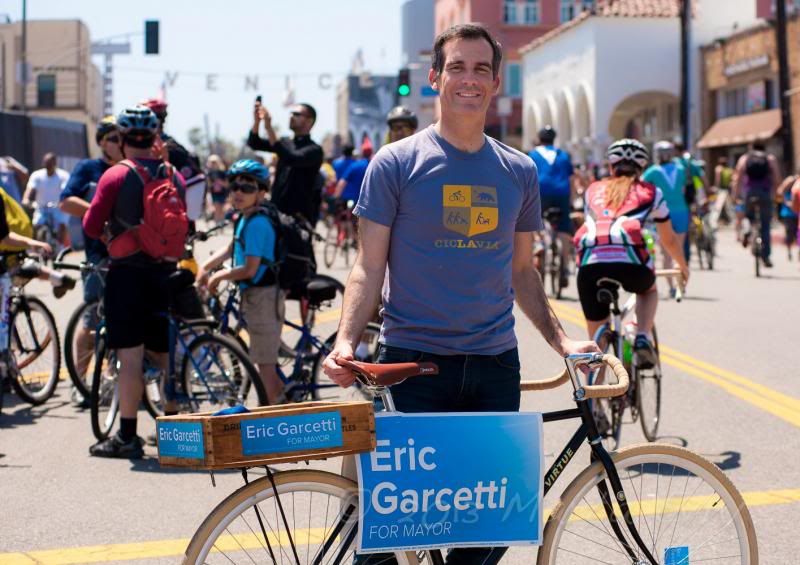
Mayoral Candidate Eric Garcetti at CicLAvia
Candidate Garcetti at CivLAvia. Photo: Marta Evry

For Los Angeles voters, there is light at the end of the tunnel: Only four weeks remain until the city finally elects a new mayor to replace Antonio Villaraigosa. Ballots are hitting mailboxes this week, and the sprint to the finish has begun.

Councilmember and former City Council President Eric Garcetti won the March 5 primary election by a hair over four points over his general election opponent, City Controller Wendy Greuel. The big question at that point was: who would win over the voters of the three major candidates–Jan Perry, Kevin James and Emanuel Pleitez–who didn’t make it? So far, Garcetti seems to be winning that battle: all three of those primary opponents endorsed him, and the latest Los Angeles Times/USC poll shows him with a 10-point lead over his rival as mail ballots drop. The poll indicates that in most cases, Greuel is failing to win over the bases of support she is depending on for victory: Garcetti leads among women, even though Greuel has made gender a key selling point in her campaign. She is effectively tied with Garcetti in the San Fernando Valley, which should be her base. And perhaps most troubling, Greuel actually trails among Republicans by a wide margin, when conventional wisdom early in the race dictated that Greuel would have natural advantages in that constituency against Garcetti, who is widely viewed as a progressive liberal. Instead, the poll indicates that Greuel’s dependence on $3 million in independent expenditure spending from the Department of Water and Power union, IBEW, is damaging her standing with a constituency most observers would have expected her to win.

“That’s an untenable situation for Greuel,” said Dan Schnur, director of the USC Sol Price School of Public Policy/Los Angeles Times City Election Poll.

It most certainly is an untenable position. And Greuel is responding the same way most candidates in an untenable position would respond: throw absolutely everything at the wall, and see if anything sticks.

The rollout of Greuel’s hard negative campaign, however, didn’t appear to go so well. The campaign built a childish attack site against Garcetti that listed essentially every single negative attack the campaign has ever used, but also included some personal attacks, like calling him a “trust fund kid” who has “never had to work a day in his life.” The site was discovered by the media, whereupon the Greuel campaign subsequently password-protected it. Of course, the site might have been a signal for Greuel’s independent expenditure allies to unleash their own negative attacks: WOMEN VOTE!, the political arm of EMILY’s List, has already spent over $80,000 on mailers with negative attacks on Eric that closely parallel the message of the Greuel campaign’s attack site.

Greuel also made a massive television buy last week, spending $700,000 for a positive piece touting her endorsements. But what ran instead during the second half of that buy was a hypocritical negative ad on digital billboards. (Funny side note: all the digital billboards in the ad have actually been deactivated by court order.)

And perhaps most amusingly, Greuel’s camp is also realizing how damaging close affiliation with the unpopular Department of Water and Power can be. A close Greuel ally, former Controller Rick Tuttle, filed an ethics complaint yesterday in advance of last night’s televised debate between the two candidates, alleging that back in 2009, Garcetti postponed an audit of the DWP that might have reflected badly on a ballot measure that both the DWP, Eric Garcetti and Wendy Greuel were all supporting. The aforementioned Jan Perry, whose committee was responsible for the hearing, has said that the accusation is bogus. Not that it matters to the Greuel camp: the mere filing of the complaint gave Greuel cover to claim during the debate that Garcetti “was under investigation” for ethics violations.

Not that it mattered: NBC-4’s political analyst Sherry Bebitch Jeffe said that Garcetti was the clear winner of last night’s debate because voters want to see specifics about policy, rather than negative attacks. But we can expect the negativity to continue from the Greuel campaign: they’re in full “spaghetti-on-the-wall” mode, desperately hoping that something will stick.

Note: This opinion piece reflects solely the viewpoint of the author, and does not constitute a Calitics.com editorial.

Revenue Higher Than Expected

State may end April $3B ahead of schedule

by Brian Leubitz

The news that April revenues are higher than expected is unambiguous good news. However, this being budget news, there are always caveats. First, the bottom line:

California’s tax revenues began 2013 stronger than expected and will end the all-important month of April some $3.5 billion ahead of Gov. Jerry Brown’s assumptions.(John Myers / News10)

Given the past decade, you can’t help but smile upon those numbers. However, Gov. Brown has already said that he isn’t keen to spend any of the excess quite yet. First of all, much of that money will be automatically diverted to make up for funds cut out of Prop 98 K12 education guarantees. And there is still speculation that a lot of the money was one-time bonuses given out by businesses before the Prop 30 tax increases took hold.

There are sure to be debates in the Legislature about providing additional funding for some of the very worthy programs that were slashed over the last few years. However, don’t expect Gov. Brown to go along with most of that additional spending, as he has already indicated that he’d prefer to save any excess revenue.

All that being said, it is certainly refreshing to be in the situation of discussing excess revenue than our tired budget slashing debates of past years.

Bogus Bankruptcy Panic: L.A. Shows $119 Million Surplus

By Gary Cohn

For five years a chorus of voices has been predicting bankruptcy for Los Angeles, while often calling for deeper cuts to city employee pensions. Yesterday, however, Mayor Antonio Villaraigosa proposed a budget for Fiscal Year 2013-2014 that includes a one-time surplus of $119 million. While some of that surplus would rely on additional pay and benefit reductions for city workers, even without such cuts the city would have a projected surplus of close to $100 million.

“It’s better than seeing the light at the end of the tunnel – we’re almost out of the tunnel!” Matt Szabo, Mayor Villaraigosa’s deputy chief of staff, told Frying Pan News in an interview last week. Szabo discussed the city’s financial picture and said that dire financial warnings have been largely overblown.

“One of the issues that’s highly irritating is the ease with which some people have thrown around the bankruptcy term,” Szabo said. “That’s not going to happen.”

Only last year City Administrative Officer Miguel Santana, Los Angeles’ top budget official, cautioned that the city could face bankruptcy or a breakdown in essential city services, unless it adopted new taxes, laid off city workers and privatized certain city services. Among other options, he said the city should consider contracting out management of the Convention Center and zoo, and hiring private companies to take over ambulance service from the Fire Department.

Santana’s gloomy prophesies have been just one part of a steady drumbeat of warnings about bankruptcy and other potential disasters allegedly facing the city – warnings that usually circle back to a supposed need to curb city employee pensions.

“Los Angeles is facing a terminal fiscal crisis: Between now and 2014 the city will likely declare bankruptcy,” wrote former mayor Richard Riordan and Alexander Rubalcava, the president of an investment advisory firm, in a 2010 Wall Street Journal opinion piece. Two years later, Riordan promoted a ballot initiative to get voters to approve “pension reform” that would have made changes to employee pensions that were more radical than city unions have already agreed to.

Riordan’s measure never made it onto the 2013 ballot, but its motivating fear of insolvency – accompanied by fingerpointing at employee pensions — remains a potent mantra in some quarters.

More recently, Mayor Villaraigosa and other officials warned of cutbacks in services and layoffs of police officers if voters didn’t approve a sales-tax increase. The day after the proposal lost, however, Villaraigosa acknowledged that the budget shortfall was far less than what he had been claiming it was. (While some observers were critical of the mayor’s initial claims about the shortfall, they continue to support the need for new revenues.)

The city’s financial situation – and bankruptcy panic — has dominated the mayor’s race, with some candidates in the winter primary arguing that the city is on the brink of ruin. The city’s budget problems took center stage at Royce Hall during a January mayoral debate at UCLA.

“Bankruptcy doesn’t happen overnight,” pro-business mayoral candidate Kevin James said during the debate. “This happened over a period of time because of a series of bad decisions.” James later told Frying Pan News that if elected, he “would seek a temporary revision of [employee] raises” and would “ask our city employees to invest in our future by foregoing . . . future raises.”

Sitting in his third-floor City Hall office, Szabo said city workers have been unfairly singled out over the past several years for Los Angeles’ financial difficulties.

“It’s an easy argument to make, it’s easy to scapegoat the employees and say city employees get paid too much,” Szabo said. “I don’t buy into demonizing city employees. It’s counterproductive in every way.”

Szabo suggested that the bankruptcy projections may have come from people with political agendas, such as those favoring the privatization or contracting out of city services. “It’s to the advantage of those that have an interest in the dismantlement of public sector work to cry bankruptcy,” he said.

“Some people have tried to use city and state [fiscal difficulties] for a political agenda, and have often tried to blame public sector workers for the financial problems,” says David Madland, director of the American Worker Project at Center for American Progress in Washington, D.C. “They’ve particularly gone after public sector pensions.” He adds: “When you have one side pushing the extreme argument that city governments are collapsing and blaming it on public sector workers, it permeates into more centrist [thinking].”

Nationally such efforts are largely being pushed by the American Legislative Exchange Council (ALEC), which is heavily funded by the billionaire Koch brothers.

“There is an ideological and self-interest agenda.” says Madland. “They get a scapegoat for budget problems instead of raising taxes on the wealthy.”

Like most cities across the country, Los Angeles was hit hard by the recession. But studies by the respected Pew Charitable Trusts have consistently found that Los Angeles is in relatively good financial shape.

In a study released this year, Pew found that cites have seriously underfunded pension and retiree health plans. But among the cities surveyed, Los Angeles had a relatively healthy pension funding level of 89 percent as of fiscal year 2009 (the most recent year for which numbers were available) and was near the top in terms of money set aside for retiree health costs, though it had put aside only 55 percent of the funds it will need for retiree health costs.

The reasons for Los Angeles’ comparatively good financial condition include a legal groundwork laid years ago that required specific funding safeguards, recent give-backs from public sector unions and an improving economy.

Some of Los Angeles’ financial problems, moreover, can be traced to lost revenue opportunities. For instance, the city currently collects about $85 million a year in taxes from parking lot operators. But, according to a report last year from the Commission on Revenue Efficiency, it is losing out on an additional $21 to $25 million a year in revenue because rogue parking lot operators who collect the money from customers fail to turn it over to the city.

A prime cause is that many parking lot operators accept only cash. The situation is made worse by the fact that city officials don’t even know how many parking lots are operating in the city, according to the commission and a separate city audit. The problem could be easily fixed, at least partly, by requiring parking lot operators to accept credit and debit cards, so the tax revenue can be traced or funneled directly to the city, the commission found.

The financial problems of the past five years have taken their toll on city residents and neighborhoods. City libraries had their hours reduced, street and sidewalk repairs were deferred, and swimming pool repairs were put off. With the exception of emergencies, there was a decades-long waiting list for tree trimming.

City officials and budget documents cite several factors for the turnaround, including anticipated growth in property, sales and other tax revenues, pension savings and reductions in certain city services.

The mayor’s budget anticipates that the $119 million surplus will go toward sidewalk repair, tree trimming services, replacement of police cars, fixing public pools, graffiti removal and citywide arts funding. It also proposes restoring seven-day service at the Central Library, while avoiding layoffs and furloughs of city employees.

However, an accompanying budget summary notes that the mayor’s budget


“Proposes the elimination of 5.5 percent pay raises scheduled for January 1, 2014 for 60 percent of the City’s civilian workforce

Proposes that all civilian City employees cover 10 percent of their health benefit premium costs on an on-going basis”

Cheryl Parisi, whose American Federation of State, County and Municipal Employees union represents 9,000 city workers, deferred comment on the new budget until the Coalition of LA City Unions, of which AFSCME District Council 36 is a member, has time to review its details. In the meantime she released a statement which said of the budget:

“After looking it over briefly, we are glad to see that the Mayor is putting some much-needed money back into funding critical city services such as road repair and tree trimming. Our concern is that this budget does not go far enough to protect the people of Los Angeles now and in the future as our city continues to recover from the recession of the past few years.”

Last week Szabo, sounding a cautiously optimistic note, said, “The next administration is going to have a tremendous opportunity – and a tremendous responsibility – to build back the city we had to break down. The next mayor is going to have an opportunity to do things to make people believe we are on a comeback.”

(Gary Cohn writes for Frying Pan News.)

Earth Day, Earth Spin

 Earth Day

It’s Earth Day. Here in California, state regulators are celebrating with their Keep California Beautiful Event that kicks off at the State Capitol followed by cleanup activities, like picking up litter and collecting e-waste, across the State. The Department of Toxic Substances Control (DTSC) that protects communities from toxic harm is in on the act with Caltrans, California Highway Patrol, CalRecycle, and several other agencies.

The Director of the DTSC, Debbie Raphael, recently characterized her agency as one that “creates ballfields, parks, schools, and vibrant communities.” She says, “We hold people accountable for polluting the world and California. We protect drinking water…we give people a voice. We are problem solvers. We protect. We heal.”

Really? Tell that to the poisoned community of Wildomar built on toxic soil, or to the community of Los Nietos in the heart of Los Angeles that may be drinking water laced with carcinogenic hexavalent chromium, or to the people of Simi Valley who suffer the runoff of carcinogenic waste from the land Boeing owns at the Santa Susana Field Lab that suffered the worst nuclear meltdown in US history years ago.

All of these are platitudes and make-believe that don’t reflect reality. Government exists to solve collective problems that industry, with its profit motive and cutting corners, just can’t manage. Government has to provide the right incentives and the right regulation.  What the government has to offer individuals on Earth Day-US EPA tips include don’t litter, save water, compost, and ride a bike to work-doesn’t get us all the way there.

Here in California, we got a sobering picture last week. The US EPA said that the state of California has failed to spend $455 million of federal money to improve water structure in the state including on water treatment facilities. Thousands of Californians are exposed to water contaminated with nitrates and other toxins every day. The California Department of Public Health had no good answer for this. And where is the State Water Resources Control Board, that paragon of water quality protection? Apparently AWOL.

And you can trust the DTSC to circle the wagons instead of look soberly at how it falls down in protecting communities and the environment from toxic harm, as outlined in our report Golden Wasteland.

The DTSC routinely lets toxic polluters who manage hazardous waste slide. We have some of the toughest environmental laws in the nation, but some of the weakest enforcement. The DTSC is the poster child for that. The department levies wrist slap fines that are just the cost of doing business, lets companies operate on expired permits for decades at a time, and doesn’t have the moxie to revoke or deny the permits of serial toxic violators as the law intends. The result is communities that report illnesses from cancer to lupus because of toxic soil and groundwater. The devastation in these communities isn’t as visible as the devastation in West, Texas. But the harm is real. It just takes longer for it to manifest.

And don’t think that a West, Texas can’t happen here, either. The Chevron refinery fire in Richmond last summer is a case in point. It could have been far worse than sending 15,000 people to the hospital. People could have been killed as they were in West, where a deadly explosion at a fertilizer plant razed five blocks around the facility. But our system of fragmented regulation and passing off of responsibility from one regulatory agency to the next almost ensures we’ll have more disasters to come.

Here in Richmond, at a public meeting on Friday night that the regional head of the U.S. Chemical Safety Board couldn’t attend-because he was investigating the Texas explosion-the chairman of the federal body said that the secretive refinery industry should provide regulators with information on refinery technology and regulators should work together to monitor wear on materials.

Chevron chose not to replace corroded pipes that led to the explosion and toxic cloud over Richmond. The explosion could have been prevented, but the regulatory system is reactive and not capable of foreseeing and forestalling problems, according to the Board. And there aren’t enough skilled refinery inspectors in the state.

The DTSC’s own priorities are so inside out that the department has gutted its refinery inspection capability to two inspectors for the whole state-while two top officials invest in refineries and other companies the department regulates. The California Department of Occupational Safety and Health (Cal/OSHA) also has too few inspectors for workplace safety. Cal OSHA fined Chevron a pinprick $1 million dollars for the fire, while DTSC refused to sanction the refinery at all even though it has the legal right. And what about the Bay Area Air Quality Management District? AWOL too. Wrist-slap fines are routine for refinery air infractions and air regulators haven’t made a peep about the toxic black cloud over Richmond.

Ironically, the U.S. Chemical Safety Board is “grossly mismanaged” itself, according to one former board member. It’s got a short attention span and hasn’t completed investigations into the Tesoro disaster in Washington State and the Deepwater Horizon disaster. Thirteen board investigations are incomplete, according to the Center for Public Integrity.

We need a new regulatory paradigm. One where we break apart the fractured system of regulation we’ve got now in favor of coordinated inspections of refineries, chemical plants, pharmaceutical plants, hazardous waste processors and other large companies. We need to grow a spine when it comes to serial violators of environmental laws and enforce the laws on the books to break the pattern. We need to focus our efforts on enforcement-DTSC now has only 13 criminal investigators for the whole state and none in Southern California. And we need to let these investigators coordinate efforts across agencies.

The pressure is growing. Eighteen environmental groups, concerned citizens, and victims of toxic harm just petitioned Senator Kevin De Leon to thoroughly investigate the Department of Toxic Substances Control for gross mismanagement, including the drop in the number of cases referred to public prosecutors, and failure to insist on strict cleanup requirements for contamination. The group is also asking for legislators to jam the revolving door of industry influence on government regulators. So, as the Earth spins, don’t let anyone spin you. Instead, keep the pressure on. Set the regulators spinning to work for us, like they are supposed to. It’s in our hands.

_________________________________________________________________

Posted by Liza Tucker, Consumer Advocate and author of Consumer Watchdog’s groundbreaking expose Golden Wasteland. Follow Consumer Watchdog on Facebook and Twitter.

CA-17: Gavin Newsom Picks Ro Khanna over Mike Honda

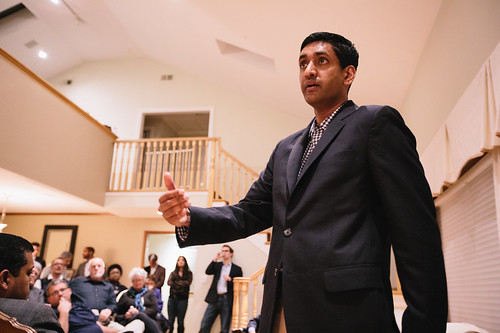
Ro Khanna & Jeremy Bird EventLG breaks ranks with Democratic Leaders

by Brian Leubitz

In a move that boosts the campaign of CA-17 Democratic challenger Ro Khanna and simultaneously promotes his Citizenville book, Lt. Gov. Gavin Newsom endorsed Ro Khanna.

I’m proud to support Ro. I know he will govern from a place of courage and authenticity. He has many innovative ideas to grow California’s economy and to apply technology to make government better for all his constituents. (h/t Josh Richman)

Most of the Democratic establishment, including Khanna’s former boss, President Obama, Nancy Pelosi, and many members of the state Congressional delegation, has already endorsed Rep. Mike Honda. But this endorsement gets some attention for the former SF Mayor and may be able to push the former Commerce dept. official’s fledgling campaign off the ground.  

Redevelopment Agencies Not Going Quietly

Wind-down of redevelopment agencies not going smoothly

by Brian Leubitz

When Gov. Brown announced, and eventually passed into law, his plan to end the redevelopment agency program, he had big plans for that money. Some went to education, and then various pots among the local governments.  Everybody in Sacramento knew that when you were dealing with physical construction, there were going to be some transitional difficulties. But, perhaps this is more than was expected:

Among audit findings so far, the controller has found that Fresno inappropriately transferred $41.5 million to the city’s housing agency and San Jose improperly transferred $148 million.

The audits suggest that the cities should not have kept that money for their own use but rather should have surrendered it to be distributed among various local government entities, as the Legislature intended.

In response, state finance officials have sent more than 40 letters warning cities that the state will begin withholding sales tax revenue if they do not transfer the amounts the state says they owe. Department of Finance spokesman H.D. Palmer said withholding tax revenue was a last resort and that the state would rather negotiate with the local governments. (Judy Lin / AP)

Adding to this fight is the fact that latest estimates that the dissolution will only bring in around 2/3 of what was originally predicted. Eventually, after the lawsuits wrap up, this will all be something of a sour chapter in the continuing balance between state and local governments in California. In the meantime, there is plenty of money left on the table.

California Cap and Trade Goes International

New pact with Quebec means credits can be traded between the two regions.

by Brian Leubitz

California’s cap and trade system is still in its big growth phrase after its relatively recent launch. Now the CA Air Resources Board (CARB) is looking to extend the reach of the market with a new deal with the Canadian province of Quebec.

With California Air Resources Board (CARB) approving linkage between California and Quebec’s cap-and-trade programs today, these two programs will now be able to trade emissions allowances across borders starting in 2014.  CARB’s action comes on the heels of Governor Brown’s recent decision to approve the linkage, which will increase the size of California’s cap-and-trade market by 20 percent. More importantly, linkage will boost California’s clean energy economy by creating a broader market for innovative, low-carbon technologies.  The linkage is also a shot in the arm for global efforts to cut greenhouse gas emissions, and it sends a positive signal to other jurisdictions that are working on building their own carbon markets and might ultimately seek to join with California and Quebec. (EDFBlog)

While California’s economy is obviously much larger than Quebec’s this deal could be the start of something much bigger. If successful, the market expansion could continue by adding additional states to the system. Former Gov. Gray Davis and Former Quebec Prime Minister had some thoughts on the linkage deal as well:

The strength of this partnership is not limited to the two jurisdictions alone, however. Its real strength is that the partnership creates a path for future partners to follow. Already, other U.S. states and Canadian provinces are watching carefully and beginning to talk about joining this movement. In addition, there are now discussions with Australia, the cap-and-trade program in the Northeast U.S., and the European Union.(Globe & Mail)

Now, the viability of the carbon market at all is still an unsettled question. A carbon tax would still probably be a more efficient mechanism while reducing speculative profits. However, cap and trade is what we have right now, and further growth and linkage of the markets will undoubtedly make the program more effective.

Steinberg says CEQA Reform Not Dead Yet

Environmental legislation is still in the works, according to Senate leader

by Brian Leubitz

In the wake of Gov. Brown’s earlier remarks that CEQA reform wasn’t going to happen this year, Sen. Steinberg is holding out hope:

Senate President Pro Tem Darrell Steinberg (D-Sacramento) said his bill to streamline the California Environmental Quality Act (CEQA) is moving forward and he looks forward to talking to Brown now that the governor has returned from a trade mission in China.

“The Legislature is hard at work on CEQA reform,” Steinberg told reporters. “As soon as the governor gets back, I’m going to sit down with him and go over specific provisions of the bill.” (Patrick McGreevy / LA Times)

Sen. Steinberg believes that environmental interests would prefer to deal with the issue rather than facing a nasty alternative that would gut CEQA at the ballot. Even if they believe they could win at the ballot, the price tag would certainly be high, not only in dollars but in focus on other issues. Pointing to Sen. Michael Rubio’s bill that would have fundamentally altered the role of environmental review, a bill that got a fair amount of support, Steinberg believes good, common sense CEQA reform is the best alternative for the environmental community as well as those who wish to see speedier development.