Tag Archives: Los Angeles

We Are Willing To Go To Any Means Necessary

On Wednesday I wrote a piece on Huffington Post and another at Open Left talking about the centrality of fixing the foreclosure crisis to any recovery from the economic meltdown. Since the toxic assets at the center of the meltdown are based on mortgages that are entering foreclosure at a rate of one every 13 seconds, we have to address foreclosure as a part of getting America back on its feet.

The Homeowner Affordability and Stabilization Plan (HASP), announced in Phoenix on Wednesday by President Obama, which will help up to an estimated 9 million families, is a good first step – and the first serious effort by the Federal government to confront the challenge. But just because there was an announcement does not lessen the urgency of the problem. We are still in a situation where four families every minute enter the foreclosure process. We believe there must be a moratorium on foreclosures until HASP is fully implemented.

So yesterday we at ACORN launched the Home Defenders campaign in seven cities – a campaign to force the question of moratoriums and to press the urgency of this crisis into the consciousness of elected officials on the state and national levels. This is a campaign of refusal and resistance, refusal by distressed homeowners to cooperate with the foreclosure process and resistance to attempts to evict them from their homes. And in some cases it is a campaign of getting people back into their homes.

I wanted to give everyone a report-back from our activities yesterday, which is in the extended text.

In Baltimore, ACORN member Donna Hanks re-took her home. Foreclosed on last Fall, the house has stood empty since then, a stark reminder of the failure of the system. But Donna joined with 30 ACORN Home Defenders to liberate her home from the bank. Her act of civil disobedience was covered by 2 radio stations, 2 TV stations, the Baltimore Sun, and the Huffington Post.

Donna used bolt cutters to break the lock to the door and re-enter the home. Unfortunately, in the six short months since the home was seized, it has been extensively damaged, essentially partially gutted. The toilets are missing, and the upstairs ceiling is badly damaged. The greatest tragedy here is that Donna worked for months with ACORN sister organization ACORN Housing Corporation to try to get the bank to modify the loan so it could be affordable, but they refused, taking the home and now allowing it to be a haven for squatters and a target of looters.

In Houston, where one in three homes sold in January was a foreclosure and foreclosure sales accounted for 34 percent of all homes sold – a 9-percent jump from the same time last year, Sara Chavez announced her refusal to leave here home. “My mother and I don’t leave,” she said.  A mother of three who cares for her sick mother, she has owned her house since 2004, but has seen her mortgage payment double from $1,000 to $2,000. She joined with ACORN Home Defenders to declare her neighborhoods a “Foreclosure Free Zone”. And the  Home Defenders backed her up. ACORN member Pennie Saldivar said, “We want to fix this problem. We are willing to go to any means necessary”.

We even had a little star power come out to help the campaign to keep hard working families in their homes. In Los Angeles, comedienne Roseanne Barr traveled to Watts to join with Tommy and Debora Beard. The Beards are a teacher assistant and hospital cook who have lived in their home for over 20 years and have lost it to foreclosure in part due to a predatory loan. There is a possibility that allies in the legal community may be able to extend the Beards’ eviction process for quite awhile to buy time get Chase to reverse the foreclosure, person after person (including Roseanne) pledged to “go to jail” with the Beards if necessary.

There are other reports from Oakland, New York, and Orlando.

Conservatives have made much of the fact that they think this campaign is really all about helping greedy and undeserving homeowners get a taxpayer bailout. Or they are itchy about the fact that keeping people in homes might involve breaking things like trespassing laws. Or they just plain froth at the mouth because we at ACORN are again standing up for working families.

On the last point, we sure hope they are drinking plenty of liquids because we’ve been doing this for 38 years and we aren’t going to stop just because it gives the people whose ideology led us into this catastrophe the vapors.

On the first two complaints, though, let me say two things. First, we all have skin in this game. This crisis is on a scale that rivals the Great Depression and foreclosures are at the heart of it. Whether you think the homeowners deserve it or not, creating a plan that gets these toxic mortgages performing again is the only way for people to agree on a value for the toxic assets clogging up the financial system.

Second, people are fed up seeing Wall Street get billions in help while the people bearing the brunt of the disaster get eviction notices. They are saying “enough is enough”. Like Pennie Salvidar says, families are willing to go to any means necessary to get elected officials to do the right thing.

This is a unique moment in history, one where we can steer the country away from the failures of conservative ideology and toward a fundamentally progressive approach to governing. As Mike Lux put it in the Huffington Post today: “The American family has to take care of each other, has to look out for each other, especially in the hard times, because the misery of our fellow citizens will spread to the rest of us.”

Right on.

This campaign is not just about helping hard working families keep their homes, it is fundamentally about saving the American Dream, about what makes us proud to call ourselves Americans, and about bit by bit making this country stronger.  

You can help by asking Congress not to give in to Wall Street and their coming attempts to block the most important aspects of HASP. If we want a new America we’re going to have to fight for it

Crips And Bloods: The Manifestation of Failed Prison Policy

The Stacy Peralta-directed documentary Crips And Bloods: Made In America looks at the history of gangs in South Los Angeles over the last 50 years, and the violent civil war on the streets that has raged for the past 30, killing as many as 15,000 residents, three times as many as in the Unionist/Catholic war in Northern Ireland in the 1970s and 80s.  Anywhere else in the world, UN peace negotiators would be brought in and Security Council resolutions passed to stop the violence.  In South Central, the battles continue, and children growing up among the chaos, according to a recent RAND Corporation study, have higher rates of PTSD (post-traumatic stress disorder) than children growing up in Baghdad.

One of the more amazing things about the documentary is that, despite unparalleled access to the gang-bangers surviving on the streets over the past 30 years, there is precious little about the actual feud between the Crips and Bloods.  Most of the history of why they fight and why they kill has been lost in the minds of the young leaders on both sides who suffered an early death.  Crips and Bloods shoot and get shot largely because they are supposed to oppose one another.  Wearing the wrong colors in the wrong neighborhood is a death sentence, but it’s unclear why.  At one point, one of the original gang leaders, Masuka, says that “one of the ways the oppressor state functions is by turning the subjects against one another.”

The story traces gang culture from the earliest days, through the Watts riots of 1965, the Black Power movements of the late 1960s and early 1970s, and the rise of the Crips and Bloods, as South Los Angeles fell into a self-perpetuating cycle of decay and despair.  After the major factory jobs left in the early 1960s, residents were without opportunity and without hope.  Crack cocaine and other drugs eventually became the only economic salvation.  And it led to violence and warfare in the streets.

The most revealing sequence in the film comes when every current gang member is asked about their childhood, and they all – to a man – respond that they were products of a broken home, without fathers, with the family members who raised them selling drugs out of the house, caught at an early age without positive role models or figures to enable their own empowerment.  Those living in South LA with strong family units had mothers and fathers who kept them off the streets and away from the gangs.  Those without had little hope.  And this is a very direct consequence of an insane prison policy that locks up nonviolent offenders, particularly in the black community, at absurdly high rates.  One out of every four black men will be imprisoned at some point in his life, and particularly in California, the inability of the system to handle all the warehousing of inmates leads to a lack of rehabilitation and an expanded recidivism rate.  In fact, the explosion of gang activity inside the prisons ensures an increase outside the jail.  This revolving door in and out of prison rips apart families and leads to a sustained cycle of gang activity and violence.  The “war on drugs” is unquestionably a war on people of color and the lower classes.

That is the faillure we are talking about when we look at California prison policy, a failure that will now lead to mass release in the absence of leadership in Sacramento.  Policymakers would rather lock away the problem instead of facing the terrible blight in the black community.  Indeed, they have locked up these people inside AND outside of prison, confining them to the few miles in South Central that is their turf; there are stories in the film of young gang members who have spent their entire lives in a 10-block radius.  The border between South Central and suburbs like Lynwood and South Gate has been a virtual pen for black youth for 50 years, with anyone crossing the border risking a beating or even their lives.  We built communities that are prisons, through restrictive housing covenants and police directives to “maintain order”.  This is what created gang life, out of mutual protection from whites.  And what now sustains it is not only the locking up of parents from sons and daughters, not only the locking up of blacks inside ghettos and away from opportunity, but the locking up of minds, the locking in of self-loathing and the snuffing out of the flame of hope.

While South LA is now as Latino as it is black, the difficulties for residents and the ravages of gang life remain.  While violent crime has decreased since 1992 it remains unspeakably high.  As we look at prison policy in California, and in particular the efforts by elites in Sacramento to block any meaningful reform, despite bending over backwards from federal receivers to work out agreements that allow for inmates to retain their Constitutional rights to be free from cruel and unusual punishment, we need to think about the Crips and the Bloods, about why they persist, about why they fight, and about why we made them.

The Elephant in the Room in L.A. City Hall

There was a very large elephant in the L.A. City Council chamber on Jan. 28th, but unlike the proverbial pachyderm, everyone was talking about him. His name is Billy, and he’s a 23-year old Asian elephant who has lived many years in a 0.6-acre, concrete enclosure at the L.A. Zoo. For 2 years, he has been alone; since the Zoo (under public pressure) sent their female elephant Ruby to a sanctuary when her mental and physical health was declining. Mayor Antonio Villaraigosa, who has said “elephants should be in sanctuaries and not in zoos”, requested a review of the exhibit. The subsequent Dec. 2005 report advised expanding the yard space to 3.0 acres and getting softer substrate. On April 19, 2006 the Council approved a massive building project, meant for several elephants, called “the Pachyderm Forest.” But in Dec. 2008, they halted construction to consider Councilmember Tony Cardenas’ new motion to close the exhibit and send Billy to roam a spacious elephant sanctuary instead (i.e. P.A.W.S., in San Andreas, where Ruby is.) Cardenas made the motion in Nov. because he felt that when the Council approved the project, they did not have all the information. “This city can’t afford to build a $40 million elephant mortuary,” he said in Nov.

On Weds., L.A. City Hall’s council chamber was so packed it was standing-room only (with spillover encouraged to go to another room, and watch on closed-circuit TV). Animal lovers came out en masse both for and against the proposal, both sides seemingly convinced that the other side doesn’t care about animals. Passions were intense, and many of the over-40 public comments made (20 on each side) were full of vitriol against their opponents. A further 60-plus requests to speak, (about 30 pro and 30 con) had to go unfulfilled. Council President Eric Garcetti warned those assembled three times not to boo during speakers’ remarks (it was the L.A. Zoo crowd booing). There was cheering, clapping, groaning, jeering, and some speaking out of turn. You could even say “it was a zoo”. But meanwhile, back at the actual zoo, solitary Billy probably spent much of the time bobbing his head up and down, in the unnatural repetitive motion called “stereotypy”, which is a sign of schizophrenia in humans and something close to it in zoo animals. The L.A. Zoo has claimed it isn’t a sign of mental illness at all, but apparently they didn’t look up ‘stereotypy’ in that kooky radical troublemaking book: Webster’s Dictionary.

See my Jan. 24th video of Billy’s head-bobbing:

http://www.youtube.com/watch?v…

Or another user’s video of it, with voice-over explanation:

http://www.youtube.com/watch?v…

Cardenas’ motion failed 11 to 4; the expansion of the elephant exhibit will continue and Billy has to wait for it. One way of looking at this is that the “Free Billy” movement picked up 2 votes from the original 13 to 2 vote approving the “Pachyderm Forest.” But they also lost progressive Councilmember Bill Rosendahl’s expected vote. He has explicitly stated before he’s “not for elephants in the zoo,” but Rosendahl voted to keep building because the report from City Administrative Officer Ray Ciranna convinced him that it would cost more to discontinue the project now than to finish it.  (Similarly, an L.A. Times editorial last weekend recommended continuing even though it had opposed the project in 2006 for fear it might not be large enough. The Zoo touts the new Times op-ed even though it’s the kind of lukewarm endorsement we heard at the beginning of the Iraq War: well, it’s a terrible idea, but we’re in it now, so we can’t pull out.)

In any case, the Council vote is not very surprising in the face of busloads of personnel and supporters co-opted by the Zoo; 27,000 signatures the Zoo gathered (they have a little advantage there, since their rivals don’t have an established, 113-acre entertainment attraction of their own in which to gather signatures); and a Fairbank & associates opinion survey reporting that Los Angelenos, 3 to 1, favor the completion of the exhibit. Councilmembers faced with all that are, in the end, politicians, and almost half of them are up for re-election on March 3rd.

But this Fairbank poll is interesting. It was likely commissioned by the L.A. Zoo, which issued a Jan. 26th press release about the results. If you ask me, it looks like a push poll, since the questions match many L.A. Zoo talking points, asking: whether respondents “agreed that closing the habitat and shipping Billy to a distant location will deprive schoolchildren and their families of the opportunity to learn about the threat of extinction facing Asian elephants”; whether they favored the Zoo “teaching wildlife conservation, breeding additional Asian elephants and helping prevent the extinction of the species” by building a new habitat; and whether they minded “hundreds of job losses that would result from shutting down the project in the middle of a deep economic downturn.” I’m not sure if that was exact poll wording, but that’s how the Greater Los Angeles Zoo Association (GLAZA) relayed it. It’s amazing, actually, that in each of those cases 30% did resist the way the Zoo wanted them to answer. Apparently, the survey also made a point of reminding respondents that voters had passed a Zoo Bond Measure to improve animal exhibits. (Which many “Free Billy” types seem to think is a fabulous idea, actually; several of those commenting at the meeting remarked there are other inadequate exhibits at the zoo.)

What GLAZA doesn’t say is whether those surveyed were asked: if they knew that 13 elephants have died at the L.A. Zoo in 30 years; whether they knew that half of those had never reached age 20; whether they knew that all but one of those 13 showed “various states of degenerative joint disease and fatal orthopedic disabilities associated with lack of mobility due to close captivity”, per Rep. Dennis Kucinich’s letter to L.A. City Council urging closure of the exhibit. (Yes, I know, he’s not from here, but he speaks against injustice and cruelty everywhere.) I also wonder if the survey mentioned that it was after years of condemnation, and new American Zoo Association rules for elephant management, that GLAZA proposed to expand its elephant enclosure.

As an L.A. Zoo member and a PETA member, I was getting emails from both camps. So I compared the arguments made by both sides in advance of the City Council meeting. The Zoo had trotted out animal TV show host Jack Hanna, who spoke in generalities in a video on their site. He exclaimed that the L.A. Zoo had “phenomenal habitats from day one”. Really? It would seem even the zoo would disagree, considering how much money they put into reforming their three great apes exhibits and now their Pachyderm Forest. He estimated that the new exhibit’s design is 10% of their total area. Well, actually the proposed 6 acre site is 5% of their total 113 acres. And only 3.6 of those will be roaming areas for the elephants. Incidentally, Kucinich’s Nov. 2008 letter noted that the home range of a male Asian Elephant in its natural state is 200 sq. km. – 235 sq. km. The smaller number of those two is 8,237 times the outer perimeter of the new exhibit.

Hanna went on to make the kind of illogical comment one used to hear at the height of the Bush Administration: i.e. what are you protesting in the streets for, things can’t really be as bad as you say, or people would be out in the streets! In the video Hanna admits how bad zoos used to be in past decades, but assures viewers “that’s no longer the case,” because “people in their communities are demanding the best for the animals.” His thesis being; so ignore those people in the community demanding the best for Billy!

Sounding alarmingly like Fox News, the video asked Hanna what are the “intentions” of the activists who want Billy removed from the zoo. (Asking the favored ‘A’ side what the disfavored ‘B’ side is all about is a patented Fox News propaganda device.) Hanna didn’t worry about putting words in the opponents’ mouths, though, and speculated that they want to “put everything back out in the wild”. Granted, some elephant advocacy groups cite how elephants live in the wild, but obviously, that’s for comparison, to illustrate how far off their needs are from a typical captivity. And to show that being able to roam on sanctuary acreage and bond with other elephants is at least closer to that state than the current or planned L.A. Zoo exhibit.

Amusingly, Hanna borrowed another favorite Fox News angle: dismissing “celebrities” for involvement in a political cause. What do you call Jack Hanna if not a celebrity? And moreover, musician Slash and actress Betty White have also leapt to GLAZA’s defense.

Zoo Trustee Betty White claims that those concerned that Billy might die a premature death at the zoo “would rather see species die out than to thrive in accredited zoos.” Now, is that fair? Her two-page message in the zoo’s winter newsletter goes into detail about “animal activists” (it must be ‘activist’ that’s a dirty word, because she likes the word ‘animal’). She accuses them of wanting “to remove all elephants from all zoos. And let’s not kid ourselves, folks, it will not stop with elephants. Giraffes will be next. If they win this battle, they will not stop until zoos themselves are extinct.”

That kind of alarmist rhetoric sounds like the Prop 8 campaign: if you allow gay marriage, then next it’ll be polygamy, pedophilia, and bestiality! They’ll be teaching our children to be gay in schools! Run for your lives!

White is no fool and I applaud her decades-long activism, even if she doesn’t applaud others’, but could we have a rational argument, please? Clearly, zoos are in no danger of disappearing. Maybe we can eventually get rid of the substandard ones – the roadside zoos, the ones with wholly ignorant staff, the ones that don’t breed their animals or have any conservation aims – but White and GLAZA reject such zoos anyway. Merely asking the L.A. Zoo to prove they have the ability or expertise, in light of their elephant track record, ought to be seen as completely reasonable and no nefarious motives necessary. A zoo is like a hospital, or a university. Some departments might be brilliantly successful; others might be total failures. You should look at them case-by-case. I think the Zoo has done quite well for its great apes. http://www.youtube.com/watch?v…

Also, one often sees happy family units there (koala bears, snow leopards, various lemurs, etc.). See baby koala here: http://www.youtube.com/watch?v… .

But not all animal exhibits are created equal — meerkats, for instance, one of which was depicted in The Lion King, live in colonies of 20-50 in the wild. They have such a sense of social responsibility that they rotate guard duty. The L.A. Zoo exhibit now has one meerkat, because all the others have died.

It is totally fair game for the general public to scrutinize how well different areas of the zoo are working, just like they do their police or school board. And the institution has the right to defend itself. But they don’t get to say only their opinion is valid. Hospitals screw up in services to humans, and you don’t necessarily have to be a neurosurgeon to notice it. At the meeting, as in their publicity, GLAZA frequently claimed that they were the only proper authority as to whether their animals were thriving as they should. Not cool.

The zoo brought out longtime staffers, and some fired-up volunteers, to be mightily offended, offended I tell you, by the accusations of past cruelty in curbing elephant behavior and of negligence in the deaths of a dozen elephants. But they did not provide an alternative explanation. It would be so much more reassuring if the L.A. Zoo admitted that the elephants didn’t just die because of bad luck. One would have more faith that they have learned what to do and that, going forward, they will understand and be able to meet the needs of elephants (for exercise, soft substrate, stimulation, social bonds).

I was not initially sure which side to be on regarding this Pachyderm Forest. But the Zoo has talked me into it, or rather, out of it. Though I’m a dues-paying member – and you’d think, as such, owed a straight answer – I have been sent emotional appeals that vilify their critics and skirt the basic issues, which ought to be simple enough to lay out. Is the projected exhibit large enough? How much space will each elephant have and how much do they need according to AZA? Is there evidence that it’s even possible to breed elephants in captivity? Instead, we get red herrings.

At City Council on Weds., several witnesses from the Zoo side derided the involvement of “celebrities” sitting across the aisle from them and urging Billy’s release: Cher, Lily Tomlin, Kathryn Joosten (“Desperate Housewives”, “The West Wing”), Bob Barker (who offered to pay $1.5 million to transfer Billy to P.A.W.S. near Sacramento), Kevin Nealon, Robert Culp (who a year ago tried unsuccessfully to sue the City and Zoo Director John Lewis), and I also thought I saw Anjelica Huston. The Zoo crowd was able to scoff because their own publicity gimmicks — Betty White, Jack Hanna, and Slash — did not show up that day. But the Zoo staff who spoke also put down their opponents as uninformed busybodies, despite the expert witnesses present who are critical of the Zoo and its plans. Since the mainstream media narrative of the elephant exhibit pits celeb amateurs against L.A. Zoo professionals, we should look at some of those on the “Free Billy” side:

1.) Dr. Joyce Poole: a wild elephant biologist and author of Coming of Age with Elephants, Poole made the crucial discovery that male elephants experience “musth” (regular sexual periods of extreme aggression). In 2005, she discovered that elephants learn to make sounds by imitating each other – the only land mammals besides primates to do so. She has worked with Cynthia Moss, the animal behaviorist at the center of two PBS Nature films on African elephants. And Poole was named the director of elephant conservation and management for the Kenya Wildlife Service.

2.) David Hancocks: a zoo architect and zoo director for thirty years, Hancocks wrote the book A Different Nature, an analytical and comparative history of zoos. He is an expert on evaluating the design of different species’ exhibits. He is not “anti-zoo”, he values the potential of zoos to do good; but he is an advocate for habitats and programs that serve the animals.

3.) Dr. Jennifer Conrad: a former L.A. Zoo vet who treated animals on five continents, including elephants in Asia and Africa, Conrad was also head veterinarian at a wildlife sanctuary. As a result, she created “The Paw Project” in Los Angeles to rehabilitate big cats’ paws which had been damaged by the discredited practice of declawing; she led teams of surgeons in operations on circus tigers and the like to help reverse their crippling. She also works as an on-set vet for films.

These are impressively credentialed people who think the L.A. Zoo is not doing right by its current, past, or future elephants. Others urging the Council to remove elephants from the L.A. Zoo included two spokespeople from the Shambala Elephant Reserve, and Will Travers (Jr.) of Born Free USA, this country’s legislative advocacy arm of the famous wilderness reserve in Africa.

Their theme is not some abstract notion that zoos are evil, but the very practical concern that Billy’s health and life are in danger. On Weds. a large blow-up photo of Billy’s foot was presented by Councilmember Rosendahl to the L.A. Zoo vet seated with Zoo Director John Lewis in the Council’s inner circle; when the vet was asked if this meant Billy may be developing foot problems, like the zoo’s elephants Gita and Tara who died at the zoo in the last 4 years, the vet couldn’t say. It seemed he had no updates on the condition of Billy’s feet, despite all the firestorm and all the publicity effort by the zoo about their excellent elephant management. But we heard assurances that the keepers give him daily foot care.

Rosendahl requested that Dr. Conrad be allowed to give a contrasting opinion; she answered that she doubted the zoo staff were even able to give Billy foot care right now, since he had been in musth, “in rut”, since Nov., and was too dangerous to work with. She told the Council he’s “in musth an abnormally long time”. (Indeed, whenever I visit, no matter what time of year, he seems to be in musth: it’s evident by the liquid streaming from his eyes and the urine that dribbles down his leg. http://www.youtube.com/watch?v… )

Conrad asserted that the reason for his long musth is that “he’s fat, because he can’t exercise.”

Bizarrely, the Council did not discuss what one might think would be at least a compromise: ship Billy out temporarily to P.A.W.S. while the exhibit is being built, thus letting him run around on acres and acres of grass instead of a hard surface and, hopefully, protect his feet from dangerous infections, give him exercise, and help him get a break from musth. The Zoo cheerleaders (who filled rows of the chamber, attired in green T-shirts, with a pep rally energy) were insistent that Billy belonged in “the only home he’s ever known”, and that “he loves his family.” It’s a little like saying Steve McQueen’s character in Papillon enjoyed his cell, right in the middle of the scene of him  going crazy in solitary.

The String Theory of Community Organizing

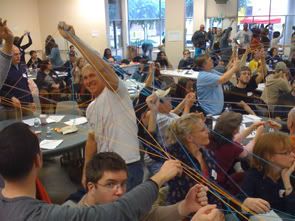
It started with yarn. A lot of little balls of colored yarn.

Last week, a lot of us in the Southern California Obama campaign gathered for the first time since the election for the mega “Change is Coming” event at LA Trade Tech because we wanted to learn what we could do next.

As one of the team building exercises, the organizers had someone at each table grab a ball of yarn and string it to another table across the room to someone else they had met through the campaign. Soon the room was a tangle of blue, yellow, green and orange strings. It’s the picture you see to the left.

At the end of the meeting, we were all asked to adopt a local food bank. Our group in the northern part of CD36 settled on the Westside Food Bank, those in the southbay and the harbor area adopted The Food Bank of Southern California, His Helping Hand Food Pantry in Lomita and Harbor Interfaith Services in San Pedro. Between the two groups, by reaching out to our Obama networks, our neighbors, Facebook, and Community Organize (a new networking site developed by the leadership of the California Obama campaign), we collected over 8,000 pounds – FOUR TONS – of food, blankets and toiletries, donated a thousand dollars, and recruited dozens of volunteers to sort and box the proceeds.

To get an idea of what this new interconnectivity means, check out these comments from some of the organizers:

Jill Gilligan (Redondo Beach)

Hi – I just left the Sprint collection site in South Torrance after helping Linda Greene and the Mira Costa team unload their haul. I had already brought in 4 bins and nother zillion bags of food from my two sites, and Linda had even more than I. I was in tears. I feel like I have known Linda my whole life and we just met in person half an hour ago. Thanks to the kids from Mira’s Young Dems, my kids, my friends, and all of the Fighting 36th. It was a great experience.

Linda Green (Manhattan Beach)

My thoughts exactly, Jill! What was a good idea turned into a great success in no small part to the awesome volunteers and incredible generosity of our communities. Really enloyed workig with Jill (Redondo Beach) and Robert (Harbor/San Pedro) and happy to say our teams were able to collect 4,255 lbs. of food and personal care products today! SPECIAL THANKS to the awesome volunteers including Mira Costa High School’s “Young Dems Club” and their prez Sam Hein who rallied the troops and worked with a huge smile all day. And to the S-Club members at Mira Costa who manned the tables and collected food donations! Congratulations to our CD36North team and good luck to the other food drives taking place this weekend. YES WE CAN…AGAIN!!


Robert Brandin (San Pedro)

Hello Everyone,This is the report for CD36Harbor. It is a beautiful day here in San Pedro. This morning the team went to our adopted food bank to check on things. We were delighted to see their Christmas party was going on. There were hundreds of people with their families enjoying the sunshine, the services and activities provided by the good souls at our adopted food bank, Harbor Interfaith Services (www.harborinterfaith.org).

Both their facilities were in full swing. The food pantry on 9th St.served more than 200 families. They left with groceries, most with a turkey, some toys, and a peppermint stick for the kids (the average age of their clients is 6yrs). On 10th St, at the homeless shelter for abused women with children; it was a block party. Janice Hahn arranged for the permit to block off the street for the first time ever. Here there was games for the kids (jumper and all). The tables and chairs began filling up for the big meal to come. Very cool.

The team managed to collect about 750 pounds of food, blankets, and things babies’ need. We used our lists from the campaign. First we “refined” the lists, called, then followed up with an email. It worked well. San Pedro High School seniors, from Mrs. Karin Bruhnke’s government classes (many of whom worked our phone banks) collected 250 pounds for us.

For me, the best thing was not so much the supplies we were able to donate, it was the experience of doing it. Working with folks like Tahia Hayslet, the benevolent and caring executive director, or Shirley , her right hand, to all the others who took the time to care enough to do something for someone less fortunate. These contacts are valuable assets . Again it is proven to me that engaged people, working together ignites the desire to get involved and take action. This is good.

So what’s next? I vote for something that has immediate impact. Something enduring. Any ideas?


On the Community Organize site, there are a dozen other food banks happening today all over Los Angeles and California. I can’t wait to hear how their day went.

And lastly, that site’s membership has gone from less than 50 to just shy of eight hundred.

In a week. A week

Welcome to the “string theory” of community organizing.

For more photos of today’s food bank sorting party, go here and here

Looking Beyond Funding In Education Reform

The fairly spectacular flameout of LAUSD superintendent Adm. David Brewer, hailed as a savior for the district just two years ago and now on the verge of being fired by the school board, could perhaps provide a valuable lesson to progressives about education policy.  Too often the focus is solely on finances – protecting education funding, fighting fee hikes at colleges and universities, spending X amount per classroom.  These are noble and important goals, but Brewer’s tenure shows the pitfalls of this focus at the expense of proper management and development, which is simply a disaster in Los Angeles, the state’s largest school district and one of the largest in the nation.  A lot of it has to do with internal politics.  Antonio Villaraigosa spent millions to put his acolytes on the school board, and Brewer was seen as a legacy of the past.  There was a Solomonic gesture to make everyone happy, and it made things worse.

Eventually, Brewer’s accumulated missteps — and his dismaying lack of prowess — led to an arrangement in which he ceded much of his authority while preserving the illusion of his leadership, a revision of his job description that avoided roiling the city’s ever-tenuous racial politics. Senior Deputy Supt. Ramon C. Cortines was hired in April to oversee academic matters for the district, while Brewer continued to preside over administrative matters such as payroll and construction; Brewer also acts as a public figurehead and attends the protracted board meetings. This is classic Los Angeles politics: Administrative and racial comity is achieved by paying two superintendent-level salaries for one complete superintendent-level package. It also typifies all that is wrong with L.A. Unified. The district protects administrators who fail rather than students whose futures depend on a solid education.

For his part, Brewer was overconfident about his ability to navigate the political shoals that lay ahead. Shortly after starting his job, he was confronted with an enormous payroll snafu, as a new computer system put in place by his predecessor repeatedly spat out inaccurate checks — for months, some teachers were overpaid, some paid not at all. Though Brewer tackled the problem competently, he also compounded it, first by trying to blame district employees for the mess and then by hiring expensive and ineffectual public relations consultants to spin a new image for the district.

On Which Way, LA last night, one guest reported that the Administrative newsletter had to be scaled back to a 10th-grade reading level because it was causing difficulties for the TEACHERS.  And there were a lot of horror stories about the composition of the district political architecture itself.  These are not all questions of finance, and many positive steps could be achieved for students without an appreciable amount of funding, or cutting back on needless public relations spending.  This CAP report about teacher tenure and high-poverty schools might be a good place to start.

I think we need to have a broader conversation about education policy than “protect our school money,” is all I’m saying.

Wildfires And The Urgency Of Combating Climate Change

While this recent spate of wildfires have been put relatively under control today, the devastation is pretty severe.  The number of houses destroyed in Yorba Linda shot up yesterday, the fire in Montecito claimed several dozen more homes, and the mobile home park in Sylmar is a near-total loss.

Even without getting back to his home, Mr. Grieb is fairly certain that all is lost.

He and his neighbors have seen aerial photos of the devastated development and, in stark black and white, a chalkboard at an evacuation center lists the homes, by lot numbers, that were spared. About 124 out of 600 homes are on the list, and Mr. Grieb’s home is not among them.

For the park’s residents, it was as if an entire village had vanished in the flames.

“I used to refer to it as our little Mayberry,” said Tracey Burns, 47. She and her partner, Wendy Dannenberg, 46, lived in Oakridge for 15 years. Ms. Burns’s parents lived nearby in a part of the complex that was spared by the fire.

“It was just a very nice community,” Ms. Burns said. “Someplace safe with a lot to offer from the pool to the tennis courts to bingo on Tuesday nights. It was a very nice way of living. People waved not because they had to but because they wanted to. We always took offense to people calling it a trailer park because you had a yard, a porch, a garage, a garden. It was a home, not a trailer.”

While some scientists are dismissing the idea that climate change has something to do with the increasing frequency of fires in the region, clearly the reduction of the snowpack in the Sierras, combined with the extended drought conditions, have extended the fire season to the point where it is year-round and unsustainable.  And that is expecteed to only worsen in the future.

The current drought in the Southwest may simply be part of the normal cycle of wet and dry spells. But looking over the next century, Cayan said, regions with a Mediterranean climate such as Southern California are expected to get drier.

“I have to believe that is going to make us more vulnerable to some of these more intense fire episodes.”

While the relief efforts of the local communities are admirable, it’s simply not sustainable to have major parts of the region go up in smoke at regular intervals.  We have barely enough money in the kitty to provide basic services, let alone a year-round fire season.

Through global warming, we have now fire season all year round. We used to have fire seasons only in the fall, but now the fire seasons start in February already, so this means that we have to really upgrade, have more resources, more fire engines, more manpower and all of this, which does cost extra money.

The scientists may want to be circumspect, but this is global boiling, a consequence of rising temperatures and a drier climate.  And while myopic conservatives like Dan Walters don’t realize it, a massive shift to green technologies is essential for financial reasons as well as environmental ones.  Fighting massive fires costs lots and lots of money that can be avoided if we reduce emissions and protect the planet.  Backwards-looking folks like Walters always examine the up-front costs while paying no attention to the externalities.  Burning the earth has severe monetary consequences, and on the flip side, creating greener ways to power our lives and transport our people is exportable technology that can make California a global economic leader.

Of course, it’s going to take more than one state, and fortunately we have a new President-elect who understands the need for immediate action.  Not only is he raising money for relief organizations helping with the current wildfires, but today he made a surprise appearance at the Bi-Partisan Governors Global Climate Summit in Los Angeles, calling for “a new chapter of American leadership on climate change.”  I’ve put the video and transcript below.  We finally have leadership to heal the planet, which is as beneficial for California as it is for anywhere in the country.

Let me begin by thanking the bipartisan group of U.S. governors who convened this meeting.

Few challenges facing America – and the world – are more urgent than combating climate change. The science is beyond dispute and the facts are clear. Sea levels are rising. Coastlines are shrinking. We’ve seen record drought, spreading famine, and storms that are growing stronger with each passing hurricane season.

Climate change and our dependence on foreign oil, if left unaddressed, will continue to weaken our economy and threaten our national security.

I know many of you are working to confront this challenge. In particular, I want to commend Governor Sebelius, Governor Doyle, Governor Crist, Governor Blagojevich and your host, Governor Schwarzenegger -all of you have shown true leadership in the fight to combat global warming. And we’ve also seen a number of businesses doing their part by investing in clean energy technologies.

But too often, Washington has failed to show the same kind of leadership. That will change when I take office. My presidency will mark a new chapter in America’s leadership on climate change that will strengthen our security and create millions of new jobs in the process.

That will start with a federal cap and trade system. We will establish strong annual targets that set us on a course to reduce emissions to their 1990 levels by 2020 and reduce them an additional 80% by 2050.

Further, we will invest $15 billion each year to catalyze private sector efforts to build a clean energy future. We will invest in solar power, wind power, and next generation biofuels. We will tap nuclear power, while making sure it’s safe. And we will develop clean coal technologies.

This investment will not only help us reduce our dependence on foreign oil, making the United States more secure. And it will not only help us bring about a clean energy future, saving our planet. It will also help us transform our industries and steer our country out of this economic crisis by generating five million new green jobs that pay well and can’t be outsourced.

But the truth is, the United States cannot meet this challenge alone. Solving this problem will require all of us working together. I understand that your meeting is being attended by government officials from over a dozen countries, including the UK, Canada and Mexico, Brazil and Chile, Poland and Australia, India and Indonesia. And I look forward to working with all nations to meet this challenge in the coming years.

Let me also say a special word to the delegates from around the world who will gather at Poland next month: your work is vital to the planet. While I won’t be President at the time of your meeting and while the United States has only one President at a time, I’ve asked Members of Congress who are attending the conference as observers to report back to me on what they learn there.

And once I take office, you can be sure that the United States will once again engage vigorously in these negotiations, and help lead the world toward a new era of global cooperation on climate change.

Now is the time to confront this challenge once and for all. Delay is no longer an option. Denial is no longer an acceptable response. The stakes are too high. The consequences, too serious.

Stopping climate change won’t be easy. It won’t happen overnight. But I promise you this: When I am President, any governor who’s willing to promote clean energy will have a partner in the White House. Any company that’s willing to invest in clean energy will have an ally in Washington. And any nation that’s willing to join the cause of combating climate change will have an ally in the United States of America. Thank you.

The Fires

Here in Southern California, if you sit outside for more than half a minute you’re bound to see some pieces of ash falling on your head.  The entire region is bathed in a film, the air quality is miserable, and the horizon is barely discernible.  Two fires – one in the northern San Fernando Valley in Sylmar, another south in Orange and Riverside counties in the Chino Hills area – have devastated local communities, burning hundreds of homes to the ground, including an entire trailer park.  Today, despite more favorable conditions, hundreds more homes have been burned and thousands evacuated.

More residents of Southern California were urged to leave their homes Sunday despite calming winds that allowed a major aerial attack on wildfires that have destroyed hundreds of homes and blanketed the region in smoke.

Fires burned in Los Angeles County, to the east in Riverside and Orange counties, and to the northwest in Santa Barbara County. More than 800 houses, mobile homes and apartments were destroyed by fires that have burned areas more than 34 square miles since breaking out Thursday.

No deaths have been reported, but police brought in trained dogs Sunday morning to search the rubble of a mobile home park where nearly 500 homes were destroyed. No bodies had been found by midday.

“This has been a very tough few days for the people of Southern California,” Gov. Arnold Schwarzenegger said after touring damage.

Our best to the firefighters on the front lines.

UPDATE by Robert: The LA Times has a helpful reminder about how the numerous reforms proposed after the 2003 firestorms have failed to be implemented, including building more fire engines and procuring other equipment. The Yacht Party has consistently opposed funding the implementation of those recommendations.

Join the Impact–Los Angeles

(From the Courage Campaign’s own Rick Jacobs. – promoted by David Dayen)

About thirty of us gathered in front of the closed Starbucks on the plaza in front of the LA courthouse to assemble our petition materials for the rally and march a few blocks away. MoveOn.org, Courage Campaign (full disclosure: I founded Courage) and Credo Mobile have, over the past week, gathered over 200,000 signatures on a pledge to repeal Prop. 8. Our group that met for the first time this morning, was volunteers who signed up to get more sigatures from the crowd. And boy did they ever!

We made our way to the staging area outside of City Hall where we were greeted by thousands of jubilant folks with home made signs. The backstage set up reminded me in some ways of the May 1, 2006 immigration march on Wilshire Boulevard that had also sprung up from the peoplem, but was managed by organized labor: there was security, a rope line, a little blue tent under which speakers gathered before their turn. Rodney Scott, who puts on LA Pride every year, did a brilliant job with logistics along with a new group of young people called FAIR.  

Just once, it would have been great to have a crowd with that energy and spirit talk to the people on the podium rather than have the elected officials and others talk to them. Theprogram was generally good, but way too long, ninety minutes while people waited in 90 degree heat. One speaker went on for nearly twenty minutes, apparently mistaking a rally for a filibuster.

Mayor Villaraigosa broke away from these horrible fires that have now dumped smoke into all of LA and destroyed numerous houses, to give an impassioned speech in English and Spanish telling us all to go talk to our neighbors and at churches, not to wait for another election. Meet people whom we do not know, break down barriers with familiarity. And he's right. That's the only way to win human rights struggles.

Rev. Eric Lee, President of the Southern Chrisitan Leadership Conference of California, gave a stirring and powerful speech about the need to put God back into church when it comes to this issue of human rights. He said, "I'm a straight black man who went" with me to the Mormon Temple three weeks ago to try to deliver 17,000 letters from Courage Campaign members to the President of the Church. He went because it was the right thing to do. He is a stand up guy, a true friend of the LGBT and progressive communities, a powerful voice for civility and dignity in our march to justice. We all need to get to know him much better.

Many of the other speakers were great, too, including City Attorney Rocky Delgadillo and long time LGBT activist Torie Osborn. There were just too many of them.

At last, we marched. The crowd was animated, colorful, respectful and determined.

The most meaningful part of the day, though, was a meeting late this afternoon at the apartment of a young man named Vincent Jones. Vincent, a gay African American, pulled together about a dozen gay, straight, white, black and brown men and women for a serious conversation about how to build real conversation in communities where we lost. I was knocked out by these folks.

Zach Shepard, one of the guys who led the first spontaneous march here in LA two Wednesdays ago said, "In places like San Bernardino County we lost 70-30%, but that means that we have 30% of the voters there who support us. We need to find them, engage them and empower them to start talking to their neighbors." One of the other participants said, "come to church. Meet people. You will be welcomed." And she's right. As Woody Allen says, 90% of life is showing up.

We did not show up before the election; we will now. The power of today's march here in LA came was in the numbers and determination of individuals who are themselves leading a movement. The are not looking "up" for any established organization to tell them what to do. They know we can win next time, provided we organize, communicate and build.

This time, the campaign will be the peoples, a real movement. And this time we will win.

Massive Protest At Mormon Temple In Los Angeles

Lots of people are angry about the passage of Prop. 8 and they are just channeling that anger organically.  One of the results has been street protests, and today’s blocked Santa Monica Boulevard.

Hundreds of people protesting California’s new ban on gay marriage demonstrated outside a Mormon temple in Westwood on Thursday, blocking traffic on a major boulevard.

The protesters claim the Church of Jesus Christ of Latter-day Saints spent millions to air deceptive advertisements in support of Proposition 8, which passed on Tuesday with 52 percent of voters casting their ballots to define marriage as a heterosexual union.

If you’re unfamiliar with LA, that is a HUGE temple.  

There is other talk of boycotting Utah and Marriott hotels, and further street actions.  This is how civil rights movements typically mature.  And many are correct in the previous thread in saying that rights are not usually put to a vote.  This is all being done haphazardly.  Will a leader emerge from this movement?

…Pam Spaulding at Pandagon has more.

UPDATE by Brian: From the comments, some folks are organizing a similar protest in SF for tomorrow. Protest8 Blog has the information. It begins at 5:30  and goes from Civic Center down to Dolores Park.  

LA County Turnout Ridiculously Huge

LA County does not turn out that heavily.  In the June primary it was abysmal.  But today, people wanted to be a part of history.  Dean Logan, the registrar of voters, is saying that they could break the record of 81% turnout county-wide.  That would be an enormous achievement, and good for progressives.

Here’s a reminder to all LA County voters: if you are in line by 8:00pm, you will be allowed to vote.  That is current law and you need to make sure it is enforced.  Some pollworkers may want to shoo you out, but you can vote if you’re in line by 8.