
Tag Archives: banking

Target Needs to Pay for Targeting Our Privacy

Target ShirtTarget is targeting our privacy. There’s a big red bullseye, a target – like the one on the shirt I’m wearing today – that Target and Neiman Marcus, who chose not to show up to answer questions today, have put on us because they haven’t done enough to protect our private financial data. And the reason is that there’s no financial incentive to do so.

110 million Americans had their personal financial information breached. That ‘s one out of two adult Americans. I was in Sacramento today to testify in front of a joint California Assembly committee hearing investigating the breach. And yet Target did not send a single representative to Sacramento today to answer questions about the largest data breach in American history?

The fact that Target didn’t show up today tells us all we need to know about how sorry Target is and how committed it is to our privacy.

If you are as offended by this as I am, I have a t-shirt for you to wear too.

The reason Target won’t face legislative questions today is the same reason that our personal financial information and data is at such grave risk: there is no price to pay. There are few financial penalties to companies like Target when our personal data is taken.  

Beyond public embarrassment, Target has little financial incentive to care.

We, the consumers, pay the consequences but we have no remedies.

According to the Committees’ own staff research, 1 in 4 consumers whose personal information that is taken becomes a victim of identity theft. 1 in 4 victims of a data breach is also a victim of identity theft. If these numbers apply to Target, that would potentially create more than 25 million identity theft victims.  

There’s a harm. The retailers had a role in creating that harm. And yet they have no liability under California law for what they have or have not done to safeguard the sanctity of our personal information.

The problem with privacy violations is that unlike thefts of money or property the law does not recognize a harm and does not provide a remedy.

As the Committees’ staff research states: consumers have no remedy under the law for the loss of financial privacy suffered through these data breaches, and the 1 in 4 risk of id theft they face.  Zero remedies.

Jamie CourtSo why would retailers invest in greater security, or meet voluntary industry standards, or move away from risky magnetic strip technology?  

If they don’t have to pay a price they don’t have an incentive to change.  And that leaves our private financial information with a big bullseye on it.

What can we do?

We need a California financial information act that mirrors our Medical Information Privacy Act.    

When there is a data breach of our medical information, the drug company, hospital or medical center is liable to the consumer for $1,000 per violation.  

Guess what?  Medical data breaches are fewer and farther between. When they occur companies pay a big price.

The same should be true for our financial data. We need a California Financial Information Privacy Act

It would:

  • Change notification standards to be immediate.
  • Write minimum-security standards into the law so that they are no longer voluntary.
  • Set limits on the time data can be retained. And limits on what information can be collected and retained
  • Most importantly: create a private right of action. Put a price tag on retailers’ mistreatment of our private financial information.

Until there is a price to pay, Target and other retailers will continue to make us targets.

If you are as offended as I am by Target’s absence today in Sacramento, please share our Target design online to show your displeasure.

When a company as big as Target won’t provide a single representative to answer questions about the largest data breach in American history, it is time for California to step up and deliver on the promise in Article 1 Section 1 of our state constitution: Privacy is an inalienable right.


Posted by Jamie Court, President of Consumer Watchdog.
On Bilking The Sophisticated, Or, Check It Out: We’re Suing Banks!

I took a break to enjoy the holiday, as I’m sure many of you did, but my inbox kept busy, and on Friday came a doozy, courtesy of the Washington Post.

You remember that little bit of a banking crisis we had a couple of years back, where banks around the world might have possibly, maybe, just a little, conspired in a giant scheme to package toxic mortgage loans into Grade A, investment-ready securities instruments, which then blew up in everyone’s faces to the tune of a whole lot of taxpayer bailouts?

Well all of a sudden, it looks like an agency of the Federal Government is looking to do something about it, in a real big way.

Last Friday the Federal Housing Finance Agency (FHFA) announced they’re suing 17 firms (I’ll give you a list, bit it’s pretty much all the usual suspects); depending on who you ask the Feds are seeking an amount as high as $200 billion.

As Joe Biden would say, it’s a big…well, it’s a big deal, anyway, and that’s why we’re starting the new week with this one.

“An artist is only answerable to himself. He promises nothing to the centuries to come save his own works. He stands caution only for himself. He dies childless. He has been his own king, his own priest, and his own god.”

–Charles Baudelaire, as quoted in the book “Cezanné and Beyond“, edited by Joseph J Rishel and Katherine Sachs

So what do we know?

As we said, on Friday the Washington Post and others reported that there were a series of lawsuits filed by the FHFA in their capacity as Conservator of the assets of Fannie Mae and Freddy Mac against darn near everyone.

The FHFA is alleging, to make a long story short, that everyone involved misled Fannie Mae or Freddy Mac (the “Entities”, in the words of the lawsuits), to some extent, and that the misleading involved making representations to the Entities about the various metrics related to what Fanny and Freddy were buying from these banks.

For example, it’s alleged that when certain banks sold batches of mortgage loans to the Entities, they lied about how many of the owners were actually living in the homes; that makes a difference when you’re trying to figure out how likely a borrower is to pay back a loan.

It appears that a defense the banks will offer is that Fannie and Freddy were “sophisticated investors” who should have known the risks buried in the batches of loans they were buying (and they were sophisticated investors: they bought, literally, trillions of dollars worth of loans) – but if it can be proven that the banks were lying about what was in the loan packages, that defense might not do so well in front of a jury.

“Everyone involved” includes Bank of America (B of A), Citigroup, JP Morgan Chase, Countrywide (which means B of A is actually being sued twice), Deutsche Bank, Credit Suisse, the UK’s HSBC and Barclays Banks, France’s Société Générale, the Royal Bank of Scotland, Nomura Securities (representing Japan), and GE and GM (GE Capital is a surprisingly large and varied business; GM got in the banking business to finance auto sales, and you may today know them as Ally Bank).

Of course, Wall Street is also part of “everyone”; that’s why the list also includes Goldman Sachs, Morgan Stanley, and Merrill Lynch (which means, thanks to acquisitions, that B of A is actually getting sued three times). The City of Memphis also proudly makes the list, thanks to First Horizon.

Some notable names not on the list? Key Bank and Wells Fargo, who seem to have escaped action so far; there’s also UBS (Union Bank of Switzerland), who was already served with a similar lawsuit in July.

It is difficult to determine exactly how much money is involved, as various sources disagree, but we know that Deutsche Bank is being sued for about $14 billion, all by itself. (B of A is being sued, all told, for a bit over $50 billion; they’ve already paid out more than $12 billion this year to settle another similar claim.)

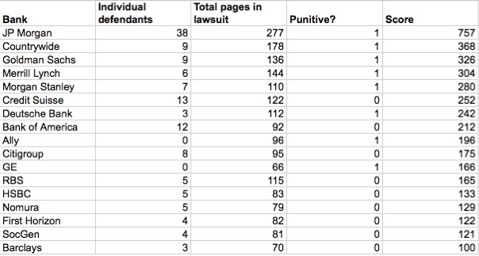
Felix Salmon, at the Seeking Alpha website, has created a chart that seeks to measure who is in the most trouble here; by his measure JP Morgan Chase is far and away at the top of the list…except that the current incarnation of B of A represents three of the top eight spots on his list, which suggests the FHFA is targeting them for the most recovery. (Salmon used the number of individual defendants, how many pages were in the lawsuit, and whether the suits seek punitive damages as his yardsticks; from there he calculated a score that makes up his rankings.)

All this had to happen right now, it appears, because a statute of limitations is in play; the WaPo reports that a failure to file the suits would have meant the FHFA would have lost the ability to recover those monies. (It’s also reported that pre-lawsuit negotiations were stalling, and those negotiations will presumably continue, with a series of impending court dates to help, shall we say, sharpen the focus.)

Now that is pretty much all the story I have for you today on this one – except for a bit of a “discuss amongst yourselves” to finish things up:

It has been suggested that the FHFA is in an inherently conflicted position in all these cases. That’s because the agency is acting as both the regulator of these banks and the “victim” as we seek any monies that may be due from any fraud.

So what would be a better situation?

Should the FHFA continue to regulate the banks they’re suing as a victim, or should another regulator be put in place…or should another Conservator be appointed, leaving the FHFA as “just a regulator”, and not a victim?

It’s a question worth about $200 billion, more or less – and even in these times, that’s still a lot of your money.

[poll id=”

471

“]

The Calderons Strike Again: Say No to More Loan Sharking

I’ve been in a tiff or two with a Calderon brother in my time,  but this time Ron Calderon isn’t the object of the net roots ire.  This time it is Asm. Charles Calderon, who was carrying a bill about advertising for payday lenders.  Apparently now he has decided that he would rather carry their water, and has gutted it and replaced it with provisions that would make many a loan shark smile.  Many consumer groups were surprised by the move, but together with CREDO, they are fighting back

Just before the Assembly went into its Spring Recess, payday lenders were able to change AB 1158, a bill originally about payday lender advertising, to instead raise the legal limit of payday loans in California from $300 to $500.

Consumer advocates were completely blindsided.

With millions of Californians struggling just to get by, the last thing we should do is make it easier for predatory payday lenders to trap people in a vicious cycle of debt.

They are asking their members, and I wholeheartedly support the ask, to call the Democratic members of the banking and finance committee in the Assembly.  Click here to get the names and phone numbers and to report the calls.

This is a sneaky move, but nothing really that new from one of the slimier business sectors.  It’s time to tell these lobbyists that they can’t just skulk around in hopes that nobody notices.  Unfortunately we can’t catch all of these egregious abuses of the arcane process, but on this one, they got caught.

Time to let the Assembly know that this is not cool.

Checking Account Interest Rates

Everyone is looking for ways to stretch their dollars further.  There are plenty of banking products that make it easier to save, such as CDs, savings accounts and money market accounts.  But did you know that your checking account can also help you reach your financial goals?  It’s possible when you get the best checking account interest rates. One of the first steps any savvy consumer should take is to compare checking account rates online.  There are many Web sites that post the latest figures and percentages from high yield checking accounts, letting you get details on who has the best rates.

Beyond checking account rates however, you should also look at the bank’s terms. Banks are willing to reward loyal customers with added perks such as unlimited check writing or withdrawals, a free check card (debit card), ATM withdrawals and online banking transfers to and from your checking account between one financial institution and another. Finally, although your checking account rates will help you earn extra money, you’ll still want to protect against overdraft charges and still have the flexibility and convenience of online access.  Look for a bank that consistently offers some of the most competitive checking account rates available.

How Edwards Can Win Over Small Business Owners

(Note: I posted this at Daily Kos recently, and based on a pretty good response I’m trying to give it a little more exposure. Hope you don’t mind the crosspost)

John Edwards is pretty good when it comes to the credit card industry. To be sure, he has made an issue out of it, while I can’t find much anything about the issue on either Hillary Clinton’s or Barack Obama’s websites. I’ll give credit where it’s due: He’s willing to take on issues that matter to real Americans.

But then the flip-side of that is that I’m addressing this diary to him, and not to the others. They should listen too. But I think Edwards is the only one who might, and maybe is the one who can make the best political use as well.

More below the jump.

In July, former Senator Edwards gave a long, wide-ranging, very good interview to BusinessWeek. Here’s the one section where he talks about the issue:

What we’re going to do is restore balance in the credit-card market. I am proposing a Borrower’s Security Act that would do the following: first, require credit-card companies to disclose the true cost of making only minimum payments, as many consumers do. Second, I would restore a 10-day grace period before imposing late fees and penalty rates. Third, apply interest-rate increases to future balances only. And fourth, end the practice of universal default, where a creditor can change a borrower’s terms based on their debt payments to other creditors. We also need a new consumer protection commission, which I would call the Family Savings & Credit Commission, whose job it’ll be to review all the financial services products that are being marketed to families and ensure that the terms are reasonable and fairly disclosed. [The commission would] oversee all types of financial institutions whether chartered under federal or state law.

These are all great. And He lists these four on his website. He knows his issues, all right. But I’d like to see number 5:

5) Assure that all credit card fees are cost-based.

In short, any fee charged by a credit card company must a) be justified, and b) reflect the cost of whatever service is being performed that the fee is being charged for. This is an issue for the Consumers Union’s credit card agenda and for merchants especially. And it’s merchant fees where Edwards could find new headway.

If you haven’t followed my diaries on the subject of the interchange fee, see my first one here: “The Biggest Reverse Robin Hood Scheme You’ve Never heard Of.” If you’ve never heard of it, that’s not your fault — the banks which control the credit card associations prefer it that way. So while proposal #5 is just a good idea in any case, it might carry specific political benefits if he put some emphasis on that fee in particular.  In practice, this would likely remove the interchange fee from the reward card equation. Rewards on Gold and Platinum cards come from the fees incurred by these transactions. That’s also where the banks’ never-been-higher profits derive. But if it costs $.50 to send the payment through, don’t worry — they’ll take a lot more.

I’m not sure where now but I read recently that only 13% of interchange fees actually goes towards paying the processing transactions — the rest goes to fund rewards as mentioned above as well as advertising and junk mail. Transactions should be no more expensive than they need to be. The fee as it was originally created was a necessary measure to cover costs. No one here is saying there shouldn’t be *any* interchange fee (although some foreign governments are considering just that).

And though the fee is charged to businesses large and small that have merchant credit card accounts, it is a consumer issue, too because it drives down your purchasing power. It is an artificial form of inflation, where the premium above regular prices goes into the pockets of bank shareholders and toward their next free airline ride.  Interchange fees are reflected in the price of nearly everything you buy. As much as $2 of every $100 you spend goes to card issuers — no wonder interchange has risen a staggering 117% since 2001. Moreover, bringing this fee back to what it was all about in the first place would give smaller merchants more pricing flexibility — another way to compete for your business, and maybe save you a bit of money. The current system costs the average American family more than $300 a year in interchange fees.

This might also be a good way to reinforce his opposition to the bankruptcy bill, and keep up the fight for working Americans. He has been a good advocate against the 2005 bankruptcy bill, but not everyone has forgotten his voting for a bad one in 2000 that Bill Clinton had to veto. I noticed the Dodd campaign is pushing a quote from Paul Wellstone in 2001, who said the bill “punishes the vulnerable and it rewards the big banks and credit card companies for their poor practices … We are heading into hard economic times and we’re going to make it hard for people to rebuild their lives.”

Small business owners might be where Edwards can make up the most support over the next few months I think we can all agree we need bankruptcy reform, and credit card reform. And I know when it comes to merchants, I know how the rising interchange fee is hurting them. If Edwards wants to make some inroads with a group that might be skeptical of him, I can think of no better way than by bringing them into his fight against the credit card industry.

[poll id=”

143

“]