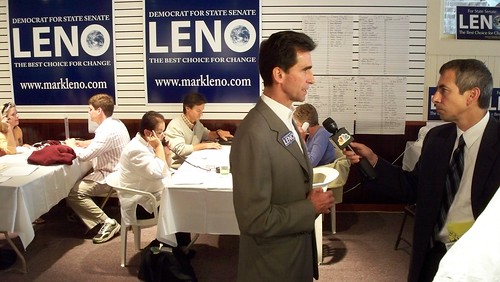
I attended a forum for the Congressional Candidates for California’s 2nd Congressional District on October 21st in the Marin Academy High School. The California Redistricting Commission redrew the map of California’s districts so Marin County (where Marin Academy is) is in the same district as Mendocino, Humboldt, Del Norte, Trinity and parts of Sonoma County including Petaluma. I testified in front of the California Redistricting Commission twice and my analysis of those meetings is here:
http://racesandredistricting.b… and
http://racesandredistricting.b…
The new district that the Commission created spans from Sausalito to Crescent City. It represents all of Marin, Mendocino, Humboldt, Trinity and Del Norte Counties. It also represents western Sonoma County, Petaluma and all of Sonoma County including and north of Windsor. The district now has a mix of affulent voters in the Marin County area with a mix of working class and extremely liberal and environmental voters in the northern part of the district. The district is heavily white and heavily Democratic.
This post though focuses on the congressional candidates for the new seat now that Lynn Woolsey (D), the current representative in Marin plans to retire. Although California has a top two primary system where all candidates run in a jungle primary and the top two vote getters face each other in a runoff, all five candidates at the forum were Democrats and many of the candidates stated, “We agree on most of the issues.” The candidates were Susan Adams (D), the President of the Marin County Board of Supervisors, Jared Huffman (D), the California State Assembly member from the 6th district representing Marin and southern Sonoma Counties, Norman Solomon (D), a progressive activist from Inverness in West Marin, Stacy Lawson (D), an entrepreneur from San Rafael and Tiffany Renee (D), a Petaluma city councilmember. Already, I noticed that none of these candidates live in the North Coast areas recently added to the district. This could create an opening for a North Coast candidate such as Wesley Chesbro (D) who is the State Assembly member there but all five Marin candidates have campaigned heavily in the North Coast which should increase their visibility there. The candidates discussed their outreach to the North Coast frequently during the forum because the North Coast has issues critical to them as a rural area that do not affect Marin which is a more suburban county. The candidates began the forum with their opening statements.
.
Jared Huffman’s main points are that he is hardworking (he passed 60 bills including those that helped state parks and oil spills,) the country needs less vitriol and he has record of overcoming political gridlock. I liked his opening statement because he stated his environmental work which will play well with the large number of pro environment voters in the 2nd district and he stated his willingness to compromise which is important in the divided house today. Norman Solomon’s opening statement including him calling himself “the grassroots candidate.” He also strongly praised Occupy Wall St. and stated “We cannot remain silent.” He also described health care as a human right. Although the 2nd district has many very liberal voters, Solomon may be running too far to the left to win. A recent poll showed him with 11% while Huffman had 16%. 46% of the voters were undecided though. Still, running to the left worked for Woolsey in 2006 when Joe Nation (D) challenged her in the primary and she won 66%-34% by running to his left. The next candidate, Stacy Lawson talked about how she grew up in a trailer in Washington State and became a successful businesswoman. After Lawson spoke, Susan Adams gave her opening statement. She stated how she wants a healthy planet with healthy communities and how she was a nurse for 33 years who supports health care for all. She ended by saying “Send a nurse to heal the house.” She will probably will try to win the woman vote, especially from Mothers by focusing on the strong communities theme. Tiffany Renee talked about how she was the first Latina elected to Petaluma’s city council, she had 20 years of experience in the community and that the United States needs to improve the nation’s infrastructure. I liked her ideas but she seemed to lack a certain charisma.
Neha Budhraja, one of the Editors in Chief of Marin Academy’s School Newspaper, the Voice asked the first question. “How will the district’s expansion change the issues you hope to work on?” Susan Adams discussed how coastal issues connected the district. “We rely on your voices,” she said. Tiffany Renee responded by talking about building consensus throughout the district and looking at natural resources. Her answer could have been more specific about which issues in particular though. Stacy Lawson explained the issues well by stating, “I went up and down the district. We need jobs. The 2nd big issue is protecting the coastline. The district was created for coastal interests. The 3rd issue is education.” Norman Solomon responded by quickly stating how all the counties are unique with common threads with a hunger for honesty like the child in the Emperor’s New Clothes who said, “The Emperor is not wearing any clothes.” Most of his answer did not fully revolve around the question though. For example, he described his article against the Bank Bailout in the Marin Independent Journal (Marin IJ.) He stated he wanted to challenge Wall Street and power does not go without a fight. Then he mentioned how 70% of his donations were $50 or less and he would not accept corporate or PAC money. It should be noted that federal candidates cannot accept corporate money, including Norman Solomon and his opponents. Norman Solomon should have focused his answer on the question instead of describing his donations or an article he wrote against the bailout because that does not answer how the new district will specifically affect the issues. Jared Huffman fully explained the issues the new districts face when he said the common elements in this district with 500 miles of coastline is protectin oceans and fisheries. Jared Huffman also listed how the League of Conservation Voters and Ocean Champions have endorsed him and he will soon announce additional endorsements. Although he mentioned his supporters like Norman Solomon did, Jared Huffman integrated them better by using them to describe his consistent reliability on environmental issues. Jared Huffman also mentioned how the North Coast has a resource based economy and how the district needs someone who understands those issues.
After the candidates answered the first question, they opened questions to the audience. The first question was, “How do you plan to work around the power of the Pentagon?” Norman Solomon answered first by stating how Wall Street was the root of the problems with the Pentagon and he had a Dr. King reference in his answer but his reference was a real stretch. Although the Wall Street issue seems very important to Norman Solomon, he should have stated his opinion on the Iraq War instead of circling back to Wall Street. I know Solomon supports a full withdrawl of troops from both Iraq and Afghanistan and I know that most of the audience members would have agreed with him. I am not sure if many of the audience members though can see the connection between the funding for the Pentagon and the corporate power referenced by Occupy Wall Street. Still, the Iraq War is not a major issue for people but the Occupy Wall Street movement is at this moment and growing every day. As for Susan Adams, she had a focused answer on the Pentagon question and she highlighted how wars affected her when she mentioned how her brother had PTSD (Post Traumatic Stress Disorder.) Jared Huffman explained how he opposed the Iraq War from the beginning. Stacy Lawson also mentioned Occupy Wall Street in her answer. Tiffany Renee mentioned how the war was a personal issue for her because she had relatives fighting in it. She did not want Operation Welcome Home to be defunded.
The next question was, “What are your proposals for deficit reduction?” Jared Huffman quickly answered by stating that the Bush tax cuts must expire. He stated his support for the American Jobs Act, proposed by President Obama, because it leads our nation on the right path by creating clean energy infrastructure and less military spending. Norman Solomon responded by saying “We need to protest Wall Street,” in order to gain tax equity. Although protesting Wall Street may not have been the best answer for a question relating to the Pentagon, Occupy Wall Street fit well with the question relating to deficit reduction. Norman Solomon made a good decision though to highlight his views on Occupy Wall Street. Jared Huffman, through his work in the State Assembly, already has established himself as the environmental candidate. Also, Huffman’s endorsements and environmental bills would make it very hard for Norman Solomon to win on the environmental issue, so discussing the extremely relevant Occupy Wall Street issue seems to work for him and increase his popularity with the district’s progressives. Stacy Lawson seems to be trying to paint herself as the jobs candidate although Norman Solomon seems to be winning the battle for the Progressive movement. Stacy’s answer to the question was that she supports the Warren Buffett plan which increases taxes on the rich. She did not highlight her opinions on Occupy Wall Street though. In order to beat Norman Solomon though and take one of the spots for the election after the top two primary, she needs to position herself as the candidate who can create jobs instead of as the candidate who dislikes the corporate power structure because voters are looking for solutions. As for Susan Adams’s response to the question, she highlighted her support for the Warren Buffett plan. “Let’s help Warren Buffett” she said. She also described how Marin County balanced its budget while she was a Supervisor and how she supported stewardship of taxpayer dollars. For example, she discussed how the state may release 40,000 prisoners because of budget problems. “In Marin, we give prisoners rehibilitation instead of jail,” she said. She then described how Marin’s recidivism rate was reduced by 85%. Tiffany Renee’s answer to the question was quick when she said that she supported Occupy Wall Street and that, “Corporations are not people. ” This was a reference to Romney’s recent statement describing corporations as people.
The next question was from an independent friend of mine who asked, “You are all liberal. How do you plan to compromise?” Adams responded first, reiterating her theme of healthy communities by stating how our country needs healthy discussions. She also discussed her experience with talking to conservatives in the Central Valley. Jared Huffman said that being bipartisan is a good idea but giving ones values away is a bad idea. He passed many bipartisan bills while in the state legislature. Stacy Lawson said that most people are favorable of tax reform and we need to look beyond ideology. People should stand for and not against something. Tiffany Renee replied by describing her politically diverse family who could always sit down together happily at family dinners. She believed Congress would not sit down together like her family at family dinners. I like how she brought the personal aspect of her life into the compromise debate. Norman Solomon though took a different stance on the compromising issue. He said, “We need to distinguish between compromise and capitulation.” He described how Civil Rights movement leaders were considered unrighteous. Then he said how they did not compromise by asking for no colored fountains on Thursdays, they asked for no colored fountains on all days. As Solomon finished his statement, he advertised his non GMO sunflower seeds in seed packets that he brought with him to the event. After this question, the event ended because of the time limit. A few of the candidates including Susan Adams, Stacy Lawson and Norman Solomon though stayed after the events. They did not have a chance to answer my questions in the forum so I wanted to have a chance to talk to them. I first talked to Stacy Lawson and I asked her about what she believes the most important issues for Marin’s youth are. She said that getting into college was an extremely important issue. As for Norman Solomon, he talked about drug issues and their importance. Susan Adams also highlighted a quality education was extremely important for youth. Even after Stacy Lawson and Norman Solomon left, Susan Adams stayed to talk to teachers and students.
Overall, this event was a fantastic way for the Marin Academy Community and me to learn about the candidates. A recent poll showed that 46% of the district’s voters are undecided so I am glad voters could see where the candidates stand. The two polls released in this race though show that Jared Huffman leads with 16% and 20% respectively. Even the poll Norman Solomon’s campaign released showed Solomon down by 5 points to Huffman. Although running to the left of all the candidates may work in the Democratic primary, California’s top two primary system may change the dynamics of the race. All candidates of all parties run in a primary and the top two vote getters face each other in the general election, even if the top two are members of the same party. This means that independents can vote for the candidates in the primary and they will probably support the most moderate candidates. The five Democrats are all liberal but Susan Adams and Stacy Lawson could make inroads with the more moderate voters. Stacy Lawson’s message of jobs will play well with voters who are unemployed while Susan Adams’s message should work with women, especially mothers with her healthy communities’ message. Overall, the candidates are successfully defining their roles. Jared Huffman is the environmental candidate, Norman Solomon is the Occupy Wall Street candidate, Stacy Lawson is the jobs candidate, Susan Adams is the health candidate and Tiffany Renee is the Latina candidate. Although the economy is rough and people want jobs, the North Coast is known for its strong commitment to the environment so I see Jared Huffman winning in the end.
[poll id=”
476
“]