
Tag Archives: Alaska

On Ruling The Arctic Frontier, Part Two, Or, There’s Stormier Weather Ahead

In order to complete today’s story we return to travelling the seas around the High Arctic…and in telling the first half of the story we were introduced to a sea captain and his parrot, we examined the destruction of a tribal village by United States Marines-and we learned that “tricing up” someone is not some kind of weird dating ritual.

The story has already raised questions of race and culture; and as we move forward it’s going to encompass whaling, an incredible rescue, and more personal trials and tribulations-not to mention the Brewery Worker’s Union-and if all that wasn’t enough, we’ll even bring in a few thousand reindeer to round the whole thing out.

So put on your caribou fur, clean up your sled runners–and let’s head north to Alaska, before the rush is on.

Those of you who were with us last time will recall that we are telling an epic tale of 19th Century Alaska…and for those of you who were not, let’s bring you up to date:

Captain Mike “Hell-Roaring” Healy, possibly the most influential man in the Arctic at the time, had risen from a Georgia plantation birth to become the commander of the most important ship in the Arctic, the Revenue Cutter Bear.

From his Aleutian base at Unalaska, his influence ran from Anchorage to Point Barrow-and even to Siberia…and within that “sphere of influence”, his word was absolutely the way it would be.

In many ways he was the United States in Alaska: his was the only (white man’s) law in a lawless Territory, he carried the mail, and he and his ship were often the first responder in emergencies.

There had been controversy, however-and when Part One of this story ended Captain Healy had just survived an investigation into his methods-and his alleged heavy drinking–while in command.

And with the catching up out of the way, let’s talk reindeer.

Despite what you might think after hearing about Captain Healy’s involvement in the destruction of that tribal village in Part One of our story, he was regarded as a man who cared deeply about life in the tribal communities.

And when American officials worried about those communities, the biggest fear was starvation.

For those not aware, most of the time, most of the interior of Alaska is geographically inaccessible, and to make things worse, what little growing season there might be is too short to allow for any real agricultural production.

That means much of what Alaska natives were eating was gathered from the sea…and since the foreign ships had come to the Arctic, those resources were getting a lot more scarce. (Much of the rest of the local diet was caribou, which is a migratory animal, which means the presence or absence of fresh meat would depend on the location of the herd.)

In the late 1800s, when the whalers had moved from the Pacific to the Arctic as the whale catches began to decline farther south, the walrus and sea lions that were quite abundant in the far north became a natural choice for harvest. At the same time, hunters had begun to work the region with rifles, which was forcing the caribou herds farther inland.

The obvious downside to this new activity was that it was becoming harder and harder for native subsistence hunters to gather enough food for their communities as these animal populations began to decline…which was something the two men who had been sent to Wales, Alaska on the Bear to establish a school had quickly noticed.

(There are those who question whether the new hunting was as serious an issue for the natives as the new educators thought it was; suggesting instead that natural forces were causing the declines in population.)

It was also well known that just a few miles across the Bering Strait, in Siberia, natives were practicing “reindeer capitalism” (the reindeer eat the omnipresent lichen, making them the perfect animal for herding in an Arctic environment).

In 1891, on board the Bear, those two men, their boss (Dr. Sheldon Jackson) and Captain Healy came up with the idea of importing Siberian reindeer to Alaska so that Alaskan natives might have a go at reindeer herding themselves. By the next year, with no official permission from Washington, they brought over the first 16 reindeer.

(It should also be noted that in addition to reducing perceived starvation, the other purpose of encouraging the local population to herd reindeer was to “civilize” the natives through assimilation with the newly arrived Americans; and developing an interest in capitalism was felt to be an effective way to advance that goal.)

By 1900 there were more than 3300 reindeer in Alaska.

The potential future? Sheldon Jackson himself wrote in 1895 that the 400,000 square miles of Alaska’s interior could support 9.2 million head of reindeer, which could employ as many as 287,500 herders.

The actual outcome? More or less 125,000 deer were processed, either for food or clothing, from the 1890s to the 1920s; and more or less 10% of those were owned by the Lomen family of Nome, Alaska.

In the 1930s, the herd grew to 650,000, but declined to as few as 25,000 in the 1950s. A renewed interest in herding began in the 1960s, and to this day there is an active reindeer industry in the State.

At the same time Healy was sailing reindeer around the Bering Sea, he was sailing himself into further trouble back home.

A variety of interest groups had been banding together to express their displeasure with Healy’s ways…including, oddly enough, the San Francisco branches of both the Brewery Worker’s Union and the Women’s Christian Temperance Union; and the problem had been building since the investigation of Healy in 1890 had cleared him of all charges.

When Healy had been accused of cruelty in that investigation, his response had been to say:

“We are empowered by Congress to suppress mutinies.  We have no right to exercise magisterial functions.  Our functions as such are exercised by policemen.  We must suppress mutinies.  A policeman does not sit in judgment on a man before he acts.  We are not allowed to hold trials . . . If a mutiny occurred at San Francisco, to quell a mutiny or disturbance we would go and arrest the man, and turn him over to the police.  But, up there, where there is no jail to bring men to, that is the last resort, to trice men up.”

And the Investigating Board, in that action, had supported him. But times were changing, and in 1895 25 officers of the various Bering Sea cutters jointly signed a new statement of charges against Healy.

The crux of the matter again revolved around his behavior while drinking; among the charges were accusations that he discovered a burial at sea occurring on board his ship without his knowledge-and that he made his entrance to the somber occasion by announcing that “Aboard this ship I am the resurrection and the life.”

In another incident Healy was accused of literally being “falling-down drunk” on duty: it was alleged that he stumbled right off the dock at Unalaska and into the water at an official social event.

This and the other alleged incidents were investigated back in Washington, DC-and this time, the Investigating Board found him guilty of various forms of bad conduct, “Tyrannous and abusive conduct to inferiors”, and “Placing a vessel in a perilous position while in an intoxicated condition, thereby endangering the lives and property under his command.”

It was recommended that he be dismissed from the Revenue Cutter Service, but the man who had the final word on the matter, Treasury Secretary John G. Carlisle, gave this order instead:

“That Captain Michael A. Healy be dropped to the foot of the list of Captains of the Revenue Service, and that he retain that place hereafter; that he be suspended from rank and command and kept on waiting orders for a term of four years. and that he be publicly reprimanded by reading this order on board all vessels of the Revenue Cutter Service, by the commanding officer of each, at a muster of the commissioned officers, and admonished that if again found guilty of the excessive use of intoxicants during the term of this sentence or thereafter, whether afloat or on shore, he will be summarily dismissed the Service.”

Just as Healy had changed the way the Service operated in Arctic regions in years past, his conviction changed the way the Service operated from that day forward. The excessive use of alcohol was now seen as an offense that demanded serious punishment; and beyond that, the very types of punishment that were allowed had themselves changed as a result of the Healy case.

In a sense, it was almost the end of the “Wild West”-in San Francisco and in Alaska-and as frontier times came to an end so did the tolerance for frontier justice.

At this point, we interrupt the tale of Captain Healy to tell a quick story about the Bear. In 1897 eight whaling ships, with 265 crew aboard, were trapped in winter ice in and around Point Barrow…and the great concern was that they would starve if no relief effort could be effectively mounted.

In November of 1897 the Bear was called upon to take up the task (despite the late date), departing from Port Townsend, Washington, and making its way to Cape Vancouver, Alaska under the command of Captain Francis Tuttle. (There had been an effort to bring Healy out of suspension for the mission, but that was not to be.)

Because of the pack ice, the ship could go no farther north, so the Captain ordered a small party to set out overland roughly 1500 miles, hugging the coast, in order to get rescue supplies to Point Barrow. Remember the reindeer? Along the way, the Overland Expedition was able to locate and purchase from local herders almost 400 head, which were used to pull sleds with supplies…and which would eventually be used for food.

It was now December 15th-which, in Alaska, means nearly 24 hours of darkness, temperatures that can easily plummet below minus 50 degrees F. (-45 C.), and an exceptionally difficult landscape…with no possibility of communications between the ship, the shore party, or those hoping to be rescued.

There were other hazards as well, as reported by Lt. E.P. Bertholf, of the shore party:

“My interpreter, a half-breed Russian, had been listening to the conversation among the natives, and he informed me he drew from their talk that they realized I was unable to obtain other means of transportation in that out-of-the-way place, and thought it was a good time to force me to increase their pay, thus showing a marked similarity to the actions of some of their more enlightened white brethren in civilization. But there was no help for it, as I was obliged to have their teams, so I was forced to listen to their demands.”

The shore party travelled along the coast for about 100 days, finally reaching Point Barrow on March 26, 1898. The Bear reached the same point July 28 of that year, and by August the crews (having suffered no fatalities) were on their way out of the Chukchi Sea and heading south.

At the end of his suspension in 1900 Healy returned to command aboard the Revenue Cutter McCulloch, which had fought in the Battle of Manila Bay-but a series of personal tragedies fell upon him, including the order to turn over command of the ship, leave the Arctic, and assume command of the Revenue Cutter Seminole, out of Boston. In the course of returning to Seattle in July of that year he apparently experienced a psychotic episode that caused junior officers aboard the ship to physically restrain him in his cabin. It is reported that at one point he attempted to cut his wrists with the crystal of his own watch.

Healy was treated at Port Townsend…and, amazingly, in 1902 his case was reviewed; and as a result of that review he was returned to command aboard the Revenue Cutter Thetis. He was able to complete cruises to Alaska in 1902 and 1903, after which he finally retired. He died in San Francisco, August 30, 1904, of a heart attack.
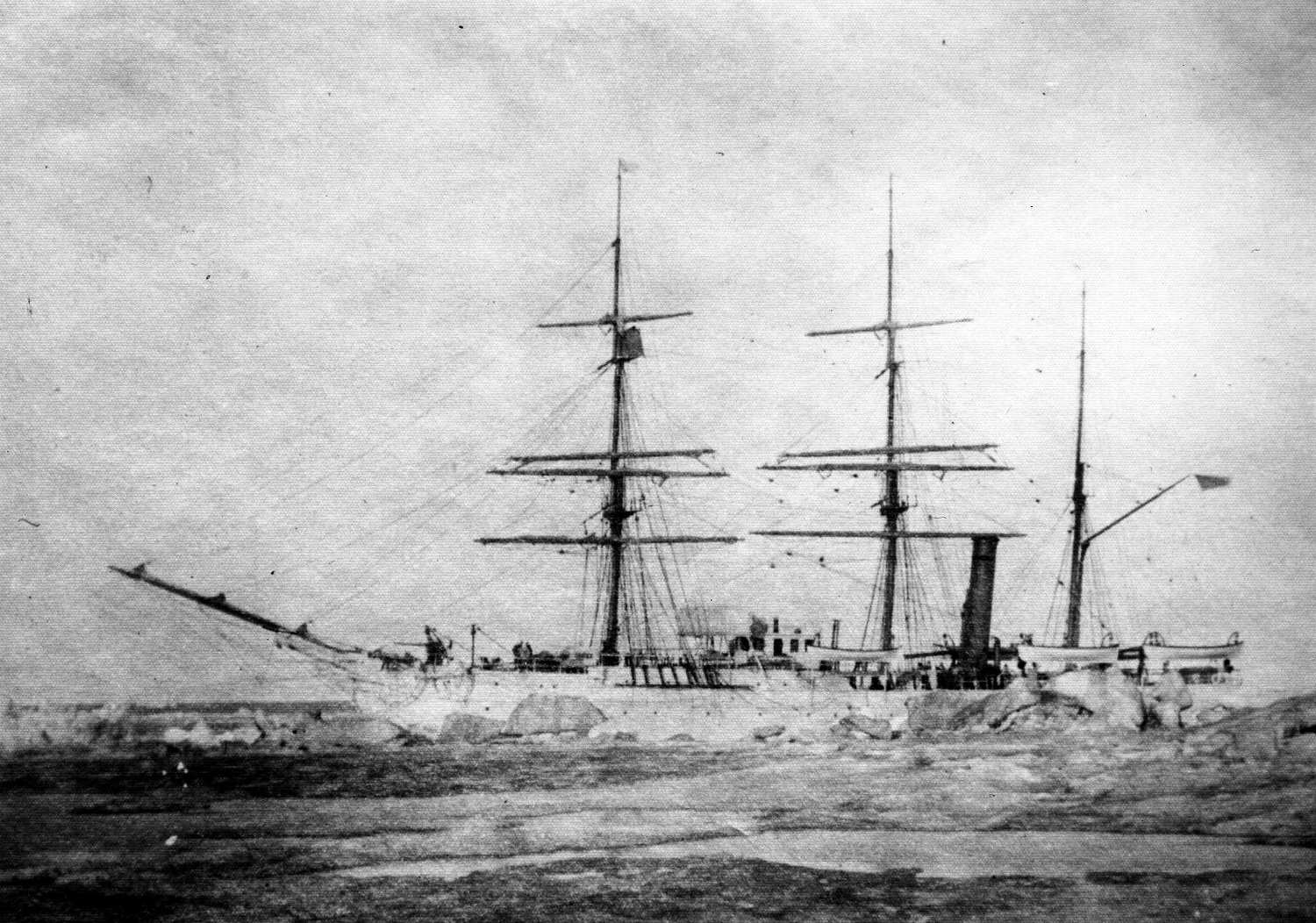
(A few words on the death of the Bear are in order at this point. The ship, as we mentioned, survived to be the flagship of Admiral Byrd’s Antarctic expeditions in the 1930s-and astonishingly enough, it even served in World War II on patrol in Greenland waters. In 1962, it had been renovated to become a restaurant and museum in Philadelphia, but it sank in waters off Boston as it was being towed there…proving that even a ship would “rather be here than in Philadelphia“.)

Way back at the beginning of Part One I promised you a surprise ending that would make this story of Arctic history relevant to today’s times…so here it is:

Captain Mike Healy was born a slave.

His father, an Irish immigrant, had chosen to live with a woman who had been born a slave, and under the Georgia law in force at the time, not only would Mike and all her other children automatically be classified as slaves, their father was prohibited from freeing them.

That’s why they were sent to Boston for their education.

It is reported that the 10 children had varying skin tones, which meant James, who was darker, could not “pass” as white…but Mike could-and apparently he successfully did.

He is today regarded as the first black commanding officer of a United States ship-although there are some who might consider a discussion of the “one-drop rule” to be appropriate before offering the good Captain that distinction.

I promised to answer one other question as well: how did this story never become a movie?

Dr. John Murphy provides that answer in his “Portrait of Captain Michael A. Healy”:

“In the late 1930s representatives of the film industry, planning to make a film on the life of the noted captain, wired to Healy’s daughter-in-law their wish to examine his four-volume diary.  When they arrived it was in ashes.  Apparently the daughter-in-law, reading the diary for the first time, learned that her husband’s grandmother had been a slave.”

So that’s the epic tale: born a slave in Georgia, but also born to the Arctic, Captain Mike Healy saved lives, changed the Revenue Cutter Service’s way of doing business-twice-and remains a controversial figure to this day, even as the ships that represent his name and his most famous command continue to ply the seas.

And now, as Paul Harvey would have said: you know the rest…of the story.

[poll id=”

269

“]

On Ruling The Arctic Frontier, Or, Polly Want A Reindeer?

We have an epic tale of history to tell today, and it has everything you’d want in your standard-issue epic tale: the vast expanse of ocean, exploration on the shores of an unknown land, questions of race and slavery and opportunity and torture…and in the center of it all, a real larger-than-life sea captain (and his parrot) who some say was more powerful in Alaska than the Territorial Governor and Circuit Judges who were his frequent shipboard guests.

Such was his influence on the Revenue Cutter Service (later to become the United States Coast Guard) that two Coast Guard Cutters operating today are named with him in mind: the USCGC Bear, named after the most famous ship our sea captain commanded, and the USCGC Healy, the newest icebreaker in the Coast Guard’s fleet.

And with that, Gentle Reader, allow me to introduce you to Captain Mike “Hell-Roaring” Healy-and the Arctic which was his domain.

“Captain Mike Healy is a good deal more distinguished person in the waters of the far Northwest than any president of the United States or any potentate of Europe has become.  He stands for law and order in many thousand square miles of land and water, and if you should ask in the Arctic Sea, “Who is the greatest man in America?” the instant answer would be, “Why, Mike Healy.”  When an innocent citizen of the Atlantic coast once asked on the Pacific who Mike Healy was, the answer came, “Why, he’s the United States. He holds in these parts a power of attorney for the whole country.”

—“The New York Sun“, January 28, 1894

Mike Healy, oddly enough, was born on a Georgia plantation in 1839. His father sent him (and his nine brothers and sisters, as they came to age) to Boston for their educations. Fate found them among the very first enrollees of Holy Cross College. Several of his brothers and sisters became notable persons in America’s Catholic history (one became a Bishop, one a Rector, three sisters became nuns, and his brother Patrick became President of Georgetown University during the 1870s and early 1880s), but such a path was not to be Mike’s.

He ran away from several academic placements in the United States and in Europe, eventually finding himself (at age 15) serving as a cabin boy on the clipper Jumna out of London (which he reports his parents helped to arrange, although this is disputed). In less than 10 years he had risen through the ranks to “…have been three times second officer and once first officer of a brig…”, as he wrote in his 1863 application for a commission in the Revenue Cutter Service. Two of his brothers were now in a position to offer influential assistance, and by January 1865 he found himself a Third Lieutenant of the Service.

By 1868 he had been dispatched to his first Alaska assignment, and by 1877 he was in command of his first ship, the Revenue Cutter Chandler. In 1880 he began one of the first of the two most significant commands of his career aboard the Revenue Cutter Thomas Corwin.

At this point we need to step back and talk about exactly what it meant to be in command of a revenue cutter in late 19th Century Alaska…and to do that, we need to start with a bit of geography.

The Aleutian Islands form an arc roughly 1500 miles long from roughly Anchorage to roughly Vladivostok, separating the Pacific Ocean from the Bering Sea. North of that is the site of the “land bridge” that once connected North America and Asia (near what is Wales, Alaska today), and north of that are the Chukchi and Beaufort Seas. Unalaska is a city located about halfway down the Aleutian chain, and Point Barrow is the northernmost point in the United States.

Within that space the revenue cutter commanders were the most visible official symbols of the United States. They were responsible for preventing smuggling, enforcing the laws among the whaling and sealing fleets and against liquor smuggling and distilling, and rescuing the various explorers, miners, traders, mappers, and other sailors that required their assistance.

Their responsibility also extended to maintaining positive relations with “the natives“-or putting down disquiet by force when relations weren’t so positive. Beyond that, before there were sheriffs and courts and jails the cutter commanders were the law on land as well. They also provided the visible face of the United States at public ceremonies.

The revenue cutters would transport the Territorial Governor on inspection tours, as well as the Circuit Judges who would occasionally visit the region (not to mention the mail), they would provide medical services to anyone they came across who might be in need; and they would often return to bases at Port Townsend, Washington or San Francisco bearing prisoners, or those that had been rescued-or both.

To survive in this environment, with that mission, requires an individual who can not only manage the administrative and diplomatic requirements of the job, but also a leader who can command the respect of a crew of fairly tough sailors…and Healy was more than up for the task.

It is reported that over the next decade his expertise in seamanship and Arctic operations grew to the point where he was involved in not just captaining a ship, but helping to design the ships that were subsequently built for Arctic service-and the way operations were conducted on board those ships.

Although much of the “Wild West” was becoming a lot more civilized than had been the case even 20 years before, in 1880 Alaska was still very much an untamed frontier territory. This meant that “frontier justice” was often the rule, and the ship’s Captain would often be required to take action.

In October of 1882 a whaling party near Angoon, Alaska experienced an accidental explosion of a “whale bomb”, killing a tribal shaman who was employed by the trading company conducting the whaling. Following the custom of the time, the two white members of the whaling party were taken hostage, along with the company’s equipment, and a demand was made for compensation (due to the importance of the decedent, the demand was for 200 blankets).

(A quick word on tribal traditions: it is likely that the large number of blankets were related to the Potlatch custom. In an interesting form of reverse capitalism practiced throughout the Pacific Northwest at the time, status is bestowed by an individual’s ability to give lavish gifts; and blankets might be turned into “button blankets“, which are worn at feasts and other ceremonial occasions.)

The Collector of Customs and the Commander of a US Navy ship, the Adams, responded by sending a force of Marines on a steamer owned by the Company, and coming in person aboard Healy’s ship the Corwin (the Adams being too large to navigate the waterways close to the village).

As soon as both vessels had arrived on the scene, the hostages and property were recovered. Healy’s report on the events describes what happened next:

“…as a punishment and as a guarantee for future good behavior, Captain Merriman [the Naval Captain] demanded twice the number of blankets demanded by the Indians, and threatened, in case of refusal, to destroy their canoes and villages. Refusing to pay the amount and remaining defiant, their canoes, to the number of forty, were taken and destroyed, after having selected those which belonged to the Indians who had remained friendly to the white men. Remaining unsubdued, their summer camp at this place was burned. Weighing anchor we steamed out of the lagoon, and at two o’clock hove to off the village of Hootsnoo and proceeded to shell the town. After shelling the village the marines were landed under cover of the guns, and they, setting fire to the houses, destroyed the entire village, with the exception of the friendly Indians.”

Although there was a considerable outcry over the events of that day, it did not prevent Lieutenant Healy from becoming Captain Healy the next year.

The most famous ship in early Arctic history is undoubtedly the Revenue Cutter Bear. The ship’s first work was in the sealing trade and after it was rebuilt for the US Government as a rescue vessel, it helped recover the few survivors of the Greely Expedition. In 1886, after modifications, Captain Healy took command and it became the flagship of the Bering Sea Force. (Fun Fact: the Bear, beginning in 1933, also became Admiral Byrd’s command ship on his Antarctic missions.)

In 1890, more controversy over Healy’s “frontier justice” form of dealing with problems and his hard-drinking ways came in the form of an investigation of charges of “cruelty and intoxication”. The long and the short of the thing is that certain sailors of the merchant ship Estrella acted in a manner that, on the scene, was felt to be mutinous. Captain Healy, as the only law enforcement official available, was called upon to punish the offenders.

“…The three sailors were then taken on board the Bear and triced up. The master at arms of the Bear, who performed this interesting ceremony, explained his method on the stand. The arms of the sailors were bent behind their backs, with their hands manacled together. Ropes were then fastened to the handcuffs, passed through ring bolts overhead, and hauled up. Master at Arms Hughes testified that after he had hauled the men up as high as he thought they ought to go, Lieut. Buhner ordered him to trice them up higher. They were then hoisted up so high that their toes barely touched the deck and they could be spun around like tops.

After remaining in this position five to seven minutes each, suffering intense agony, they were taken down and seated with their backs against stanchions, around which their arms were stretched and fettered behind. They were kept in this position for four hours, and then triced up again, after which Commander Healy seems to have thought their crimes sufficiently punished…”

—“The New York Times“, March 12, 1890

Healy was exonerated of all charges. The Investigating Board placed no credence in the charge of drunkenness, and they felt:

“…that there were no courts or peace officers within reach, and that, therefore, the punishment of the crew as a last resort to suppress the mutiny was justifiable.”

—“The New York Times“, April 5, 1890

I have had to apologize on too many occasions for stories that are too long, so let’s take a break here and finish up in Part Two…but before we do, let’s recap where we’ve been.

Alaska in the second half of the 19th Century was all the frontier anybody could want, Captain Mike Healy had risen from a Georgia plantation background to become perhaps the most recognized man in the Arctic, commanding one of the Nation’s most historically renowned ships…and while he was enjoying his successes, there had already been questions about his methods-and his drinking.

In Part Two we tell the story of an amazing overland rescue, we learn about international reindeer transplantation, we examine Healy’s troubled life and times-and just as if we were Paul Harvey, we end with a “rest of the story” that makes everything you’ve heard so far become an even more unlikely narrative…and one that will end with a controversy unresolved to this day.

It’s an epic tale indeed-and for those of you who wonder “why hasn’t anyone ever made a movie out of this story?”…well, we’ll answer that question too.

[poll id=”

268

“]

On Ruling The Arctic Frontier, Or, Polly Want A Reindeer?

We have an epic tale of history to tell today, and it has everything you’d want in your standard-issue epic tale: the vast expanse of ocean, exploration on the shores of an unknown land, questions of race and slavery and opportunity and torture…and in the center of it all, a real larger-than-life sea captain (and his parrot) who some say was more powerful in Alaska than the Territorial Governor and Circuit Judges who were his frequent shipboard guests.

Such was his influence on the Revenue Cutter Service (later to become the United States Coast Guard) that two Coast Guard Cutters operating today are named with him in mind: the USCGC Bear, named after the most famous ship our sea captain commanded, and the USCGC Healy, the newest icebreaker in the Coast Guard’s fleet.

And with that, Gentle Reader, allow me to introduce you to Captain Mike “Hell-Roaring” Healy-and the Arctic which was his domain.

“Captain Mike Healy is a good deal more distinguished person in the waters of the far Northwest than any president of the United States or any potentate of Europe has become.  He stands for law and order in many thousand square miles of land and water, and if you should ask in the Arctic Sea, “Who is the greatest man in America?” the instant answer would be, “Why, Mike Healy.”  When an innocent citizen of the Atlantic coast once asked on the Pacific who Mike Healy was, the answer came, “Why, he’s the United States. He holds in these parts a power of attorney for the whole country.”

—“The New York Sun“, January 28, 1894

Mike Healy, oddly enough, was born on a Georgia plantation in 1839. His father sent him (and his nine brothers and sisters, as they came to age) to Boston for their educations. Fate found them among the very first enrollees of Holy Cross College. Several of his brothers and sisters became notable persons in America’s Catholic history (one became a Bishop, one a Rector, three sisters became nuns, and his brother Patrick became President of Georgetown University during the 1870s and early 1880s), but such a path was not to be Mike’s.

He ran away from several academic placements in the United States and in Europe, eventually finding himself (at age 15) serving as a cabin boy on the clipper Jumna out of London (which he reports his parents helped to arrange, although this is disputed). In less than 10 years he had risen through the ranks to “…have been three times second officer and once first officer of a brig…”, as he wrote in his 1863 application for a commission in the Revenue Cutter Service. Two of his brothers were now in a position to offer influential assistance, and by January 1865 he found himself a Third Lieutenant of the Service.

By 1868 he had been dispatched to his first Alaska assignment, and by 1877 he was in command of his first ship, the Revenue Cutter Chandler. In 1880 he began one of the first of the two most significant commands of his career aboard the Revenue Cutter Thomas Corwin.

At this point we need to step back and talk about exactly what it meant to be in command of a revenue cutter in late 19th Century Alaska…and to do that, we need to start with a bit of geography.

The Aleutian Islands form an arc roughly 1500 miles long from roughly Anchorage to roughly Vladivostok, separating the Pacific Ocean from the Bering Sea. North of that is the site of the “land bridge” that once connected North America and Asia (near what is Wales, Alaska today), and north of that are the Chukchi and Beaufort Seas. Unalaska is a city located about halfway down the Aleutian chain, and Point Barrow is the northernmost point in the United States.

Within that space the revenue cutter commanders were the most visible official symbols of the United States. They were responsible for preventing smuggling, enforcing the laws among the whaling and sealing fleets and against liquor smuggling and distilling, and rescuing the various explorers, miners, traders, mappers, and other sailors that required their assistance.

Their responsibility also extended to maintaining positive relations with “the natives“-or putting down disquiet by force when relations weren’t so positive. Beyond that, before there were sheriffs and courts and jails the cutter commanders were the law on land as well. They also provided the visible face of the United States at public ceremonies.

The revenue cutters would transport the Territorial Governor on inspection tours, as well as the Circuit Judges who would occasionally visit the region (not to mention the mail), they would provide medical services to anyone they came across who might be in need; and they would often return to bases at Port Townsend, Washington or San Francisco bearing prisoners, or those that had been rescued-or both.

To survive in this environment, with that mission, requires an individual who can not only manage the administrative and diplomatic requirements of the job, but also a leader who can command the respect of a crew of fairly tough sailors…and Healy was more than up for the task.

It is reported that over the next decade his expertise in seamanship and Arctic operations grew to the point where he was involved in not just captaining a ship, but helping to design the ships that were subsequently built for Arctic service-and the way operations were conducted on board those ships.

Although much of the “Wild West” was becoming a lot more civilized than had been the case even 20 years before, in 1880 Alaska was still very much an untamed frontier territory. This meant that “frontier justice” was often the rule, and the ship’s Captain would often be required to take action.

In October of 1882 a whaling party near Angoon, Alaska experienced an accidental explosion of a “whale bomb”, killing a tribal shaman who was employed by the trading company conducting the whaling. Following the custom of the time, the two white members of the whaling party were taken hostage, along with the company’s equipment, and a demand was made for compensation (due to the importance of the decedent, the demand was for 200 blankets).

(A quick word on tribal traditions: it is likely that the large number of blankets were related to the Potlatch custom. In an interesting form of reverse capitalism practiced throughout the Pacific Northwest at the time, status is bestowed by an individual’s ability to give lavish gifts; and blankets might be turned into “button blankets“, which are worn at feasts and other ceremonial occasions.)

The Collector of Customs and the Commander of a US Navy ship, the Adams, responded by sending a force of Marines on a steamer owned by the Company, and coming in person aboard Healy’s ship the Corwin (the Adams being too large to navigate the waterways close to the village).

As soon as both vessels had arrived on the scene, the hostages and property were recovered. Healy’s report on the events describes what happened next:

“…as a punishment and as a guarantee for future good behavior, Captain Merriman [the Naval Captain] demanded twice the number of blankets demanded by the Indians, and threatened, in case of refusal, to destroy their canoes and villages. Refusing to pay the amount and remaining defiant, their canoes, to the number of forty, were taken and destroyed, after having selected those which belonged to the Indians who had remained friendly to the white men. Remaining unsubdued, their summer camp at this place was burned. Weighing anchor we steamed out of the lagoon, and at two o’clock hove to off the village of Hootsnoo and proceeded to shell the town. After shelling the village the marines were landed under cover of the guns, and they, setting fire to the houses, destroyed the entire village, with the exception of the friendly Indians.”

Although there was a considerable outcry over the events of that day, it did not prevent Lieutenant Healy from becoming Captain Healy the next year.

The most famous ship in early Arctic history is undoubtedly the Revenue Cutter Bear. The ship’s first work was in the sealing trade and after it was rebuilt for the US Government as a rescue vessel, it helped recover the few survivors of the Greely Expedition. In 1886, after modifications, Captain Healy took command and it became the flagship of the Bering Sea Force. (Fun Fact: the Bear, beginning in 1933, also became Admiral Byrd’s command ship on his Antarctic missions.)

In 1890, more controversy over Healy’s “frontier justice” form of dealing with problems and his hard-drinking ways came in the form of an investigation of charges of “cruelty and intoxication”. The long and the short of the thing is that certain sailors of the merchant ship Estrella acted in a manner that, on the scene, was felt to be mutinous. Captain Healy, as the only law enforcement official available, was called upon to punish the offenders.

“…The three sailors were then taken on board the Bear and triced up. The master at arms of the Bear, who performed this interesting ceremony, explained his method on the stand. The arms of the sailors were bent behind their backs, with their hands manacled together. Ropes were then fastened to the handcuffs, passed through ring bolts overhead, and hauled up. Master at Arms Hughes testified that after he had hauled the men up as high as he thought they ought to go, Lieut. Buhner ordered him to trice them up higher. They were then hoisted up so high that their toes barely touched the deck and they could be spun around like tops.

After remaining in this position five to seven minutes each, suffering intense agony, they were taken down and seated with their backs against stanchions, around which their arms were stretched and fettered behind. They were kept in this position for four hours, and then triced up again, after which Commander Healy seems to have thought their crimes sufficiently punished…”

—“The New York Times“, March 12, 1890

Healy was exonerated of all charges. The Investigating Board placed no credence in the charge of drunkenness, and they felt:

“…that there were no courts or peace officers within reach, and that, therefore, the punishment of the crew as a last resort to suppress the mutiny was justifiable.”

—“The New York Times“, April 5, 1890

I have had to apologize on too many occasions for stories that are too long, so let’s take a break here and finish up in Part Two…but before we do, let’s recap where we’ve been.

Alaska in the second half of the 19th Century was all the frontier anybody could want, Captain Mike Healy had risen from a Georgia plantation background to become perhaps the most recognized man in the Arctic, commanding one of the Nation’s most historically renowned ships…and while he was enjoying his successes, there had already been questions about his methods-and his drinking.

In Part Two we tell the story of an amazing overland rescue, we learn about international reindeer transplantation, we examine Healy’s troubled life and times-and just as if we were Paul Harvey, we end with a “rest of the story” that makes everything you’ve heard so far become an even more unlikely narrative…and one that will end with a controversy unresolved to this day.

It’s an epic tale indeed-and for those of you who wonder “why hasn’t anyone ever made a movie out of this story?”…well, we’ll answer that question too.

[poll id=”

267

“]

Alaska Congressional Candidate Ethan Berkowitz Coming to LA for Fundraiser, to Dish on Palin

(Sounds like fun! – promoted by Brian Leubitz)

4 Star Democratic Club, Dems for Israel, bloggers such as Dante Atkins (Hekebolos), Todd Beeton and California’s new Democratic National Committeeman Andrew Lachman have come together to organize a grassroots fundraiser for Alaska’s Democratic Congressional nominee Ethan Berkowitz in Los Angeles on Friday, September 19th at 6:30pm at 3077 Earlmar Ave., Los Angeles 90064.  You can RSVP via Act Blue, on Facebook or by calling Anna at (907)947-1628.

Berkowitz, a San Francisco native, worked as a fisherman, Alaska state prosecutor, and minority leader of the Alaska House of Representatives.  The Alaksa At-Large House race is part of the “Red to Blue” program of the most watched races in the country as his opponent, Representative Don Young, barely survived the Republican primary, winning by less than 300 votes.  Young is also under investigation by the FBI for his dealings with the same oil company involved in the indictment of Alaska’s Senator Ted Stevens.  

While Steven’s opponent, Anchorage Mayor Mark Begich is in a very close race, Berkowitz has pulled ahead to a 14 point lead in the recent Anchorage Press/Ivan Moore poll.  This looks like it could be a Democratic pickup.  Also, Berkowitz has debated Sarah Palin before, so he should have some great stories!