
Tag Archives: h1n1

Momentum Grows for Paid Sick Days in California

By Mariana Huerta & Cathy Dang

Restaurant Opportunities Center of Los Angeles

What did you do for Valentine’s Day?  On the most romantic day of the year and the highest grossing day for restaurants, chances are that you dined at a new or favorite restaurant. Chances are also high that the people who prepared, cooked, and served your food lack a basic workplace protection that makes restaurants healthy for workers and diners: Paid Sick Days.

Depending on what your job is, you might take for granted the fact that you can take off from work and still get paid if you are sick. But a report just released by Restaurant Opportunities Center (ROC) in Los Angeles shows that 89.4% of restaurant workers in the city do not have paid sick days and 58.3% have gone to work while sick. Workers reported they could not take time off when sick, either because they would be penalized or because they couldn’t afford to lose pay. One worker reported having to work cooking food while sick with the H1N1 virus, because he could not afford to take a day off.

We are pretty sure the flu isn’t something you want coming out of the kitchen when you go to a restaurant.

It’s just common sense that sick workers should stay home. Both workers and customers benefit.  Yet some businesses and their lobbyists claim that basic workplace policies like paid sick days would be “job killers.”  Last week a study released by the independent, nonpartisan Institute for Women’s Policy Research (IWPR) provided clear evidence those claims are false.  San Francisco has had a citywide paid sick days policy since 2007. IWPR’s report showed that two-thirds of employers are supportive of the policy and six out of seven reported the law had no negative effect on profitability.

Diners across the country have shown an increasing interest in sustainable food, including locally grown, organic and healthy cuisine.  But food will never be truly sustainable as long as it is prepared, cooked and served by workers who feel forced to work while sick because they fear losing their job or missing a paycheck.  This Valentine’s Day, Assembly member Fiona Ma introduced AB400 to guarantee all California workers the right to paid sick days – a long overdue policy that benefits both workers and businesses.

Read ROC’s Los Angeles report, Behind the Kitchen Door: Inequality and

Opportunity in Los Angeles, the Nation’s Largest Restaurant Industry
:

http://www.rocunited.org/files…

To learn more about IWPR’s study, San Francisco’s Paid Sick Leave Ordinance:

Outcomes for Employers and Employees
, visit http://www.iwpr.org/publicatio…
San Fran H1N1 Vaccination News

My doctor can give me the vaccination for the H1N1 swine flu virus if I want to wait until November eleventh.  Which I don’t, really.

Especially since the San Francisco Department of Public Health announced this week that our public health clinics would begin limited hours Thursday, Friday and Saturday with free H1N1 vaccinations.  My doctor’s office hasn’t decided whether to charge an administrative fee of $17 or my health plan co-pay of $15.  Either way, free and sooner sounds better, right?

So — I headed over to the Castro-Mission Health Center on 17th street at 3pm, thinking I’d be near the head of the line when they started vaccinating people at 4pm.  

I arrived shortly after 3pm; there were about 100 people in line, around the clinic building, down the short 17th Street block and ready to curl around onto Prosper.  With just three hours planned, more than thirty people an hour needed to get vaccinated in order to get through the folks in line already.  That’s more than one person every two minutes — and they weren’t starting for another forty-five minutes!

I’m going to try again tomorrow.  Moral of the story? Call your doctor if you want a guaranteed vaccination; I’m keeping my appointment, and if you want a shot, you probably should get your doctor to slot you in.  Check with your doctor or check your city’s .gov website and search “flu shots.”

Here’s the San Francisco schedule, for those of you who are at risk for H1N1 and want to try to get vaccinated at a public health clinic tomorrow or Saturday:

When:

Thursday and Friday

4 pm – 7 pm

Saturday

8 am – 12 pm (noon)

Where:

   * Castro Mission Health Center – 3850 17th St

   * Maxine Hall Health Center – 1301 Pierce St

   * Ocean Park Health Center – 1351 24th Ave

   * Potrero Hill Health Center – 1050 Wisconsin St

   * Silver Avenue Family Health Center – 1525 Silver Ave

   * Southeast Health Center – 2401 Keith St

   * Mission Neighborhood Health Center – 240 Shotwell

   * North East Medical Services – 1520 Stockton

   * St. Anthony’s Free Medical Clinic – 150 Golden Gate Ave


More info at the link.

Cross-posted at FireDogLake Seminal.

[poll id=”

323

“]

Nurses Demand Stronger Swine Flu Safety Protections

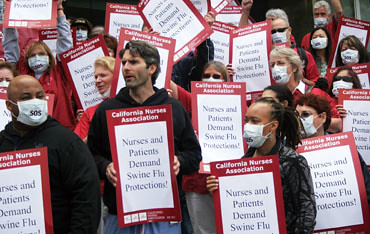
Aug. 5 — More than a hundred CNA/NNOC registered nurses rallied on the steps of the University of California San Francisco Medical Center today with a simple message for the public: California and the nation’s hospitals are not prepared to handle the H1N1 influenza, known as swine flu, when it hits the country full force this fall, and frontline registered nurses, other healthcare workers, patients, and the public are all in serious jeopardy.

090805_UCSF_SwineFlu_5500-w

The rally came on the heels of several major swine flu events alarming to registered nurses. Last week, Sacramento registered nurse Karen Hays became the first healthcare worker to die of the virus. She had been a fit, 51-year-old athlete, and her family suspects she was exposed while at work. Also last week, a registered nurse at UCSF claims she was not informed a patient she was treating had swine flu, then was fired for speaking up about swine flu after she began exhibiting symptoms. Last month, registered nurses at Sutter Solano Medical Center filed a complaint with Cal-OSHA about the hospital’s failure to provide and fit them with proper N-95 respiratory masks though RNs are caring for swine flu patients.

“The hospitals in California don’t have plans, they don’t know what they’re doing,” said Jill Furillo, RN and CNA/NNOC’s Southern California director.

Preliminary surveys by CNA/NNOC and interviews with RNs reveal that hospitals lack consistent policies to deal with swine flu, and even if they do have policies, employees are not educated about following them or provided and fitted with the proper equipment, such as N-95 masks, to do so.

At UCSF, Erin Carrera, a recovery room RN, said that coworkers are having trouble finding masks when they need them. Also, RNs are not always explicitly informed about a patient who likely has swine flu. “When patients are coming up from the emergency department, there are certain symptoms that should automatically trigger they be put in isolation,” said Carrera. “But that’s not happening.”

James Darby, RN and chief nurse representative at UCSF, said it was appalling that hospitals are actually punishing RNs who are speaking up about being inadequately prepared. “If you complain, if you speak out, if you speak up about adequate materials that we need to take care of our patients, if you speak up about more staffing to take care of our patients, UC’s message is that they will retaliate,” said Darby at the lunchtime rally. “My message to UC is that you may retaliate, but the nurses will not stop advocating for our patients.”

View more photos