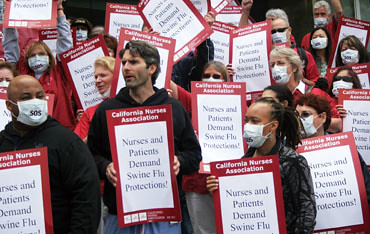
We are going to be talking a lot about swine flu over the next few weeks.
The conversation about the politics of the thing is already well underway, engulfing those who sought to remove funding for infectious disease control out of the “stimulus” bill.
We are lacking, however, an examination of the science of the thing, and that’s the point of today’s conversation.
How dangerous is this infection?
Why is it killing people in Mexico but not here?
Exactly what is a pandemic?
Do those facemasks really serve any purpose?
And what about closing the border?
They’re all good questions; and they are all questions we’ll try to answer today.
“I’ve always been a hypochondriac.
As a little boy, I’d eat my M & M’s one by one with a glass of water.”
—Richard Lewis
Why don’t we define a pandemic first, then move on to the “what we knows”?
A pandemic is a global event characterized by the emergence of a new virus that readily spreads from human to human. When humans are exposed to new viruses, the lack of previously developed antibodies means we lack biological defenses, making new viruses the most dangerous to human health.
(Vaccines are designed to safely expose humans to diseases. The body makes antibodies based on that exposure, making it better prepared for the next exposure.)
So here’s what we know: a swine flu outbreak that seems to have begun in Mexico has claimed more than 150 lives and sent more than 2000 to the hospital in that country as of Tuesday morning.
As of Wednesday, there are 91 laboratory-confirmed cases of swine flu in the United States, with 81 of them occurring in New York, California, and Texas. There has been one confirmed death in the US as of Wednesday, a child who had come to the US from Mexico to be treated for this infection.
In an ordinary year, the CDC reports, about 36,000 people die from influenza in the United States (during the 1990s, the number varied from 17,000 to 52,000).
There are a smaller number of infected individuals in numerous other countries.
The World Health Organization had, early this week, declared a Phase 4 alert, meaning that we have:
“…verified human-to-human transmission of an animal or human-animal influenza…virus able to cause “community-level outbreaks.” The ability to cause sustained disease outbreaks in a community marks a significant upwards shift in the risk for a pandemic…Phase 4 indicates a significant increase in risk of a pandemic but does not necessarily mean that a pandemic is a forgone conclusion.”
As of Wednesday that has been raised to a Phase 5 alert, which:
“…is characterized by human-to-human spread of the virus into at least two countries in one WHO region. While most countries will not be affected at this stage, the declaration of Phase 5 is a strong signal that a pandemic is imminent and that the time to finalize the organization, communication, and implementation of the planned mitigation measures is short.”
We also have suspicions about a number of things.
We suspect that a pig farm near La Gloria, Mexico was the source of the outbreak.
We suspect (with very high confidence) that the number of confirmed infections will grow substantially as labs are able to complete the testing that changes probable and suspected cases to confirmed ones.
We suspect there will be additional deaths in the United States from this infection beyond the one that has already been confirmed.
Because at least 45 of the confirmed cases in the US are associated with a group of spring breakers just back from Cancún, we are suspicious that they might be the group responsible for introducing the virus into the country….however…the CDC reports that cases were first seen in San Antonio, Texas, and in Southern California in late March and early April.
Because the health authorities in Mexico might not have been tracking minor infections, it is suspected that the very high death rate currently associated with this infection in that country is overstated.
There is, as you might imagine, an entire list of things we cannot as yet explain.
The question of why young and presumably healthy Mexicans are dying at an alarming rate while citizens of other countries are not is first on that list. There are several possible explanations besides the potential statistical problems we note above, and one of those is the question of air quality in Mexico City.
The amazing level of air pollution in Mexico’s capitol city has created a childhood asthma problem of such long standing that it has now also become an adult asthma problem. It is known that people with compromised respiratory systems are predisposed to become victims of opportunistic respiratory infections, lending credence to this supposition.
It is possible that nutritionally compromised individuals in Mexico are becoming targets for more severe infections than individuals in the US who are getting sick but have more robust overall health due to better nutrition.
There is confusion due to an inability to accurately track the infection in Mexico. It is possible that new infections are still occurring, that the virus is in regression, that it is has mutated in new ways, or that another, as yet unidentified virus is now circulating; but due to a lack of reliable information it is impossible to tell which, if any, of these events are actually taking place.
The US public health authorities seem to be better able to respond to this health event than Mexican authorities have been. For example, there are reports, confirmed by Mexican Health Secretary Jose Angel Cordoba, that people who had close contact with individuals who have died from swine flu have not had access to medical or epidemiological follow-up…or access to antiviral drugs.
There have been questions as to whether border screening should be intensified to prevent infected persons entering from Mexico. In testimony before Congress Tuesday it was pointed out to Senator Kay Bailey Hutchison that infected persons might not show any symptoms while crossing the border, rendering such screening techniques as temperature monitoring ineffective.
Now let’s talk about this virus.
Dr. Anthony Fauci, in the same hearing room, gave us a lot to worry about. He points out that this is an almost unique virus, in that it has, within its structure, genes from bird, pig, and human influenza viruses (the process of these genes combining themselves in new ways is called “reassortment”); and seeing a “triple reassortment” is highly unusual.
The H1N1 virus that is the basis of this new virus is inherently capable of human-to-human transmission, he tells us, which is particularly problematic.
We will talk about what drugs might be effective in a moment…but first, a word or two on uncertainty.
There is no way to know if the virus we are dealing with today will mutate into new forms, nor can we predict if the virus will become relatively more dangerous if and when new populations are exposed. (It is also possible that the virus might mutate into a less harmful form).
We have no way to predict whether this virus will return, even stronger, in the fall, which would not be uncommon.
We cannot predict what other influenza viruses might appear, or if the two other currently circulating “seasonal” viruses might mutate in ways that cause greater concern.
We cannot predict the potential for further reassortment caused by the current seasonal flu viruses that had been circulating before the emergence of swine flu interacting with this new virus.
We cannot predict where the virus (and its antecedents) will crop up.
We cannot say for certain that the virus will not develop resistance to currently effective antiviral drugs.
These are problems associated with influenza management every flu season, and they are not particular to this virus.
“Excessive calm…may be a symptom of swine flu.”
—Stephen Colbert
Because things can change on literally a day-by-day basis, some of our comments on drugs will be correct as of today, but not necessarily correct in the future.
There are four antiviral drugs available, and two of them are rather ineffective in dealing with certain strains of influenza due to the fact that those strains have developed resistance to those drugs.
That leaves two useful drugs, Tamiflu and Relenza.
When deciding what drug to prescribe for someone who shows up at the doctor’s office, the doctor needs to have an idea what kind of flu you have. If you show up with swine flu, today, a doctor might be inclined to offer you Tamiflu…but if you showed up with an infection caused by the “seasonal” Type A H1N1 virus from 2007-2008, Tamiflu would be the wrong choice, as that virus is resistant to Tamiflu.
Why not just dose the entire US population with Tamiflu or Relenza right now, you might ask?
It’s partly a question of side effects and the damage they can cause, multiplied by 300,000,000 patients.
In the case of Relenza, there are significant side effects for those with respiratory diseases, and the drug is not normally recommended for those patients. The FDA recommends that patients who do use this drug have ready access to a fast-acting inhaled bronchodilator at the time it is administered. Some patients have experienced “transient neuropsychiatric events” (specifically self-injury or delirium) after using the drug.
Roughly 10% of Tamiflu users experience vomiting, and there are also patient reports of transient neuropsychiatric events with this drug (“confusion, paranoia, anxiety attack, nightmares” were among the listed symptoms). The use of this drug by children under one year of age is not normally advised, but on Wednesday an Emergency Use Authorization was issued for such use.
It’s also, to some extent, a question of uncertainty about this flu: will this virus turn out to be less harmful than the impact of those side effects? Will it, in other words, “just fade away“?
Beyond that, to try to prevent these viruses from developing resistance, we need to use these drugs as sparingly as possible; with that in mind, if we can avoid mass administration of these drugs it would be to our advantage.
The preferred approach would be to vaccinate…and it is hoped that by this fall a vaccine will be available…and it is hoped that the virus that is in circulation this fall will be roughly the same virus that was “designed into” the vaccine between now and summer.
Now a quick word on facemasks and respirators:
The CDC recommends facemasks for those in crowded settings…but they strongly suggest limiting the time in which you are in those settings more than they do the use of facemasks. They also strongly emphasize handwashing, covering your mouth when you cough, and washing hands after shaking hands.
It is also noted that airborne droplets can get around the edges of facemasks, rendering them fairly ineffective.
Respirators, on the other hand, can be effective, and are currently recommended for people who cannot avoid contact with infected persons. The “all-day” use of these respirators, however, is a challenge simply because of the increased effort involved in breathing while wearing such a device.
An artist asked the gallery owner if there had been any interest in his paintings on display at that time.
“I have good news and bad news” the owner replied. “The good news is that a gentleman inquired about your work and wondered if it would appreciate in value after your death. When I told him it would, he bought all 15 of your paintings.”
“That’s wonderful!” the artist exclaimed. “What’s the bad news?”
“The man was your doctor.”
–From Doctor Jokes at “Resources for Attorneys”
So what good news, if any, is there to tell?
As of right now we have no reason to believe that this flu is more likely to cause fatalities than the seasonal influenzas that we would normally see. (Keep in mind, however, that this could quickly change.)
If the pattern we have seen so far were to continue (and there is no particular reason to say it will or it won’t) we could end up with a virus that is widely transmitted but no more dangerous than what we are used to seeing in normal years.
Ironically, the virus’ wide dissemination would itself be good news; as it would expose more of us to this new virus, enabling us to develop antibodies to the infection even before a vaccine is developed for the fall.
We have covered a lot of ground today, so let’s wrap it up:
An influenza caused by a nearly unique virus is moving through the population of Mexico, that infection has spread to several other countries, and so far the number of fatalities worldwide has not exceeded 200. (We expect more than 35,000 deaths annually from influenza in the United States, by way of comparison.)
Because it is a virus to which humans have not been previously exposed, there is heightened concern among The Experts.
There is no reason, at this moment, to believe this influenza will be more lethal than the seasonal influenzas currently circulating among the US population.
This flu can currently be controlled by administration of either of two readily available antivirals. (By the way, don’t forget all that handwashing, covering your mouth when you cough…and handwashing….is pretty helpful as well.)
This type of virus (H1N1) is generically known for its ability to transmit readily from person to person, and not for its inherent lethality. (It is not yet certain, however, if this specific virus will follow that pattern.)
It is possible that a useful vaccine will be available for fall-and it is also possible that this virus will have morphed into a form that will be resistant to the newly developed vaccine.
Closing the borders isn’t logical, facemasks don’t really work, respirators do, but they’re not the sort of “all-day” accessory that a lot of us will enjoy…and avoiding crowded places is what the CDC today feels will work best.
There are a host of unknowns that could change all of this, and there are no predictive tools that can reliably give us reasons to be either sanguine…or scared to death.
All of this can and will change rapidly-sometimes on a day-to-day basis. In the time I spent putting all this together, the WHO raised the alert to Phase 4, then Phase 5, the number of US cases doubled, and the CDC has changed their recommendations for antiviral drug administration twice.
Put it all together, and at the moment things are nowhere near as bad as they could be, with a whole lot of uncertainty ahead.
Warning-commercial message ahead: I’m competing for a Netroots Nation scholarship, and I could use your support. Just head on over to the Democracy for America website, click on the “Add your support” link under “Grassroots Supporters”, and offer a word or two…and with that, thanks very much, and we return you to your regular programming.
[poll id=”
279
“]