Exclusivity Argument Goes Up In Flames

The main talking point that, in particular, Dianne Feinstein and Nancy Pelosi have used to claim the necessity of the FISA capitulation is that under this law, the FISA Court will be the “exclusive means” for electronic surveillance.  The bamboozlement here is that FISA, a federal statute, never was the exclusive means before.  Now we have confirmation of this, from a federal judge in California no less.

A federal judge in California said Wednesday that the wiretapping law established by Congress was the “exclusive” means for the president to eavesdrop on Americans, and he rejected the government’s claim that the president’s constitutional authority as commander in chief trumped that law.

The judge, Vaughn R. Walker, the chief judge for the Northern District of California, made his findings in a ruling on a lawsuit brought by an Oregon charity. The group says it has evidence of an illegal wiretap used against it by the National Security Agency under the secret surveillance program established by President Bush after the terrorist attacks of Sept. 11, 2001 […]

But Judge Walker, who was appointed to the bench by former President George Bush, rejected those central claims in his 56-page ruling. He said the rules for surveillance were clearly established by Congress in 1978 under the Foreign Intelligence Surveillance Act, which requires the government to get a warrant from a secret court.

“Congress appears clearly to have intended to – and did – establish the exclusive means for foreign intelligence activities to be conducted,” the judge wrote. “Whatever power the executive may otherwise have had in this regard, FISA limits the power of the executive branch to conduct such activities and it limits the executive branch’s authority to assert the state secrets privilege in response to challenges to the legality of its foreign intelligence surveillance activities.”

Idiots, idiots, idiots.  In the course of giving away massive new surveillance powers and immunity for lawbreakers, the so-called “chip” that they received in return was already in the law to begin with.  Remember that exclusivity was DiFi’s amendment, and Pelosi said it was “the most important” aspect of any new law.

(By the way, this lawsuit is against the federal government, not the telecoms, so it would continue regardless of the outcome of Tuesday’s vote.)

Feds Say California’s Fires Aren’t a Disaster

The numbers are staggering – 1,400 wildfires burning around the state. Over 70 homes destroyed and 7,800 under threat. President Bush has declared the fires a federal emergency and released $50 million in federal aid, announced by FEMA administrator David Paulison – surely a sign that the feds are fully engaged in the fire aid effort, right?

Not so fast. There is a difference between an “emergency,” which frees up something like the $50 million in firefighting funds, and a “federal disaster” declaration, which frees up the full range of FEMA assistance to fire victims, including relocation shelters and financial assistance.

According to the Monterey Herald the federal government has refused to declare the California fires a disaster:

But assistance from FEMA for fire victims has not been approved because the fires have not been declared a federal disaster.

Paulison said a preliminary damage evaluation will be done to determine if more declarations are needed.

Rep. Sam Farr, D-Carmel, said he was told it does not appear California’s wildfires qualify as a federal disaster because the level of destruction has not been great enough.

It’s conservative government in action – the stingy nature of FEMA assistance that was revealed to the world during Hurricane Katrina continues to dominate the Bush Administration’s approach to disaster relief. As a Daily Kos diarist has explained FEMA is screwing around with Midwest flood disaster relief and of course, FEMA’s initial reaction to last fall’s fires here in California was to host a news conference where its employees posed as actual reporters and lobbed softball questions at FEMA administrators.

California’s fire season is going to be long and difficult. As the Big Sur and Goleta fires show, a rapid response by firefighters is necessary to saving homes and lives. Unfortunately a combination of drought and a lack of firefighting resources is intensifying the fires.

Understaffing is one of the main issues facing firefighters, as the Firefighter Blog makes clear:

“Fire has jumped a southern containment lines and crews are attempting to hold a secondary dozer line with limited resources. Structures, heavy fuel loads due to sudden oak death, . Active fire behavior on the southern end and north of Pfeiffer State Park is becoming a challenge to containment actions. East Zone: Numerous structures and improvements located in the proximity to Carmel Valley Road and Tassajara Road areas. Limited access. Extremely steep and rugged terrain with continuous heavy fuel loading. HEBM is needed for military assets.”

It seems improbable this fire could move that far north but Commander Deitrech has a tired army under his watch. Under “normal” conditions he would already have the necessary resources to mount a proper attack. Like all the other fire commanders statewide he is simply understaffed.

If this is a problem now, one shudders to think of what will happen this fall when the Santa Ana winds kick up across a bone-dry Southern California. FEMA’s stinginess and the lack of adequate firefighting resources are both the product of conservative opposition to government – the only body in our society that’s capable of managing a response to disasters of this magnitude.

John McCain excels poorly at ineffective format.

Or something.

I’m still trying to make heads and tails of Bob Drogin’s narrative in Thursday’s L.A. Times regarding John McCain’s campaign strategy, which seems to be treating the entire country like one giant New Hampshire:

CINCINNATI — When John McCain campaigned here last week, he relied on his signature event, an unscripted town hall meeting, to sway undecided voters in this crucial swing state.

The presumed Republican presidential nominee paced with a microphone at Xavier University, taking questions about energy, the economy and other issues from about 150 people.

Problem is, it doesn’t work.

(see extended…)

First, let’s talk pure logistics.  Running a general election campaign where there is one nationwide election day to focus on is not the same as a primary campaign, where (at the beginning at least) you can do retail politics across states with low population.

McCain’s brand of retail politics may have been effective in Iowa (where, remember, he came in second) and New Hampshire (where he won in a state that has traditionally been sympathetic to him), at which point the Republican nomination had essentially come down to between him and Huckabee when it was shown that Romney was such a disaster that he couldn’t even win in his own backyard.

But in a general election where you have to appeal to hundreds of millions of voters and get them to enthusiastically volunteer for your campaign and turn out all their friends and neighbors to vote for you as well, talking to 150 people in Cincinnati a couple of times a week just won’t cut it.

And that’s even if you’re working on weekends, which McCain just won’t do.

Instead, after workweeks full of fundraisers, town hall meetings and interviews, McCain has been, in campaign parlance, “down” on nearly every Saturday or Sunday for 20 weeks, largely sequestered away from the news media.

He’s usually spending time with family, friends and campaign advisers at residences in Arlington, Va., and Phoenix or vacation homes near Sedona, Ariz., and San Diego.

The problem is, though, that as much as McCain may enjoy bantering back and forth with (and perhaps insulting) participants at town hall meetings, he still can’t do jack to convince voters that he knows what the hell he’s talking about:

But McCain’s hourlong pitch didn’t persuade Rosemary Meinders, a wavering Democrat. His answers were too general, she said. “Honestly, I don’t know what I’m going to do.”

The next day, Janine Koss, a lifelong Republican, also was unconvinced after McCain met about 80 autoworkers at the General Motors Lordstown plant outside Youngstown. “Now I don’t know,” the 31-year-old assembly line worker said. “I really don’t know.”

I’m not really surprised that someone even a Republican would be ambivalent after hearing McCain speak.  After all, he came to California recently and told us that we should open up our beautiful coastline to offshore drilling because it would make us feel good:

“I don’t see an immediate relief, but I do see that exploitation of existing reserves that may exist – and in view of many experts that do exist off our coasts – is also a way that we need to provide relief. Even though it may take some years, the fact that we are exploiting those reserves would have psychological impact that I think is beneficial.”

Bottom line: McCain has a campaign strategy of talking (poorly) to small handfuls of voters a few times a week.

It’s not exactly like he has a choice, though.  What else is he going to do?  Go head-to-head with Obama on the traditional campaign strategy of big rallies and inspiring speeches?  Not even McCain’s rosiest sympathizers believe that’s an option.  As Drogin writes:

Aides and supporters say the freewheeling sessions showcase the Arizona senator as a straight-talking candidate who is an expert on policy issues and ready to be president. It also lets him display a sense of humor that, they admit, is more appealing than his formal speeches, which can sound stilted. Even some GOP leaders have panned his delivery.

Cottage cheese in a lime jello salad, anyone?  You can read the reviews on how it would look if McCain tried to match Obama on speeches.

But the other significant problem with McCain’s fondness for town halls goes beyond the fact that he just can’t close the deal.  In fact, he risks losing the sale altogether.

“He’s very good for TV because there’s often a surprise,” she said. “You’re never sure what he’s going to say next. He moves into uncharted territory more readily than other politicians.”

That worries some supporters. They say McCain’s unstructured sessions often overshadow efforts to communicate a single, clear message each day. Worse, they fear, the routine events now only produce national news when he makes an error. Indeed, McCain has made his worst gaffes during town hall meetings.

As much as Republican strategists may wish to convince themselves that McCain’s “authenticity” (i.e., saying whatever seems convenient, no matter how tactless or insulting) can win him the day, the truth is that–unlike Obama’s rallies that are often the size of small cities–the only serious press that small town halls can generate is…negative press when you make a gaffe.

Before the digital age, this was not such a big deal.  But now that anyone can be a journalist and all it takes is a small handheld camcorder, everything is fair game.  And that’s bad news for John McCain, who likes to go off the cuff as a sign of “authenticity”.

So basically, the Republicans nominated a someone who can’t give a speech worth a damn who loves to do town halls (but can’t do too many and has to keep the schedule light owing to his age and stamina) and who gives inconsistent policy positions at the town halls that make message discipline impossible and who makes frequent gaffes during them.

And all that, simply because Republican primary voters couldn’t find anyone less unpalatable.  Well played, GOP.

McCain has essentially turned himself not into a candidate, but into a walking POW war hero narrative whose relevance for the qualifications of the Presidency is not allowed to be questioned, all for a lack of consistency on any other issue.

I, for one, am certainly not losing any sleep over seeing that inviolate automatic qualification brought into question.  If it’s all they have, why not try to take it away?

Big Sur Ablaze

Programming Note: I will be on KRXA 540 AM at 8 tomorrow morning, as usual, to discuss this and other topics in California politics

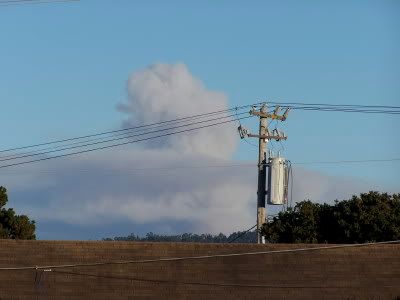
I took that picture 30 minutes ago, of the Basin Complex Fire that is raging on the Big Sur coast about 20 miles south. The fire jumped a containment line last night and is now threatening the village of Big Sur. The entire area is now under an evacuation order, and the 850 or so residents are now gathered at Carmel Middle School or with friends and family in the area.

The Big Sur community has always been tight-knit, and grew even moreso in the late 1990s after El Niño rains washed out Highway 1, closing it for months. One result is a rich online network of sites providing information and resources about the fire, such as Xasáuan Today’s fire news and Sur Fire 2008’s community information.

The Carmel chapter of the Red Cross is taking donations for the shelter and other needs.

Arnold Schwarzenegger was here earlier today surveying the fire damage, and John Laird had this to say:

Governor Schwarzenegger’s visit to Big Sur today is a significant indicator of the impact the Basin Complex fire is having on the people of the Central Coast and California. The people and businesses of the Big Sur community have shown courage, resourcefulness and generosity as this difficult fire has unfolded.

Today and in the weeks ahead, as I continue to work hard on the budget in Sacramento, I will stay focused on ensuring funds are available to fight this fire. And as we consider next year’s budget, I’ll continue to advocate for the funding increases for air attack resources, as approved by the Assembly Budget Committee.

California’s firefighters are stretched thin by the fires, and Arnold has called the National Guard to help relieve the burden. Another example of how we need to be nation-building here at home, not using the National Guard to occupy Iraq.

Finally, it may be an individual home fire, but you’ve probably heard by now about the fire that destroyed Darcy Burner’s house east of Seattle. $60,000 has been raised so far to help her meet her $150,000 goal for July, so that she can attend to her family needs this month instead of worrying about raising money for her campaign for Congress in WA-08.

Darcy Burner has been there for the netroots – on net neutrality, on the Responsible Plan (which she initiated), and will be there for us on many other issues. I had the pleasure to meet her and do some volunteering for her campaign in 2006, and it was a bitter disappointment that she did not win. Certainly the loss of her home is a bigger disappointment – but just as she came back from the 2006 loss, so too will she come back from this one. Let’s give her some help in doing so.

A Brown Lawn is a Good Lawn

It sounds like one of those stories that conservatives often use to make government look bad – the city of Sacramento is fining a household $746 for letting their lawn die to save water. But the real issue here isn’t government – it’s whether California will abandon wasteful and even elitist 20th century values to meet the needs of the 21st century.

The basic tension:

“In order to make the lawn go, I would have had to keep watering it intensely, and since the drought was declared, I decided that wasn’t a good idea,” said Hartridge. “Honestly, I think there’s a disconnect within the city about priorities.”

Two weeks ago, The Bee reported that Sacramento’s per capita water use is among the greatest in the world….

The city’s landscaping rule is intended to maintain neighborhood visual standards to prevent one neighbor’s tastes from harming another’s property values.

The rule was the subject of much conflict last year when amended to provide gardeners leeway to grow more than grass. Sacramentans can now grow large trees, shrubs and, yes, even food in their front yards without fear of reprisal.

But the rules still require front landscaping to be irrigated, which means scores of homeowners could be penalized for growing cacti or other drought-tolerant vegetation.

The problem here isn’t bad bureaucrats – it’s bad policy. Like so many other California cities, Sacramento maintains absurd codes that mandate green lawns and other wasteful practices simply to perpetuate a failed 20th century urban design model. The belief is that property values will be hurt if people have anything other but green lawns and shrubbery. We have to ensure our neighborhoods look exactly as they did in 1965, never mind the cost to our water supplies.

But it goes deeper than just water conservation – important though that is. As noted in the blockquote, Sacramento only recently allowed residents to grow their own food in their yards. Urban food production, and home gardening, is an essential step in healthier eating and energy conservation. Many cities still have bans on using a clothesline to dry your laundry, even though it saves a lot of energy (and is usually easier on your clothes!).

Residents ought to be encouraged to live sustainably, and use their home as it ought to be used – to produce self-sufficiency. We can and do discuss density and mass transit as part of urban design needs, but the micro-level issues such as brown lawns and clotheslines matter too.

When I lived in Seattle from 2001 to 2007 I saw a different and better way to live. Residents there let their lawns die over the summer. Many grew food in their yards. I learned to use a clothesline there (because it wasn’t kosher to use them in Orange County, sensible as it’d have been). My neighbors had chickens, who laid delicious eggs – most summers we never had to buy eggs from a store.

Many California cities have outlawed some or all of those practices since the 1950s or earlier. It was a class-based move – middle-class homeowners saw clotheslines and chicken coops as signs of poverty and low-class behavior, which would invariably drive down property values. To a homeowner, government merely exists to protect property values, even at the expense of sustainable practices that help the environment and the infrastructure.

These practices will also help preserve the middle-class. California’s 20th century middle class was a product of cheap oil, which made it affordable to live in a suburban home and get your food from a supermarket. With the end of cheap oil, food inflation is going to destroy the living standards of working Californians. It just makes sense to encourage sustainable living.

From American Hero to Political Hypocrite

Just as presidential hopeful Barack Obama left California this past weekend, news is circulating about a new headline grabbing statement he made to a small group of people in San Francisco.  This time, conservatives are going mad because Obama told a Lesbian Gay Bisexual Transgender group that he opposes Prop. 8, a discriminatory ballot measure that would prohibit marriage equality via constitutional amendment.

Good for Obama, and good for California.  His opponent on the other hand, is playing so many sides of the fence, it’s hard to keep track.  Since when did it become so acceptable to flip flop your positions in the manner John McCain appears to do with so much comfort and ease.

McCain even goes so far as accusing Obama of flip-flopping in an effort to mask his own very real lack of integrity on the issue.

Follow this bias-filled Fox News article:

  • “I am proud to join with and support the LGBT community in an effort to set our nation on a course that recognizes LGBT Americans with full equality under the law,” reads the Obama letter, available on the Alice B. Toklas LGBT Democratic Club Web site.

    Obama said he supports “extending fully equal rights and benefits to same sex couples under both state and federal law,” and called the measure a “divisive and discriminatory” effort to amend California’s constitution.

    In response, John McCain’s campaign told The Sacramento Bee that Obama is guilty of flip-flopping, saying his support for the measure contradicts an earlier statement in which the Democratic candidate said it should be left to the states to decide their marriage policies.

Let’s see, Obama is merely supporting the position of a soon-to-be-revealed majority of California voters at least, who support the constitution and equal rights to marry therein.  On November 4th, the state voters will decide.  Therefore, McCain is dead wrong about Obama on this point and further investigation reveals that McCain himself is guilty of this precise claim.

Case in point.  In 1996, McCain voted in favor of the 1996 Defense of Marriage Act, which declares that the federal government will not recognize same sex marriage and that states are not compelled to recognize such marriages that may be legal in other states.

That act federally undermines a legal marriage in California, wherein its state constitution, ratified and upheld by its people and sovereignty uphold the grant equal rights to marry.

Today, McCain prefers to allow each state to decide its own marriage laws, as California has done and will do on November 4th when Prop 8 is defeated.  Problem is, the McCain supported Defense of Marriage Act voids certain marriages at the federal level, abridging the right of a state to make its own decision.

On the issue of marriage equality, McCain goes from American hero to political hypocrite.  

Density Comes To California

Via Matt Yglesias and Atrios, the city of Sebastopol is thinking about supporting increased density in their upcoming development plans.

The Sebastopol City Council kicked off deliberations of a controversial redevelopment plan Tuesday with a majority of members voicing support for higher-density buildings as the most environmentally sound approach.

“Density is what makes transit feasible, giving us the option of getting out of our cars,” said Councilman Larry Robinson […]

The redevelopment plan would allow 300 residential units and nearly 400,000 square feet of new business and civic space between the Laguna de Santa Rosa and downtown.

Supporters have said the plan encourages the most environmentally sound method of development and would help add economic vitality to the city.

This approach is not without critics.  There remain those who consider tall buildings an urban blight, think that all development comes with traffic woes and want to maintain local “character” when talking about growth.

The point here is that we have to start to re-orient to a different kind of lifestyle.  If basic necessities are within walking distance and a strong transit spoke can build out from denser development, the traffic problems are eliminated, the quality of life goes up, and people can get around and get to work without the need for their cars.  Santa Monica is a pretty dense city, with several points of interest and commercial shops within walking distance and a strong bus system.  It’s not Manhattan and it doesn’t have to be.  But there’s less of a reliance on the automobile, and ultimately reducing that reliance is the key to making us energy secure.

The alternative is areas like the Inland Empire, where runaway sprawl and persistent construction of single-family homes is not only unsustainable, it’s unaffordable, as the mortgage crisis and soaring energy costs turn these developments into ghost towns.  With 200 dollar-a-barrel oil on the horizon, urban planning simply cannot retain the status quo and expect to survive.  There isn’t one complete answer here – telecommuting and Internet delivery, increased mass transit (I can’t wait for my subway to the sea), and density will all play a role.  But we cannot sacrifice any of those options in the name of NIMBYism.  

What Economic Problems? Arnold is doing great

Sometimes you don’t even have to work at this:

SACRAMENTO – The state may be facing a growing economic crisis, but Gov. Arnold Schwarzenegger is doing just fine, thank you.

That was the image at the Capitol this week, when Schwarzenegger pulled a money clip stuffed with his own cash out of his pocket when asked if the state would be running out of money any time soon.

“Not at this point,” he said. “As a matter of fact, I still have some left.” (CoCo Times 7/2/08)

So, don’t you Californians worry, Arnold is doing fine! Sure, your house has been foreclosed upon and you’re looking for work in record numbers.  But don’t worry, Arnold has money rolling in from the DVD sales of T3. And as soon as he can get out of Sacto, he can make a movie with Stallone for another $25 million. So, what is your problem?

Combine this with the story in the Bee that–gasp–legislators will have to put their vacations on hold, and you have a regular “let them eat cake” news cycle.

Of course, Arnold can’t personally pay the state’s debt, but he could go out on a limb like Pete Wilson did back in the 90s by proposing tax increases to get the Republican legislature to play ball. But as of yet, there’s only the modest sales tax proposal. That won’t cut it. Now if Arnold wants to flash the bling around, he should be waving a real budget proposal rather than his gas money for the Hummer.

The Governor’s Lottery Scheme – Bottom of the Barrel?

Dave Johnson, Speak Out California

Is California’s lottery becoming just one more subsidy for the rich?  

When We, the People of California agreed to have a state lottery it was to pay for extra education for our children on top of the existing education budget.  It was not supposed to make up for other budget cuts for schools, it was supposed to be extra money to improve the educational system.

This has … migrated.  The lottery under the Governor’s new borrowing plan may be fast becoming one more gimmick to avoid taxing the rich and big corporations.  (Not to mention paying out millions upon millions in debt interest for years and years to those with the means to loan the state these billions.)

The California Budget Project has a new report, Borrowing Against the Future: Are Lottery Bonds the Best Way To Close the Budget Gap? (PDF file)  It is well worth taking a look at.  They say the numbers don’t add up, the lottery can’t deliver the needed revenue, the scheme makes it even harder to fix the budget in the future, will have a high interest rate, and has numerous other problems.  On a conference call Tuesday with jean Ross, one of the report’s authors, I also learned that the cost over time of borrowing this money will be between $41.5 and $50 billion — way too high.  The lottery is largely played by low-income people so efforts to drive up lottery purchases increases their burden and will likely come at a cost of other purchases, thereby sacrificing sales tax revenue to the state.

That there are so many things wrong with this latest borrowing scheme might be a good sign.  It might, just might mean that the Republicans are scraping the very bottom of their barrel of anti-government and tax-avoidance gimmicks.  After this wild scheme collapses maybe, just maybe they’ll come to their senses.

Click through to Speak Out California

Obama’s Opposition to Marriage Amendment isn’t “News”

Cross-posted with Beyond Chron.

The SF Chronicle announced “breaking news” on their website yesterday (and front-page headline today) that Barack Obama is against Proposition 8 – California’s right-wing constitutional amendment to repeal marriage equality.  Too bad the “breaking” news was a letter that Obama sent to the Alice B. Toklas LGBT Democratic Club several days earlier, and was publicly read at their Pride Breakfast on Sunday.  But regardless of how you define news as “breaking,” Obama has been on record opposing Prop 8 for the past six weeks – as he issued a formal statement on the day of the California Supreme Court’s decision.  The Chronicle yesterday referred to Obama’s May 15th statement as “carefully nuanced” – even though his position was quite explicit, and he even used some of the same language.  Obama has always opposed Prop 8, and his pledge to repeal the federal Defense of Marriage Act gives LGBT couples very strong reason to campaign for him in the fall.

It’s amusing for the Chronicle to treat a letter read to a crowded room of activists two days earlier in downtown San Francisco as “breaking” news.  Spain won the Euro Cup on June 29th – the same day that Obama’s letter was read.  Would SFGate.com announce Spain’s victory two days after the fact on their front page and call it “Chronicle Breaking News”?  Readers would naturally find that strange, so how is this example any different?

Obama’s position against California’s anti-gay marriage initiative – a welcome addition as activists mobilize to defeat it – isn’t “breaking news.”  In fact, it’s not even news.

Six weeks ago, when the state Supreme Court issued its powerful decision on marriage equality, Barack Obama – like most politicians – issued a statement.  While the statement included some wishy-washy language that Obama “respects” the court decision, supports civil unions and that states should make “their own decisions,” he also formally came out against California’s Proposition 8.

“On the issue of constitutional amendments,” said the May 15th statement, “Senator Obama has been on record for some time: He opposes all divisive and discriminatory constitutional amendments, state or federal.  That includes the proposed amendments in California and Florida.” (my emphasis)

Now compare it with Obama’s letter from three days ago: “As the Democratic nominee for President, I am proud to support the LGBT community in an effort to set our nation on a course that recognizes LGBT Americans with full equality under the law … And that is why I oppose the divisive and discriminatory efforts to amend the California Constitution, and similar efforts to amend the U.S. Constitution or those of other states.” (my emphasis)

Far from accusations by the right wing that Obama has “flip-flopped” on the issue (which the Chronicle quoted without criticisms), Obama opposed efforts to change California’s Constitution six weeks ago – and he opposes the amendment now.  But somehow, the Chronicle dismissed what the Obama campaign released on May 15th as a “carefully nuanced statement.”

Granted, Obama’s letter on June 29th was more forceful – and it also cited his support for axing Don’t Ask Don’t Tell and repealing the Defense of Marriage Act.  The latter is extremely important, because California same-sex couples still don’t have all the benefits of marriage until the federal government treats them equally.  But even that isn’t news: Obama supported repealing both laws back during the primaries, which made his platform more gay-friendly than Hillary Clinton.

On May 15th, Obama’s position was that marriage should be left to the states – but that he opposed any and all state constitutional amendments.  So his allegedly “nuanced” position was that marriage could be legislated as being between a man and a woman – just as long as you didn’t enshrine hate within the constitution.  Obama didn’t change that position with his letter – he just re-iterated his opposition to California’s Proposition 8, in case you didn’t hear it the first time.

After having carefully read (and re-read) Obama’s letter to the Alice B Toklas Club, the only “news” I can see is that he publicly acknowledged the same-sex couples who got married since the Supreme Court decision.  “I want to congratulate all of you who have shown your love for each other by getting married these last few weeks,” he wrote.  “I look forward to working with you in the coming months and years, and I wish you all continued success.”  That may be news – but the media completely missed the boat on why.

In All the President’s Men, which details how Washington Post reporters helped bring down Richard Nixon with Watergate, the paper’s editor dismisses a salesman trying to sell him a feature for a weather report for people who were too drunk the day before, with the line: “Send it out to the San Francisco Chronicle – they need it.”  Apparently, the Chronicle still hasn’t learned in the past 35 years that yesterday’s news is not “breaking news.”

But it wasn’t just the Chronicle that got this story wrong — even liberal blogs treated the Alice B Toklas letter as a break from Obama’s prior position.  But Barack Obama has opposed changing the California Constitution to discriminate against same-sex couples for quite a long time – which gives the LGBT community more reason to enthusiastically support his candidacy.

EDITOR’S NOTE: In his spare time and outside of regular work hours, Paul Hogarth volunteered on Obama’s field operation in San Francisco. He also ran to be an Obama delegate to the Democratic National Convention.