All posts by Robert Cruickshank

Standing Up For Hilda Solis

I work for the Courage Campaign

The stimulus plan isn’t the only thing Republicans are obstructing. Hilda Solis, still the representative from CA-32, was nominated as Secretary of Labor by President Obama on December 19. It’s been nearly two months and her nomination still hasn’t moved out of the Senate HELP committee.

Republicans, led by Mike Enzi of Wyoming, are trying to stop Hilda Solis because of her support of workers’ rights, including – but not limited to – the Employee Free Choice Act. They even want her to promise to not lobby on behalf of Employee Free Choice as a condition of confirmation – which she has so far refused to do.

A hearing was finally to have been held in committee on her nomination last week but news of a tax problem her husband had – which has since been resolved – caused yet another delay, and conservatives are hoping to use the delays to kill one of Obama’s most progressive nominees entirely.

It’s time for Californians to stand up for Hilda Solis.

She’s been there for us in the past. Last summer when Arnold Schwarzenegger planned to slash the wages of over 200,000 state workers to the minimum wage, Solis joined our successful grassroots effort to block that move. Now that she is poised to bring significant progressive change to an important part of the federal government, it’s vital that California progressives show that we have her back.

The Courage Campaign is asking its members to show their support for Hilda Solis by asking them to sign a letter to Senator Ted Kennedy, chair of the Senate HELP committee, encouraging him to lead the fight against conservative resistance and for Hilda Solis’s confirmation.

In doing so we join our allies at SEIU and MoveOn.org who have also pushed out their own kinds of support Solis actions in recent days. There’s also a Facebook group to join as well.

Why a letter to Senator Kennedy? We’re not at all worried that he isn’t supportive of the nomination or that he’s unwilling to move quickly to get it done. What we want to do instead is demonstrate to key Senators just how wide and deep public support for Hilda Solis truly is. To reinforce the case for her confirmation, and to help Kennedy and other Democrats beat back the conservative attack on a true progressive hero.

So sign the letter here and show your support for Hilda Solis!

Over the flip is the email we sent to our members and the letter we’re asking folks to sign:

Dear Robert,

Hilda Solis has consistently stood up for Californians. And now, as she faces a tough confirmation battle to become Secretary of Labor, it’s time for progressives to take a stand for her.

When Arnold Schwarzenegger threatened to cut the salaries of state employees to the minimum wage, Hilda Solis stood with tens of thousands of Courage Campaign members who successfully forced the Governor to back down.

All her life, Solis has stood up for the values we all share — democracy, justice, and prosperity. As one of Barack Obama’s most progressive Cabinet picks she is poised to bring much-needed change to not only the Department of Labor, but to American politics as a whole.

But now, Hilda Solis needs our help. Senate Republicans, led by Mike Enzi of Wyoming, have declared all-out war on our progressive hero. They are determined to kill her nomination so they can stop the momentum of President Obama and the labor movement.

We cannot let them succeed. It’s time for progressives to rally together to stop the right-wing campaign to deny her appointment. Please sign our letter to Senator Ted Kennedy, chair of the Senate Labor Committee, asking him to lead the confirmation of Hilda Solis as Secretary of Labor:

http://www.couragecampaign.org…

Conservatives want to destroy her nomination because they do not like President Obama’s policies, the ones Hilda Solis holds so dear. The same policies and values that are Senator Kennedy’s legacy.

If Solis is not confirmed then conservatives will be emboldened to attack other progressives and their causes.

We must draw the line here.

Please join us in asking Senator Kennedy once again to lead progressives and fight for Hilda Solis. Sign our letter to Senator Kennedy and join him in standing up to the right-wing campaign to deny Americans the change they voted for in November:

http://www.couragecampaign.org…

Thank you for standing up and supporting one of California’s progressive heroes.

Rick Jacobs

Chair

And the letter to Senator Kennedy:

   Senator Ted Kennedy,

   As one of the greatest champions for progress in America, we once again need your leadership as the right-wing seeks to make an example of another champion, Labor Secretary-designate Hilda Solis.

   They want to destroy her chances of confirmation as President Obama’s Secretary of Labor because they do not like his policies. These are policies Hilda Solis shares — democracy, justice, prosperity. They are the same policies that you have spent your life promoting.

   Congresswoman Solis has always stood for the people and for progress. Her efforts on behalf of the rights of women, the working class, the poor, and of environmental justice show that Congresswoman Solis is a leader America needs in these tough times. She will bring these values to the Department of Labor, where after eight years of George W. Bush’s misrule, those values are desperately needed.

   We know Hilda Solis because we are her neighbors and friends and constituents here in California. By nominating Hilda Solis, President Obama chose a person dedicated to crafting bipartisan solutions to rebuild our middle class and ensure workers’ rights are protected. Hers is the kind of smart, innovative leadership we need as we face the highest jobless rate in more than 16 years and record job losses of 3.6 million since the start of the recession in December 2007.

   The Republicans who are stalling Solis’ confirmation are the very same group who spent the last eight years putting the needs of big corporations over the needs of working Americans. It’s an insult to every Californian for the Republicans to hold up, postpone or otherwise delay her confirmation. We urge the Senate to quickly confirm Secretary-designate Solis so she can use her expertise to help us through these tough economic times.

   Senator Kennedy, please lead the confirmation of Hilda Solis as Secretary of Labor.

Rachel Maddow on California Water Security

Rachel Maddow is more than just an excellent TV host and progressive hero. She’s also a policy geek who hails from Castro Valley and who, because of her father’s long experience working for East Bay MUD, knows a LOT about California water policy.

In December she was invited to give the keynote address at the annual conference of the Association of California Water Agencies in Long Beach. It was a fantastic speech, showing her range of knowledge on federal infrastructure politics and California’s water needs.

The speech is reproduced below in its entirety; I haven’t been able to find an audio or video of the address but am told it was very well received by the audience.

Maddow’s words are all the more important as California enters the third year of the most severe drought the state has faced since the American conquest. She speaks of three “water eras” and that the third, which we are now entering, will be defined by the search for “water security.” It’s a perceptive, big picture talk that sets out the fundamentals that ought to guide us as California struggles to deal with the water crisis.

The speech is also a useful counterpoint to Dan Walters’ latest column, which blames the water crisis on the state being “ungovernable.” That misses the key point – California’s ungovernability stems from the decision in 1978 to lock 20th century policy in place by giving conservatives a veto, conservatives who have defined their politics by promising to preserve the 20th century model of California life, with all of its waste of resources and unequal outcomes.

Maddow reminds us that to deal with the crisis, we need an attitudinal shift – and that shift must come as part of a breaking of the conservative veto over California politics. Only when we decide that the policies of the 20th century must be abandoned will Californians mobilize to take power away from those who so recklessly defend those policies.

RACHEL MADDOW’S SPEECH

ACWA FALL CONFERENCE

LONG BEACH, CALIFORNIA

WEDNESDAY, DECEMBER 3, 2008

Thank you so much for having me here — it really is an honor.

I know that I’m a new face to a lot of you here — which makes it all the more kind that you invited me to speak.  But maybe it’s wise if I introduce myself a little — or at least explain how I got here.

I was born in 1973 — or as we called it in my family — the year the California Aqueduct was completed.

I went off to school — to public kindergarten — the year that Prop 13 went into effect — I can actually remember the library hours changing because they couldn’t afford to staff it anymore.

I grew up in the East Bay Municipal Utility District, and my parents still live in the house I grew up in — though now there’s a drinking water filter on a pitcher next to the sink in the kitchen, which we never had when I was a kid.

The first posters-or-anything I remember us putting up in the house were really pretty drought-related exhortations in favor of native plants.  I don’t even think my mom liked California poppies, but we had posters of them all over the house because they were apparently the poster-plant for patriotic gardening in the 70s.

Our family vacations were to a place that other kids called “Yosemite” — but in our family, it was the place with the reservoir where Hetch Hetchy got its water!  

We’d pile in the car and drive to grandma and grandpa’s house in San Diego, very excited for the canal-viewing opportunities from interstate 5 as we drove south.

We didn’t go so far as to have a Delta smelt as a pet or anything, but California’s water troubles… were really quite central to the way I understood the world as a kid.  

And growing up in a time of drought — made a lasting impression on the wet-cement of my very young mind — it gave me a lifelong appreciation that water is rare… water is fragile… and water is power.  I live on the east coast now, in New York City, where everyone thinks that time is money — to me as a kid… and I guess now, too… water always seemed like money.  Water.  Oil.  Land.  Information.  Control.  Things to fight over — things to fight for.

Now California’s back in drought — my parents have long-since converted everything at their house that’s convertible to low-water-use… and so have all our neighbors as well.  They didn’t do that out of do-gooder hippy instincts… we don’t live in a very hippy do-gooder kind of town and we’re not a do-gooder hippy kind of family — but people have made the switch because it’s dumb not to.  It’s the same for families as it is for farmers and businesses now — no one can afford to waste water… or to waste much of anything anymore.

As we head into the worst economic prospects in more-than-a-generation… as we’re back in drought in California… with a new democratically-dominant era coming to Washington… is California going come out of this drought differently than it has from others?  Are big changes ahead for the perennial resource fights that have defined my life as the daughter of a California water geek?

Briefly, let me say this about the election of Barack Obama to the presidency.  He ran, essentially, as the Hope candidate.  I know everyone says he was the “change” candidate — but honestly, both campaigns ran their guy as the change candidate — McCain said he’d bring mavericky no-business-as-usual change to the republican party and to Washington, Obama said he’d bring change to Washington not just by changing the party in charge, but by changing from the divisiveness of typical politics.  

Dick Cheney was not on the ballot this year — the chant of “four more years” was a threat and an insult, not a cheer this time around — everyone was running as a change candidate.  You know, our existing President George W. Bush told an interviewer during the campaign that if he was running for a third term this year, he would have run as a change candidate!

So while this was inevitably a change election — I think it’s important to remember that Obama ran as the hope guy. The hope candidate — the don’t be afraid, don’t look down — look up, we can aspire to better things, be hopeful, brighter days ahead guy.

While that’s neat — and I do feel good about our country electing an African-American president for the first time, and for choosing the let’s-not-blame-each-other, we’re-a-united-country, we-all-need-to-pull-together candidate?  While I think that’s neat and I do feel proud about that?

I do think it’s worth asking who in their right mind… would be hopeful about the country’s future with an economic outlook like this.

The economic crisis we’re in right now is so big and so dire, that you can’t use metaphors anymore to explain it.  The burning house, the house of cards, dominoes, they’ve all been rendered quaint by how big a mess this is.  Rather than a metaphor — how about a comparison.

If you add up the money that the federal government, the Bush Administration, has spent-or-committed-to-spend in an effort to shore up the economy THUS FAR — what we’ve spent or committed — it is greater than the entire cost of the new deal.

– It is greater than the cost of the Louisiana purchase. – It is greater than the cost of the Marshall plan. – It is greater than the cost of the Vietnam war. – It is greater than the cost of the KOREAN war. – It’s greater than the S&L scandal. – It is greater than the cost of the effort to get a rocket to the moon. – It is greater than the expenditures, actually, for the entire lifetime of NASA as an agency. – It’s greater, and I am not kidding here, it is greater than all of those things combined. – And yes, I’m adjusting those dollars for inflation.

For what we’ve spent… for all that… does it seem like we’re out of the woods?

Yeah, I know.

So it is hard to be hopeful.  About the future of the country… given the scale of the economic pickle that we’re in.

But you guys here in this room — maybe ought to be hopeful… about the prospects for fixing some of the problems you’ve joined this association to confront.  Oddly, the depth of the financial crisis may offer a historically-informed reason to be hopeful.  

And that’s because spending on infrastructure… at the federal level… and to a certain extent at the state level, too — starts to look like a smart economic idea, in tough economic times.

In fact, when you start reading, in any field, about crumbling American infrastructure, you very frequently come across the phrase, “about 80-years-old”!  So much of what we worry about, and what needs replacing, and what we wonder how we’ll ever match in terms of scale and ambition — is about 80 years old — because about 80 years ago — the second-President Roosevelt’s response to the great depression was to build build build, invest invest invest.  To spend massive amounts of public money to put people to work and to pray to the gods of keynesian economic prowess, that it would work to swing the country back into the black.

The spending helped… the projects were built… and ultimately what ended the depression full-stop, was World War 2 — and a level of massive national mobilization…and spending — that also had the pleasant side effect of liberating the world from Nazi tyranny and elevating us to superpower status and a source of envy and pride for the world.  (That list of all the massive spending outlays that don’t even come close to equalling what we’ve spent-or-committed-to-spend on this financial crisis?  That didn’t include World War 2.  We spent more on World War 2 than we’ve spend thus far on this crisis).

But in the 1930s, the Depression, the New Deal and its public-investment prescription meant a lot of very specific things to the West and water.  FDR promised the new deal in 1933 — in 1934 — the Bureau of Reclamation received a budget that was half of the total budget it had received for all of the previous 31 years combined.  A hundred million dollars!  

In the 1930s, we saw the construction of the Central Valley Project, the Big Thompson project, the Columbia Basin, of course the Hoover Dam, completed two years ahead of schedule in 1935.  

The Central Valley Project had been proposed in 1931, it had a hundred and seventy million dollars worth of bond-funding approved for it in 1933, but in the midst of the Great Depression and a dearth of investors, it wasn’t going anywhere until two years later, in 1935, when FDR approved federal funds for it.

As you all know, the CVP was a massive project, equivalent in size if not fame to the Tennessee Valley Authority — it was a huge undertaking that turned the Central Valley of California into the breadbasket of the nation.  And of course brought with it some equally massive environmental challenges.

Are we due for a new New Deal as a response to this current financial crisis? If you squint and he starts smoking again, can you imagine this new guy as Barack Delano Obama?  In some ways, yes.  Yes, we can.

Candidate Obama talked up a fifteen billion dollar national infrastructure investment bank while he was on the campaign trail.  Since the financial crisis ate trilions of dollars of investment income and stock value, since the industry we used to call “investment banking” disappeared in America, since we seriously began to ponder the very real possibility that there will no longer be any American-owned companies that make cars anymore — since jobless numbers started hitting ten, twenty, thirty year highs — you can take that 15 billion-dollar infrastructure-spending campaign-promise, add a zero on the end of it, and then start doubling.

By economic imperative if not ideological commitment, the federal government will increase, by impressive amounts, its spending on the home-grown systems that form the basis of our economy and our way of life.  

I interviewed then-Senator Obama about a week before the election; I asked him about infrastructure investment — and he proactively raised the issue of the electrical grid as something that is not only antiquated and fragile, but in need of a politically-informed overhaul to bring it in line with our ambitions about diversifying our energy sources and making our energy use more sustainable.  

In his first president-elect youtube radio fireside chat thingie — president-elect Obama then singled out roads and bridges and schools as targets for federal re-investment, as part of a new jobs program that he says aims to create or save 2 and a half million jobs over the next two years.

In other words, infrastructure is back.  Some Republicans in Congress will oppose a lot of the new spending, but they will not be able to mount a unified opposition to the democratic-led efforts because a lot of them support it, too.  Democrats like to capitulate to Republicans even when Republicans don’t have any real power to wield, so they will succeed in inflecting some of the spending bills, changing some of the areas of focus for the new investment, but they won’t stop it.  There will be a big new federal-spending commitment to roads, bridges, schools, mass transit, communications, energy, and… water.

Which is the silver lining we’ve been waiting to find… around the dark, dark cloud that is this worst economic forecast … in about 80 years.

But there’s that phrase again — in about 80 years.  If water-in-the-west is due once again for a round of federal investment much as it was in the last great economic downturn — should we expect that the same kind of projects will be built?  Is there another Hoover Dam, another CVP, another massive water-storage diversion civil engineering monument that’s ready-to-go, agreed-to, and just waiting to be funded?

Maybe there is — I’m not dumb enough to weigh in pro- or con- on the old peripheral canal idea, so don’t try to tempt me.

But my sense is that the infamous water wars of California… of which you-all are veterans… have seasoned you… prepared you well for the big-grab, the big resource scrum that’s ahead.  But I just want to interject one idea about how the politics of infrastructure and federal investment in infrastructure have recently been changing.  Since the Bush Administration has been in office and the Department of Homeland Security has been created — there’s been a sort-of democratic government-in-waiting taking shape, biding its time, working on campaigns, writing think-tank articles and giving speeches — about how they’d do security differently.

It’s true in every field, actually — Tom Daschle since he lost his job as democratic leader in the senate, has been positioning himself as the democratic party’s big health-care thinker — now he’s coming back to washington as the secretary of HHS.  Lawrence Summers, Bill Clinton’s Treasury Secretary — since he left Washington, he’s most publicly known for a really bad time as president of Harvard — but he’s also been the Democrats’ economic modeller-in-chief — very publicly transforming himself from an anti-regulation ruling-class-interests kind of guy — into the centrist reformed-deregulator, post-Rubinomics that is the hallmark of all the economists who Obama has brought to Washington now.  

And on security issues… one big difference between the outgoing administration and the incoming administration… the old-school and the new-school, which you can tell if you geek out on this stuff like I do and you read the academic papers of and go to the speeches of the wonks who have been the Democratic-government-in-waiting while Bush has been in office?  The difference?  Is that the homeland security thinking of the new guys.  Includes infrastructure.

Which means you won’t be able to compete for infrastructure resources using the same arguments that you did with the Bush administration… or that you might have used during earlier eras of federal investment like during the New Deal.

I think you can make the case that the first era in water-in-the-west was defined by development — on the national scale it was Manifest Destiny, at the local scale… it was things like the migration of people out of San Francisco after the 1906 earthquake that forced the quick buildup of water infrastructure in the area where I grew up.

The second era of water-in-the-west I think has been the struggle to find sustainability — balance… to make sure that even the stakeholders who don’t use water to turn a profit, are having their interests represented in the great competition for western water.

As you know here in California, fish have much better lawyers now than they did back in the day. Sustainability and environmental concerns are not going away in California or anywhere else.  Ideally we’d be moving into a time in which environmental and business concerns were not always automatically assumed to be at odds, but as long as there are scarce resources, held to a certain extent in common, which require private exploitation for necessary for-profit industries… I think there’s always going to be conflict there.  Creative conflict, hopefully — but conflict.  May the best lawyers win!

I’d argue now, that a third era is on us that isn’t specific to the west, but will affect how well the west does against the rest of the nation in competing for federally-funded infrastructure investment… and ultimately what kind of projects get agreed-to, funded, and built here in this era of opportunity — and that’s the issue of security.  The ideas of catastrophe and resilience.

All those peat levees built oh-about-80-years-ago in the Sacramento-San-Joaquin river valley?  Their failure due to earthquake, flood, or evil design?  Would not only drown the islands of the delta… it would drown the islands of the delta and the delta itself under hundreds of billions of gallons of salt water.  And then what would California drink?

Sure, the great aqueduct every year swallows its fair share of cars, trash and unlucky fishermen… but what if the little pipebombs those fishermen sometimes put into the aqueduct to make the fishing a little easier (and a heck of a lot more dramatic)… what if one day instead we found a smuggled warhead… a biologic agent… maybe capable of killing a lot of people… definitely capable of terrorizing a whole population.

Of the 101 chemical facilities in the United States that are considered to pose the highest risks to nearby population centers?  15 are water utilities.  What if one of the 11 of those utilities that uses chlorine gas as its treatment agent… what if one of those utilities, again, due to earthquake, flood, or evil design, ended up pushing a cloud of chlorine gas downwind to the nearest population center…

Infrastructure is central to security for two reasons.  One — it’s a target for terrorism for all the obvious reasons.  The goal of terrorism is to generate enough social and economic disruption — to traumatize an entire population.  And thereby generate political pressure to pursue draconian measures in response, that ultimately undermine the sustainability of the existing political leadership… or ultimately… that undermine the sustainability of that whole existing political system.  Terrorism works like an antigen — you introduce an agent to an organism that causes the organism to turn its own resources against itself.

For that reason, we’ve seen on 9/11, in Madrid, in London, in Mumbai — low-tech coordinated terrorist assaults designed to inflict maximum civilian casualties, maximum disruption, maximum economic impact.  Bin Laden, in statements since 9/11, has consistently bragged about the economic impact of the September 11th attacks — the bang for the buck — how little the operation cost them to carry out, as compared to the costs it inflicted on us… and that we later inflicted on ourselves.

So infrastructure is important to security first, because it’s an obvious target for terrorism.  But infrastructure is also important to security because even if the threat does not come from terrorism, having the ability to withstand natural disaster, the strains that come from growth and development is an important indicator of national strength, and of competitive advantage.  

The Council on Competitiveness last year reported on risk, security, and terrorism for the private and public sectors, and concluded that, “the ability to manage emerging risks, anticipate the interactions between different types of risk, and bounce back from disruption will be a competitive differentiator for companies and countries alike in the 21st century”.

Companies and countries alike — and I’d argue, states as well.  

People and companies and the ensuing opportunities will gravitate to places that seem robust, dependable, and predictable.  Not being able to manage crises? Having obvious sources of risk and potential catastrophe unattended to?  Is a great excuse for any business to say bye-bye California hello Puget Sound, hello Toronto, hello Asia…

This is the new thing to understand about the new Democratic federal political scene.  The idea is that things will go wrong periodically — whether by God’s design or man’s — and our ability to be resilient, to withstand a punch, to bounce back quickly, to get things back to normal — is a form of national resilient strength and national security… that puts a different cast on potentially catastrophic failure of existing infrastructure.

The guy who’s best at spelling this out is a retired Coast Guard officer from the east coast named Stephen Flynn — he wrote a book called Edge of Disaster — required reading for understanding how to argue for infrastructure investment in the new administration.

Our water infrastructure, much like our energy, communications, transportation, and emergency response systems — need to be able to stay standing, to stay operational in the face of natural disaster or man-made disaster.  That means that our systems need to be strong-enough and well-maintained enough to take a punch — it also means we may need redundancy built into the system — so if critical function are incapacitated, we can swap something else in temporarily to take its place until repairs can be completed.  

Even if the world were as safe as it felt when I was growing up drinking East Bay Mud tapwater… it would still be the right thing to do by America to make those kinds of investments.  We skipped a generation of investment in infrastructure — we just passed the fifty-year anniversary of the Eisenhower interstate system — and those roads and bridges built for less than 200 million people … are now, at the end of their expected lifespans, serving more than THREE hundred million people… who sit in traffic a lot… and pray a lot… when we feel that truck ahead of us on the bridge making those expansion joints rumble.  We’re squandering the inheritance from our smart grandparents who built this country — we’re not doing our part.

Even if the world were as safe as it felt when my mom first planted those California poppies in our back yard, investing in infrastructure would still be the right thing to do, particularly in a massive economic downturn — in order to give American business a fair-shake at competing in the modern world, just as the earlier generations of investment gave American business a huge leg-up in the world because our reliable water sources, our aquifers, or aqueducts, our dams, our electrical system, our highways, our airports and our air traffic system… they were the envy of the world.

Now, the imperative of security has added a new layer to the way that we talk about and argue for and make decisions about what gets built and what gets maintained, where the money goes.  Thinking about security, thinking about catastrophe isn’t fun – it isn’t the kind of be-afraid–be-triumphant emotional whipsaw that we’ve been on, nationally, for the last seven-plus years since 9/11.  But it is the grown-up way for us to move forward as a country.  It’s about denying our enemies easy targets and satisfying results.  And beyond terrorism, it’s about responsibility and competence and the core strength of the country.  

In the big scramble for resources that’s coming, as the new administration starts thinking new-deal-ish thoughts, the choice that you guys have to make now — is whether, looking west, California will look like the land of perennial water wars and thorny politics and the-perfect-as-the-enemy-of-the-good — or whether, instead, California will be able to describe its plans for its own future, in clear terms that resonate with the new politics… that are sweeping into Washington.  

It’s a real honor to have been asked to speak here today — thank you so much for having me.

Mobilizing the Public Against Republican Lawlessness

I work for the Courage Campaign

When we watched the helicopter carry George W. Bush away from our nation’s capital many of us hoped we had finally seen the end of lawlessness as governing policy by Republicans in our country. And though President Obama has moved to restore the rule of law in Washington D.C., California Republicans are demonstrating the problem persists here in the Golden State.

David Dayen has written about how Mike Villines’ insistence that Republicans would only vote for a budget deal by trading votes on new taxes for votes to gut labor and environmental protections were a likely violation of Section 86 of the California Penal Code:

Section 86. Every Member of either house of the Legislature…who asks, receives, or agrees to receive, any bribe, upon any understanding that his or her official vote, opinion, judgment, or action shall be influenced thereby…or offers or promises to give, any official vote in consideration that another Member of the Legislature shall give this vote either upon the same or another question…is punishable by imprisonment in the state prison for two, three, or four years and, in cases in which no bribe has been actually received, by a restitution fine.

The Courage Campaign is joining the California Labor Federation, the Sierra Club, and other groups in calling on Attorney General Jerry Brown to investigate the Republicans for violating Section 86 by offering to trade votes. Please sign our petition, to be delivered to the Attorney General’s office next week.

Republicans believe they can make whatever demands they want, regardless of their impact on the state’s economy, on its services, on its future, and without regard to the law, because the public hasn’t yet mobilized against them. It’s time we built a movement to stop Republican lawlessness. Sign the petition and join the Facebook group Bob Brigham created to generate the necessary public outcry.

If Republicans want to negotiate on the budget, they must do so without violating the law – something the Sacramento Bee seems to misunderstand. Their editorial against this investigation call seems to miss the fact that vote trading is already criminalized via Section 86.

Over the flip is the email we sent to our members this morning.

Dear Robert,

Are extremist Republicans breaking the law as they hold our state budget hostage?

California is broke. The state is printing IOUs — or what we are calling “Arnoldbucks” — instead of tax refund checks. Unemployment claims are not being processed. And yesterday, government offices were closed and workers sent home without pay.

This is an unprecedented crisis. Without a budget deal, the state cannot provide the economic recovery that we so desperately need. Democrats have already agreed to a package of new revenues and extremely tough spending cuts.

But that’s not enough for these right-wing Republicans. Republicans refuse to vote for a budget, unless Democrats agree to eliminate meal and rest breaks for workers and stop the fight against global warming.

The Republicans are proposing trading votes with Democrats to eliminate bedrock labor and environmental protections.

It may sound like politics as usual, but vote trading is against the law. Section 86 of the California Penal Code explicitly prohibits this kind of horse-trading. But Republicans, whose oath to anti-tax extremists supersedes their oath to the constitution, are ignoring the law. They are using the state’s financial crisis to explicitly trade their votes for a budget that would crush the California dream.

And now, a coalition of groups are joining together to call on California Attorney General Jerry Brown and United States Attorney General Eric Holder to investigate, including the California Labor Federation, Sierra Club California, State Building and Construction Trades Council and the Planning and Conservation League.

Time is running out. To stop what the Republicans are doing, we have to take action before it’s too late. That’s why we’re joining our friends in the environmental and labor community to ask Attorney General Jerry Brown to investigate Republican legislators for illegal vote trading on our state’s budget. Will you join us right now?

http://www.couragecampaign.org…

Just two weeks ago Americans watched with relief as George W. Bush left the White House and saw Barack Obama restore the rule of law to our federal government. Unfortunately California Republicans continue to follow Bush’s lead by ignoring the law in pursuit of a far-right agenda.

We need to put a stop to Republican lawlessness. Before it’s too late.

Thank you for helping to restore the rule of law to California.

Robert Cruickshank

Public Policy Director

P.S. Time is not on our side. And we need to show Californians – and Attorney General Jerry Brown – that the public demands action now. The best way you can help is by signing our letter to Brown and forwarding this message to your friends ASAP.

http://www.couragecampaign.org…

Fabian Núñez For State Senate (SD-22)?

The former speaker of the Assembly hasn’t actually been gone all that long, and it was always anticipated that he would might make a run at the State Senate in 2010 (among other possibilities). Fabian Núñez has filed papers to run for the SD-22 seat currently held by Gil Cedillo – a seat that might open up even sooner if Cedillo wins a special election to replace Hilda Solis in the Congress:

This week, he filed paperwork to fill the seat of termed-out Sen. Gil Cedillo in 2010. Cedillo’s seat could be vacated even sooner, as the Los Angeles Democrat is running for Congress to replace Rep. Hilda Solis, who President Barack Obama has tapped as labor secretary.

Núñez would be a prohibitive favorite, should he run. His campaign treasury was stuffed with nearly $5 million as of the end of 2008.

The filing could also simply be a place to legally store all that campaign cash. Many former leaders keep accounts open for races in which few if anyone expects them to compete.

Although it’s possible Núñez is just parking the cash, this would seem like a sensible move for him to make. He’d have at least another 8 years in the Legislature, potentially longer if term limits reform ever gets implemented (and I hope it does). And I have to believe that Núñez would indeed be the favorite for the seat, given his profile as Speaker and his campaign warchest.

Still, Núñez would do well to build his campaign around a solution to our state’s ongoing budget mess. He was in the Big Five room for the last four years of negotiations, and should have as good an idea as anybody what could be improved in the system.

And he also has a responsibility to voters to explain how he would do better – Democrats failed to offer a clear alternative to the Republican tax cuts mantra while he was speaker, making it very difficult for Democrats and progressives in 2009 to mount a successful pushback against Republican demands. That’s not say this crisis is all his fault, but as one of the recent leaders in Sacramento, he would do well to give voters a clear sense of how he would use his experience to chart a different course in the Senate.

Steven Chu’s Wake Up Call

The new Energy Secretary, UC Berkeley physicist Steven Chu, has offered a chilling warning to California of the consequences of unchecked global warming – consequences we’re already witnessing:

“I don’t think the American public has gripped in its gut what could happen,” he said. “We’re looking at a scenario where there’s no more agriculture in California.” And, he added, “I don’t actually see how they can keep their cities going” either….

Chu warned of water shortages plaguing the West and Upper Midwest and particularly dire consequences for California, his home state, the nation’s leading agricultural producer.

In a worst case, Chu said, up to 90% of the Sierra snowpack could disappear, all but eliminating a natural storage system for water vital to agriculture.

One of those cities facing severe crisis already is Bolinas, in Marin County:

The oceanside enclave in Marin County has enacted some of the state’s toughest water restrictions. Each customer – with the exception of schools and some businesses – may use no more than 150 gallons a day, about 4,500 gallons each month.

A third violation of the order would allow the Bolinas Community Public Utility District to cut off water.

Without drastic cutbacks, officials say, the community of 1,200 could run out of water by the end of April. The town on the southern end of the Point Reyes Peninsula already is drawing from two emergency reservoirs, one of which is effectively empty.

There are a lot of California cities that are nervously watching Bolinas and the dry reservoirs, including Monterey. Sure, we’re due to get some rain tonight, but the estimates are that we’ll get 1-2 inches tops out of the two storms lined up in the Pacific. At this point we need a deluge reminiscent of March and April 2006 to recharge our reservoirs, severely depleted by three months of drought.

Back to Secretary Chu – he offered a strong warning to Americans about the need to not delay action on global warming and sustainable energy use:

He said the threat of warming is keeping policymakers focused on alternatives to fossil fuel, even though gasoline prices have fallen over the last six months from historic highs. But he said public awareness needs to catch up. He compared the situation to a family buying an old house and being told by an inspector that it must pay a hefty sum to rewire it or risk an electrical fire that could burn everything down.

“I’m hoping that the American people will wake up,” Chu said, and pay the cost of rewiring.

One of those who ought to be listening is Senator Barbara Boxer, who was yesterday reported to be working with global warming denier Jim Inhofe to divert $50 billion in transit funding for highways. Massive pressure from transit activists has led Boxer to lessen the damage somewhat but she is still working with Inhofe, for reasons that defy all logic and common sense, and Transportation for America which has led this fight still opposes the amendment.

As the US Senate fiddles, and as the Yacht Party actively seeks to destroy our state’s government, California is going dry. The climate crisis is here.

The Worst Possible Outcome

As local governments make the obvious moves to try and force resolution to the budget crisis, Republicans continue to hold the state’s economy and its future hostage to their insane right-wing demands. And unless Democrats refuse to give in, we will see the worst possible outcome – a permanent destruction of government services.

The Republican plan appears to be one of permanently locking into place the cuts that will be made during this budget deal. Some Californians believe cuts are necessary right now given the economic crisis – they’re wrong and misguided, but they see the cuts as a temporary measure of necessity, and many believe they can be restored once the economy recovers.

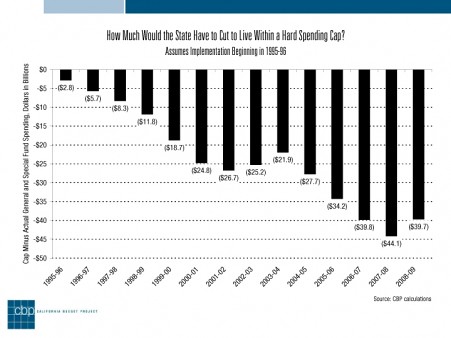
That’s not the Republican plan. There are persistent reports that a “hard spending cap” is going to be placed on the ballot as part of the deal – and a recent PPIC poll showed 70% of Californians would support a cap – never mind the fact that we’ve had one for 30 years.

As the California Budget Project clearly explains, a hard spending cap is a death sentence for government services. If we had a cap in place starting in 1995, as the chart below shows, this year we would have…you guessed it, $40 billion in cuts to make–>

Even worse, a spending cap prevents new spending efforts even if voters want to do so. Presumably a hard cap would stop high speed rail in its tracks, for example. Kiss goodbye any effort to address climate change, the drought, or the economic crisis. And when the economy recovers, California can never restore what was cut now. Schools will die once they are hit with the double whammy of massive funding cuts and NCLB rules.

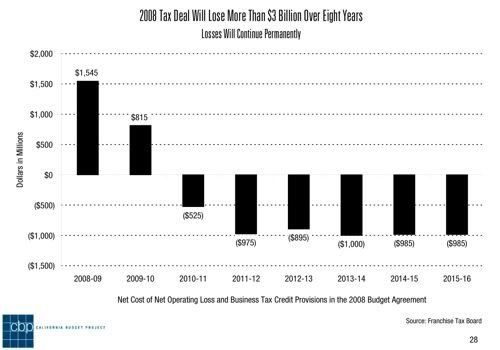
And that’s not all. We’re also told that the budget deal may include new tax cuts – permanent tax cuts at that, including for corporations. Whereas the federal government can simply go deeper into deficit to pay for a tax cut stimulus, bad policy though it may be, California cannot. The CBP showed the impact of similar tax cuts that were included in the 2008 deal – which will soon cost over $1 billion per year (<–)

Democrats need to understand – a bad deal is worse than no deal. A hard spending cap and tax cuts mean that the pain that would be induced by the current budget solution would last far into the future. It is a recipe for permanent disaster. It’s time for Democrats to show that they have given all they can give, and that if Republicans want to destroy public services, it will not be done with Democratic votes.

Media News Group Editorials: It’s the Yacht Party’s Fault

On Sunday 11 of the Media News Group papers – including the San Jose Mercury News – published editorials on their front page criticizing the budget mess. Notably, these papers placed most of the blame where it actually belongs – on the Republicans. From the Mercury News editorial:

The governor and all 120 legislators share responsibility for this. But most of the blame for the immediate crisis falls on Republicans in the Legislature, who this past summer – to a person – signed a pledge to not raise taxes. That was before an already large deficit mushroomed, making the need for more revenue imperative. Since then, Democrats and the Republican governor have offered significant compromise, but GOP lawmakers cling to ideological purity – schools, health care and other essential responsibilities be damned.

These lawmakers constitute barely over one-third of the Legislature. But because the California Constitution requires a two-thirds vote on the budget, it enables the tyranny of a minority to trump majority rule.

This day didn’t sneak up on anyone. It’s the result of too much borrowing and too little political courage over too many years – lavish spending in good times and insufficient restraint in bad. For this, Democrats, who’ve controlled the Legislature, and the governor share responsibility. Compounding the problem are spending initiatives that bind the Legislature’s hands. Voters have themselves to blame for these.

Obviously it’s not a perfect editorial – California doesn’t really have a spending problem – but it’s good to see MNG papers, owned by a notorious right-wing union buster make such a strong case for Republican ideology being at the core of the crisis.

The Monterey Herald was even more direct in their version of the editorial:

The best hope is that the people will become angry enough to get the message across, especially to the Republicans, that they need to get the job done or get out of the way.

The stalemate is the result of the GOP’s “no new taxes” pledge. It may have made for good headlines months ago, but sustaining it to the point of budgetary chaos is irresponsible….

A huge part of the problem is the state Constitution’s requirement that budgets be approved by a two-thirds vote. It has not prevented past overspending, but it enables the minority party, Republicans for the moment, to play the spoiler role no matter the consequences.

It is time to join the majority of states without a super-majority provision. It is time to say goodbye to those who pretend to stand on principle. The no-tax pledge may have been sincere at the start, but it has become only a bargaining chip. Republicans are simply holding out for maximum impact.

Does this mean it’s now conventional wisdom that Republican ideology and the 2/3 rule are to blame? I sure hope so. These editorials should bolster the case for an aggressive push by progressives and Democrats against the Republicans and the 2/3 rule in particular. If/when there is a special election this year, eliminating the 2/3 rule must be on there.

Let’s hope these editorials will percolate around the state, especially to some of the bigger news outlets, and produce some accurate reporting on the crisis for a change – California is broke because Republicans wanted it to happen.

Yacht Party To Hijack the Federal Stimulus?

It’s a pretty brazen suggestion even for the Yacht Party, which has already made clear that it wants to force California into an economic depression – Sacramento Republicans want to divert the federal stimulus into a “rainy day fund.” This would accomplish two of their goals – one, preventing California from protecting such vital services as schools and health care; and two, preventing a stabilization of the state budget that might frustrate their goal of using this crisis to impose far-right policies for good.

While many of the funds pegged for California would immediately help children, the poor and commuters, some Republican state lawmakers argue that the state should sock away some of the money for hard times in the future.

Democratic lawmakers say the federal funds should be spent sooner rather than later for whatever purposes the federal government requires.

Matthew Yi’s article is biased in favor of the Republicans – we’re already in hard times and the stimulus money is intended to be spent right now to reverse those hard times – but he does convey the core point, which is that the Yacht Party wants to destroy California’s ability to help ease the pain:

Villines agreed that avoiding costly borrowing would be prudent. But he had other ideas about using federal funds. Any federal money that “we might get should basically be put away into a … rainy-day fund for any potential future deficits if the economy continues to get worse,” he said, “as opposed to any budget factoring now.”

What Villines is saying here is that “we should hijack the stimulus money for our own radical agenda, instead of using it to help people who need help right now.” Chuck DeVore makes the point explicit:

“This is why the park service doesn’t want you to feed the bears in Yosemite,” said Assemblyman Chuck DeVore, R-Irvine. “All it’s going to do is to prevent them from being able to fend for themselves in the wilderness. This money is not the sort of tough love that we need … for us to have serious reforms that we need.”

To people like Chuck DeVore, Californians are the equivalent of Yogi Bear – people who don’t deserve help in an economic crisis, and who certainly shouldn’t be allowed to stand in the way of long-held wingnut dreams like a hard spending cap.

The fact is that the Republicans are way out on a limb here. If California progressives can move beyond the single-issue silos and unite, they will have a very good chance at turning the public against this kind of insanity. Even the LA Times is starting to get it – that the Yacht Party isn’t trying to help the budget or the economy, but merely wants to settle old scores. Unfortunately, too many people are not willing to actually listen to what Republicans are saying and still want to see this as some sort of bipartisan crisis:

[Sac State poli sci prof Barbara] O’Connor said all sides in the talks “are going to have to give up stuff they don’t want to give up.” Meanwhile, she said, the general public is finding it hard to understand why Republicans and Democrats can’t sit down, hash it out and “come up with the best bad solution.”

The general public is “finding it hard to understand” because that’s NOT what’s actually happening. The Yacht Party is hellbent on destroying California’s ability to recover from this economic crisis. It is that simple, and anyone who even listens to what Republicans are saying can understand that.

The only thing standing between the Yacht Party and total oblivion is the 2/3 rule and a public that, until now, has been resigned to fatalism regarding state politics. But when those Republicans start monkeying around with the core economic policy of the president over 60% of Californians supported, they are proving to us all that they are overexposed and overreaching. It’s time for progressives to unite to take them down.

We Must Change The Way We Live

In the 1930s two crises hit the Great Plains at once – 50 years of overfarming marginal lands had destroyed the topsoil and created what we know as the Dust Bowl, and at least twenty years of economic pressure to overfarm (to pay debts and make up for collapsed prices) had created an untenable financial situation for the farmers. Either one was going to end in disaster – the land would give out or the overuse of credit would end in deflation and ruin. As it happened, the crises both occurred at exactly the same time, producing a social catastrophe from which several states have still not recovered.

California now faces the same problem. For 60 years we have based our economy on the production and consumption of sprawl. This worked well enough until the late 1970s, when those who had prospered the most from this model decided to stop reinvesting profits in the state and in society, and took their ball and went home. The next 30 years were dominated by even more sprawl, financed by massive amounts of debt and by eating the state’s seed corn by slashing the government programs that built prosperity in the first place.

This was always bound to end in disaster, and as we are well aware, that disaster – in the form of economic depression and government bankruptcy – is now here. But the massive sprawlconomy binge had another set of costs whose bill is now coming due – water.

California had an unusually wet 20th century, and we exploited that to the fullest. To have a society built on sprawl and consumption, we needed to siphon as much water as possible to give not just to the new housing developments, but to the sprawling farms. Sprawl is a farming phenomenon as well – wasting land and water resources on resource-intensive crops grown to enrich shareholders, instead of sensibly using land and water to grow crops for subsistence and food security. California was in a water bubble, just as the state was experiencing a financial bubble. We have been living well beyond our means.

Ultimately the water bubble was going to burst. And just as in the 1930s Great Plains, it is bursting at the same moment as the economic bubble. For the least year or so you could drive down the backroads of the Salinas Valley, Salad Bowl Of The World, and see shuttered warehouses and laid off packing workers.

Now that water is less available the agricultural recession is shifting into higher gear. The highest unemployment rates in California are in our agricultural counties – 22.6% in Imperial, 14.3% in Tulare, 13.7% here in Monterey County. (Note: those stats are for nonfarm jobs, and yet the correlation between ag and the rest of the county economy is obviously very strong.)

The water crisis is now about to come to the rest of California. Sitting here in Monterey, in summer-like weather in January, I am inclined to believe the claims that this is the worst drought ever in the state’s recorded history:

California teeters on the edge of the worst drought in the state’s history, officials said Thursday after reporting that the Sierra Nevada snowpack – the backbone of the state’s water supply – is only 61 percent of normal.

January usually douses California with about 20 percent of the state’s annual precipitation, but instead it delivered a string of dry, sunny days this year, almost certainly pushing the state into a third year of drought.

The drought exacerbates the problems caused by our overuse of water resources. To prevent a total environmental collapse in the Delta massive reductions of water flows will be required. And for those of us who live in counties that don’t get our water from the Delta – places like Sonoma, Marin, and Monterey – the situation is going to be worse. Water managers in those counties are planning to 50% cutbacks in urban water use, which is an amount that will dramatically change how we live. We could let every lawn die and stop hosing down every driveway and still not get anywhere close to 50% reductions.

The Monterey Peninsula has been under Stage 1 water rationing for ten years now. You rarely see water wasted here, and new development has been at a standstill (how many towns have vacant lots and abandoned homes within a mile of the beach as we do?). But a 50% cut will force dramatic changes in how we live, as it will around the state.

Those changes ARE coming. There is no way around the fact that the way California was organized in the 20th century – politically, economically, and especially in terms of our land use and water use – is over. Done. Gone.

The question for us now is will we try to actively transition California to a more sustainable future? Or will we do nothing and let the chips fall where they may? The first option at least allows us a chance of rebuilding widely shared prosperity by funding local food, sustainable farming, and urban density. The latter would produce widespread immiseration while allowing a small aristocratic elite to enjoy a semblance of the 20th century lifestyle.

The choice is up to us.

Arnoldbucks

Note: I work for the Courage Campaign

Sometime next week California is going to begin running out of money, and instead of sending checks that to people that are owed tax rebates, financial aid, or other forms of state assistance, they will either have their payment delayed or receive an IOU. This will make our recession even worse, and will make it more difficult for the state to begin economic recovery.

The budget crisis has many fathers, but one in particular stands out – Arnold Schwarzengger. For five years he railed against taxes and government spending, and because he failed to lead the state toward a stable budget, California is going broke. Yet the media persists in speaking of Arnold as a strong post-partisan leader. They don’t tell Californians that he is a failure, that he is more responsible than anyone for the IOUs – particularly since he vetoed the Democratic majority vote budget plan that would have finally neutralized the 2/3 rule.

Progressive Californians need to engage in many forms of activism to respond to this crisis – and one of those forms is good old fashioned agitprop. And that’s what the Courage Campaign has done with Arnoldbucks. – our term for the IOUs that are almost inevitably going to be sent soon to Californians.

We made a video that answers the question of “what happens when Californians actually try to use an Arnoldbuck?” The result is frustrating and humorous, and hopefully it can help show Californians that this crisis literally has Arnold’s name all over it. And we also created our own version of the Arnoldbucks for Californians to download, print, and give to their friends.

Obviously the impact of Arnoldbucks, if and when they are actually sent to Californians instead of the payments they are owed, will not always be funny. Disabled families, health care clinics, and schools will be hit extremely hard by the state’s inability to meet its financial obligations. That will require a multifaceted response – including an effort to educate the public as to who is responsible for this mess. Our video campaign is one attempt to do exactly that.

So have a look at our Arnoldbucks video and share it with your friends – and help us push back against a media that refuses to hold Arnold accountable.

Below is the text of the email we sent to our members:

Dear Robert,

Just when you thought it couldn’t get much worse…

California faces financial “Armageddon,” as Arnold Schwarzenegger bluntly stated a few weeks ago. And yet Arnold and his fellow Republicans rejected compromises by Democrats to rescue our state from a catastrophic budget crisis, unparalleled in the history of California.

Because of the ridiculous 2/3rds budget rule — the super-majority required to pass a budget in the California state legislature — and Arnold’s failure to deliver even one vote from a small cabal of obstructionist Republicans, Californians may be getting IOUs in the mail next week instead of financial aid checks or tax refunds.

Many Californians are so overwhelmed by this paralyzing crisis that they’ve just tuned it out. As a result, Arnold is not being held accountable for his failure to lead.

That’s why we decided to try something a bit unorthodox — raise awareness by using humor to highlight the absurdity of these IOU’s, or what we are calling “Arnoldbucks.”

We asked one of our members to see what would happen if he tried to use “Arnoldbucks” as legal tender at a few businesses in the area. You won’t believe what happened. It’s all caught on camera — even a few security cams.

Take the edge off and check it out:

http://www.couragecampaign.org…

Know a friend who might need a laugh? Share this video with them, download your own Arnoldbucks, then tell us your ideas. We’d love to know what you plan to do with your Arnoldbucks:

http://www.couragecampaign.org…

We’re looking forward to hearing about your adventures with Arnoldbucks.

Rick Jacobs

Chair