All posts by Robert Cruickshank

Dems Step up on Safe Bicycling

Once upon a time bicycles were seen as a purely recreational form of transportation. Something for the kids in the cul-de-sac or for the health nut who tackles Highway 1 in Big Sur. To most Americans using bikes for commuting purposes was something done in places like Beijing – something to be pitied and dismissed.

Over the last few years this has begun to change, as more and more Californians are using their bicycles to commute to work or to school. To encourage this, May has been declared “National Bike Month” and May 12-16 is Bike to Work Week.

Since January I have been among the ranks of the bicycle commuter. Which just goes to show anyone can do it – I was always the unathletic nerd, but biking has come easy to me and has me in excellent shape. Last month I began serving on the Transportation Agency of Monterey County‘s Bike and Pedestrian Advisory Committee, to help develop a stronger network of bike trails, bike lanes, and to promote safe bicycling for riders, whether they’re recreational or commuters.

One of the most common issues we run into in developing these facilities is a lack of funds. To their credit Democrats have stepped up and proposed increasing funding for bike facilities. Assemblymember Mark DeSaulnier has proposed AB 2971 which would shift some developer fees into construction of bike paths and other safety measures. It was the subject of today’s Democratic radio address, where DeSaulnier linked bike commuting to cutting our carbon emissions as part of the AB 32 project.

It’s not everything we need, and most California cities have a ways to go to catch up to Davis or Portland. But with state support we can make bike commuting a viable method for more and more Californians. Besides, who ever said cars had to be the primary method of commuting? After all they began as a recreational form of travel.

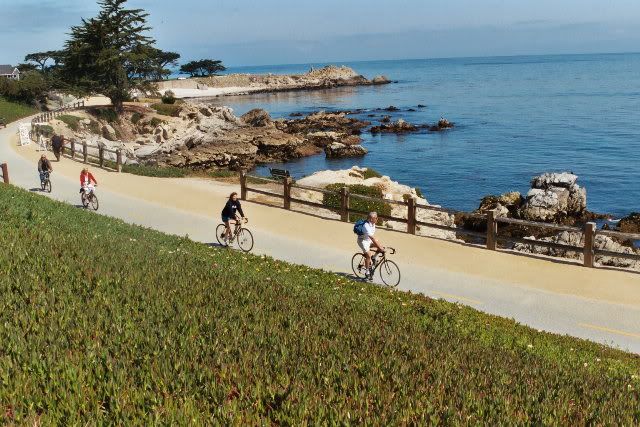
Finally, if you have a bike, and live reasonably close to your workplace, consider taking part in Bike to Work Week. You may not think you can make it – I know I didn’t – but you might surprise yourself. Even if not everyone can have the commute I have (pictured above).

What is CSU’s Problem with the Loyalty Oath?

Last week I brought you the story of another CSU teacher who was fired for wanting to change the state’s ridiculous and anachronistic loyalty oath to suit her religious beliefs. Today’s LA Times brings us the update on her story:

A Quaker who lost her appointment as a Cal State Fullerton lecturer after she objected to a state loyalty oath submitted a revised statement of her beliefs Thursday in a bid to win the job back.

People For the American Way, a Washington-based civil rights group now representing lecturer Wendy Gonaver, called on the university to reinstate her and adopt a policy protecting the religious freedom of all California State University system employees.

“She is willing to sign the oath as long as she can exercise her free-speech rights and note that her views as a Quaker would prevent her from taking up arms,” said Kathryn Kolbert, president of the organization and a constitutional lawyer. “We would like to avoid filing a lawsuit, but we are certainly prepared to do so if we need to.”

PFAW has clearly stepped up on this, and rightly so – this is a clear-cut case of violation of constitutional rights and Wendy Gonaver deserves support. They have proposed a new CSU policy regarding the oath in a letter to the Cal State Fullerton administration:

CSU recognizes that some of our employees may have religious or other objections to taking this oath.  It is our policy to accommodate the religious and other beliefs of our employees by allowing an employee to append an explanatory statement to the employee’s signed oath.

This would be a sensible policy, at least until the state finally does away with the moronic oath. No word yet on whether CSU is going to accept this, but the recent incidents suggest that CSU needs to reexamine their practices regarding the oath and need to adopt proposals such as this to guarantee the rights of their employees. There is absolutely no reason for them to resist this.

Unfortunately for Wendy Gonaver, Cal State Fullerton is resistant on offering her the job again:

[CSU General Counsel Christine] Helwick said the campus might not be able to rehire her despite the revision: “The addendum she is now proposing is different in tone, scope and content from the one she originally presented. However, the position for which she originally applied last August had to be filled by someone else when she refused to sign the oath.”

This is BS. It wasn’t Gonaver’s fault, as the CSU implies, but their own. The CSU system, and CSUF in particular, should be able to offer her another position. And the CSU system needs to implement the PFAW’s proposed policy change as well as get behind Alan Lowenthal’s effort to do way with the oath. Enough is enough.

Vallejo Declares Bankruptcy

After months of wrangling and negotiating the city of Vallejo has voted to declare bankruptcy. And to hear the local media tell it, like the San Francisco Chronicle, it is the fault of public workers, not poor political leadership:

After about four hours of discussion and public comment from the standing-room-only crowd, the council voted 7-0 to approve Tanner’s recommendation to declare Chapter 9 bankruptcy protection as a means to reorganize its finances, which have been shattered by spiraling public employee salaries and the plummeting housing market….

The city and its public safety unions have been at the bargaining table for about two years. The city is asking for its police and firefighters to take salary, benefit and staff cuts, while the unions say any further cuts would endanger public safety as well as the safety of the police and firefighters.

Vallejo spends 74 percent of its $80 million general fund budget on public safety salaries, significantly higher than the state average. The generous contracts are the result of deals struck in the 1970s, following a police strike that left the city in turmoil.

What is not said here, or anywhere in the article, is the reason for that public safety spending. Vallejo’s police and fire services are understaffed – as are many agencies in California, in a little-known but extremely important and widespread phenomenon. City leaders have been loath to hire new workers, but they have also needed the public safety services – so the workers that are on the payroll have been working overtime. And overtime pay is usually always higher than regular pay.

Vallejo, like many California cities, wanted to maintain a high services and low tax environment, and has found this is not possible, especially when an artificially-created bubble bursts. Instead of accepting responsibility and seeking new revenues to balance the city’s books without endangering the public, city leaders chose to blame the public workers for the problems and declare bankruptcy instead of avoiding the underlying issues.

To be fair, Vallejo is not in complete control of its own destiny. Decades of state and federal budget cuts, made to pay for tax cuts for the wealthy, have had a trickle-down effect of eviscerating services and leaving cities more and more financially exposed as state and federal aid has begun to dry up. It’s not exactly as if Bush and Arnold have directly told Vallejo to drop dead but through their inaction in the face of widening government financial crisis, they have achieved the same result.

Vallejo IS the tip of the iceberg, as many cities face similar problems. Some have done the right thing and sought new revenues, like Salinas, and avoided destructive service cuts. Others are following Vallejo down the path of blaming public workers. Without state and federal solutions, this scene may well replay itself again and again across the state in the coming years.

UC Privatization Proceeds – Fee Hikes Coming Next Year

When I was an undergrad at Berkeley in the late ’90s we paid around $4400 in “student fees.” It was higher than it should have been given the cost of living at the time, but the state of California had held UC costs at a fixed level from 1995 to 2001.

Of course, during the 1960s the state and the UC system actually held to the promises of the 1960 Master Plan for Higher Education, which included a promise to never charge students for the cost of instruction. In the 1960s when state treasurer Bill Lockyer attended UC Berkeley his total cost – for all 4 years – would have been $880. Figuring inflation and that’s $5,808 in 2007 dollars.

That’s going to be less than the per-year charge under a new UC fee increase plan being floated:

UC tuition will rise $490 to $7,126 plus campus fees, which average $881 this year. The tuition would reach $8,180 if raised to the 10 percent total.

Hume said students at UC’s nine undergraduate campuses can expect a more difficult time registering for some classes, larger class sizes, and cuts in student services.

“We will be less efficient. They will take longer to graduate. They will not be able to get classes. They will not be able to get their majors,” Hume said.

The CSU is following suit with a 10% increase of its own:

CSU Chancellor Charles Reed said during the same editorial board meeting that he is recommending that the CSU Board of Trustees approve a 10 percent tuition increase next week but that he will not go back for more later in the year. Fees at CSU will rise by $276 to $3,048 plus campus fees, which were an average of $749 per student this year.

These increases are going to make it even more difficult for qualified Californians to attend college, improve their earning power, and strengthen the state economy. With the credit crunch reducing the availability of student loans these increases leave me wondering whether this isn’t a sly way to drive students away – applications and freshman classes have been soaring year after year.

It’s also a further step in the privatization of our higher education system. With decreasing public support the onus is now on students to self-finance their education, which is in direct contravention to the principles of the UC and CSU systems as laid out in the 1960 Master Plan. If California is to have an economic future in the 21st century – if we are to keep pace with European and Asian economies – we need trained and skilled Californians able to handle the tasks of a 21st century civilization. Instead the state of California is abandoning that mission – for the sake of preserving the 20th century, we are going to sacrifice the 21st.

McCain-Clinton Gas Tax Plan to Cost CA 23,107 Jobs?

That’s the claim from the American Road & Transportation Builders Association, which has a study showing how the gas tax cut will affect jobs in each state.

The assumption the AR&BTA is using is that the tax cut would blow a $9 billion hole in the federal transportation budget. Based on FY 07-08 expenditures CA’s share of that would be $664,406,924. The association then estimates that 23,107 jobs would be lost here in California – roughly equivalent to the proposed school layoffs – over the next three years.

No wonder then that local transportation agencies across the state are denouncing this foolish proposal. From Santa Cruz:

“It would deplete an already oversubscribed highway trust fund, making a bad situation worse,” commission Executive Director George Dondero said. “We’re trying to get the government to generate more money for transportation, not less.”

Dondero said he didn’t know how much the county could lose, just that “future projects would have to wait.”

Critics of the gas-tax break, including Clinton opponent Barack Obama, say it would have little impact on consumers, saving the average driver an estimated $30 over the course of the summer, and instead create a $10 billion gap in the federal highway trust fund, used for highway construction and maintenance.

Calling the proposal an “election pandering” tactic, commissioner and county Supervisor Ellen Pirie said it would benefit oil companies.

“There will be a lot of harm in terms of infrastructure projects and maintenance people want taken care of,” Pirie said. “It would be great if there were a way to reduce the price of gas. I know a lot of people are struggling with this, but I don’t think [the tax break] is an effective way to do this.”

Thanks to Daily Kos diarist Jimmy Crackcorn you can see just how much this pander will be worth to you with an online calculator. Plugging in my expected summer driving (75 mi per week) and car mileage (33 mpg) I get…$16!

Wow. A whopping $16. That’s maybe a dollar a week. And at the low, low cost of 23,107 jobs in our state during a recession and stalled transportation projects that if completed would help drivers save on gas for years to come. Of course, the lost jobs have a ripple effect on both state budgets (lost income tax revenue, lost sales tax revenue) and the state economy.

The real solution is, as I explained at my high speed rail blog last night, investment in things like trains. Thank god someone in this race is talking about that:

The irony is with the gas prices what they are, we should be expanding rail service. One of the things I have been talking bout for awhile is high speed rail connecting all of these Midwest cities — Indianapolis, Chicago, Milwaukee, Detroit, St. Louis. They are not that far away from each other. Because of how big of a hassle airlines are now. There are a lot of people if they had the choice, it takes you just about as much time if you had high speed rail to go the airport, park, take your shoes off.

This is something that we should be talking about a lot more. We are going to be having a lot of conversations this summer about gas prices. And it is a perfect time to start talk about why we don’t have better rail service. We are the only advanced country in the world that doesn’t have high speed rail. We just don’t have it. And it works on the Northeast corridor. They would rather go from New York to Washington by train than they would by plane. It is a lot more reliable and it is a good way for us to start reducing how much gas we are using. It is a good story to tell.

That was Barack Obama, giving impromptu remarks to an Indiana couple a few days ago.

The Budget is Up for Grabs

That’s the impression I am getting after surveying the political and media landscape over the last few days. With the May Revise now two weeks away, the outcome of a long and contentious summer budget process is less clear than ever.

There is a growing recognition among Californians that new revenues are going to be needed to close the deficit if we are to continue having public schools. Health care, transportation, and other government services are all going to be impacted by this budget, of course, but it is education that has become the most high profile part of the budget. If Californians can be convinced to restore the relationship between taxes and services, as David Dayen framed it yesterday, it is going to happen because they will refuse to destroy our schools.

Whether Californians will be convinced – and what the details of a tax proposal will be – are at the core of what is “up for grabs” with the budget.

Today’s LA Times reports that Arnold has now embraced new taxes, sending his staff to negotiate not with Democrats but with business groups on what form this will take:

As Gov. Arnold Schwarzenegger continues to say publicly that he will hold the line against new taxes, his administration is laying the groundwork for a possible tax increase.

Administration officials are soliciting advice from business groups and other special interests on how to propose billions of dollars in tax hikes that could help close a budget shortfall the governor now says is as large as $20 billion.

Schwarzenegger’s staff is exploring a range of options, including sales taxes on lawyer and accountant services, on high-end services such as golf lessons and personal-trainer sessions, and on takeout coffee and other prepared foods that are not taxed now.

The administration’s goal, participants in the discussions say, is to gather support for new taxes from a broad spectrum of the business lobby, giving the Legislature’s Republicans political cover to break their pledges never to vote for them.

More below, including how Hillary Clinton may be undermining a progressive revenue solution…

Arnold’s proposed new revenues are very much like those that Pete Wilson used to close the budget deficit he faced in 1991-92, when newspaper and snack taxes were used to raise the needed revenues.

The problem with this approach is that it is still nibbling around the edges of our structural revenue shortfall. Estimates are that the modernized sales and professional services taxes might raise as much as $9 billion, a figure that seems a bit high. And of course, even that would leave as much as $11 billion in deficit still to close.

The core of our revenue shortfall is a regressive tax system that hits the lower classes harder than the upper classes. California’s overall tax burden is 18th among the states, but our property tax rates are at #42. The failure to modernize property tax law, to revise Prop 13 to protect fixed income homeowners while making the wealthy and commercial property owners pay their fair share, is perhaps the major reason why California faces such enormous budget deficits, whereas other states face far smaller shortfalls.

And of course, nowhere does Arnold appear to be acknowledging his colossal error of repealing the restoration of the Vehicle License Fee, which costs our state $6 billion a year. A modernized sales and professional services tax and a pre-1998 VLF would bring as much as $15 billion in revenue, making legislators’ jobs this summer far easier.

The devil is in the details of course, especially in what we have to give up to get new revenues. These would be the right wing tax solutions I discussed last week, and the LA Times article refers to them again:

Before the governor raises taxes, should he go that route, he is expected to demand legislative support for spending restraints that would force the state to create a rainy-day fund with revenue windfalls it receives during good economic times. Business leaders have long pushed for such measures, arguing that they would curb runaway spending and bring some stability to state finances.

Business leaders are also lobbying the administration to use potential tax hikes as leverage for policy changes unrelated to state spending, such as changing workplace rules to allow employers to dictate when workers can take breaks. Political analysts were not surprised to learn that the governor was considering tax hikes.

Some continue to argue whether voters will even support new taxes at all. The recent PPIC poll has given ammunition to both sides of the argument, with Bill Cavala arguing it suggests new taxes are unlikely:

Bad news for California’s budget came in from the precincts today. The latest PPIC survey indicates that (1) voters don’t want to cut education’s budget; and (2) don’t want to raise taxes to avoid those cuts. Years of budget flim-flam – led by Governor flim-flam – have convinced voters we can simply ‘reorder’ priorities and get by….

With many of the gimmicks used to ‘balance’ budgets in previous short-fall years no longer available, and with a cash-flow problem that will crest this summer, things look bleak indeed for the new leaders of the Legislature. And they deal with these problems starting with a ‘favorable’ rating by the public of 22%.

I am much less pessimistic than Cavala. He seems to be falling back on the failed assumptions that Democrats have used over the last 30 years to evade action on our structural revenue shortfall – blame the voters for not supporting tax fixes. Reading the PPIC numbers I see a very different story – about half of the state believes new taxes are a good idea. Sure, we need 66.7%, but even half is a very good place to be in considering how widespread our state’s anti-tax madness has become. Democrats should use this as a starting point, not an excuse for inaction.

Unfortunately these efforts may have been undercut by, of all people, Hillary Clinton. Her embrace of McCain’s idiotic gas tax cut – which would save drivers a total of $30 for the whole summer while blowing a $10 billion in the already-stressed federal transportation budget.

By embracing the notion that tax cuts, not investment in public services, are the solution to economic distress, Hillary Clinton has delivered a major victory for the Club for Growth and Howard Jarvis Association and delivered a serious blow to progressive Democrats who are trying to restore the link between taxes and services, between taxes and a high quality of life.

Democrats in both DC and Sacramento need to unite on this matter, and categorically reject the Republican anti-tax framing that has done so much to produce this mess. It doesn’t make our job easier here in CA to have one of the Democratic candidates running around agreeing with the right-wingers on taxes.

Another CSU Teacher Fired over Loyalty Oath

This is getting ridiculous:

When Wendy Gonaver was offered a job teaching American studies at Cal State Fullerton this academic year, she was pleased to be headed back to the classroom to talk about one of her favorite themes: protecting constitutional freedoms.

But the day before class was scheduled to begin, her appointment as a lecturer abruptly ended over just the kind of issue that might have figured in her course. She lost the job because she did not sign a loyalty oath swearing to “defend” the U.S. and California constitutions “against all enemies, foreign and domestic.”…

As a Quaker from Pennsylvania and a lifelong pacifist, Gonaver objected to the California oath as an infringement of her rights of free speech and religious freedom. She offered to sign the pledge if she could attach a brief statement expressing her views, a practice allowed by other state institutions. But Cal State Fullerton rejected her statement and insisted that she sign the oath if she wanted the job.

“I wanted it on record that I am a pacifist,” said Gonaver, 38. “I was really upset. I didn’t expect to be fired. I was so shocked that I had to do this.”

This comes on the heels of the firing – and reinstatement – of a CSU East Bay instructor who modified the oath – she too was a Quaker. The article in the LA Times does an excellent job of showing the background of the oath and the different ways it is treated in California higher ed – whereas the UC system advises signers of their rights to modify the oath to suit their religious needs, CSU campuses do not.

It suggests that there should be some sort of investigation of the CSU system, to see if there have been any directives that were sent from the central offices to campuses regarding strict – and illegal – interpretations of the oath.

All this demonstrates is how absurd this oath is. There is no good reason for it to remain as part of our state’s constitution – the Soviet Union is dead and buried and communism is barely clinging to life – literally and figuratively – in the few remaining outposts it has where it hasn’t morphed into neoliberalism.

Last month Alan Lowenthal authored a bill to drop the oath – to which the Yacht Party cried that the oath was necessary to guard against terrorist groups.

Perhaps someone should inform the Republicans – and the CSU system – that Quakers are not terrorists?!

Is Water Rationing In Our Near Future?

Like me, you probably thought this was a wet winter. It certainly was in January and February here in Northern California, where several major storms dumped a lot of rain into local reservoirs, and snow in the Sierras. There was even hope by late February that we might have had enough snow to make up for 2007’s drought.

Unfortunately those hopes have been dashed:

California just came through its driest March-April rain period – 2.3 inches of precipitation in the Sierra – since records began being collected in 1859. The biggest reservoir in the state, Lake Shasta, is at 75 percent of its average capacity for this time of year. The second-biggest reservoir, Lake Oroville, is at 59 percent.

State officials warned today that widespread water rationing was a very real possibility this summer. Another few years like this, experts say, and we might start running drastically short of water….

Water managers in the East Bay, Santa Cruz and San Diego are either considering or instituting water-rationing measures this spring, and they expect to tighten their mandates next year.

I would not be surprised if we on the Monterey Peninsula, dependent on the Carmel River and not hooked up to the state water system, face rationing this summer as well.

As the article goes on to explain, with an interview with Stanford (and former UW) historian Richard White, California has to make some major decisions about how to deal with its water future:

“There is enough water for people – just not enough for people and the agricultural system the way it’s set up now,” Richard White, a leading environmental historian, said as he hiked past one of Stanford’s two main reservoirs Saturday. “Like with so many things, you may have to make some choices. Hard choices.”…

White said the trouble isn’t that there are too many people or too much agriculture in the sprawling growing regions. It’s just that we expect too much of what we have.

“My guess is that something major will have to be done in the next 10 years or so, and it will probably take a drastic drought to bring it about,” said White, who also is co-director of Stanford’s Bill Lane Center for the Study of the North American West.

Arnold wants to ignore the problem and simply build more dams and canals to prevent Californians from making these hard choices. Although Lois Wolk helped deal a major blow to the Peripheral Canal this week, it and other backward plans will resurface.

Ironically, global warming might just be the kind of opportunity we need to make these major changes. Much of California’s water delivery systems were built over 50 years ago, on the assumption that the relatively wet climate of that era would persist, or was “normal.” As we now know, it wasn’t, and California has experienced 200-year megadroughts as recently as the 13th century. Global warming is already altering our rainfall patterns, and will force us to make the changes we have been for too long postponing.

Our watchwords for water solutions must be “sustainability” and “affordability” (as in keep private companies FAR away). Many California localities, like Monterey, have shaped growth around water supplies for many years now. This practice needs to be extended to the entire state, to ensure that growth and development happen with respect to, and not ignorance of, locally available water sources.

Ultimately we must also deal with agriculture. The food shortages experienced around the world and here in California show the value of locally produced food. But that is a different use of the land than the massive export-oriented agribusiness that characterizes California agriculture. We must now consider changing that set of practices, if our water supplies are to hold out, and if our people are to be properly fed.

Yacht Party Plans to Hold State Budget Hostage Again

Today’s SacBee is reporting that Republicans are planning to demand gutting of business and environmental regulation as a price of their support for any budget. Among their list of demands is an end to mandatory overtime pay (because you want workers to be paid less as we enter a recession), a one-year delay in the implementation of the AB 32 goals, state assessment of the effects of regulation on business, and a yacht and safe passage to Costa Rica. (Hmm, not sure about that last one.)

Speaker Fabian Núñez provided the proper response:

“It’s unfortunate Senate Republicans are once again trying to use their budget leverage to push unrelated proposals that would dirty our air and hurt working families,” Assembly Speaker Fabian Núñez, D-Los Angeles, said in a statement. “They tried unsuccessfully to do that last year, and their efforts will fail again this year.”

Whereas Don Perata provided the wrong response:

“We are in such dire trouble fiscally, I am glad for anybody who wants to get into the game,” Perata said. “We have not yet come to grips with how difficult this year will be. Everything must be on the table.”

Don, the Republican proposals have absolutely nothing to do with the state’s fiscal situation and would in fact make it much worse by destroying our economy and thereby lowering collection of taxes.

In any case Democrats may have been given a gift with this. They can go to Californians and say “we have a balanced plan to balance the budget, a plan that balances public services and public taxes. The Republicans prefer to hold the state hostage so they can implement a far-right agenda.” Show voters who is really interested in solving our budget problems and who just wants to use it to ram more disaster capitalism down our throats.

Of course this all just shows the need to get rid of the 2/3 rule. Too bad nobody thought to spend some money on that one this year…

How Exactly is a $20 Billion Deficit Good For Arnold?

In November 2002, after winning a close re-election battle against Republican Bill Simon, Gray Davis announced to Californians that the budget deficit had swelled to $35 billion. In response the state’s media denounced Davis as having caused the crisis and hiding the real facts from voters. In this atmosphere the recall effort that began in early 2003 caught on like wildfire, as the deficit was blamed on Davis, instead of on Tom McClintock’s tax cuts or the economic downturn.

Six years later we find ourselves in a similar place. The economy is in a downturn and state revenues are being hammered. Arnold Schwarzenegger is now warning that the deficit could be as large as $20 billion. So how does the media react?

Well, if you’re the San Francisco Chronicle‘s Matthew Yi, you talk about how this might help the governor and his proposed budget reforms:

The new deficit figure – 30 percent higher than the latest estimates by lawmakers – reflects a deepening fiscal crisis that has polarized the budget debate in the state Legislature, with Republicans vowing to fight tax increases and Democrats saying they won’t settle for cuts only.

Schwarzenegger, while maintaining he won’t support raising taxes, also wants to make fundamental changes in California’s budget process, and experts said today that the governor’s deficit estimate this week could help his campaign for budget reform.

The governor’s ideas include imposing a cap on spending, setting aside a so-called “rainy day fund” for lean budget years and giving him authority to impose automatic spending cuts in years when the state faces a fiscal crisis.

His proposal has gotten little traction in the state Legislature as Democrats, who control both houses, are balking at the governor’s ideas. But the widening budget deficit highlights the need for a structural change in how the state budget is worked out each year, said Larry Gerston, a political science professor at San Jose State University.

The article goes on to discuss the various reform proposals, and has a good quote from Steve Maviglio emphasizing the need to focus on immediate solutions instead of pointless “rainy day funds” and the like (when your roof is leaking, you need to fix it, not plan for the next rainstorm).

Nowhere in the article is any criticism leveled at Arnold for having created this mess. Gray Davis, victimized by a severe economic downturn, was held responsible by virtually the entire state media corps for the budget deficit. Arnold gets a pass, even though his role in creating this deficit was far more direct. Let’s review:

  • Arnold refused to consider new taxes to close the last budget deficit. Instead he floated billions in bonds, leaving the state with a debt service load of $3-$4 billion each year.
  • As his very first act in office, Arnold issued an executive order repealing the VLF fee increase. At the time it cost the state $4 billion a year; recent numbers from the California Budget Project suggest the current figure is $6.1 billion.
  • When the first warnings of a looming budget deficit were sounded last summer, Arnold offered no leadership whatsoever to help right the state’s finances. A few tax increases in 2007 would have helped improve the state’s fiscal picture and given us a smaller, more manageable deficit today. Instead Arnold enabled the Yacht Party’s two-month hissy fit and line-itemed $700 million in health care cuts and $1.3 billion in public transit cuts from the 2007-08 budget.

The first two points suggest that Arnold is directly responsible for around $9 billion – half the projected deficit. Gray Davis had the bad luck to be elected governor in 1998. Arnold helped force Davis’ early exit from that office in 2003 on a promise to permanently fix the state’s budget. Apparently that promise is as forgotten by the media as Arnold’s role in creating the current deficit.

Madness. Simply madness.