Tag Archives: bankruptcy

The Reality of RDAs

What do the Cities of San Bernadino, Mammoth Lakes, & Stockton have in common?  All three cities  follow RDA and the League of California Cities, all circumvented AB26,  and all three went bankrupt within a year.

Tax revenue is collected for the basic needs and services of the community, not to fund the private sector.   The League of California Cities and the RDA Association are not on the side of the people.  They are lobbyist groups who’s purpose is to divert money to themselves and their affiliates.  

In 1945 California authorized Redevelopment Agencies (RDA’s) to alleviate urban blight.   Blight is defined by state law as a combination of physical and economic conditions – vacant buildings, declining property values, poverty, high crime rate – that prevent private enterprise from developing in the area.    

In the beginning very few cities used RDA, now most not only use but abuse RDA.    Half of California cities are declared between 11-30% blight and 20% of cities claim over 30% blight to acquire land for RDA.   The entire city of Imperial Beach has been declared blight.  Imperial Beach is 1 ½ miles of beach-front property in Southern California;   Does that sound ‘blight’ to you?

Powers of RDA:

Eminent Domain – Once an area is declared blight the city has the right to exercise the powers of eminent domain.   The League of California Cities considers the powers of eminent domain an ‘important tool’ and encourages city officials to declare areas of their city blight to obtain eminent domain powers.  

Take Out Loans & Issue Bonds without Voter Approval – RDA’s use a federal Community Development Block Grant to start a project, but the remainder of the funding comes from issuing debt.  By declaring a city blight the city is able to side-step Prop 13 to take out loans and issue bonds without voter approval.

Funding of RDA:    

RDA gives the impression that the money is from state or federal grants, but 97% of all RDA finances are funded by the city.   RDAs receive the federal Community Development Block Grant (CDBG) to begin work, but all redevelopment activity is financed by taking out loans that the city backs with future property taxes.  

Tax Increment Financing:  When Prop 13 passed RDAs feared a limited money stream, so they lobbied for special property tax revenues.  After an RDA area has been established all property tax increases – less 2% for inflation – goes entirely  to RDA instead of being used for the basic needs of the city.   In the case of Imperial Beach all of IB is declared blight so ALL property tax increases go to the RDA program.    The payments to RDA last as long as there is debt outstanding, and RDAs no longer have plans to conclude their projects, so eminent domain remains on the properties.

Cost of RDAs:

We can see the results of RDAs in the bankruptcies of Stockton, San Bernadino, and Mammoth Lakes.   RDA eats up $1.5 billion/year of our cities budgets in the State of California.  By reviewing the  financial records of Imperial Beach shows the actual costs of RDA.  

City Services vs RDA:  97% of all RDA funding is from the city itself.   Taxes are collected for the general needs of the community, not to fund the private sector.    Originally an RDA project took about 2% of a city’s budget, now RDAs are swallowing up to 30% of city budgets.  

The bigger problem is that the cities are spending even more on RDA than they are acknowledging.   Imperial Beach’s RDA is 32% of the budget, but I also found $4 million spent on RDA that is being funneled through ‘dump accounts’.    The budgets of numerous city departments have ‘ABC’ accounts listed with their expenditures.   The ABC accounts pad the departments’ budget by as much as 25%.   The ABC accounts on the IB Fire Department’s $2.3 million budget is $450,000 – 19% of their budget is being padded with RDA costs and legal fees.  

Legal Fees:  

Google ‘RDA’ and you’ll find dozens of lawsuits pending.  The Imperial Beach Financial Report for  the year ending 06/30/11 stated City Attorney Fees at $244,000 – but paid out over $500,000 defending RDA lawsuits.   This year the City Attorney Fees are budgeted at $200,000, but have already spent $600,000.   In 2011 the City of IB also cut two checks to the RDA Association to help pay for their legal fees.

Massive Payrolls:

Another similarity of every city that belongs to RDA and the League of California Cities is massive payrolls for the top elected and appointed officials.  Mammoth Lakes has a population of 8,000 people yet the Comptrollers’ 2010 report shows their City Manager’s salary is $198,533; Assistant City Manager at $186,358; and Exec Assistant to the City Manager at $71,708; and Airport Director at $151,431.  

What are the salaries of elected and appointed officials in the city of Imperial Beach?    That is information the City refuses to disclose.  The new budget shows the City Council and Appointed City Officials shifted half of their payrolls to RDA accounts to avoid the State Wage Limits.    City elected and appointed officials are giving themselves multiple titles to double dip wages.

How To Tell If Your City Is RDA?       Simply look at the City Council Agenda.    

“..JOINT REGULAR MEETING OF THE MAYOR AND COMMON COUNCIL OF THE CITY OF SAN BERNARDINO, MAYOR AND COMMON COUNCIL OF THE CITY OF SAN BERNARDINO ACTING AS THE SUCCESSOR AGENCY TO THE REDEVELOPMENT AGENCY, MAYOR AND COMMON COUNCIL OF THE CITY OF SAN BERNARDINO ACTING AS THE SUCCESSOR HOUSING AGENCY TO THE REDEVELOPMENT AGENCY, AND MAYOR AND COMMON COUNCIL OF THE CITY OF SAN BERNARDINO ACTING AS THE HOUSING AUTHORITY ..”

The Mayor and Council are hired to oversee the affairs of the City Employees and finances.  It is a conflict of interest for council to belong to lobbyist organizations and to use tax payer dollars to fund  lobbyists.   ‘Successor’ RDA agencies are RDA on steroids.   Their purpose is to shift as much money as possible from the city general fund to RDA regardless of the harm done to the city.  

Our  government functions on a system of checks and balances, but when city elected and appointed officials conspire together we have lost balance.

The League of California Cities lobbies every branch of city government.   Their website lists departments for  council, city managers, city attorneys, finance, city clerks, fire, police, & public works.   The League nurtures a mentality in city officials that circumventing laws and putting their cities in debt with unnecessary construction projects and massive salaries is acceptable.

Circumventing wage laws burdening cities with massive debt from unnecessary construction projects  can no longer be acceptable in our State.      We must close down RDAs and remove any elected or appointed officials associated with and lobbyist organizations.     Government officials are paid to work for the people, not to conspire against us.    

Read more about the Imperial Beach Audit at: http://libionline.net/index.html

[poll id=”

487

“]
Municipal bankruptcy is all the rage?

Cities throwing in the towel on fiscal issues

by Brian Leubitz

The budget issues in cities across the state are trying at best. With state cutbacks and lower than expected growth in sales tax revenue, many are facing severe budget issues.  So…

Facing the same financial stressors that pushed San Bernardino toward bankruptcy, cities across California are slashing day-to-day services and taking other drastic actions to skirt a similar fiscal collapse.

For some, it may not be enough.

San Bernardino on Tuesday became the third California city to seek bankruptcy protection in the last month and, while no one expects the state to be consumed by municipal insolvencies, other cities teeter on the abyss.(LATimes)

Now, decreasing the pressure to pay back bond holders in a time of crisis might be the best course for some of these cities. However, the other side of this issue is that benefits that were agreed to many years ago in a negotiation process are now being reversed. Typically, the cities negotiate  in order to reduce the fiscal strain at some point in the process, but when it comes to bankruptcy, all bets are off. And in many cases, this is putting some real stress on retirees.

“I am already taking generic meds for cholesterol and triglycerides against my doctor’s advice, I can’t afford the $70 co-pay. My wife cries all the time. She don’t understand how when they promise you all this stuff, then they can] just take it away,” he said in court documents.([LA Times)

The stigma of muni bankruptcies may be decreasing but the impacts are still substantial.  At this point, let’s hope that we can move forward through the traditional budgeting process for a while to come.

Fresno Also Looking at Bankruptcy

Municipal bankruptcy becomes mainstream

by Brian Leubitz

When Vallejo was looking at bankruptcy, it still seemed a little taboo. There was a stigma attached.  However, since then, municipalities, especially when right-wingers are involved, figured out that municipal bankruptcy is a great way to break the back of the public employees.  And, so hooray, they are becoming more acceptable. Stockton is already considering it, and now add Fresno to that mix:

Fresno Mayor Ashley Swearengin on Monday warned that the city is in “severe financial stress” that demands immediate action and presented a 10-year plan calling for more concessions from city workers.

But the presidents of the city’s two public-safety unions said they sense Swearengin is being overly dramatic for political reasons, and urged the public to get all the facts before choosing sides.

Fresno’s budget season has come early this year, and it’s already turning into a war.

At a morning City Hall news conference where she was joined by City Manager Mark Scott, Swearengin warned that “there is no Plan B” to the cost reductions, and Scott warned that even bankruptcy could not be ruled out if expenses don’t come down.

“It is not in our employees’ best interest for their employer to be so financially unstable,” Swearengin said. “I hope they will see that.”(Fresno Bee)

The city is facing a $15mil shortfall in the next fiscal year, doubling a few times over in the next 5 years. For a city like Fresno, this is a really big deal, and changes they way they provide services.  At the same time, this isn’t as existential as Mayor Swearingen is making it seem. This is a negotiation, and cities have discovered that they have a nuclear weapon in their pocket that they didn’t know about.  And, oh, look, at that…it’s a nuke, it sure would be bad if that went off in here, wouldn’t it?

Mayor Swearingen isn’t necessarily a right-winger. She’s hardly a progressive, but not one to really be pushing the ball forward too much on the big conservative issues. But, perhaps that tells us more about the role of muni bankruptcy now that is being used in this situation. Fresno seems unlikely to ever get there, but anything to beat down the unions, I suppose.

Fortunately after the Vallejo bankruptcy, the Legislature passed, and the Governor signed, AB 506  that requires a mediation process before they can actually declare.  It’s something of a credit counseling service, that brings the City and the creditors together to work things out before the situation becomes a toxic waste site for future credit for the relevant city. It still isn’t as restrictive as some other states are with their municipalities, but it was a step forward from the old situation of playing with the nukes out in the open.  Whether this will actually prevent bankruptcies is still to be determined.

Pressured By CA Lawmakers, Obama Expands Mortgage Refinance Program

When the Obama Administration’s plan to mitigate foreclosures came out, it was clear that it would be insufficient to deal with the particular challenges faced in California.  Initially, the plan would only modify loans where the amount owed was 105% of the home’s true value.  Given that home prices have collapsed here, this would have helped almost nobody in California.  State lawmakers, in particular the Democratic point person on mortgages and foreclosures Asm. Ted Lieu, went to Washington to lobby for changes.  And today, faced with a sluggish mortgage rescue program attracting few lenders or homeowners, the Administration expanded the plan.

The Obama administration said Tuesday it is expanding its foreclosure prevention program to cover second mortgages and to direct more troubled borrowers to the Hope for Homeowners program.

Under the administration’s new program, the interest rate on second mortgages will be reduced to 1% on loans where payments cover interest and principal and to 2% for interest-only loans. The government will subsidize the rate reduction, with the money going to the mortgage investor […]

Also Tuesday, the administration said it is now requiring servicers to offer troubled borrowers access to Hope for Homeowners as a modification option if they qualify.

Expanding Hope for Homeowners would address one of the major holes in the original Obama foreclosure prevention plan. It helps homeowners whose homes are now worth far less than their mortgages.

Servicers had balked at participating in the Hope program because it required they reduce the mortgage principal balance to 90% of a home’s current value.

Hope for Homeowners, which began in October, is being revamped in Congress. Servicers would have to reduce the principal to 93% of the home’s value. The change would also reduce the program’s high fees, which turned off many troubled borrowers.

Loan servicers get a fair bit of cash incentives for participating in the program, which I don’t totally support, but if we have to bribe lenders in order to keep people in their homes, that makes more sense than spending the same amount of money on the fallout from a foreclosure.  And lenders do take a haircut in the Hope for Homeowners program, the first loss to my knowledge that lenders have been forced to take.

Asm. Lieu responded with this release (flip it):

“I am very pleased the Obama Administration today acted on the concerns raised by states such as California and took two steps to expand refinance and foreclosure assistance to distressed homeowners.

First, the Administration announced it would incorporate the Federal Housing Administration’s (FHA) Hope for Homeowners program into the existing Making Home Affordable Program.  This is significant because currently, the Making Home Affordable Program has a 105% underwater refinancing cap, which shuts out many Californian homeowners.  The Hope for Homeowners program does not have that limitation; instead, the Hope for Homeowners program states that lenders will take a loss on the difference between the existing loan amount and the new refinanced loan, which is set at 96.5% of the appraised loan value.      

For example, under the existing Making Home Affordable program, a homeowner whose home is valued at $100,000 but owes $120,000 on the existing loan balance would not qualify for refinancing under the program because the loan is 120% underwater.  However, under the Hope for Homeowners program, the homeowner could qualify and the new refinanced loan would be $96,500.  The lender would take the loss of $23,500.  The Obama Administration would increase the number of lenders participating in the Hope for Homeowners program by offering financial incentives to the lenders.

Second, the Administration announced steps to address the second lien problem.  Many distressed mortgages have two liens and often the second lien holder does not want to modify the loan.  The Obama Administration will provide financial incentives to allow the second lien to be reduced or extinguished.

These two critical actions will expand assistance to distressed homeowners in states such as California, where many loans are more than 105% underwater or have second liens.”

This is decent news.  Unfortunately, the tool that homeowners really need to stave off foreclosure, the ability for bankruptcy judges to cram down the principal of a loan on a primary residence, appears poised for what amounts to defeat in the Senate, a testament to the continued power of the nation’s biggest banks.

In order to garner the support of conservative Democrats and a few Republicans, the proposal has been watered down. The bankruptcy legislation will still allow homeowners to renegotiate mortgages in bankruptcy – the so-called cram down provision – but only under strict conditions. The banking industry has lobbied fiercely against cram down, but Durbin said on the Senate floor Monday night that the compromise was supported by Citigroup, which has been at the negotiating table.

“In the past, some of my colleagues understood the need for action but have been uncomfortable with the original language. Let me be clear: this amendment is different,” said Durbin. “The amendment I’m going to offer will make a modest change in the bankruptcy code with a lot of conditions. It won’t apply across the board. This amendment limits assistance in bankruptcy to situations where lenders are so intransigent that they are unwilling to cooperate with the foreclosure prevention efforts already underway – Obama’s homeowner assistance and stability plan and the Congressionally-created HOPE For Homeowners, which this bill will greatly improve.” […]

Meanwhile, the banking lobbyists are furiously lobbying against it and Durbin acknowledges it will be difficult to “muster the votes, although I know it will be hard.”

It is “hard to imagine that today the mortgage bankers would have clout in this chamber but they do,” said Durbin. “They have a lot of friends still here. They’re still big players on the American political scene and they have said to their friends, stay away from this legislation.”

We will be in a better position with foreclosures by the end of the week than we were at the beginning, but not where we need to be.

Ellen Tauscher’s Insatiable Appetite For More Homeless People

Late last week, Democrats temporarily shelved a bill that would allow bankruptcy judges to modify the terms of mortgages on primary residences (also known as “cram-down”).  Moderates who put the hold on this legislation, particularly former Wall Street investor Ellen Tauscher, crowed about it to the media.

This hardly amounts to a breakthrough win for party moderates – or a major concession by the speaker. But it was a consequential moment in the minds of moderate leaders who often find themselves marginalized in a caucus dominated by liberals.

“It shows we have bench strength, and it shows we can flex,” said California Rep. Ellen O. Tauscher, who chairs the New Democrat Coalition and played a central role in negotiations over the bankruptcy bill […]

Moderates worry Pelosi is routinely staking very liberal positions to push House versions of big bills as far to the left as possible to enhance their standing in negotiations with the historically centrist Senate. This might be a smart tactic, but it often hurts Democrats who rely on Republican votes to win reelection. Put bluntly, it makes them look too liberal […]

That prompted lawmakers, like Tauscher, to limit the scope of the bankruptcy bill as much as possible, even though this measure is only loosely related to the president’s broader proposal.

Tauscher’s New Democrat Coalition teamed with their natural allies in the Blue Dog Coalition to impose 10 significant changes, including requirements that bankruptcy judges use federal guidelines to determine the fair market value of a home and that modified loans must be “unaffordable and not just underwater” to prevent wealthy homeowners from taking advantage of the process, according to a widely distributed e-mail from Adam Pase, executive director of the New Democrat Coalition.

This, of course, angered some liberals. “The New Dems’ position is the banks’ position,” a senior Democratic aide involved in the bankruptcy negotiations complained on Friday. “New Democrats are shills for the banks.”

It’s confounding that any New Democrat thinks their constituents give a ring-a-ding about banking industry concerns, and are not in fact the very people struggling to keep their homes that this legislation would help.

More, including Tauscher staffers lying to bloggers, on the flip…

When Chris Bowers used Tauscher as the face of the moderate backlash against working people facing foreclosure, her office responded by saying they supported the rule on the bill (HR 1106), and that their changes would “strengthen” the bill, and that they didn’t meet with anyone in the financial services industry about it.  But David Waldman explains why that, simply put, is a crock – she voted for the rule because it incorporated the changes she wanted to make.  And if that was the only hurdle, why didn’t the legislation get a vote last week?

Now, that amendment was approved by the Rules Committee last Wednesday night, the 25th of February, and the rule was adopted on Thursday morning, the 26th. That locked in place that the voting on the bill would include a vote on an amendment incorporating Tauscher’s list of changes.

So why, if she supports the bill, would work on it be suspended on the afternoon of Thursday, the 26th? She “supports the bill,” and voted for the rule that locked in a shot at making the changes she proposed to the Judiciary Committee, and yet here we are, waiting over the weekend for… what, exactly?

Ellen Tauscher supported the rule because it made an amendment in order that would incorporate her list of demands. That’s all. But she must clearly want more changes, because even after winning these concessions, the bill is still stalled, and the news reports on the stall have Tauscher’s name all over them.

Jane Hamsher has a lot more on Tauscher, who is clearly putting banking industry interests ahead of her constituents’.  She doesn’t have to necessarily talk to anyone in the financial services industry personally, because Adam Pase, the chairman of the New Dmocrats, works out of her office:

Pase is is a former lobbyist for the Twenty First Century Group, whose client, the Coalition for Fair & Affordable Lending, is an astroturf group, financed by the banking industry, that lobbied on behalf of. . . you guessed it. . . sub-prime lenders. Contrary to what you might hear on Morning Joe, it was national civil rights leaders who joined together to fight the Coalition’s predatory lenders as they tried to pass the Ney-Kanjorski bill, which would have enabled banks to get around predatory lending laws and make more bad loans. This they justified based on the oh-so-high-minded need to provide loans to low income and minority borrowers. It was true scumbaggery.

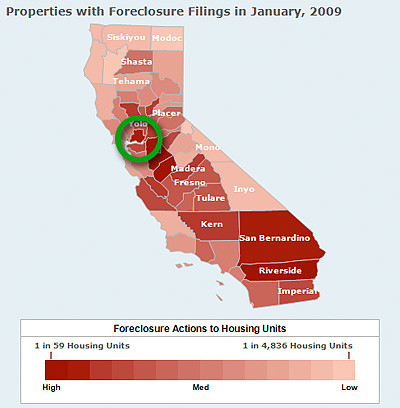
Pase was also the senior policy adviser for Dennis Moore when Moore organized Blue Dogs to oppose mortgage write-downs on behalf of the banking industry in 2007, and he is evidently the one driving policy on this one for the New Dems. But one has to wonder — what is Tauscher thinking? Her district is one of the hardest hit by the mortgage crisis, as you can see from the map. Why is she trying to limit mortgage write-downs to subprime loans only, on behalf of banks, when every foreclosure brings down the value of all houses in a neighborhood? Her claim to care so very much about people still struggling to pay their mortgages rings hollow.

Shaun Donovan, the HUD Secretary, is headed to the House today to whip support for the bill.  This legislation would save perhaps 800,000 families from foreclosure without one penny of cost to the taxpayer.  All the bill would do is give leverage to homeowners who have been screwed by their lenders at practically every step of this process.

Homeowners burned by Blue Dogs and New Dems like Tauscher are not likely to forget the treachery.  Firedoglake has some action items.

We’re asking you to do two things:

Write a letter to the editor of your local papers (just enter your zip code) saying you expect your Member of Congress to represent you, not the banks, and you’ll be watching to see if they oppose Tauscher and her bank lobbyist cronies.

Sign a petition to Nancy Pelosi telling her not to “buckle” to pressure from bank lobbyists working through greedy corporatist Members of Congress, and to act swiftly to give judges the authority they need to write down mortgages.  The banks must take responsibility for their own bad judgment; taxpayers shouldn’t be expected to pick up the tab.

These same people killed efforts in 2007 to allow bankruptcy judges to write down mortgages at that time, which could have helped us from ever getting to this place.  It’s time they stop pretending that they care about their constituents when they’re only being tools of the banking lobby.

I think it’s more about telling Pelosi we’ll have her back if she stands up to these cretins.  You know what to do.

ACTION: Ellen Tauscher Needs To Work For People And Not The Financial Services Industry

Chris Bowers advises that the House will be going ahead with housing legislation tomorrow that would allow bankruptcy judges to modify the terms of mortgages to reflect current home values and allow homeowners to avoid foreclosure (commonly known as “cram-down”.  As I discussed with Rep. John Conyers, the author of this bill, this would not encourage bankruptcy but help people avoid it, giving them a level playing field to get banks to follow through with loan modifications.  While practically every other property someone owns can have the terms rewritten by a bankruptcy judge, primary residences are excluded.  That is arbitrary and wrong, and changing it would reduce foreclosures and homelessness and bring some stability to the housing market.  This legislation is supported by the President and included in his housing plan, but a change in the law like this should be passed by the Congress to make it a federal statute.

Bowers writes:

Tomorrow, the House will vote on Representative Conyer’s bankruptcy cram down. The whip count is unclear right now, but some Blue Dogs and New Democrats, including Melissa Bean (D-IL), Dennis Moore (D-KS), and New Democratic chair Ellen Tauscher (D-CA), are working on behalf of the financial services industry to water down the legislation. Tauscher in particular is problematic, both because of her leadership role in one of the ideological caucuses, and also because rumors are that she has organized up to two dozen members thus far. It is about time that Tauscher, and the Representatives she is organizing, stop listening to industry lobbyists who do not have the public interest in mind.

So, let’s make Representative Tauscher listen to someone else right now. Contact Ellen Tauscher, and urge her to stop organizing other Democrats to water down HR 200. She needs to listen to honewoners, not to the financial industry that got us into this economic disaster.

Here is the contact information:

Email form (California residents only)

D.C. office: 202.225.1880

Ellen Tauscher’s New Democrat ways haven’t surfaced much since the threatened primary challenge in 2007, but torpedoing this bill would bring that back all over again.  She needs to know that people are watching her and want to be sure that she is protecting homeowners and not the big banks and lenders.

Please contact her now or in the morning.

Nearing The Economic Cliff

The unemployment statistics for October at the state level were released today, and as it turns out California lost the third-most jobs in the nation at 26,400.  Only Washington and Florida lost more.  This puts the unemployment rate in the state at 8.2%.  This is a 2.5% increase from one year ago, the largest year-over-year increase since 1982, the last major recession.  Worse, in regions of the Central Valley, that number is much higher.  Unemployment in Fresno County is 11.2%.  In San Joaquin County, 11.1%.  In Merced County, 11.7%.  In Tulare County, 11.8%.  And in Stanislaus County, 11.8%.  Those are desperate numbers.

The loss of income tax revenue along with the dip in property taxes thanks to cascading foreclosures is leading more cities to the brink of bankruptcy.

Now two more California cities – Rio Vista and Isleton – are considering bankruptcy protection as an option as they face large budget shortfalls and staggering debt.

While experts caution against ringing the alarm bells just yet, they do say tough economic times could push municipalities already on the brink over the edge.

“I think it’s quite possible municipal bankruptcies could become somewhat more common but will still be very rare,” said Jason Dickerson, budget and policy analyst at the state’s Legislative Analyst’s Office. “There are more municipalities that will look at what it means.”

We need a massive fiscal stimulus as soon as humanly possible.  And that needs to include aid to state and local governments, particularly here in California.  We are right on the edge.

California Progressive Members of Congress Seek Bailout Improvements

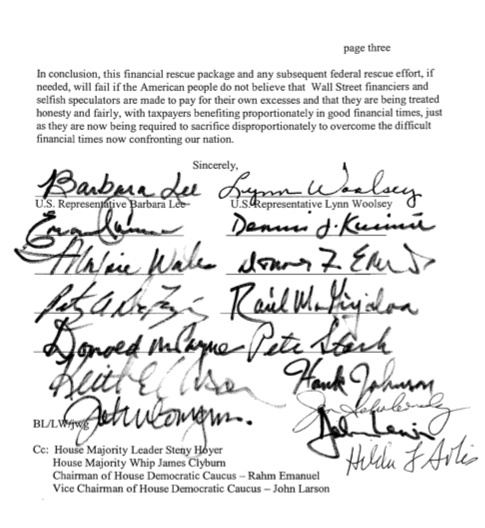
Matt Stoller at Open Left has reproduced a letter from progressive Democrats in the Congress demanding changes to the proposed bailout package. Barbara Lee and Lynn Woolsey are the two lead authors, and other California members of Congress who have signed it include Hilda Solis and Pete Stark.

The letter insists that 4 kinds of reform be included in any bailout:

  • A 0.25% tax on all stock trades and “exotic transactions” such as derivatives trading as a kind of “progressive PAYGO” to ensure that the taxpayers won’t be paying the costs of the bailout.
  • Equity shares in any companies that benefit from the bailout
  • “Major bankruptcy reform” including homeowner renegotiation of mortgages. Obama undercut progressives on this when he said bankruptcy reform didn’t need to be part of the package, perhaps a telltale sign of how unprogressive an Obama administration might be. But it’s still a necessary part of any financial solution.
  • A detailed list of new regulations to protect consumers and provide more stable, responsible regulation of the financial industry to prevent a recurrence of this crisis.

The progressives’ move in Congress comes as more economic observers question the need for a bailout. It’s possible that this represents the first move by the 74 members of the Progressive Caucus to block a bill that in particular lacks bankruptcy reform. Even so, an axis of Bush Dogs, House Republicans, and timid/weak/complicit House Democratic leadership may prove to be too much for the Progressive Caucus to overcome.

Still, this letter is a welcome move by California progressives like Barbara Lee and Lynn Woolsey. The bailout needs to be either made a fundamentally progressive policy move or stopped entirely. If a progressive coalition is to come together to stop it leadership from the Progressive Caucus is a necessary component. Even if it is too little too late, it potentially marks the beginning of a push for truly progressive solutions to our economic crisis – the kind that FDR and the Democratic Party stood for 75 years ago, but that current Democratic leaders from Obama on down have now eschewed.

UPDATE: A deal has been announced, although the details have been slow to materialize – a likely sign that the deal isn’t exactly set in stone. More significantly Republicans are being pressured to deliver 70-100 votes which suggests that Congressional progressives, especially those from California, do have leverage to stop this train wreck. Universal health care, green infrastructure, a jobs-and-wages economic recovery – all those things are imperilled by this bailout. Better to deal with this after January 20.

Vallejo Declares Bankruptcy

After months of wrangling and negotiating the city of Vallejo has voted to declare bankruptcy. And to hear the local media tell it, like the San Francisco Chronicle, it is the fault of public workers, not poor political leadership:

After about four hours of discussion and public comment from the standing-room-only crowd, the council voted 7-0 to approve Tanner’s recommendation to declare Chapter 9 bankruptcy protection as a means to reorganize its finances, which have been shattered by spiraling public employee salaries and the plummeting housing market….

The city and its public safety unions have been at the bargaining table for about two years. The city is asking for its police and firefighters to take salary, benefit and staff cuts, while the unions say any further cuts would endanger public safety as well as the safety of the police and firefighters.

Vallejo spends 74 percent of its $80 million general fund budget on public safety salaries, significantly higher than the state average. The generous contracts are the result of deals struck in the 1970s, following a police strike that left the city in turmoil.

What is not said here, or anywhere in the article, is the reason for that public safety spending. Vallejo’s police and fire services are understaffed – as are many agencies in California, in a little-known but extremely important and widespread phenomenon. City leaders have been loath to hire new workers, but they have also needed the public safety services – so the workers that are on the payroll have been working overtime. And overtime pay is usually always higher than regular pay.

Vallejo, like many California cities, wanted to maintain a high services and low tax environment, and has found this is not possible, especially when an artificially-created bubble bursts. Instead of accepting responsibility and seeking new revenues to balance the city’s books without endangering the public, city leaders chose to blame the public workers for the problems and declare bankruptcy instead of avoiding the underlying issues.

To be fair, Vallejo is not in complete control of its own destiny. Decades of state and federal budget cuts, made to pay for tax cuts for the wealthy, have had a trickle-down effect of eviscerating services and leaving cities more and more financially exposed as state and federal aid has begun to dry up. It’s not exactly as if Bush and Arnold have directly told Vallejo to drop dead but through their inaction in the face of widening government financial crisis, they have achieved the same result.

Vallejo IS the tip of the iceberg, as many cities face similar problems. Some have done the right thing and sought new revenues, like Salinas, and avoided destructive service cuts. Others are following Vallejo down the path of blaming public workers. Without state and federal solutions, this scene may well replay itself again and again across the state in the coming years.

Bankruptcy! Vallejo is Just the First

The city of Vallejo has been flirting with bankruptcy for for a few months now, but it looks like it will probably happen soon.  While the Mayor and other leaders continue to point the finger at public safety workers, the city looks set to pass its own deadline this week for some other resolution. The Chronicle:

Vallejo will inch closer to financial ruin Tuesday when the City Council lets pass its do-or-die date to avert bankruptcy.

City staff members have been unable to come up with a detailed, long-term financial plan because negotiations with the police and fire unions are still ongoing. The city is asking for steep concessions from the unions, whose members are among the highest paid in the Bay Area and whose salaries comprise about 74 percent of the city’s budget.

“We had hoped to have an agreement by April 22 to give to the council,” said Mayor Osby Davis, who has sat in on the negotiations. “But I’m optimistic. There’s always room for a resolution if people are willing to give and take.”

Davis, if you’ll remember, is the Mayor who lost the election, and then won the election on a recount.  In the end, I’m not sure there’s a winner at all here.  The unions allege that there’s some accounting tricks being used, while the City contends that the salaries are just killing them. The salaries are quite high due to mandatory overtime required by the city’s low staffing.

The Mayor and others want a “long-term solution”, but one will be increasingly difficult to find for Vallejo and cities across California as the budget continues to bleed. There is no solution – none at all – until California’s leaders and the Yacht Party obstructionists choose to look at the budget sheets from towns and cities across the state. Small, large, whatever. They are all feeling the pain of the last 30 years. Prop 13, the VLF cuts, everything is costing the cities money at a time when more and more is expected of them.

We can dally no longer. The governor needs to step up and admit that he was wrong on the VLF. Vallejo is just the first large city to tumble towards bankruptcy. It will certainly not be the last.