Category Archives: Election 2010

Manipulating the Process To Get the Result You Want Isn’t Reform

Fellow Orange County native Ezra Klein picks up on a point we’ve been making a lot here at Calitics over the last few years:

Polarization isn’t a new story, nor were California’s budget problems and constitutional handicap. Yet the state let its political dysfunctions go unaddressed. Most assumed that the legislature’s bickering would be cast aside in the face of an emergency. But the intransigence of California’s legislators has not softened despite the spiraling unemployment, massive deficits and absence of buoyant growth on the horizon. Quite the opposite, in fact. The minority party spied opportunity in fiscal collapse. If the majority failed to govern the state, then the voters would turn on them, or so the theory went.

That raises a troubling question: What happens when one of the two major parties does not see a political upside in solving problems and has the power to keep those problems from being solved?…

The lesson of California is that a political system too dysfunctional to avert crisis is also too dysfunctional to respond to it. The difficulty is not economic so much as it is political; solving our fiscal problem is a mixture of easy arithmetic and hard choices, but until we solve our political problem, both are out of reach. And we can’t assume that an emergency, or the prospect of one, will solve the political problem for us. If you want to see how that movie ends, just look west, as we have so many times before.

Ezra’s column shows how the looming dysfunction in the Senate, where the Republicans are preparing to block all solutions to our problems that are not deeply ideologically conservative, is a tactic perfected here in California. I wish he had pointed out that “polarization” is a natural outcome of a 50-year political process that has seen public opinion evolve to a point where there is clearer distinction between the two parties, and that this is not necessarily a bad thing. Personally I welcome polarization, voters deserve a genuine choice, especially when the “bipartisanship” people yearn for was itself a very temporary phenomenon of the 1950s, a product of an economic boom the likes of which we’d never seen before and will never see again.

Although Ezra doesn’t offer clear solutions here, he is pointing out that both California and the US Congress have the same problem: rules that empower a minority are a rule for catastrophe in a polarized politics. By implication, you basically have two options: eliminate those rules, or eliminate the polarized politics.

Again, since “polarization” is the product of very deep and fundamental historical forces, ending it is going to be rather difficult anytime soon, and may not be desirable anyway, since a less polarized politics generally means more corporate politics, cramming down working people in the name of bipartisan comity so that the rich can get richer. Calitics and most California progressives have frequently embraced a restoration of majority rule – let the majority make policy and let the chips fall where they may.

Predictably, large corporations don’t like that option, and still believe they can and should produce more corporate-friendly politics. So instead of supporting a restoration of majority rule, they’re going to try to manipulate the process to reduce the polarization that voters repeatedly embrace.

That’s the takeaway from an extremely revealing profile of the Silicon Valley Leadership Group in today’s New York Times. The article is one of Dan Weintraub’s first pieces since moving to the NYT from the Sacramento Bee, and it’s quite good, showing how the SVLG thinks about “reform”:

With nearly 300 companies on its roster, from Accenture to Yahoo, the group stands out as a small island of ideological diversity in a sea of partisan polarization….

One is a June measure that would create open primaries in California elections. If the proposal passes, voters would be able to choose among all candidates in the primaries without regard to party affiliation. The top two finishers would advance to a run-off election.

“The open primary,” [Carl] Guardino [head of SVLG] said, would help “free well-meaning legislators from the grips of the party caucuses.” The result might be a Legislature that looks a little more like Silicon Valley and less like Orange County or Marin County.

That last line is probably Weintraub’s spin, but it is telling. Guardino and the SVLG haven’t noticed that Californians have self-selected themselves into communities of shared political philosophies over the last 30 to 40 years. If they have noticed, they think it’s somehow a bad thing that voters in San Francisco or Mission Viejo have decided they share some deeply held values and prefer their representatives reflect that. I call that a genuine example of “representative democracy.” What does Guardino call it?

Apparently he calls it something crying out for technocratic manipulation. Since it’s not possible to draw districts in California that are competitive without truly massive gerrymandering and diluting the preferences of the electorate, which is much more strongly Democratic than anything else, Guardino and the Silicon Valley Leadership Group are throwing their weight behind Abel Maldonado’s top two primary, which he got on the June ballot only through an act of blackmail.

The top two would do two things that Guardino wants. First, it would push primary battles out into the general election in most CA districts, which will always be drawn to favor one party or the other, since that’s how Californians have chosen to self-associate. The SVLG’s members can then play a bigger role in determining the outcomes of those races, where money will play a bigger role. They can also use a few of those races to distract progressive activists while the big boys focus on even bigger races, such as California governor.

Second, it would give a boost to conservative Democrats in some key districts by enabling Republicans and other right-wingers to choose the outcomes of a Democratic primary. Let’s take AD-27, my assembly district, which includes the  very progressive electorate of Monterey and Santa Cruz. If SVLG decided to fund a “centrist” Democrat, they’d probably garner enough votes to make it to the general election against a more progressive Democrat. That would give them the ability to combine some conservative and Republican votes to try and sneak the centrist in, combined with spending to sell the centrist to a more progressive electorate as the only winnable candidate. It might not work in every district, surely many progressive voters would see through the ruse, but in districts where the Democratic electorate isn’t as strongly progressive, the strategy could swing some seats to corporate-friendly right-wing Dems. Which is exactly the opposite of what we want as progressive Californians.

This is what you get when large California corporations see the natural outcome of the right-wing policies they’ve endorsed and funded for decades: they don’t like the “polarized” politics, don’t like the collapsing infrastructure and inability of government to fund a competitive job climate. But since they also can’t accept that they’d have to give up a measure of their own power and some of their money in order to have more stable economic growth – after all, these are fundamentally greedy people – they won’t admit their earlier error and try to destroy the right-wing’s power by restoring majority rule.

Instead they’ll try and one more time revive the “bipartisan centrism” that had worked so well at growing their power and wealth in the late 20th century. And they’re willing to massively manipulate the state’s political system in order to do it.

Eventually they will learn the same lesson every other corporation learns: when you help build a right-wing political movement, you are creating a Frankenstein monster that you will be unable to control and that will cause so much damage and chaos that you’ll lose more than you’ve gained. But since corporate neoliberal centrist politics and Doctor Frankenstein share something fundamental – an unending belief in their own god complex – they’re going to keep on trying it until its failure is beyond doubt, and until the populist masses take up pitchforks and torches and clean house.

2010: California’s Ballot Initiative Thunderdome

A new year and a new decade are upon us, as is a new election year. But 2010 isn’t going to be just any old election year in California. After spending 2009 watching state and national politics oriented around defending the status quo, we are finally starting to see the emergence of a politics oriented around change, spurred on by the most severe political and economic crisis since the American conquest.

The result is that 2010 will be the most important, consequential, and decisive elections in a long time in California. While there are interesting and significant races for elected office that will be decided, it’s the ballot initiatives that really matter. Proposals from across the political spectrum will likely be on the November 2010 ballot in particular, setting up a major contest between right, left and corporate center to determine the future of this state at a pivotal moment in its history.

Even though it’s still unclear which initiatives will be on the ballot, with 51 initiatives in circulation and 37 pending at the Attorney General’s office, a significant number of which will likely make the ballot, it’s clear that the initiative process is still the primary path by which genuine change happens in this state.

And as we’ll see, it’s a path that is controlled not by the people, but by those with access to the large sums of money needed to get the signatures and qualify the initiative for the ballot. Many of the initiatives we’ll see on the November 2010 ballot will involve large corporations trying to use the state’s crisis to change the law, or even the constitution, to further empower and enrich themselves.

More below, including an overview of the initiatives on both the June and November ballots.

Let’s have a look at the Thunderdome contenders. Only a handful of initiatives have qualified for either June or November, but based on my own sources, a lot more are likely to qualify, almost all of them for November.

June 2010

Already qualified:

Seismic retrofitting – retrofits don’t add to property tax value

California Fair Elections Act – creates a public financing system for the Secretary of State’s race in 2014 and 2018

Top two primary – the fruit of Abel Maldonado’s blackmail, this would change the way primaries work to send the top two finishers regardless of party to the general election. The practical effect will be to force intraparty primary battles out into the general election, diverting money and resources from other fights.

Signatures submitted for qualification:

2/3rds vote for public power: PG&E’s effort to make it more difficult for localities to create public power utilities. A truly pernicious and anti-democratic proposal.

Mercury Insurance’s effort to gut Prop 103 – would enable auto insurers to raise rates for those who, for whatever reason, have had gaps in insurance coverage. Designed to punish the poor and leech money out of the middle class.

November 2010

Already qualified:

$11 billion water bond – although environmental groups are split, I expect most progressive organizations to unite against this massive giveaway of scarce taxpayer resources to large corporations, undermining those with senior water rights to favor relative but well-heeled newcomers who waste our water resources.

Likely to qualify:

(In other words, I am very confident these will be on the November 2010 ballot)

Marijuana legalization – Richard Lee’s effort has already gathered enough signatures, but they’re holding off on submitting them so as to ensure qualification for November. This may be one of the few genuinely progressive proposals on the November 2010 ballot, and will require a year-long effort from progressives to ensure it passes.

Term limits reform – backed by both the LA County Labor Fed and the LA County Chamber of Commerce and aided by a rather interesting donation of $300,000 to the qualification effort by the folks who got the legislature to pass a law helping bring an NFL stadium to the City of Industry. Unlike Prop 93, this would exempt current legislators from being able to serve longer in office, increasing its chances of passage. This too is a progressive solution, taking power back from the lobbyists and enabling voters to continue to send good people back to Sacramento if they so choose.

Parental notification, round 4 – this is the poster child for the need for initiative reform, the “bleed Planned Parenthood dry” strategy of trying to restrict women’s rights or destroy the pro-choice movement’s resources in the process. And it’s all but certain to be on the November ballot.

Constitutional Convention – The Bay Area Council has some money set aside to run a campaign to get their two initiatives on the ballot to convene a limited con-con, and have hired San Francisco political consultant Clint Reilly to run the effort. This one’s a bit less certain to make the ballot than the others in this category, but I still think it’s likely we’ll be voting on both proposals in November.

California Forward’s budget and governance proposals – perhaps the most ambitious and immediate set of solutions to our political and fiscal crisis, it’s also a center-right plan that would reinforce the momentum for spending cuts and having state government do less. It would also reinforce the 2/3rds rule for revenues by largely undoing the Sinclair Paints decision on fees. However, it may also be the only proposal on the ballot to restore majority rule on the budget.

Corporate tax loophole repeal – this proposal to repeal the $2 billion in corporate tax loopholes created in budget deals in 2008 and 2009 is probably going to get enough financial support to make the ballot in November. A welcome proposal it is – even if it doesn’t solve the whole budget crisis, it would help reverse the corporate-friendly nature of our budgeting.

Might qualify for the ballot:

(I’m less sure that these will make the ballot, and would put their chances at 50-50 at best, at least under present conditions)

Part-time legislature – this proposal to turn the legislature into a place only accessible to the wealthy has been withdrawn and resubmitted once. It’s unclear whether they have enough resources to get this on the ballot.

End to raids on local government funds – I hear different things about whether this will indeed qualify, but it’d be welcome if it did. This proposal would end once and for all the theft of local government funds by the state legislature. This is a badly needed reform to not only protect local services, but to force the legislature to actually fight to make long-term revenue solutions part of the budget, instead of trying ever more damaging gimmicks.

State parks funding – a coalition of state parks advocacy groups have raised $1 million for an initiative that would increase the vehicle license fee by $18 to fund state parks. It’s not yet clear if that’ll be enough to put this on the ballot – if so, then this initiative would go under the “likely qualify” heading.

Redistricting commission for Congressional seats – Charles Munger’s proposal to create a Prop 11-style commission for Congressional seats, currently exempt from Prop 11, would cause a big battle with Speaker Nancy Pelosi if it qualified. But it’s pretty unclear whether Munger has the resources to do so, and it might be harder to get them as the Prop 11 commission faces problems with its budget and in recruiting enough applicants.

Paycheck protection, pension cuts, split roll property tax – A big fight between labor and corporations is unfolding over rival ballot initiatives. Big corporations want to gut public employee pension rules and try once again to limit workers’ ability to organize politically, so CTA and other unions are threatening to put a split-roll initiative on the ballot. The link here goes to a Dan Walters column that says the corporate tax repeal is part of this battle, but I understand that initiative is likely to qualify anyway. This all could fizzle, or it could all go on the ballot anyway, dwarfing the battles in 2005 given everything else that’ll likely be on the November ballot.

New Prop 187 – similar to the notorious Prop 187 in 1994, this is an attack on undocumented Californians and the public services they need and that the rest of us need to ensure they receive. I’ve heard a lot of different things about whether this has the money to qualify. Right now it doesn’t look like it will, but definitely one to watch like a hawk.

Voter ID – similar to the New Prop 187 initiative, it’s hard to judge whether George Runner’s effort to limit democracy and voter participation has a shot at the ballot.

Unlikely to make the ballot:

Barring any surprise infusions of cash, the other dozens of initiatives circulating or pending at the AG’s office aren’t likely to make the ballot. Some of the more prominent ones that aren’t likely to qualify include Prop 8 repeal, defining a fetus as a person, the Lakoff majority vote initiative, and a bunch of totally wacko religious fundamentalist proposals.

Finally, it’s also possible, if not likely, that the upcoming budget solution will include tax proposals that will go to the voters in November as well.

The record for ballot initiatives in a single year in California is 1990, including 27 at the November election, including Prop 140 (which squeaked out a victory and created the term limits tyranny). Most of the November 1990 initiatives were defeated. November 2010 may not quite match that record, but in terms of the importance and significance of the proposals, this year’s initiatives may indeed produce a turning point in our state’s political history.

If nothing else, it will at least be a titanic political battle. Welcome to Thunderdome!

Why a Democrat can win California 50th Congressional District race in 2010 (Part 2)

The Republicans in the 50th Congressional District are starting to feel comfortable about having a win in the bag in 2010. CQ Politics just released an assessment that Bilbray’s GOP seat in North County’s 50th is secure. Clearly the author is unaware of the district’s history and political leanings before 2002 covered in Part 1 of this series and plays down the systematic closing of the point gap between Democrats and Republicans since the Republican’s gerrymandered win in 2002.  Part 2 of this series will explore why a Democratic candidate hasn’t yet won the District and what they need to do to wrestle control back from the Republicans.

Why hasn’t a Democrat won the district back yet?

The following list encompasses some personal observations as well as election analysis in a 2006 poll commissioned in California’s 50th Congressional District by Courage Campaign, a non-partisan, Progressive 527 based in Los Angeles, and MyDD, a Progressive blog devoted to analysis and commentary on political campaigns and infrastructure, to determine why the national Democratic message failed to give Democrat Francine Busby the seat formerly occupied by convicted felon, Republican Randy “Duke” Cunningham. Busby also lost to Republican Brian Bilbray in the 2006 regular election, having probably been her last best chance to win this district.

1. Voter Turnout – A winning Democratic candidate needs high Independent and Decline to State voter turnout, which combined currently makes up at least 28% of registered voters in North County, to close the point gap with the Republican incumbent. Busby has been repeatedly unsuccessful in mobilizing this demographic and securing their vote. Voter appeal beyond Democratic base voters will be instrumental.

2. Inland Voter Turnout – A winning Democratic candidate needs to mobilize and secure the vote of residents in the inland part of the district. The highest density of registered voters are inland and the majority of these voters are working class families. Thus far, the previous Democratic candidates have been coastal candidates, such as Busby and Nick Leibham, which did not resonate with inland voters. However, one candidate Progressive Democrat Tracy Emblem, a resident of Escondido since 1964 with working class roots and strong support from Labor Unions will appeal to this key inland working class demographic.

3. Issue-based Campaign – A winning Democratic candidate needs to clearly draw a distinction between themselves and the Republican incumbent by running a strong, issue-based campaign. Most voters in 2006 had no concrete idea where Busby stood on important issues, so her image in the mind of the voter was poorly defined. The Republicans, on the other hand, led the discussion and framed any debate around issues they knew would resonate in their favor. Even in the current jockeying for the 2010 primary election, until a month ago Emblem was the only candidate who clearly outlined her positions on important issues on her campaign website. Busby only recently added any substantive issue-based information to her campaign website after Emblem pointed out  the omission at a Mesa Democratic Club meeting in November.

4. Accountability – A winning Democratic candidate has to hold the current administration accountable for problems that have occurred under its watch both at home and abroad. This is as relevant now as it was during the Bush administration, perhaps more-so. President Obama has high disapproval ratings and a successful candidate needs to distinguish clearly how they will provide viable solutions to the problems the Obama administration and Democratic legislators have been unable to resolve. San Diego News Network noted that Busby is still uncritically toting President Obama’s change message as if she’s his sidekick. Emblem, on the other hand, has demonstrated that she can hold the President accountable for unsuccessful policy decisions, like Afghanistan.

What’s the bottom line?

The Democratic party cannot continue to do the same old same old in the 50th district if they have any hope of unseating incumbent Republican Bilbray. With a focus on voter turnout, an issues-based campaign focusing on issues that resonate with Independent, Decline to State and Inland voters, and lastly courage to hold the current administration accountable for policy missteps, Democrats can pull off this supposed Hail Mary pass win.

Desparate Vetting for Desparate Times

Earl Robert Brooks

John T. Nejedly

For the many of us who know – the County Assessor’s seat is a non-partisan, elected position within the county.  But for those who are not so keenly aware, much of the back-room politics happens along party lines.  As the Contra Costa Assessor’s seat is shaping its candidates for the June 2010 primaries – I’m very puzzled, as a political strategist at what the Democrats are entertaining and/or supporting for a candidate.

First, let’s look at John T. Nejedly who is a Republican.  Instantly, the name “Nejedly” jumps out as a recognizable name throughout Contra Costa – and it should.  John A. Nejedly, father of John T. Nejedly, represented Contra Costa County (CCC) as a State Senator from 1969 to 1980, CCC District Attorney from 1958 to 1969 and has built quite a family name and empire in this area.  There’s no question that John T. will be riding off his father’s coat tails in name recognition.

Second, John T. has run a successful campaign as Board Member for CCC Community College District, Ward 4.  With a whopping 67.7% win over Frank Quattro in the November 2006 election, this should at least give pause for the Dem’s to consider a political heavy-weight against John.

In October, Lisa Vorderbrueggen, of the Contra Costa Times reported that Bob Brooks of Antioch was “seriously exploring a run against Assessor Gus Kramer.”  Since October, it seems the CCC Democratic Central Committee has embraced Bob, as the candidate of choice to back.  Now this is where it gets fuzzy:

In chatting it up in the inner circles of Democratic Clubs around Contra Costa, nobody has heard the name of Bob Brooks.  When asked if they’ve heard of Earl Robert Brooks, I get the look of “deer in headlights,” or the other answer, “does he own Brooks Furniture?”  

According to the CCC Elections Department, Bob Brooks has never run a campaign, which means the probability of Brooks ever fundraising is pretty low.  Considering Brooks has yet to build a political machine, understand the mechanics behind it and execute everything from campaign filings, advertising, canvassing, strategy, GOTV and much, much more – will Bob be able to pull this off against seasoned politicians?  

If there were storm clouds hanging over this candidate about controversy, then there’s a 100% chance of rain.  As one of the members of the County Appeals Board, Brooks granted the favor of a $12.6 million tax break to Chevron’s Corporation – money that is desperately needed in our Cities, County schools, parks and fire districts.  When you do the math off Chevron’s balance sheets for 2008 – the Gross Profit for the corporation was around $79.6 Billion U.S. Dollars – $12.6 million is about 0.00015% of that Net Profit.  Some may say that there was an Assessor’s error – “Show me the hard evidence of that.” Or they may say that Chevron had the tax cuts coming to them; however the State Auditors has given “high marks of excellence” to the Assessor’s Office during this time.  Whose interests does Bob Brooks serve – Chevron’s or the County?

Lastly, we can only hope that Brooks will be clean of any campaign donations made from Chevron employees or the Black American Political Action Committee of Contra Costa County (BAPAC), which is heavily funded by Chevron to the tune of $50,000 – according to 2006 campaign contribution records.  East Bay Express recently reported that another board member had received campaign contributions from Chevron – will Brooks take BAPAC money?

So as a political strategist within the Democratic ranks, I fail to see the advantage in vetting Bob Brooks, who in my opinion will easily give the non-partisan seat to a registered Republican.  My question to Central Committee Chairman Chuck Carpenter is, “is this the best candidate the Democrats can challenge toward John T. Nejedly?”

Back to the future: Will Jerry Brown be the next Democratic nominee for California governor?

California may soon experience a deja vu all over again of sorts. The 2010 election cycle may take us back to more than just bellbottoms, platform shoes, and disco. Jerry Brown, former governor of California (1975-1983), has established a 2010 Exploratory Committee for a run for governor.

For those living underneath a rock for the last 40 years, it is worth underscoring that Brown has developed a lengthy political resume. He’s served terms on the Los Angeles Community College Board of Trustees (1969-1971), as California Secretary of State (1971-1975), as Governor of California (1975-1983), as chair of the California Democratic Party (1989-1991), the Mayor of Oakland (1998-2006), and the Attorney General of California (2007-present). He unsuccessfully sought the Democratic nominations for president in 1976, 1980, and 1992, and was an unsuccessful Democratic nominee for the United States Senate in 1982. Since Brown’s terms in office are not covered by the term limits that came into effect in 1990, he is not barred from running for Governor again, and has indicated that he plans to run for the office again in 2010.

What was 1970s Governor Brown about? He was opposed to the Vietnam War, supported environmental protection (repealed a tax break for the state’s big oil companies while passing tax-breaks for homeowner installation of solar panels), and appointed more women and minorities to office than any other previous California governor. As Governor, he passed landmark legislation to force full disclosure of finance and interest charges by credit card companies, allowed consumers to purchase generic drugs and created the nation’s first affordable “life-line” utility rates for seniors and needy residential customers. Brown signed landmark legislation adding public members to regulatory boards that previously had been controlled by industry representatives.

What might the Governor Brown of today be about?

  • Brown may be a supporter of marriage equality: The State Attorney General normally argues in support of laws that have been passed by the electorate. Brown took an unusual step by declining to defend Proposition 8, a voter-approved amendment to the state constitution that banned same-sex marriage.
  • He will continue to protect the environment: As Attorney General, Brown has led the fight against George Bush’s EPA, defended California’s landmark tailpipe emission laws and actively promoted local land use policies that reduce oil dependency and global warming.
  • Brown will fight mortgage fraud and real estate scams: As Attorney General, Brown has pursued companies and individuals who perpetrated massive mortgage fraud, including an $8.6 Billion settlement with Countrywide, and claims that he will also go after those who would further exploit the mortgage crisis by offering fraudulent “rescue” services.
  • He will support labor: As Attorney General, Brown has sued unscrupulous employers for denying workers wages and benefits required by state law, shut down companies that have jeopardized worker safety and prosecuted businesses that have bilked California’s workers’ compensation system or otherwise circumvented state tax and employment laws.
  • Brown will continue protecting consumers: As Attorney General, Brown has made consumer fraud prevention a top priority. In addition to vigorous pursuit of the mortgage scam artists, he has gone after price gouging, false advertising, and contaminated and unsafe products.
  • He will fight fraud and abuse in California’s health care system: As Attorney General, Brown has sued medical laboratories for massive overcharges, stopped rip-offs in the Medi-Cal Program, cracked down on unlawful abuse of prescription drugs, fought misleading ad campaigns by major drug companies and arrested nursing home operators for forcibly drugging elderly patients.

Progressive Pushback

Despite Brown’s Progressive past, on a recent campaign stop in Orange County, he left a bad aftertaste in the mouths of Los Angeles Progressive Democrats who attended:

Brown refused to endorse any changes to Prop 13, saying he did not think it was “needed” and that “we’ve got to downsize government to the maximum degree.” He also voiced support for the three-strikes law, and would not take a stance on a “public option” for health care. He did support scrapping the “two-thirds” rule for passing a state budget (but not taxes), and endorsed a path to legalization for undocumented immigrants – but with no candidate running to his left, this was the best that progressives can hope from Jerry Brown. Given California’s mammoth problems that need immediate attention, that’s depressing.

It will be interesting to see what the new year brings as Brown faces formidable Republican candidates Meg Whitman, Steve Poizner, and Tom Campbell.

Meg Whitman: California’s Sarah Palin

Sarah Palin, WaPo op-ed, December 9, 2009:

Meeting [carbon reduction] targets would require Congress to pass its cap-and-tax plans, which will result in job losses and higher energy costs… The last thing America needs is misguided legislation that will raise taxes and cost jobs.

Meg Whitman, San Jose Mercury News op-ed, September 16, 2009:

In January, the first AB 32 mandates take effect and will lead to higher energy costs at a time when we can least afford them. They will discourage job creation and could kill any recovery.

Notice the similar phrasing here: “higher energy costs,” “cost jobs/discourage job creation.”

It’s not just similar phrasing that Whitman and Palin share: it’s similar policies. Palin’s op-ed was written to attack the Copenhagen climate summit and to oppose the Congressional cap-and-trade bill. Whitman’s op-ed was written to attack AB 32, which she said she would order suspended indefinitely as her very first act as governor.

Earlier today in Copenhagen, Governor Arnold Schwarzenegger slammed Sarah Palin’s climate stance:

“You have to ask: what was she trying to accomplish?” he told the Financial Times. “Is she really interested in this subject or is she interested in her career and in winning the [Republican] nomination [for president]? You have to take all these things with a grain of salt.”…

“I think there are people that just don’t believe in fixing and working on the environment. They don’t believe there is such a thing as global warming, they’re still living in the Stone Age, which is OK, we need people like that, too,” he said.

But will Arnold say similar things about Meg Whitman, who shares Sarah Palin’s attitude about global warming legislation?

The Courage Campaign isn’t going to wait to find out. That’s why we are going to produce and air a radio ad that will broadcast on stations across California later this week. The ad will explain to the listener that Palin and Whitman share the same views on the climate crisis – views that are NOT shared by President Obama, Governor Schwarzenegger, and most Californians.

We’re a small organization and can’t simply cut and air the ad ourselves. We need your help to get this on the air. Please click here to kick in $25 to get this ad produced and aired.

Why a radio ad? Well, as you probably know, Whitman has launched a big radio ad buy in recent weeks. Whitman’s ads are designed to raise her name identification with voters and boost her poll numbers by presenting herself as a friendly moderate who wants to help fix our broken state.

The Courage Campaign thinks that the public needs to hear the truth about Whitman’s stand on global warming, which is why we’re going to the radio airwaves. Will you join us? Donate now!

Once the ad is ready to be aired, I’ll be sure to post it here so you can listen. Over the flip is the email we sent to our members today launching this campaign.

note: I’m the Public Policy Director for the Courage Campaign

Dear friend —

Have you heard Sarah Palin’s, er, I mean Meg Whitman’s radio ads?

Almost every time I turn on my radio, I hear one of Meg Whitman’s “A Better California” campaign ads. Whitman — who wants to be Governor and strongly supported the McCain/Palin campaign — has just launched a huge radio ad buy across California.

I have to admit, they’re good ads. Whitman’s ads are designed to raise her name identification with voters and boost her poll numbers by presenting herself as a friendly moderate who wants to help fix our broken state.

What Whitman doesn’t say is that, when it comes to global warming, she’s another Sarah Palin.

It’s time to hold Meg Whitman accountable. That’s why, with your help, the Courage Campaign is going to produce and air a radio ad of our own, pointing out that Whitman and Palin have the same “wait and see” approach to our planet’s climate crisis (read on below to see what we mean).

We’re calling our radio ad “California’s Sarah Palin” and we want to get it up on the air against Whitman’s ads before the Copenhagen summit ends on Friday. Will you help us produce and air it across California — and even in Copenhagen? Click here now to contribute $25 or more and kick off this campaign. DEADLINE: Thursday 9 AM:

http://www.couragecampaign.org…

Our current governor, Arnold Schwarzengger, is speaking at the Copenhagen summit on global warming this week. And President Obama is speaking on Friday.

While Gov. Schwarzenegger is there, he’ll show how California has taken the lead in reducing carbon emissions through a law passed in 2006 — Assembly Bill 32. As many Democrats and Republicans agree, AB 32 is a model for Congress and the Copenhagen summit.

But Meg Whitman agrees with Sarah Palin, who claims that bills like AB 32 are harmful. In fact, Whitman has pledged that the first thing she would do as governor is suspend AB 32 indefinitely, and order California to stop taking action to deal with global warming.

Californians need to hear the truth about Meg Whitman — California’s Sarah Palin. Please contribute now to help us produce this ad and put it on the air across California. If we raise enough, we’ll even air it in Copenhagen before the summit ends on Friday. DEADLINE: Thursday 9 AM:

http://www.couragecampaign.org…

“California’s Sarah Palin” is just the beginning. Please help the Courage Campaign hold Meg Whitman and others accountable when they threaten the progressive principles Californians share.

Thanks for helping us kick off this accountability campaign today.

Rick Jacobs

Chair, Courage Campaign

An Idea Whose Time Has Come

Yesterday Richard Lee of Oaksterdam University announced that he has gathered over 680,000 signatures to place an initiative to legalize, tax, and regulate marijuana on the November 2010 ballot:

The petition drive, which was run by a professional signature-gathering firm, collected more than 680,000 signatures, 57% more than the 433,971 valid signatures needed to put it on the ballot, said Richard Lee, the measure’s main proponent.

“It was so easy to get them,” Lee said. “People were so eager to sign.”

The initiative would also allow cities and counties to adopt their own laws to allow marijuana to be grown and sold, and the localities could impose taxes on any aspect of marijuana production and sales. It would make it legal for adults over 21 years old to possess up to an ounce of marijuana and to grow it in a 25-square-foot area for personal use.

Because this particular initiative creates a “local option” for taxation, on top of a statewide legalization, it is hard to quantify exactly how much money this would raise. Initiative proponents cite the Legislative Analyst who says it could generate up to $1.4 billion in new revenue, in addition to an unknown but likely significant amount of savings in prison and court costs.

Although some other legalization initiatives are floating around out there, this is the only one that’s expected to make the 2010 ballot. And despite some earlier debate over whether 2010 or 2012 was the best time to go the ballot, other marijuana legalization advocates plan to support this initiative fully and work to pass it.

They may be joined by the rest of the state:

Polls have shown that a majority of California voters support legalization. A Field Poll taken in mid-April found that 56% of voters in the state and 60% in Los Angeles County want to make legalize and tax pot as a way to help solve the state’s fiscal crisis. In October, a poll taken by a nonpartisan firm for the Marijuana Policy Project found 54% support in the county.

A poll taken for the initiative’s proponents by EMC Research, an opinion research firm in Seattle, found that 51% of likely voters supported it based on language similar to what will be on the ballot, but support increased to 54% when they were read a more general synopsis.

Those numbers are no slam dunk. But they also show that this is clearly an idea whose time has come. California has proven that the costs of the war on drugs are unacceptably high, and that we need to bring that stupid and pointless conflict to an end before it bankrupts the state.

There’s still 11 long months to go between now and the November 2010 election. But I’m hoping that Californians are ready to take the national lead in legalizing and taxing marijuana as part of a more rational and sensible approach to drug policy, prison reform, and the budget crisis.

On The Futility Of War, Part Two, Or, Twelve Times The Charm?

We are halfway through a story that is about to turn winter in one of the most beautiful places in the world profoundly ugly.

Just like in a Cecil B. DeMille movie, we have a cast of millions, we have epic scenery, and we have made acquaintance with someone who will go on to perform a heroic act.

Unlike your typical Hollywood production, however, this movie is not going to have a happy ending-in fact, you could make the argument that it’s not over yet.

So wrap yourself up in something comfortable, grab something to drink…and when you’re ready, we’re packing up and heading to the Alps.

So for those of you just coming to the story, here’s where we’re at:

There has been, for as long as anyone can remember, some degree of “friendliness balanced with hostility” in the relationship between the Austrians, Italians, and Ladins who have been living in the Tyrol, a region of the Alps just to the east of Switzerland.

In the 1800s, a variety of national unification movements emerged, leaving Italy, the Austro-Hungarian Empire, and Germany in possession of various parts of the Tyrol.

For those unfamiliar with the geography, the Alps would represent a bit of trim extending all the way across the top of Italy’s “boot”; if the boot had a buckle, it would be where the Italian, Austro-Hungarian, and German borders come together in the center of the Alps.

As WWI approached, there was some question as to whether Italy would join the Central Powers (Germany, Austro-Hungary, Bulgaria, and the Ottoman Empire) or the Triple Entente (Russia, France, Britain, and eventually, the United States).

Italy broke its neutrality by signing the Treaty of London and attacking Austrian and other Central Powers forces along a 450-long offensive line stretching from Lake Garda to not quite Trieste.

In May of 1915 the Italians had 875,000 troops trying to mount an attack uphill, the goal being to emerge near Zagreb, Croatia (and cover their backsides at the same time, thus the attack on the Lake Garda region), so they could wheel north and attack into Austrian territory while simultaneously moving south along the Adriatic coast; the Austrians were defending from the peaks with roughly 300,000 troops.

Among those troops were units specially trained in mountain combat; those units recruiting from the mountain guides and hunters who lived in the mountain regions. The Austrians had in their command a legendary mountain guide-turned-hotelier named Sepp Innerkofler, who had more than 50 “first ascents” on some of the world’s toughest peaks under his belt.

For those with a memory of history, Hannibal did the same thing on a much narrower offensive front, 2200 years ago, starting from roughly Nice, France and ending up between Turin and Milan, in what is today Northern Italy–a feat he performed at great cost to his own forces.

And now, you’re caught up.

“Our vigil is ended. Our exultation begins … The cannon roars. The earth smokes … Companions, can it be true? We are fighting with arms, we are waging our war, the blood is spurting from the veins of Italy! We are the last to join this struggle and already the first are meeting with glory … The slaughter begins, the destruction begins … All these people, who yesterday thronged in the streets and squares, loudly demanding war, are full of veins, full of blood; and that blood begins to flow … We have no other value but that of our blood to be shed.”

— Gabriele D’Annunzio, April 25th, 1915

The first four of the twelve Battles of the Isonzo were fought, along that long front, between May and December of 1915. The main tactic, on both sides, was to use artillery as a way of “softening up” the opposition, after which somebody would have to run up a hill, under fire, in an attempt to dislodge someone else from their well dug-in position (which explains why controlling the high ground is so vitally important).

“The men rest for a few hours, trying to dry out. At noon, they form a line, dropping to one knee while the officers stand with sabres drawn. The regimental colours flutter freely. Silence. Then a trumpet sounds, the men bellow ‘Savoy!'[the name of the royal house] as from one throat, the band strikes up the Royal March. Carrying knapsacks that weigh 35 kilograms, the men attack up the steep slope, in the teeth of accurate fire from positions that the Italians cannot see. An officer brandishing his sabre in his right hand has to use his left hand to stop the scabbard from tripping him up. The men are too heavily laden to move quickly. Renato remembered the scene as a vision of the end of an era: ‘In a whirl of death and glory, within a few moments, the epic Garibaldian style of warfare is crushed and consigned to the shadows of history!’ The regimental music turns discordant, then fades. The officers are bowled down by machine-gun fire while the men crawl for cover on hands and knees. The battle is lost before it begins. The Italians present such a magnificent target, they are bound to fail. A second attack, a few hours later, is aborted when the bombardment falls short, hitting their own line. The afternoon peters out in another rainstorm.”

— Renato di Stolfo, describing his view of the First Battle of the Isonzo

As the Italians attacked the Austrians were basically engaged in a slow retreat into the highest mountain redoubts, destroying the rail and road infrastructure as they went.

Among the unbelievable tales of combat from those first engagements is this account of how bulls were used as a tool of assault:

“…Realizing that Korada must be captured, if at all, by dash and surprise, the Italian brigadier in charge of the attack gathered a herd of fierce bulls, which are numerous in that part of Venetia, and penned them in a hollow out of sight of the enemy, while his artillery began to bombard the hostile trenches. When the animals were wrought to a frenzy of rage and fear by the noise of the guns, they were let loose and driven up the mountain against the Austrian positions. Their charge broke through many strands of the wire entanglements, and before the last of them fell dead under the Austrian rifle fire, Italian troops with fixed bayonets had crowded through the gaps in the wires and captured the position…”

By the time the fourth battle was over the Austrian commanders’ extremely effective defense not only had the Italians stopped cold-literally-but even worse, the few miles gained in those seven months had already cost the Italians 250,000 dead or wounded soldiers.

The Austrians were losing soldiers as well-including Sepp Innerkofler.

July 3rd had found Innerkofler under attack on the Croda Rossa early in the day, and, amazingly, deer hunting later in the afternoon a couple miles away at the Alpe di Andert:

“…We start the descent at 12 and 13.50 are the Alpe di Andert. Lieutenant Gruber goes back to his position as we head towards the Kulewaldplatz, where our 6 men, they start hunting with deer starting from the so-called Bastrich. I look forward to the post until the end of the broad valley. 5 are found deer and fox-1, I will see two but failed to hit them. He fired a total of 8 shots, but unfortunately it is the prey of a single chapter. And so, as two hours and a half ago we were engaged in a manhunt, now we are dedicated to our unique pleasure to that of the deer!…”

–From Sepp Innerkofler’s diary entry, July 3rd, 1915

July 4th, however, was a bit of a different story.

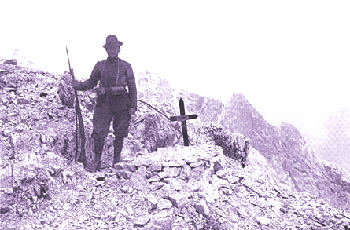
Innerkofler and five members of his “flying squad”, all top climbers, were ordered to dislodge a group of Italian  mountainsoldiers (Alpini) from a mountain peak. To make this happen Innerkofler’s team was required to perform a vertical ascent upon the Monte Paterno-an ascent that was actually among his resume of Alpine “first climbs”; a feat he had achieved 19 years earlier and many, many, times since.

The climb was completed by sunrise, and with the sun at their backs the Austrians began to attack with grenades and small arms and the thud of their own artillery sending shells just overhead into the Italian position. Austrian and Italian machine gun emplacements were trading fire across the ridges at each other.

There are several versions of what happens next, including an almost Wagnerian account-but the eventual outcome of each is the same: Innerkofler is killed by a rock-wielding Alpini.

The Italians, risking Austrian fire, recovered the Austrian’s body and give him a funeral with full respect, burying him on the Paternkofel.

With four of the Battles of the Isonzo down, there were still eight to go.

The next May, after an exceptionally bitter winter and spring and with more equipment, the Italians were preparing to attack, again, from north of Milan to up above Lake Garda-but the Austrians had two Armies in the mountains, who were able to drive the Italians back into their own northern plain, stopping the Fifth Battle before it ever got started.

It’s reported that the Austrians had to fall back from that newly acquired land partly because of problems running a logistics operation through the mountains…and also partly because the Russians mounted an offensive to the Austrians’ east. The cost to the Italians was substantial, however, as they were forced to commit 500,000 troops to the defense of the Lake Garda region.

In this environment, the Italians and Austrians were not limited to the use of traditional means of killing each other-in fact, rockslides and avalanches were becoming weapons of mass destruction, as this description of an action at the Col di Lana in April of 1916 indicates:

“…so the entire western margin of Col di Lana was carefully and patiently mined, an undertaking which probably took months of hard work, and several tons of high explosives were distributed in such a way as to destroy the whole side of the mountain above which the enemy was in- trenched.

The explosion that followed was terrific. The earth shook as if rocked by an earthquake, and the havoc wrought was so great that out of the 1,000 Austrians who held the position, only 164 survived.”

Just a few months later, on just one day (December 13th, a day which became known as “White Friday”) 10,000 soldiers are said to have died in avalanches; the problem being so serious that both sides had detachments of soldiers assigned specifically to the avalanche rescue mission.

This went on for months and months and months, with neither side really accomplishing anything in terms of territory gained. The Italians, however, were growing their Army, both in size and in the amount of materiel they could put in the field, until October of 1917, when either the Twelfth Battle of the Isonzo or the Battle of Caporetto took place (pick your favorite name; various sources use both).

The Austrians, coming down from the buckle of our boot, mounted an attack that was so successful that the Italian 2nd Army collapsed in disorganized confusion to the south, suffering severe levels of casualties; the better organized 3rd and 4th Armies seem to have lost about 20% of their forces “coming to the rescue”.

While the Italian Army under General Cadorna had begun the battle with 1,250,000 troops, in two weeks he lost roughly 320,000 of them to death or capture, along with most of his Army’s artillery-and his own job. An additional 350,000 soldiers were reportedly wandering the countryside, for the moment unattached to any military organization.

400,000 people became refugees in those two weeks.

Eventually the Austrians had to retreat back into their own territory; some of the reason for that being related to the same problems the Italians were having maintaining supply lines through mountains, some of the reason for that being that the Austrians were losing on other fronts.

This was not the end of the fighting along the Italian-Austrian frontier, nor the end of the ethnic conflict that has peppered the region’s history, but you get the idea: no one ever really won any victories that mattered, but thousands upon thousands of people died in the effort, and hundreds of thousands more were wounded-again, all for nothing, really.

“…das Schlagwort vom lebenslangen Lernen für alle – auch für Politiker – gilt…”  

(English translation: “…the slogan of lifelong learning for all – even for politicians – applies…”)

—Luis Durnwalder, Governor of the Autonomous Province of Bolzano

Now at some point in this story we have to answer the question of…what is the point of all this?

Folks, I hate to be the bearer of bad news, but the moral of this story is that there is no point.

More or less 400,000 soldiers died on both sides, countless more were wounded, and hundreds of thousands of people, if not millions, became refugees.

Sepp Innerkofler’s hotel was bombed as he and so many other of his friends, both Austrian and Italian, were killed up in those mountains.

And all of it for nothing.

Italy was not able to advance its national interests at all (in fact, things got much worse), and despite everything that happened back and forth over those years,  Austria certainly saw no gains: in fact, thanks to this war, the Hapsburg Dynasty also went the way of “Cats” and the Ottoman Empire…closing, after a long run.

If it was my job to apply all of this to some war that my bosses were fighting…I think I’d be looking at Afghanistan, and I think I’d be looking at the place as a collection of tribal communities, rather than one big country; and I think I’d be telling my bosses that all those talking heads-and just plain folks-who think we should “defeat the Taliban” through some military campaign so that we can come home, having achieved some kind of ultimate victory, need to understand that you will never defeat anything up in the mountains simply be throwing a bunch of people and equipment at the problems.

Instead, you’re going to have to consider whether it’s possible to help the Afghans create something like what is happening in the Tyrol today, where protections for the various tribal and ethnic groups could be laid out in a framework that reassures Pashtuns, Persians, and Turcoman alike that they have a place in a community of interdependent communities.

This has been a long and, at times, rather depressing, look at who we are as people, and I wanted to end on a postscript that is a bit happier…and it all comes back to Sepp Innerkofler.

Despite the fact that his hotel was bombed, and he was killed, the family carried on, as did the strength of his reputation…which is why you can, even to this very day, hike the Sepp Innerkofler Höhenweg (Ridgeway, in English), and why, should you find yourself a bit tired from the hike, you can stay at Sepp’s original Hotel Dolomitenhof, rebuilt since the war, where the legacy also continues, as Innerkofler Katharina recently noted in an email exchange we had:

“…of course we are proud of our grand-grand pa. We´ve a little museum in our hotel, where we show his climbing successes and explain his destiny.”


[poll id=”

344

“]

John Burton Comes Out Against Maldonado Confirmation

Putting concern over a relatively insignificant office over the extremely significant 2/3rds majority in the State Senate, CDP Chair John Burton opposes Maldonado’s confirmation as Lt. Gov.:

“Why should they give the job to a Republican — when there hasn’t been a Lt. Gov. who’s been a Republican since Mike Curb in 1978,” said Burton, whose own history as a powerful State Senate Pro Tem — and his current control of party money as the Dem leader in CA — could give him clout with state lawmakers on the matter. “Why give his seat to another party?”

“They’ll vote him down,” Burton predicted confidently….

“There’s a reason why some people are Democrats, and some are Republicans,” he said. “And Democrats don’t vote for Republicans.”

Of course, in this case, Democrats don’t actually have to vote for Republicans. They can do nothing. Maldonado would become Lt. Gov. and serve for a few insignificant months while either Dean Florez or Janice Hahn mobilize around the state to defeat him.

Meanwhile, Democrats here on the Central Coast organize to send either John Laird or Bill Monning to the State Senate to replace Maldonado, combining with a Democratic victory later in the year in SD-12 to reclaim two Democratic districts and attain 2/3rds in the Senate.

As a member of my county’s Democratic Central Committee, as well as a member of the California Democratic Party Executive Board, this strikes me as a favorable deal for the Democratic Party. Dems don’t actually have to vote for Maldonado, and can continue to rail against him and his right-wing views. Meanwhile, we do the on-the-ground work that Dems can and should do to win the Lt. Gov. office as well as 2/3rds in the Senate.

Ultimately, if we have to weigh the considerations against each other, it is far more important for Democrats to have 2/3rds than to have the Lt. Gov. office. The state legislature is at the center of Democratic fortunes in this state. Because it has been in Democratic hands for nearly 40 years, it is seen as the most obvious model of what the Democratic Party stands for and can accomplish in California.

If the Democratic majority is unable to implement its vision because they lack a 2/3rds majority, then that makes Democrats look weak and ineffective. This is particularly the case with a Democratic governor. One of the things that led to Gray Davis’s recall in 2003 was the inability of the Legislature to agree on a budget, making Davis look like a weak leader.

Democrats need to think like a party and a movement – and not like an organization dedicated to advancing the career of any single individual. The California Democratic Party is stronger by stepping out of the way of Maldonado’s confirmation and instead focusing on making the case to California’s voters, whether here on the Central Coast or statewide, as to why Democrats deserve votes instead of acting like those votes, or any particular office, belong to us by divine right.

The Lt-Gov Plot Thickens: Denham Drops Out

It’s not every day that the exodus from the legislature gets reversed. Jeff Denham, who went straight into the State Senate from SD-12 in 2002 without serving in the Assembly (Denham lost to Símon Salinas in a 2000 Assembly race), has announced that he will drop out of the Lieutenant Governor’s race and run to replace Tom Berryhill in AD-25:

Denham met in the past two days with Gov. Schwarzenegger, other GOP leaders and his family before reaching his decision to run for Berryhill’s Assembly District 25. It will require him to move out of Merced County and into Stanislaus County.

He said running for the Assembly seat will give him a chance to become a key leader in the Legislature after serving two terms in the Senate.

Obviously Arnold and the Republican power elite are trying to grease the skids for Maldonado to become the next Lt. Gov., and have succeeded in pushing Denham – who has no love lost for Maldonado – to run for the Assembly. And Denham’s even going to move to Modesto (he currently lives near Merced) to make this happen.

To top it off, Denham isn’t going to have AD-25 handed to him on a platter:

He faces Modesto City Councilwoman Janice Keating, who announced this week that she intends to run for Berryhill’s seat. Keating is a solid fund-raiser in her own right, having assembled six-figure war chests for a 2006 race for a Stanislaus County supervisor’s seat and to help pass a local government reform measure in 2008.

Of course, Keating may well decide to drop out instead of facing Denham. But it does show that the California GOP is making a priority out of the Lt. Gov. race.

That shouldn’t be cause for Democrats to circle the wagons on the Maldonado appointment. Either Dean Florez or Janice Hahn should be able to beat him, and we should not be afraid to make that case – especially when 2/3rds in the Senate is on the line.

UPDATE by Brian: I just want to also toss in here that Abel still has another challenger in the LG race: Sam Aanestad. At this point, it seems unlikely that Aanestad will drop out. So, Denham dropping out might help Maldonado, but it also helps Aanestad, should he choose to remain in the race. He can now suck up all the right-wing base love in the race. If he can get his name ID up a little bit, this could be a dogfight.