Tag Archives: Barack Obama

Obama Welcomes Edwards Supporters with Open Arms

Crosspost at Raising Kaine:  The Voice of Progressive Virginia

John Edwards is one of those rare political figures who is both capable of inspiring hope while taking up the most difficult and tumultuous fights.

With the announcement of his pending withdrawl from the race for the Democratic nomination for President this year, there will be millions of Americans struggling to decide where to pledge thier ongoing support.  Neither Hillary Clinton, nor Barack Obama  can represent precisely the firebrand populism of the Edwards campaign, but on issue after issue, there is strong reason for Edwards supporters to join the rising movement for change that has been inspired by the Obama candidacy.

Barack Obama had this to say about Edwards withdrawl from the race:

“John Edwards has spent a lifetime fighting to give voice to the voiceless and hope to the struggling, even when it wasn’t popular to do or covered in the news. At a time when our politics is too focused on who’s up and who’s down, he made a nation focus again on who matters – the New Orleans child without a home, the West Virginia miner without a job, the families who live in that other America that is not seen or heard or talked about by our leaders in Washington.”

Obama added, “John and Elizabeth Edwards have always believed deeply that we can change this – that two Americans can become one, and that our country can rally around this common purpose. So while his campaign may end today, the cause of their lives endures for all of us who still believe that we can achieve that dream of one America.”

From all of us Obama supporters to all of you Edwards supporters:  we are here to welcome you with open arms.

Back in 2005, when Raising Kaine began fighting for our own particular brand of Teddy Roosevelt, John F. Kennedy Progressivism, we found inspiration in the words and strategies of the blogging leader who would later found the Progressive States network and then sign on to the Edwards Campaign, David Sirota.   In particular, in his American Prospect Cover Story from January 2005, “The Democrat’s Da Vinci Code“, Sirota identified a pathway to success for Democrats that has been successfully employed by great Dems from John Tester to Sherrod Brown, and which was largely embraced by the Edwards Campaign itself.

On issue after issue, as described by Sirota, Obama’s positions and leadership drive the way towards the kind of populism that Edwards himself embraced, and which will form the lasting and broad coalition for a new era of Progressive politics in America.

1.  Fight the Class War

If patriotism is the last refuge of scoundrels, crying “class warfare” is the last refuge of wealthy elitists. Yet, inexplicably, this red herring emasculates Democrats in Washington. Every time pro-middle-class legislation is offered, Republicans berate it as class warfare. Worse, they get help from corporate factions within the Democratic Party itself.

But as countless examples show, progressives are making inroads into culturally conservative areas by talking about economic class. This is not the traditional (and often condescending) Democratic pandering about the need for a nanny government to provide for the masses. It is us-versus-them red meat, straight talk about how the system is working against ordinary Americans.

Obama’s inspiring style doesn’t easily lend itself to Hewey Long muckrakery, but his message and experience absolutely speak to the need to protect and defend “the little guy”:

From the Washington Post, January 4:

Obama didn’t stop there. He played a major role in passing many other bills, including the state’s first earned-income tax credit to help the working poor and the first ethics and campaign finance law in 25 years (a law a Post story said made Illinois “one of the best in the nation on campaign finance disclosure”). Obama’s commitment to ethics continued in the U.S. Senate, where he co-authored the new lobbying reform law that, among its hard-to-sell provisions, requires lawmakers to disclose the names of lobbyists who “bundle” contributions for them.

Taken together, these accomplishments demonstrate that Obama has what Dillard, the Republican state senator, calls a “unique” ability “to deal with extremely complex issues, to reach across the aisle and to deal with diverse people.” In other words, Obama’s campaign claim that he can persuade us to rise above what divides us is not just rhetoric.

While Obama’s oratory may not spark the same prarie fire as Edwards’, his record shows that he is dedicated to the same progressive principles and is capable of getting results.  Obama’s policy of “Tax Fairness“, is precisely in line with the interests of the middle-class.  Moreover, you’ll recall that it was Obama and Edwards who refused to take PAC money, while Hillary Clinton refused to take a stand against it.

Specifically:  

Taxes: Obama would raise income taxes on wealthiest and their capital gains and dividends taxes. He would also raise corporate taxes and provide $80 billion in tax breaks mainly for poor workers and elderly, including tripling Earned Income Tax Credit for minimum-wage workers and higher credit for larger families.

2. Champion Small Business Over Big Business

The small-business lobby in Washington is a de facto wing of the Republican Party. But Democrats are finding that, at the grass-roots level, small-business people are far less uniformly conservative, especially as the GOP increasingly helps huge corporations eat up local economies. While entrepreneurs don’t like high taxes and regulations, they also don’t like government encouraging multinationals to monopolize the market and destroy Main Street.

It’s no secret that John Edwards was the champion of “Main Street over Wall Street”.    He decried the excesses of corporate greed and sought to set fire to the pillars of oligarchy.  He was also the champion of small businesses, and will likely continue to be in whatever he pursues after this contest.  

Barack Obama has very clearly delineated plans to address the issues facing small businesses,

As one blogger put it when his conservative republican parents suggested that they could vote for Obama:

3) The Republicans have long relied on a fundamental commonality of interest between big business and small business, between the Club for Growth and the Fortune Four Hundred on one hand and the members of thousands of local Chambers of Commerce and Rotary Clubs on the other. This notion of a common interest is harder and harder to sustain. In the 1960s the health of America’s big businesses meant they were hiring workers somewhere in the U.S., but today multinational corporations can boom while Main Streets are busting. Furthermore, the gap between the wealth of a successful small town entrepreneur or executive and that of a big business mogul has become immense. The fundamental argument that campaigning against the estate tax or corporate income taxes will improve the lives of “average” white-collar managers is less and less persuasive.

Obama’s message in favor of small businesses is one that can be heard from the hovels of the deeply impoverished to the increasingly uncertain country club set, and in order to make profound change, we will need a group that diverse to make it.

Finally, Obama is a great champion of Media Ownership Diversity, an issue that includes the small-business v. big-business dichotomy and transcends it to include issues that go to the very foundations of our democracy.

3. Protect Tom Joad

Protect Tom Joad

Northern Wisconsin and the plains of North Dakota are not naturally friendly territories for progressives. Both areas are culturally conservative, yet their voters keep sending progressive Democrats like Representative David Obey and Senator Byron Dorgan, respectively, back to Congress.

No issue is closer to these two leaders’ hearts — or more important to their electoral prospects — than the family farm. In Wisconsin, corporate dairy processors have tried to depress prices for farmers’ dairy products. In North Dakota, agribusiness has squeezed the average farmer with lower prices for commodities. But unlike other lawmakers who simply pocket agribusiness cash and look the other way, Obey and Dorgan have been voices of dissent. They have pushed legislation to freeze agribusiness mergers, a proposal originally developed by populist Senator Paul Wellstone of Minnesota. As Dorgan once wrote, “When Cargill, the nation’s number one grain exporter, can buy the grain operations of Continental, which is number two, the cops aren’t exactly walking tall on the antitrust beat.”

Dorgan and Obey also opposed the Republican-backed “Freedom to Farm Act,” which President Clinton signed into law.

The family farm is an endangered species in American life and just as John Edwards emerged as a powerful voice speaking to the needs of rural voters, the results from Iowa and Nevada point to Obama’s power in rural communities.

Obama is a true leader on family farming, and has been for decades.  His family managed to live off of the proceeds of a modest oil lease, but before that, they were simple family farmers.

Obama stands against the excesses of the farm subsidy programs that have driven prices below the sustanence level for most small producers:

Obama’s farm plan, which would cost the United States an estimated $300 million a year in new spending, would also include the elimination of income taxes for seniors making less than $50,000, conservation and land protection measures, and investments in bioenergy expansions.

“What we’ve learned, above all else, is that we’re at a critical and urgent moment for rural America,” Obama said, referring to the dozens of meetings his campaign held with rural Iowans during the summer to help draft the plan. “Our economy is in transition, our environment faces growing peril.”

Farm subsidies have drawn national attention, particularly after a federal report this year showed that $1.1 billion was paid by the federal government to 172,801 dead people between 1999 and 2005. In addition, some large corporations have been paid millions, which Obama says has hurt family farms.

The plan proposed Tuesday would limit such payments to a maximum of $250,000 a year. Obama, a U.S. senator from Illinois, estimated that such limits would save the federal government $100 million.

“Too many family farmers are being squeezed as big agribusiness takes up larger shares of federal subsidies, takes up more market share, manipulates prices and contracts, makes it harder for family farmers to control how they run their own farms,” Obama said.

There was a time when small, family farms were the backbone of our agricultural policy, but when Bill Clinton signed the “Freedom to go out of business farming” bill, into law, he set the stage for massive agribusiness to overwhelm the market.  

The excesses here also go well beyond merely squeezing small families out.  As we have well documented, agribusinesses like Smithfield Farms in Virginia are vicious exploiters of undocumented labor.  The fact that Farm subsidies drive grain prices through the floor, also contribute to world poverty and the flood of undocumented aliens.  When people can’t survive on the food they grow it engenders the cycles of poverty that lead to worldwide disease, and force farmers to seek lives in America.  Obama opposes these mega subsidies, seeking instead to support small farmers and keep them and their rural economies thriving.

4. Turn the Hunters and the Exurbs Green

For years, conventional wisdom has said that culturally conservative hunters and exurbanites will always vote Republican. But the GOP’s willingness to side with private landowners and developers is now putting the party at odds with these constituencies. And that could create a whole new class of Democratic-voting conservationists.

Obam hears this one loud and clear.  For Obama, creation stewardship is a moral imperative, and it’s one that is being undermined by vested corporate interests:

Climate change is not just a scientific or an environmental issue, says Democratic presidential candidate Barack Obama. It is an issue of morals and of faith.

Men and women of faith have always waded into issues that impact society in profound ways: prison reform, temperance, abolition, women’s rights, Obama reminded the group crowded into the public library on a rainy Sunday in Iowa’s capital.

Climate change should also become one of those moral imperatives.

Obama was speaking the day after former Vice President Al Gore received a Nobel Prize for his efforts to promote awareness of the dangers of climate change.

“When God created the Earth he entrusted us to take responsibility to take care of that Earth,” Obama says, and we are not living up to our responsibility to ensure our children’s future.

From Obama’s Rural Plan:

Protect the Rights of Sportsmen: Barack Obama deeply respects America’s sportsmen and is committed to protecting their rights. Tens of millions of Americans hunt and fish. Obama believes that we can protect the rights of hunters and other lawful gun owners while still working to reduce gun violence and make sure that guns do not fall into the hands of criminals or the mentally ill. Barack Obama is fully committed to protecting the forests, fish, and game our sportsmen enjoy. Obama will provide full funding for a broad range of conservation programs. He also supports a proposal by more than 25 national hunting and fishing organizations to help fish and wildlife survive the impacts of climate change.

Obama champions the policies that will fulfill Sirota’s powerful equation:  Red + Blue = Green.  His voice it the voice that will win the crossover  for redstate Americans sick to death of watching their precious natural resources destroyed by the excesses of big-business.

6. Become a Teddy Roosevelt Clone

“Tough on crime” has always been a reliable Republican mantra. Now, though, progressives are claiming that law-and-order mantle for themselves. Led by state attorneys general, Democrats are realizing the political benefits of fighting white-collar crime, big-business rip-offs, and corporate misbehavior.

John Edwards led on the issue of corporate responsibility, but Obama is ready to continue the fight.  

For example:


# Obama joined union efforts to get Wal-Mart & other large employers to improve working conditions, wages & health coverage.

# Obama supports amending bankruptcy laws to keep companies from avoiding their pension obligations.

# Obama supported new rules to force companies to properly fund their pension plans so workers aren’t left without adequate retirement security.

# He has also voted to shore up the funding of the Pension Benefit Guaranty Corporation.

His record and policies stand up to anyone on this issue, and he will carry this fight  to Washington where he has already proven able to make change.

6.  Clean Up Government

In the early 1990s, Newt Gingrich attacked Democrats as corrupt, wasteful, and incompetent, eventually leading the Republicans to reclaim Congress. Now, though, progressives are using the tactic for themselves.

Obama’s hallmark achievement in the US Senate was the most sweeping ethics reform in modern history.  It doesn’t go far enough, but he promises to take the ethics fight farther from the White House:

   “I am in this race to tell the corporate lobbyists that their days of setting the agenda in Washington are over. I have done more than any other candidate in this race to take on lobbyists – and won. They have not funded my campaign, they will not get a job in my White House, and they will not drown out the voices of the American people when I am president.”

   – Barack Obama, Speech in Des Moines, IA, November 10, 2007

7. Use the Values Prism

In 2004, pundits seem to agree that the national election was decided by “moral values.” And though many believe the term is a euphemism for religious, anti-abortion, and anti-gay sentiments, it is likely a more general phrase describing whether a candidate is perceived to be “one of us.”

It is this sense of cultural solidarity that often trumps other issues. For example, many battleground-state voters may have agreed with John Kerry’s economic policies. But the caricature of Kerry as a multimillionaire playboy windsurfing on Nantucket Sound was a more visceral image of elitism. By contrast, successful red-region progressives are using economic populism to define their cultural solidarity with voters. True, many of these Democrats are pro-gun, and some are anti-abortion. But to credit their success exclusively to social conservatism is to ignore how populism culturally connects these leaders to their constituents.

In terms of reconnecting the reputation of the Democratic party with authentic American values, there is no greater champion in the party than Barack Obama.  His eloquence and call to the greater nature of the American spirit is effective not only in speaking to the necessity of dramatic change, but in making the powerful case that the Democratic and progressive way is the American way.  

The impact of this particular aspect of Obama’s message of change cannot be overstated.  In this age of disillusionment with the excesses and failures of the conservative agenda, Americans are looking for powerful ideas and the power to turn them into lasting transformation for the future of our country.  It is Barack Obama’s voice that connects America to it’s authentic progressive base and inspires Americans from all walks of life to a better and brighter future filled with possibility and that can overcome the massive adversity set before us by the powers of conservative ideology.

In Sum

David Sirota sums up his opus thus:

In these seven ways, successful red-region Democrats have tacked back to a class-based populism that puts them firmly on the side of the little guy. And because voters implicitly know that big guys with lots of cash dominate the political system, that populism projects a deeper sense of values and a McCain-like authenticity.

In the aftermath of the recent election, the stale cadre of campaign consultants who helped run the party into the ground now say the solution is for Democrats to simply invoke God more often and radically change their positions on social issues. But the point is not to impulsively lunge rightward in some cheap, unprincipled gesture to red America that would reek of political strategizing.

The point is to follow red-region Democrats who have diminished the electoral impact of traditional social issues by redefining the values debate on economic and class terms. Granted, the progressive populists profiled above do not uniformly hew to the standard liberal line on social issues: some are pro-life, some pro-choice; some pro-gun ownership, some pro-gun control; some pro-gay marriage, some anti-gay marriage; some vociferous about religion, some subdued. But they have shown that there is another path that moves past wedge issues if the party is willing to fundamentally challenge the excesses of corporate America and big money.

For all of you Edwards supporters who are looking for a new way forward, and a new candidate who will support the things that you found inspiring in John Edwards, we hope that you will consider taking this moment, along with the millions of Barack Obama supporters who are championing change in this nation.

You are the key to the future.  And if you are asking yourselves whether we can emerge from this dark era of Bush Republicanism into a new era of cooperation, transformation and success, millions of supporters and devoted Americans, Progressives, Democrats, Men Women, African-Americans, Hispanics, Asians, moderates, and newly inspired republicans are here to tell you:

“YES! WE CAN!”

[poll id=”

172

“]

Election 2008: John Edwards to Withdraw From Democratic Primary Process

(XPosted 1/30/2008 10:10 AM PST on MyDesert.com as BluePalmSpringsBoyz)

The media has reported that former-Sen. John Edwards plans to withdraw as a Democratic candidate for the nomination for President.  It is a sad day as for many supporters, Edwards epitomized someone who early in the process opposed the disastrous policies of the so-called Pres. George Bush in Iraq and Iran, who was overwhelmingly supportive of LGBT issues, who spoke on behalf of the poor and working people of this country, and who set a mature tone for the Democratic campaign in general.

More below the flip…

Edwards had voted in favor of extending to Bush the power to conduct himself as he wished in Iraq.  Edwards, however, later recognized the foolishness of bestowing trust on someone who demonstrated a lack of trustworthiness.  He regretted his vote on Iraq, and withdrew his support from Bush and his poorly conceived and poorly executed occupation strategy.  When he attacked Bush, he did it on a policy level and avoided personal attacks.  He is no Bush or Karl Rove, indeed.

Edwards also espoused almost universal support for the LGBT community and for our issues.  He supported repeal of the Defense of Marriage Act, supported the Employment Non-Discrimination Act, supported the repeal of Pres. Bill Clinton’s Don’t Ask, Don’t Tell policy, supported the ability of LGBT families to adopt, and supported fully funding HIV/AIDS research and treatment.  His only failure was in his failure to support Marriage Equality.  However, the LGBT community did have the support of Elizabeth Edwards in that regard.  It was a breath of fresh air to have the almost complete support of a Presidential candidate rather than being an object of homophobia and hatred as we were during Election 2004 with Bush and Rove.

He derived support from the poor and from unions and from middle class workers in general because Edwards spoke to their economic and employment issues.  Edwards opened his campaign in the Lower Ninth Ward of New Orleans and will apparently close his campaign there as well in order to attempt to refocus the Democratic campaign on the issues rather than on personalities.  He also received the support of many unions and locals across the country because of his stand opposing NAFTA and outsourcing jobs.  On the other hand, Bush and his corporate cronies only serve to enrich the coffers of big business, Halliburton, Blackwater, Brown, Kellogg & Root, and the Defense and Mercenary Contractors at the expense of the poor and middle class.

Already, Sen. Hillary Clinton has posted a statement on her website at HillaryClinton.com

“John Edwards ended his campaign today in the same way he started it – by standing with the people who are too often left behind and nearly always left out of our national debate.

“John ran with compassion and conviction and lifted this campaign with his deep concern for the daily lives of the American people. That is what this election is about – it’s about our people. And John is one of the greatest champions the American people could ask for.

“I wish John and Elizabeth all the best. They have my great personal respect and gratitude. And I know they will continue to fight passionately for the country and the people they love so deeply.”

Sen. Barack Obama released a statement concerning Edwards on his website located at BarackObama.com.  Here is Obama’s statement in its entirety:

“John Edwards has spent a lifetime fighting to give voice to the voiceless and hope to the struggling, even when it wasn’t popular to do or covered in the news.  At a time when our politics is too focused on who’s up and who’s down, he made a nation focus again on who matters – the New Orleans child without a home, the West Virginia miner without a job, the families who live in that other America that is not seen or heard or talked about by our leaders in Washington.  John and Elizabeth Edwards have always believed deeply that we can change this – that two Americas can become one, and that our country can rally around this common purpose.  So while his campaign may end today, the cause of their lives endures for all of us who still believe that we can achieve that dream of one America.”

Yes, Edwards will be missed by BluePalmSpringsBoyz and BlueBeaumontBoyz and, apparently by Clinton and Obama as well.  Truth will be told in the pudding though.  We shall see if the tenor of the campaign changes and if the focus turns to the issues rather than remaining on petty squabbling.  This will determine who we support on February 5, 2008.

Election 2008 Delegate Race: Clinton, McCain Lead in Delegate Counts as of January 29, 2008

(XPosted in the BluePalmSpringsBoyz Blog 1/29/2008 7:50 PM PST on MyDesert.com)

The National and local news media usually only focus on who ‘wins’ the caucus or primary race.  They provide little information on election night regarding the important race, that for delegates.

This is interesting stuff from CNN.com, see http://www.cnn.com/ELECTION/2008/primaries/results/scorecard/#R for the Republican totals and http://www.cnn.com/ELECTION/2008/primaries/results/scorecard/#val=D for the Democratic totals.

More below the flip…

The magic number of delegates for the Democratic nominee is 2,025.  Thus far, the Democratic delegate scorecard is:

Barack Obama:  63

Hillary Clinton:  48

John Edwards:  26

Mike Gravel:  0

Clinton is now contesting the Michigan and Florida delegate selection process and hopes to pick up a massive amount of delegates when the slates are challenged at the Democratic National Convention.  Obviously, Obama and Edwards are none too pleased with that scenario.

When factoring the so-called Super Delegates, 452 Democratic delegates have been chosen, including those from last Saturday’s South Carolina Democratic primary as well as the so-called Super Delegates (e.g., governors, U.S. Senators, U.S. Representatives).  Only 11.16% of the Democratic delegates and Super Delegates are committed to date.  Clinton leads this field far and away.  The results are as follows:

Hillary Clinton:  232

Barack Obama:  158

John Edwards:  62

Mike Gravel:  0

Clinton still has more delegates committed to her than all of her challengers combined.  However, the Super Delegates’ commitment is somewhat less certain than that of the primary and caucus delegates and are possibly more likely to switch allegiance.  Obama follows Clinton with 158 delegates, while Edwards has 62 delegates.

The magic number of delegates on the Republican side is 1,191.  Thus far, the Republican Convention delegate scorecard is as follows:

John McCain:  95

Mitt Romney:  67

Mike Huckabee:  26

Ron Paul:  6

Rudy Giuliani:  1

However, when factoring in the so-called Super Delegates, 208 Republican delegates have been chosen.  This means that only 8.74% of the Republican delegates are committed thus far.  McCain now leads the Republican candidates when including the Super Delegates with 97 because of his primary win today in the Florida primary.  The totals are as follows:

John McCain:  97

Mitt Romney:  74

Mike Huckabee:  29

Ron Paul:  6

Rudy Giuliani:  2

Very few Republican delegates have been chosen, but McCain now has almost as many delegates as his challengers combined.  The pressure will be on Giuliani and Paul now to withdraw from the race, especially when Giuliani put all of his 9/11 eggs into the Florida primary basket.  Huckabee also now seems to be reeling, wobbling off to Tennessee.

February 5, 2008, looms on the horizon when another 22 states including California hold their primaries and caucuses.  The picture will be much clearer then, when over 50% of the delegates on both the Democratic and the Republican sides will have been chosen by the end of that day’s primaries and caucuses.

“Rapid Responders”? This is getting ridiculous

In what is becoming an increasingly nasty campaign,  (most ably demonstrated by having our 42nd president serve as attack dog) the two leading campaigns are signing up dueling rapid response teams.  Here are the two press announcements today:

US Sen. Hillary Clinton’s campaign for president reports launching “Rapid Responders” teams in all 22 of the states with caucuses or primaries on February 5. The teams will respond to “inaccurate or misleading attacks directed at Senator and President Clinton,” and in California the team members listed are: State Controller John Chiang; Pres. Alice Huffman, California NAACP; San Francisco Mayor Gavin Newsom; Assembly Speaker Fabian Nunez and former US Rep. Lynn Schenk.

US Sen. Barack Obama’s campaign for president reports forming a California Truth Squad “to respond to misleading negative attacks from the Clinton campaign.” Members listed are: US Reps. Barbara Lee, George Miller, Linda Sanchez, Zoe Lofgren and Adam Schiff, Sen. Gloria Romero, Asm. Karen Bass, San Francisco DA Kamala Harris and Maria Elena Durazo, executive secretary-treasurer of the Los Angeles Federation of Labor.

The bashing back and forth is getting annoying, and I suspect the only real beneficiary is John Edwards as he pursues his quest for delegates to make himself into a kingmaker.

And, for what it’s worth, I’d take Obama’s squad, mostly because Barbara Lee and George Miller are super-duper cool.

Obama has a shot at the Hispanic vote in California

Hispanic voters in New York and specially in California may hold the key to Tsunami Tuesday.

Obama is doing something very smart about it (advertising in Spanish radio and TV) and he is enjoying from the support of perhaps the greatest organizer of Hispanic voters in California, I am talking by El Cucuy de la Mañana, The Bogeyman of the Morning.

Take a look at the front page of ElCucuy.com today (El Cucuy in the red vest);

The key is this audio of the telephone interview of Barack Obama by El Cucuy broadcast late last year and available front this link below Obama’s photo on the front page.

Towards the very end responding to Obama’s invitation to meet next time he went to Illinois El Cucuy says;

Ojala nos veamos en la Casa Blanca.  

or

I hope we meet at the White House

First of all, if you Recommend this diary, the audio of the wonderful and very informative interview will get a broader audience.  Trust me, as a Hispanic supporter of Obama I think that the more Hispanics get exposed to it the better.  The woman that does the real time translation does a great job even if she is not perfect.  

I think this may be more a case of El Cucuy approaching Obama more than Obama’s campaign doing an outreach, but it its clear who El Cucuy supports.

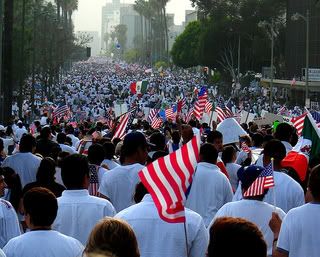
El Cucuy was one of the key forces behind the massive May 1st 2006 demonstration in Los Angeles.

The demonstrations were co-opted by LA Mayor Pedro Villaraigosa who spoke to the huge crowd that marched down peacefully from downtown to the Fairfax district.

I diaried about this historic event which I attended.

Antonio Villaraigosa supports Hillary Clinton, but he may not necessarily be as effective in turning out the California Hispanic vote as her campaign wishes.

But there are more points of reference that indicate a pattern of key Hispanic vote influencers actively supporting Obama.

On Monday in the LA Times OpEd, Gregory Rodriguez thoroughly debunks the notion that Hispanics will not vote for black candidates;

He could have also added that longtime Los Angeles Mayor Tom Bradley won a healthy chunk of the Latino vote in 1973 and then the clear majority in his mayoral reelection campaigns of 1977, 1981, 1985 and 1989.

Here in L.A., all three black members of Congress represent heavily Latino districts and ultimately couldn’t survive without significant Latino support. Five other black House members represent districts that are more than 25% Latino — including New York’s Charles Rangel and Texan Al Green — and are also heavily dependent on Latino voters.

So, given all this evidence, why did this notion get repeated so nonchalantly? For one, despite the focus on demographic changes in America, journalists’ ignorance of the aspirations of Latino America is pretty remarkable. They just don’t know much about the biggest minority in the nation. And two, no Latino organizations function in the way that, say, the Anti-Defamation League does for Jewish Americans. In other words, you can pretty much say whatever you want about Latinos without suffering any political repercussions.

If I were David Plouffe, Obama’s campaign manager, I would spend a hearty amount of ad dollars in Spanish TV, newspapers and radio in Los Angeles and New York in the days.  

Level with Hispanics, what he said in the interview about education, health care and immigration is what they want to hear from Obama.  Specially in those radio stations that cater to young Hispanics, who, like young people of any ethnicity see in Obama someone closer to their way of thinking.

Those who have proclaimed that Hispanics will not vote for black politicians are making as big a blunder as President Bill Clinton made when he proclaimed that blacks in South Carolina would vote based on race.

Primary Polling

There’s a new Gallup poll of California which finds Senator Clinton and Senator McCain currently leading in California.  What’s interesting is the margins.  Clinton leads Obama by a 47-35 margin with Edwards at 10, tighter than the race has been since about a year ago.  Which is notable in itself, but also compared to national polling (average of the last seven national polls from Pollster.com):  Clinton over Obama and Edwards, 44.1% – 32.3% – 13%.  Those polls, unlike the new Zogby poll, include Kucinich bouncing between 1 and 4 percent.  I’d discuss the Republican side but the national polling all has Thompson so it doesn’t really reflect the current situation.

So my question is, who’s leading who?

Also: LA Times/CNN/Politico poll of California makes the Dem race at 49-32-11.  Also mentions that “3 in 10 likely voters said they could change their minds.”

State of FISA

Full disclosure: I work for the Courage Campaign

Update: Everything failed cloture.  McConnell’s bad amendment failed and so did Reid’s good-ish 30-day extension.  Which means that nothing has changed and we’re back to where everything was last week. Except that now President Bush has some nice fodder for his speech.  Updated update: Senators Boxer and Feinstein voted against cloture on McConnell’s and for cloture on Reid’s extension.  Good votes all.

All sorts of interesting developments on the FISA debate over the weekend as we swing into the next phase of the showdown.  First, the New York Times blasted leading Senate Democrats in an editorial for even considering an extension of Bush’s protections.  It also went ahead to say what so many of us know already: the notion that amnesty for telecom companies is anything but an attempt to cover up what this administration has been up to is…well…crazy.  The President contends that amnesty is necessary to get cooperation in the future, but it just doesn’t pass the smell test.  If the law is followed, it’s not a problem.  And if there’s any question about legality, the time to sort it all out isn’t well after the fact.  That’s the whole point of having a FISA court in the first place.

Senator Feinstein holds one of the votes that could be vacillating this week as FISA winds through vote after vote.  Call her and speak your mind about the ugly notion of providing amnesty to the telecoms.  She has many phone numbers:

202-224-3841 (Washington, DC)

310-914-7300 (Los Angeles)

415-393-0707 (San Francisco)

619-231-9712 (San Diego)

559-485-7430 (Fresno)

Either way, here we find ourselves.  Tim Tagaris noted over at OpenLeft that President Bush will veto any temporary extension of FISA.  Which means a lot of things, but the major one is that we can expect some theatrics.  There’s a State of the Union address coming soon, and as a result there’s a full chamber of Senators in town.  Including the ones with names like Clinton, McCain, and Obama.  Senators like that bring cameras, and Senators like cameras.

So here are the benchmarks to be watching for.  Senators Clinton and Obama will be joining with most (hopefully all) Democrats against cloture on Mitch McConnell’s odious offering on FISA.  That’s at 4:30pm eastern and is a good start.  Reid will be looking to pass a 30-day extension (the one Bush would apparently veto).  For now, this is the big one.

Rubber hits the road AFTER the State of the Union when there’s no fodder for the speech to be had.  The President is likely to establish the framework for the rest of the week during his speech, and it’s later in the week that Dodd’s filibuster will likely come to a head.  As a result, it will be when we get the real test of who stands where and who is willing to lead on this issue.

And yes, I’ll be keeping at least one eye on Senator Feinstein there.  She’s been pretty willing to buy the line of crap about telecom amnesty being important, which quite frankly it isn’t.  When it really comes down to it, where will she be? We’re gonna find out.

The Courage Campaign is one of many organizations fighting to make sure our Democratic Senators hang tough and beat Bush on this issue.  Help out with a call to Senator Feinstein and remind her we’re paying attention.

Endorsements A Go-Go

Just a quickie on a bunch of endorsements from over the weekend.  Xavier Becerra came out for Obama this weekend, which could combine with Ted Kennedy’s endorsement to provide a lot of support in the Latino community.  Apparently, Kennedy will be campaigning in California.  This is a counterweight to the United Farm Workers’ endorsement of Hillary Clinton last week.  But I was interested by Tom Hayden’s endorsement, not of Obama, but actually for the movement he has inspired.  From an email:

I have been devastated by too many tragedies and betrayals over the past 40 years to ever again deposit so much hope in any single individual, no matter how charismatic or brilliant. But today I see across the generational divide the spirit, excitement, energy and creativity of a new generation bidding to displace the old ways. Obama’s moment is their moment, and I pray that they succeed without the sufferings and betrayals my generation went through. There really is no comparison between the Obama generation and those who would come to power with Hillary Clinton, and I suspect she knows it. The people she would take into her administration may have been reformers and idealists in their youth, but they seem to seek now a return to their establishment positions of power. They are the sorts of people young Hillary Clinton herself would have scorned at Wellesley. If history is any guide, the new “best and brightest” of the Obama generation will unleash a new cycle of activism, reform and fresh thinking before they follow pragmatism to its dead end.

Many ordinary Americans will take a transformative step down the long road to the Rainbow Covenant if Obama wins. For at least a brief moment, people around the world — from the shantytowns to the sweatshops, even to the restless rich of the Sixties generation — will look up from the treadmills of their shrunken lives to the possibilities of what life still might be. Environmental justice and global economic hope would dawn as possibilities.

I’ve been saying for a while now that, regardless of the President, what will create this “change” that everyone’s been bandying about is we the people.  The coalition that Obama represents does offer an opportunity to build such a movement, at a level that Clinton does not appear to be attempting to build.  It’s certainly fragile, and may fracture once the Republicans prove resistant to a rhetoric of “post-partisanship” and working together.  But it’s our best hope.

Newsflash: CA Voter Finally Decides, She Thinks…

(Bumped with a pic moved after the jump. Have you written a diary on why you are supporting your pick? – promoted by Bob Brigham)

I’m seriously considering changing my vote from Edwards to Obama because I really like the latter’s ability to inspire people.

Photobucket Bush boasted that he was a “uniter” (which was opposite of the truth of course) but Barack Obama really is a leader who can bring all the splintered groups in this country together. His campaign has already done that. It’s filled with supporters who really represent ALL of America. They’re all races, all economic backgrounds, all political persuasions. He is the antidote, the UN-Bush. This morning I’m thinking of voting for him because he certainly has a better chance to win than Edwards, (though I hope he’d ask Edwards to be his VP) and I think he’d be able to unify the Democratic party and the entire country (except for hard-core racists but none of our candidates could reach those haters anyway).

Because all three top Dem candidates have generally good plans, (you can read my recent diary comparing them HERE) all three, have committed to getting us out of Iraq, making health care affordable and available to all citizens, and equalizing the imbalance between economic classes, my decision has come down to who I think will be a more effective leader. I still think Edwards would be a wonderful leader but his current position in the race puts him out of reach of the win.

Between Clinton and Obama, I think Obama will make a better leader for the entire country. I read a very interesting opinion piece in yesterday’s San Francisco Chronicle which helped me come to this decision. Perhaps it will help you decide too:


Why I’m not necessarily for Hillary

by Alice Kessler-Harris, Professor of American history at Columbia University.

“I am not reassured by learning that John Edwards is the son of a mill worker, that Barack Obama is black, or that Clinton is a woman. Each of those identities reflects something about which I care deeply. But I can’t vote for any of them because of who they are. Supporting Hillary because she is a woman fosters a debate about whether to place race or sex or religion at the top of our list of priorities. If I support Hillary (or any candidate) because I am drawn to her identity, I am simply encouraging others to support their candidates for the same reason. And identity is no guarantee that a particular individual will speak for feminist values and issues. Remember Margaret Thatcher supervised the dismantling of the British welfare state; Clarence Thomas has routinely made judgments that have closed the gates to economic opportunity for African Americans.

As a feminist, I want a president who will inspire us to achieve at least some of the values that I care about. I want a president who will use government resources to make this a more humane and equitable society by enhancing educational opportunity and economic security for the poor and constructing health care for all. I want a president who will actively protect our civil liberties and civil rights; one who will speak loudly against the grotesque impositions of secrecy, surveillance, torture and incarceration. I want a president who will not only end this war quickly, but who will change the direction of American foreign policy in acknowledgment of the new global realities; I want a president who will eschew fear-mongering, tear down fences, and work out dignified ways to cope more effectively and more humanely with the inevitable movement of workers across the borders. I want these things as a feminist.” – Full Article

Watch Obama’s victory speech in South Carolina, it’s excellent:

PART 1

PART 2

Read his plans in detail www.barackobama.com<

[poll id=”

169

“]