Tag Archives: history

On Ruling The Arctic Frontier, Part Two, Or, There’s Stormier Weather Ahead

In order to complete today’s story we return to travelling the seas around the High Arctic…and in telling the first half of the story we were introduced to a sea captain and his parrot, we examined the destruction of a tribal village by United States Marines-and we learned that “tricing up” someone is not some kind of weird dating ritual.

The story has already raised questions of race and culture; and as we move forward it’s going to encompass whaling, an incredible rescue, and more personal trials and tribulations-not to mention the Brewery Worker’s Union-and if all that wasn’t enough, we’ll even bring in a few thousand reindeer to round the whole thing out.

So put on your caribou fur, clean up your sled runners–and let’s head north to Alaska, before the rush is on.

Those of you who were with us last time will recall that we are telling an epic tale of 19th Century Alaska…and for those of you who were not, let’s bring you up to date:

Captain Mike “Hell-Roaring” Healy, possibly the most influential man in the Arctic at the time, had risen from a Georgia plantation birth to become the commander of the most important ship in the Arctic, the Revenue Cutter Bear.

From his Aleutian base at Unalaska, his influence ran from Anchorage to Point Barrow-and even to Siberia…and within that “sphere of influence”, his word was absolutely the way it would be.

In many ways he was the United States in Alaska: his was the only (white man’s) law in a lawless Territory, he carried the mail, and he and his ship were often the first responder in emergencies.

There had been controversy, however-and when Part One of this story ended Captain Healy had just survived an investigation into his methods-and his alleged heavy drinking–while in command.

And with the catching up out of the way, let’s talk reindeer.

Despite what you might think after hearing about Captain Healy’s involvement in the destruction of that tribal village in Part One of our story, he was regarded as a man who cared deeply about life in the tribal communities.

And when American officials worried about those communities, the biggest fear was starvation.

For those not aware, most of the time, most of the interior of Alaska is geographically inaccessible, and to make things worse, what little growing season there might be is too short to allow for any real agricultural production.

That means much of what Alaska natives were eating was gathered from the sea…and since the foreign ships had come to the Arctic, those resources were getting a lot more scarce. (Much of the rest of the local diet was caribou, which is a migratory animal, which means the presence or absence of fresh meat would depend on the location of the herd.)

In the late 1800s, when the whalers had moved from the Pacific to the Arctic as the whale catches began to decline farther south, the walrus and sea lions that were quite abundant in the far north became a natural choice for harvest. At the same time, hunters had begun to work the region with rifles, which was forcing the caribou herds farther inland.

The obvious downside to this new activity was that it was becoming harder and harder for native subsistence hunters to gather enough food for their communities as these animal populations began to decline…which was something the two men who had been sent to Wales, Alaska on the Bear to establish a school had quickly noticed.

(There are those who question whether the new hunting was as serious an issue for the natives as the new educators thought it was; suggesting instead that natural forces were causing the declines in population.)

It was also well known that just a few miles across the Bering Strait, in Siberia, natives were practicing “reindeer capitalism” (the reindeer eat the omnipresent lichen, making them the perfect animal for herding in an Arctic environment).

In 1891, on board the Bear, those two men, their boss (Dr. Sheldon Jackson) and Captain Healy came up with the idea of importing Siberian reindeer to Alaska so that Alaskan natives might have a go at reindeer herding themselves. By the next year, with no official permission from Washington, they brought over the first 16 reindeer.

(It should also be noted that in addition to reducing perceived starvation, the other purpose of encouraging the local population to herd reindeer was to “civilize” the natives through assimilation with the newly arrived Americans; and developing an interest in capitalism was felt to be an effective way to advance that goal.)

By 1900 there were more than 3300 reindeer in Alaska.

The potential future? Sheldon Jackson himself wrote in 1895 that the 400,000 square miles of Alaska’s interior could support 9.2 million head of reindeer, which could employ as many as 287,500 herders.

The actual outcome? More or less 125,000 deer were processed, either for food or clothing, from the 1890s to the 1920s; and more or less 10% of those were owned by the Lomen family of Nome, Alaska.

In the 1930s, the herd grew to 650,000, but declined to as few as 25,000 in the 1950s. A renewed interest in herding began in the 1960s, and to this day there is an active reindeer industry in the State.

At the same time Healy was sailing reindeer around the Bering Sea, he was sailing himself into further trouble back home.

A variety of interest groups had been banding together to express their displeasure with Healy’s ways…including, oddly enough, the San Francisco branches of both the Brewery Worker’s Union and the Women’s Christian Temperance Union; and the problem had been building since the investigation of Healy in 1890 had cleared him of all charges.

When Healy had been accused of cruelty in that investigation, his response had been to say:

“We are empowered by Congress to suppress mutinies.  We have no right to exercise magisterial functions.  Our functions as such are exercised by policemen.  We must suppress mutinies.  A policeman does not sit in judgment on a man before he acts.  We are not allowed to hold trials . . . If a mutiny occurred at San Francisco, to quell a mutiny or disturbance we would go and arrest the man, and turn him over to the police.  But, up there, where there is no jail to bring men to, that is the last resort, to trice men up.”

And the Investigating Board, in that action, had supported him. But times were changing, and in 1895 25 officers of the various Bering Sea cutters jointly signed a new statement of charges against Healy.

The crux of the matter again revolved around his behavior while drinking; among the charges were accusations that he discovered a burial at sea occurring on board his ship without his knowledge-and that he made his entrance to the somber occasion by announcing that “Aboard this ship I am the resurrection and the life.”

In another incident Healy was accused of literally being “falling-down drunk” on duty: it was alleged that he stumbled right off the dock at Unalaska and into the water at an official social event.

This and the other alleged incidents were investigated back in Washington, DC-and this time, the Investigating Board found him guilty of various forms of bad conduct, “Tyrannous and abusive conduct to inferiors”, and “Placing a vessel in a perilous position while in an intoxicated condition, thereby endangering the lives and property under his command.”

It was recommended that he be dismissed from the Revenue Cutter Service, but the man who had the final word on the matter, Treasury Secretary John G. Carlisle, gave this order instead:

“That Captain Michael A. Healy be dropped to the foot of the list of Captains of the Revenue Service, and that he retain that place hereafter; that he be suspended from rank and command and kept on waiting orders for a term of four years. and that he be publicly reprimanded by reading this order on board all vessels of the Revenue Cutter Service, by the commanding officer of each, at a muster of the commissioned officers, and admonished that if again found guilty of the excessive use of intoxicants during the term of this sentence or thereafter, whether afloat or on shore, he will be summarily dismissed the Service.”

Just as Healy had changed the way the Service operated in Arctic regions in years past, his conviction changed the way the Service operated from that day forward. The excessive use of alcohol was now seen as an offense that demanded serious punishment; and beyond that, the very types of punishment that were allowed had themselves changed as a result of the Healy case.

In a sense, it was almost the end of the “Wild West”-in San Francisco and in Alaska-and as frontier times came to an end so did the tolerance for frontier justice.

At this point, we interrupt the tale of Captain Healy to tell a quick story about the Bear. In 1897 eight whaling ships, with 265 crew aboard, were trapped in winter ice in and around Point Barrow…and the great concern was that they would starve if no relief effort could be effectively mounted.

In November of 1897 the Bear was called upon to take up the task (despite the late date), departing from Port Townsend, Washington, and making its way to Cape Vancouver, Alaska under the command of Captain Francis Tuttle. (There had been an effort to bring Healy out of suspension for the mission, but that was not to be.)

Because of the pack ice, the ship could go no farther north, so the Captain ordered a small party to set out overland roughly 1500 miles, hugging the coast, in order to get rescue supplies to Point Barrow. Remember the reindeer? Along the way, the Overland Expedition was able to locate and purchase from local herders almost 400 head, which were used to pull sleds with supplies…and which would eventually be used for food.

It was now December 15th-which, in Alaska, means nearly 24 hours of darkness, temperatures that can easily plummet below minus 50 degrees F. (-45 C.), and an exceptionally difficult landscape…with no possibility of communications between the ship, the shore party, or those hoping to be rescued.

There were other hazards as well, as reported by Lt. E.P. Bertholf, of the shore party:

“My interpreter, a half-breed Russian, had been listening to the conversation among the natives, and he informed me he drew from their talk that they realized I was unable to obtain other means of transportation in that out-of-the-way place, and thought it was a good time to force me to increase their pay, thus showing a marked similarity to the actions of some of their more enlightened white brethren in civilization. But there was no help for it, as I was obliged to have their teams, so I was forced to listen to their demands.”

The shore party travelled along the coast for about 100 days, finally reaching Point Barrow on March 26, 1898. The Bear reached the same point July 28 of that year, and by August the crews (having suffered no fatalities) were on their way out of the Chukchi Sea and heading south.

At the end of his suspension in 1900 Healy returned to command aboard the Revenue Cutter McCulloch, which had fought in the Battle of Manila Bay-but a series of personal tragedies fell upon him, including the order to turn over command of the ship, leave the Arctic, and assume command of the Revenue Cutter Seminole, out of Boston. In the course of returning to Seattle in July of that year he apparently experienced a psychotic episode that caused junior officers aboard the ship to physically restrain him in his cabin. It is reported that at one point he attempted to cut his wrists with the crystal of his own watch.

Healy was treated at Port Townsend…and, amazingly, in 1902 his case was reviewed; and as a result of that review he was returned to command aboard the Revenue Cutter Thetis. He was able to complete cruises to Alaska in 1902 and 1903, after which he finally retired. He died in San Francisco, August 30, 1904, of a heart attack.

(A few words on the death of the Bear are in order at this point. The ship, as we mentioned, survived to be the flagship of Admiral Byrd’s Antarctic expeditions in the 1930s-and astonishingly enough, it even served in World War II on patrol in Greenland waters. In 1962, it had been renovated to become a restaurant and museum in Philadelphia, but it sank in waters off Boston as it was being towed there…proving that even a ship would “rather be here than in Philadelphia“.)

Way back at the beginning of Part One I promised you a surprise ending that would make this story of Arctic history relevant to today’s times…so here it is:

Captain Mike Healy was born a slave.

His father, an Irish immigrant, had chosen to live with a woman who had been born a slave, and under the Georgia law in force at the time, not only would Mike and all her other children automatically be classified as slaves, their father was prohibited from freeing them.

That’s why they were sent to Boston for their education.

It is reported that the 10 children had varying skin tones, which meant James, who was darker, could not “pass” as white…but Mike could-and apparently he successfully did.

He is today regarded as the first black commanding officer of a United States ship-although there are some who might consider a discussion of the “one-drop rule” to be appropriate before offering the good Captain that distinction.

I promised to answer one other question as well: how did this story never become a movie?

Dr. John Murphy provides that answer in his “Portrait of Captain Michael A. Healy”:

“In the late 1930s representatives of the film industry, planning to make a film on the life of the noted captain, wired to Healy’s daughter-in-law their wish to examine his four-volume diary.  When they arrived it was in ashes.  Apparently the daughter-in-law, reading the diary for the first time, learned that her husband’s grandmother had been a slave.”

So that’s the epic tale: born a slave in Georgia, but also born to the Arctic, Captain Mike Healy saved lives, changed the Revenue Cutter Service’s way of doing business-twice-and remains a controversial figure to this day, even as the ships that represent his name and his most famous command continue to ply the seas.

And now, as Paul Harvey would have said: you know the rest…of the story.

[poll id=”

269

“]

On Ruling The Arctic Frontier, Or, Polly Want A Reindeer?

We have an epic tale of history to tell today, and it has everything you’d want in your standard-issue epic tale: the vast expanse of ocean, exploration on the shores of an unknown land, questions of race and slavery and opportunity and torture…and in the center of it all, a real larger-than-life sea captain (and his parrot) who some say was more powerful in Alaska than the Territorial Governor and Circuit Judges who were his frequent shipboard guests.

Such was his influence on the Revenue Cutter Service (later to become the United States Coast Guard) that two Coast Guard Cutters operating today are named with him in mind: the USCGC Bear, named after the most famous ship our sea captain commanded, and the USCGC Healy, the newest icebreaker in the Coast Guard’s fleet.

And with that, Gentle Reader, allow me to introduce you to Captain Mike “Hell-Roaring” Healy-and the Arctic which was his domain.

“Captain Mike Healy is a good deal more distinguished person in the waters of the far Northwest than any president of the United States or any potentate of Europe has become.  He stands for law and order in many thousand square miles of land and water, and if you should ask in the Arctic Sea, “Who is the greatest man in America?” the instant answer would be, “Why, Mike Healy.”  When an innocent citizen of the Atlantic coast once asked on the Pacific who Mike Healy was, the answer came, “Why, he’s the United States. He holds in these parts a power of attorney for the whole country.”

—“The New York Sun“, January 28, 1894

Mike Healy, oddly enough, was born on a Georgia plantation in 1839. His father sent him (and his nine brothers and sisters, as they came to age) to Boston for their educations. Fate found them among the very first enrollees of Holy Cross College. Several of his brothers and sisters became notable persons in America’s Catholic history (one became a Bishop, one a Rector, three sisters became nuns, and his brother Patrick became President of Georgetown University during the 1870s and early 1880s), but such a path was not to be Mike’s.

He ran away from several academic placements in the United States and in Europe, eventually finding himself (at age 15) serving as a cabin boy on the clipper Jumna out of London (which he reports his parents helped to arrange, although this is disputed). In less than 10 years he had risen through the ranks to “…have been three times second officer and once first officer of a brig…”, as he wrote in his 1863 application for a commission in the Revenue Cutter Service. Two of his brothers were now in a position to offer influential assistance, and by January 1865 he found himself a Third Lieutenant of the Service.

By 1868 he had been dispatched to his first Alaska assignment, and by 1877 he was in command of his first ship, the Revenue Cutter Chandler. In 1880 he began one of the first of the two most significant commands of his career aboard the Revenue Cutter Thomas Corwin.

At this point we need to step back and talk about exactly what it meant to be in command of a revenue cutter in late 19th Century Alaska…and to do that, we need to start with a bit of geography.

The Aleutian Islands form an arc roughly 1500 miles long from roughly Anchorage to roughly Vladivostok, separating the Pacific Ocean from the Bering Sea. North of that is the site of the “land bridge” that once connected North America and Asia (near what is Wales, Alaska today), and north of that are the Chukchi and Beaufort Seas. Unalaska is a city located about halfway down the Aleutian chain, and Point Barrow is the northernmost point in the United States.

Within that space the revenue cutter commanders were the most visible official symbols of the United States. They were responsible for preventing smuggling, enforcing the laws among the whaling and sealing fleets and against liquor smuggling and distilling, and rescuing the various explorers, miners, traders, mappers, and other sailors that required their assistance.

Their responsibility also extended to maintaining positive relations with “the natives“-or putting down disquiet by force when relations weren’t so positive. Beyond that, before there were sheriffs and courts and jails the cutter commanders were the law on land as well. They also provided the visible face of the United States at public ceremonies.

The revenue cutters would transport the Territorial Governor on inspection tours, as well as the Circuit Judges who would occasionally visit the region (not to mention the mail), they would provide medical services to anyone they came across who might be in need; and they would often return to bases at Port Townsend, Washington or San Francisco bearing prisoners, or those that had been rescued-or both.

To survive in this environment, with that mission, requires an individual who can not only manage the administrative and diplomatic requirements of the job, but also a leader who can command the respect of a crew of fairly tough sailors…and Healy was more than up for the task.

It is reported that over the next decade his expertise in seamanship and Arctic operations grew to the point where he was involved in not just captaining a ship, but helping to design the ships that were subsequently built for Arctic service-and the way operations were conducted on board those ships.

Although much of the “Wild West” was becoming a lot more civilized than had been the case even 20 years before, in 1880 Alaska was still very much an untamed frontier territory. This meant that “frontier justice” was often the rule, and the ship’s Captain would often be required to take action.

In October of 1882 a whaling party near Angoon, Alaska experienced an accidental explosion of a “whale bomb”, killing a tribal shaman who was employed by the trading company conducting the whaling. Following the custom of the time, the two white members of the whaling party were taken hostage, along with the company’s equipment, and a demand was made for compensation (due to the importance of the decedent, the demand was for 200 blankets).

(A quick word on tribal traditions: it is likely that the large number of blankets were related to the Potlatch custom. In an interesting form of reverse capitalism practiced throughout the Pacific Northwest at the time, status is bestowed by an individual’s ability to give lavish gifts; and blankets might be turned into “button blankets“, which are worn at feasts and other ceremonial occasions.)

The Collector of Customs and the Commander of a US Navy ship, the Adams, responded by sending a force of Marines on a steamer owned by the Company, and coming in person aboard Healy’s ship the Corwin (the Adams being too large to navigate the waterways close to the village).

As soon as both vessels had arrived on the scene, the hostages and property were recovered. Healy’s report on the events describes what happened next:

“…as a punishment and as a guarantee for future good behavior, Captain Merriman [the Naval Captain] demanded twice the number of blankets demanded by the Indians, and threatened, in case of refusal, to destroy their canoes and villages. Refusing to pay the amount and remaining defiant, their canoes, to the number of forty, were taken and destroyed, after having selected those which belonged to the Indians who had remained friendly to the white men. Remaining unsubdued, their summer camp at this place was burned. Weighing anchor we steamed out of the lagoon, and at two o’clock hove to off the village of Hootsnoo and proceeded to shell the town. After shelling the village the marines were landed under cover of the guns, and they, setting fire to the houses, destroyed the entire village, with the exception of the friendly Indians.”

Although there was a considerable outcry over the events of that day, it did not prevent Lieutenant Healy from becoming Captain Healy the next year.

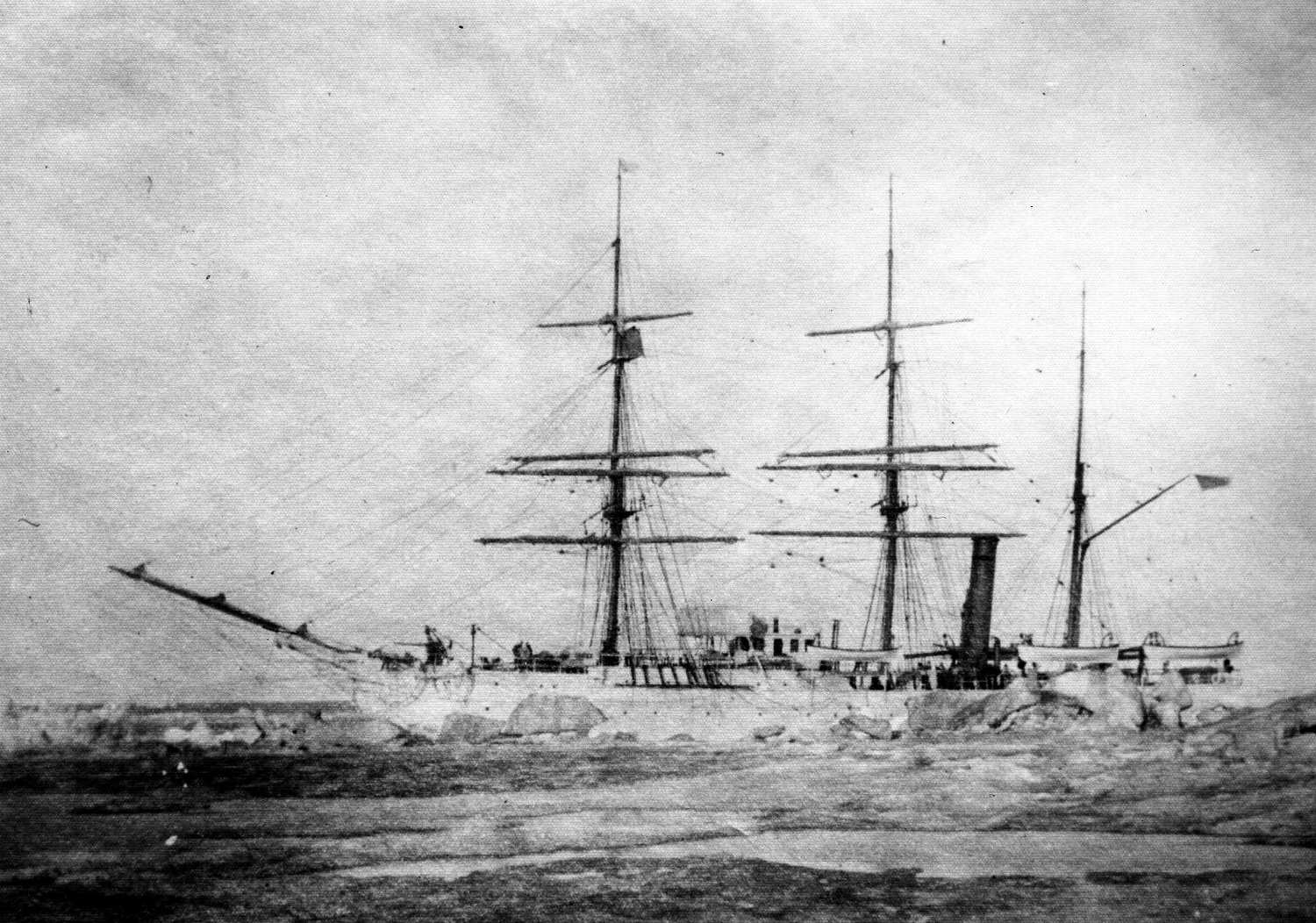
The most famous ship in early Arctic history is undoubtedly the Revenue Cutter Bear. The ship’s first work was in the sealing trade and after it was rebuilt for the US Government as a rescue vessel, it helped recover the few survivors of the Greely Expedition. In 1886, after modifications, Captain Healy took command and it became the flagship of the Bering Sea Force. (Fun Fact: the Bear, beginning in 1933, also became Admiral Byrd’s command ship on his Antarctic missions.)

In 1890, more controversy over Healy’s “frontier justice” form of dealing with problems and his hard-drinking ways came in the form of an investigation of charges of “cruelty and intoxication”. The long and the short of the thing is that certain sailors of the merchant ship Estrella acted in a manner that, on the scene, was felt to be mutinous. Captain Healy, as the only law enforcement official available, was called upon to punish the offenders.

“…The three sailors were then taken on board the Bear and triced up. The master at arms of the Bear, who performed this interesting ceremony, explained his method on the stand. The arms of the sailors were bent behind their backs, with their hands manacled together. Ropes were then fastened to the handcuffs, passed through ring bolts overhead, and hauled up. Master at Arms Hughes testified that after he had hauled the men up as high as he thought they ought to go, Lieut. Buhner ordered him to trice them up higher. They were then hoisted up so high that their toes barely touched the deck and they could be spun around like tops.

After remaining in this position five to seven minutes each, suffering intense agony, they were taken down and seated with their backs against stanchions, around which their arms were stretched and fettered behind. They were kept in this position for four hours, and then triced up again, after which Commander Healy seems to have thought their crimes sufficiently punished…”

—“The New York Times“, March 12, 1890

Healy was exonerated of all charges. The Investigating Board placed no credence in the charge of drunkenness, and they felt:

“…that there were no courts or peace officers within reach, and that, therefore, the punishment of the crew as a last resort to suppress the mutiny was justifiable.”

—“The New York Times“, April 5, 1890

I have had to apologize on too many occasions for stories that are too long, so let’s take a break here and finish up in Part Two…but before we do, let’s recap where we’ve been.

Alaska in the second half of the 19th Century was all the frontier anybody could want, Captain Mike Healy had risen from a Georgia plantation background to become perhaps the most recognized man in the Arctic, commanding one of the Nation’s most historically renowned ships…and while he was enjoying his successes, there had already been questions about his methods-and his drinking.

In Part Two we tell the story of an amazing overland rescue, we learn about international reindeer transplantation, we examine Healy’s troubled life and times-and just as if we were Paul Harvey, we end with a “rest of the story” that makes everything you’ve heard so far become an even more unlikely narrative…and one that will end with a controversy unresolved to this day.

It’s an epic tale indeed-and for those of you who wonder “why hasn’t anyone ever made a movie out of this story?”…well, we’ll answer that question too.

[poll id=”

268

“]

On Ruling The Arctic Frontier, Or, Polly Want A Reindeer?

We have an epic tale of history to tell today, and it has everything you’d want in your standard-issue epic tale: the vast expanse of ocean, exploration on the shores of an unknown land, questions of race and slavery and opportunity and torture…and in the center of it all, a real larger-than-life sea captain (and his parrot) who some say was more powerful in Alaska than the Territorial Governor and Circuit Judges who were his frequent shipboard guests.

Such was his influence on the Revenue Cutter Service (later to become the United States Coast Guard) that two Coast Guard Cutters operating today are named with him in mind: the USCGC Bear, named after the most famous ship our sea captain commanded, and the USCGC Healy, the newest icebreaker in the Coast Guard’s fleet.

And with that, Gentle Reader, allow me to introduce you to Captain Mike “Hell-Roaring” Healy-and the Arctic which was his domain.

“Captain Mike Healy is a good deal more distinguished person in the waters of the far Northwest than any president of the United States or any potentate of Europe has become.  He stands for law and order in many thousand square miles of land and water, and if you should ask in the Arctic Sea, “Who is the greatest man in America?” the instant answer would be, “Why, Mike Healy.”  When an innocent citizen of the Atlantic coast once asked on the Pacific who Mike Healy was, the answer came, “Why, he’s the United States. He holds in these parts a power of attorney for the whole country.”

—“The New York Sun“, January 28, 1894

Mike Healy, oddly enough, was born on a Georgia plantation in 1839. His father sent him (and his nine brothers and sisters, as they came to age) to Boston for their educations. Fate found them among the very first enrollees of Holy Cross College. Several of his brothers and sisters became notable persons in America’s Catholic history (one became a Bishop, one a Rector, three sisters became nuns, and his brother Patrick became President of Georgetown University during the 1870s and early 1880s), but such a path was not to be Mike’s.

He ran away from several academic placements in the United States and in Europe, eventually finding himself (at age 15) serving as a cabin boy on the clipper Jumna out of London (which he reports his parents helped to arrange, although this is disputed). In less than 10 years he had risen through the ranks to “…have been three times second officer and once first officer of a brig…”, as he wrote in his 1863 application for a commission in the Revenue Cutter Service. Two of his brothers were now in a position to offer influential assistance, and by January 1865 he found himself a Third Lieutenant of the Service.

By 1868 he had been dispatched to his first Alaska assignment, and by 1877 he was in command of his first ship, the Revenue Cutter Chandler. In 1880 he began one of the first of the two most significant commands of his career aboard the Revenue Cutter Thomas Corwin.

At this point we need to step back and talk about exactly what it meant to be in command of a revenue cutter in late 19th Century Alaska…and to do that, we need to start with a bit of geography.

The Aleutian Islands form an arc roughly 1500 miles long from roughly Anchorage to roughly Vladivostok, separating the Pacific Ocean from the Bering Sea. North of that is the site of the “land bridge” that once connected North America and Asia (near what is Wales, Alaska today), and north of that are the Chukchi and Beaufort Seas. Unalaska is a city located about halfway down the Aleutian chain, and Point Barrow is the northernmost point in the United States.

Within that space the revenue cutter commanders were the most visible official symbols of the United States. They were responsible for preventing smuggling, enforcing the laws among the whaling and sealing fleets and against liquor smuggling and distilling, and rescuing the various explorers, miners, traders, mappers, and other sailors that required their assistance.

Their responsibility also extended to maintaining positive relations with “the natives“-or putting down disquiet by force when relations weren’t so positive. Beyond that, before there were sheriffs and courts and jails the cutter commanders were the law on land as well. They also provided the visible face of the United States at public ceremonies.

The revenue cutters would transport the Territorial Governor on inspection tours, as well as the Circuit Judges who would occasionally visit the region (not to mention the mail), they would provide medical services to anyone they came across who might be in need; and they would often return to bases at Port Townsend, Washington or San Francisco bearing prisoners, or those that had been rescued-or both.

To survive in this environment, with that mission, requires an individual who can not only manage the administrative and diplomatic requirements of the job, but also a leader who can command the respect of a crew of fairly tough sailors…and Healy was more than up for the task.

It is reported that over the next decade his expertise in seamanship and Arctic operations grew to the point where he was involved in not just captaining a ship, but helping to design the ships that were subsequently built for Arctic service-and the way operations were conducted on board those ships.

Although much of the “Wild West” was becoming a lot more civilized than had been the case even 20 years before, in 1880 Alaska was still very much an untamed frontier territory. This meant that “frontier justice” was often the rule, and the ship’s Captain would often be required to take action.

In October of 1882 a whaling party near Angoon, Alaska experienced an accidental explosion of a “whale bomb”, killing a tribal shaman who was employed by the trading company conducting the whaling. Following the custom of the time, the two white members of the whaling party were taken hostage, along with the company’s equipment, and a demand was made for compensation (due to the importance of the decedent, the demand was for 200 blankets).

(A quick word on tribal traditions: it is likely that the large number of blankets were related to the Potlatch custom. In an interesting form of reverse capitalism practiced throughout the Pacific Northwest at the time, status is bestowed by an individual’s ability to give lavish gifts; and blankets might be turned into “button blankets“, which are worn at feasts and other ceremonial occasions.)

The Collector of Customs and the Commander of a US Navy ship, the Adams, responded by sending a force of Marines on a steamer owned by the Company, and coming in person aboard Healy’s ship the Corwin (the Adams being too large to navigate the waterways close to the village).

As soon as both vessels had arrived on the scene, the hostages and property were recovered. Healy’s report on the events describes what happened next:

“…as a punishment and as a guarantee for future good behavior, Captain Merriman [the Naval Captain] demanded twice the number of blankets demanded by the Indians, and threatened, in case of refusal, to destroy their canoes and villages. Refusing to pay the amount and remaining defiant, their canoes, to the number of forty, were taken and destroyed, after having selected those which belonged to the Indians who had remained friendly to the white men. Remaining unsubdued, their summer camp at this place was burned. Weighing anchor we steamed out of the lagoon, and at two o’clock hove to off the village of Hootsnoo and proceeded to shell the town. After shelling the village the marines were landed under cover of the guns, and they, setting fire to the houses, destroyed the entire village, with the exception of the friendly Indians.”

Although there was a considerable outcry over the events of that day, it did not prevent Lieutenant Healy from becoming Captain Healy the next year.

The most famous ship in early Arctic history is undoubtedly the Revenue Cutter Bear. The ship’s first work was in the sealing trade and after it was rebuilt for the US Government as a rescue vessel, it helped recover the few survivors of the Greely Expedition. In 1886, after modifications, Captain Healy took command and it became the flagship of the Bering Sea Force. (Fun Fact: the Bear, beginning in 1933, also became Admiral Byrd’s command ship on his Antarctic missions.)

In 1890, more controversy over Healy’s “frontier justice” form of dealing with problems and his hard-drinking ways came in the form of an investigation of charges of “cruelty and intoxication”. The long and the short of the thing is that certain sailors of the merchant ship Estrella acted in a manner that, on the scene, was felt to be mutinous. Captain Healy, as the only law enforcement official available, was called upon to punish the offenders.

“…The three sailors were then taken on board the Bear and triced up. The master at arms of the Bear, who performed this interesting ceremony, explained his method on the stand. The arms of the sailors were bent behind their backs, with their hands manacled together. Ropes were then fastened to the handcuffs, passed through ring bolts overhead, and hauled up. Master at Arms Hughes testified that after he had hauled the men up as high as he thought they ought to go, Lieut. Buhner ordered him to trice them up higher. They were then hoisted up so high that their toes barely touched the deck and they could be spun around like tops.

After remaining in this position five to seven minutes each, suffering intense agony, they were taken down and seated with their backs against stanchions, around which their arms were stretched and fettered behind. They were kept in this position for four hours, and then triced up again, after which Commander Healy seems to have thought their crimes sufficiently punished…”

—“The New York Times“, March 12, 1890

Healy was exonerated of all charges. The Investigating Board placed no credence in the charge of drunkenness, and they felt:

“…that there were no courts or peace officers within reach, and that, therefore, the punishment of the crew as a last resort to suppress the mutiny was justifiable.”

—“The New York Times“, April 5, 1890

I have had to apologize on too many occasions for stories that are too long, so let’s take a break here and finish up in Part Two…but before we do, let’s recap where we’ve been.

Alaska in the second half of the 19th Century was all the frontier anybody could want, Captain Mike Healy had risen from a Georgia plantation background to become perhaps the most recognized man in the Arctic, commanding one of the Nation’s most historically renowned ships…and while he was enjoying his successes, there had already been questions about his methods-and his drinking.

In Part Two we tell the story of an amazing overland rescue, we learn about international reindeer transplantation, we examine Healy’s troubled life and times-and just as if we were Paul Harvey, we end with a “rest of the story” that makes everything you’ve heard so far become an even more unlikely narrative…and one that will end with a controversy unresolved to this day.

It’s an epic tale indeed-and for those of you who wonder “why hasn’t anyone ever made a movie out of this story?”…well, we’ll answer that question too.

[poll id=”

267

“]

How Republicans Misuse History To Oppose Obama’s Stimulus–A History Lesson

Did FDR’s Jobs and Spending Programs Make the Depression Worse?

A HISTORY LESSON FOR OUR ELECTED REPRESENTATIVES

During the debate on President Obama’s stimulus package, I was astonished to hear Republican Congressional leaders argue that history shows us that massive government spending programs make economic crises worse. As an example, they invoke the jobs and public works programs of the Roosevelt Administration, which, they claim, lengthened the Depression rather than ameliorated its impact.

Their arguments are based on a 2004 book called “Roosevelt’s Folly” by a resident scholar with the Cato Institute named Jim Powell, a book that has been rejected by most historians of the period as unbalanced and inaccurate. There is no question that Powell is right that FDR’s policies did not lead to full recovery from the Depression- that only came as a result of World War II.

But his argument that reliance on the free market would have produced better results than government job creation, public works and encouragement of collective bargaining is not only impossible to prove , it flies in the face of the common sense understanding held by most Americans of what FDR achieved, as well as the assessment of FDR’s policies offered by most scholars in American history.

As someone who has studied the impact of New Deal policies “on the ground, ” in the rural South as well as black and working class neighborhoods in New York City, I would like to offer my own deeply skeptical view of this revisionist history Republicans are promoting.

From my point of view, Roosevelt’s policies offered hope and opportunity to a deeply wounded, fearful American population who had lost their jobs, their homes, their savings and their dignity during the three years between the stock market crash and Roosevelt’s inauguration.

At the time Roosevelt took office, almost a third of the labor force was unemployed, and another third was working part time.

The banking system was in paralysis and the signature American industry, steel, was operating at 29% of capacity.

Large numbers of Americans were hungry. Long breadlines extended outside charities in New York and other cities and city governments lacked the funds to supply hungry people with food.

Millions of Americans were homeless. Shantytowns, often called “Hoovervilles,” filled parks and vacant lots in American cities, and an estimated 3 million people rode the rails from town to town and city to city looking for work.

Evictions and foreclosures,undertaken by banks and landlords provoked violent resistance in many sections of the country, Eviction riots involving thousands of people made throwing out working class families a dangerous proposition in the South and East Bronx, while gun wielding farmers prevented banks from taking over foreclosed farms in portions of Iowa, Wisconsin and Minnesota.

When you combine this level of popular distress with a financial system in disarray, and a near paralysis of economic activity in agriculture, manufacturing, construction and retail trades, you have conditions very similar to those which paved the way for the rise of fascism in Italy, and Nazism in Germany.

Left on their own, this is what market forces had wrought, so New Deal leaders took what in the context of American history was very radical step.

They decided to get money into the hands of displaced and demoralized people through direct relief, funded by the federal government, distributed by the states, through payments to farmers for restricting production, and for public works jobs created by the federal government.

These measures didn’t restore the economy to pre 1929 levels. But they did dramatically reduce hunger and homelessness, bring a modest revival in manufacturing, construction agriculture and retail trades, reduce unemployment by half, and make dramatic improvements in the infrastructure by through the construction or roads, dams and bridges

More importantly, they restored the morale of a population which had feared that their poverty would be permanent and that their hard earned skills would no longer have value. The work relief programs of the New Deal gave millions of unemployed Americans a renewed sense of their own value, which spilled over into their responsibilities as family members and citizens.

And when war did come this restored and reinvigorated people rose to the challenge of with a vigor and a unity that amazed the world, both on the product line and the battlefield

This is hardly a legacy of failure!

Nor did the American people understand it as such.

That is why they elected Roosevelt to four terns as president, and why pictures of Roosevelt adorned the mantelpieces of tens of millions of Americans, rural and urban north and south, east and west, black and white, native and immigrant.

This is the lived experience that Republicans seek to denigrate, offering as evidence only the mythic properties of private markets as exist in the imagination of conservative economists

Let us remember: it was unregulated private markets that got us into the Great Depression and it is unregulated markets which have been are destroying our jobs and incomes for the last year and a half.

Now, as then, public works and government spending are needed to restore economic growth and ease the suffering of an increasing worried and frightened American people.

Republicans in the California Legislature are singing the same revisionist history for the California Budget. The SAME spending is needed and the very same type psychology applies to the California Budget (and will certainly be needed if the FEDERAL STIMULUS for States that was cut by Republicans on Friday are not restored), thanks to the Republicans in Congress and the Senate.

Elected Officials, especially Republicans, Take Note! And get a new song book while you are at it.

Credit to Dr Mark Naison for original concept/used w/Permission

On Imperfect Choices, Or, Jesus Ain’t Running

A question has come across my inbox today, and as I am wont to do I began to answer my email friend (who I’ve known, by the way, since we both posted on the John Edwards blog). More or less 100 words into the reply it occurred to me that this was a question best answered in front of a larger audience.

The question? My friend is having trouble committing to Obama.

Why? I’m paraphrasing, but it would be fair to say that the sudden emergence of Obama’s “handlers” was a factor…and although it’s not in the note, I suspect the fact that Obama has “tacked to the center” recently on various issues is part of the problem as well.

It’s a great question…and in an effort to provide a great answer I’m going to offer a few words of my own-and then I thought we might reach back a bit into history and see if there might be something we can learn.

Having come to the metaphorical tee and taken the first shot, let’s head down the fairway and see where that ball might be…and where we can get it to go.

Our good friends at Democracy for America have been running “Night School” for those seeking to learn about the campaign process from the inside, and just a couple nights ago we held a training on “The Political Mind“, with George Lakoff leading the discussion.

Professor Lakoff talked about how to frame a discussion; and I’m going to see if I can apply some of what I learned in the response I offer here.

The question “should I vote for Obama, despite his imperfections?” which is the question I was asked, does not correctly frame the discussion…so allow me to offer a question from an alternative “framing”:

The real question you have to ask is which of the two candidates that might actually win-McCain or Obama-is less flawed than the other?

There will be no perfect candidates-now or ever…and waiting for the perfect candidate to support is guaranteed to lead to disillusionment every time.

To put it bluntly: Jesus ain’t running…and absent any other Deities appearing on the electoral horizon, perfection seems unattainable.

Between McCain and Obama, the choice gets quite simple.

McCain talks about military tactics, Obama talks about military strategy.

Obama talks about the ecomony, McCain talks about how his economic spokesman, Phil Gramm, the guy who wrote McCain’s economic policy, doesn’t speak for him on the economy.

For more McCain…issues…or, issues…or, ummm, issues, or just the fact that he, for some reason, hates Martin Luther King Day, check the Web.

Now for a bit of encouraging history.

We elected a President once before who was far from the President he became-a pro-business candidate who did not support the abolition of slavery, but instead a compromise leading to the gradual phase-out of the practice…something that was already occurring in the North.

“…You suggest that in political action now, you and I would differ. I suppose we would; not quite as much, however, as you may think. You know I dislike slavery; and you fully admit the abstract wrong of it. So far there is no cause of difference. But you say that sooner than yield your legal right to the slave — especially at the bidding of those who are not themselves interested, you would see the Union dissolved. I am not aware that any one is bidding you to yield that right; very certainly I am not. I leave that matter entirely to yourself.

I also acknowledge your rights and my obligations, under the constitution, in regard to your slaves. I confess I hate to see the poor creatures hunted down, and caught, and carried back to their stripes, and unrewarded toils; but I bite my lip and keep quiet. In 1841 you and I had together a tedious low-water trip, on a Steam Boat from Louisville to St. Louis. You may remember, as I well do, that from Louisville to the mouth of the Ohio, there were, on board, ten or a dozen slaves, shackled together with irons. That sight was a continued torment to me; and I see something like it every time I touch the Ohio, or any other slave-border. It is hardly fair for you to assume, that I have no interest in a thing which has, and continually exercises, the power of making me miserable. You ought rather to appreciate how much the great body of the Northern people do crucify their feelings, in order to maintain their loyalty to the Constitution and the Union…”

–From a letter to Joshua Speed, August 24, 1855

And there was division from those in his own Party who were not inclined to make deals on the moral issues he was willing to make compromises upon:

“In the interior of the country, the cities as well as the rural districts, I found the people much more unanimous. The panic has not been felt so severely there, and the political feelings of the people are less controlled by mercenary motives. While some politicians in the large cities were somewhat inclined to smooth the difficulty over by a compromise, the Republican masses in the country are just as strongly and uncompromisingly opposed to anything that would look in the least like a lowering of the Republican standard.

I was in western New York when Thurlow Weeds compromise articles came out and when it was rumored that Seward was preparing to make a compromise speech. The feeling was very intense every where, Thurlow Weed’s propositions were generally condemned, and I have heard the most conservative and moderate Republicans say, that Seward could not yield a single inch of ground without destroying himself and forfeiting forever the confidence of his friends.

What I have seen and heard, not only in New York, but in Pennsylvania and New England also, forces the conviction upon my mind, that every serious attempt on the part of the Republicans in Congress, to patch up a compromise by yielding a single one of the principles of the Chicago platform, will inevitably result in the immediate disruption of the Republican party. It turns out again what I have observed quite frequently, that as far as courage and consistency are concerned, the rank and file are far ahead of their leaders.”

–From a letter written by Carl Schurz, December 18, 1860

This candidate wanted a bi-partisan Administration…and that wasn’t making the Party faithful happy, either:

“…We have now a still higher issue — a higher duty — the preservation of the Republic itself! We must not “back down” — we can make no compromise with traitors, but we can, and I think we must now, as we did in 1854-5, ignore all other issues for the time being, and invite the co-operation of men of all parties in putting down treason. The enemies of the Republic appear to be fearfully numerous, and to prevent accessions to their ranks, the friends of the Union must evrywhere become united.

To accomplish this, I beg respectfully to suggest, whether it may not be necessary to organize the administration different from what your friends, under other circumstances would have expected — to exclude men, however worthy or prominent, who would be objectionable to the friends of the Union in other parties?

In Ohio, I am quite sure that no man would be more [accessable?] in this view, than Thomas Ewing. All parties regard him as by far most able man in the State. For the firmness and courage exhibited by him in cabinet of President Taylor, he is admired, and would be trusted by all reasonable anti slavery men. I have been intimately accquainted with him for many years, and am satisfied that upon all important public questions, his opinions do not differ from yours. While it is true that he has not professed to be a Republican, I know that he has…acted with no other party — has voted for Republicans or not voted at all…”

–From a letter written by Thomas C. Jones, December 24, 1860

And from that highly controversial candidacy, we got Abraham Lincoln.

So what am I trying to say?

Politics is a process made up of humans.

All humans are flawed.

Therefore, we will never have a perfect candidate.

We will have to settle.

In choosing between McCain and Obama, ask yourself: who is going to be your best candidate…who is more likely to get you to the place you want to be on the issues that matter to you-and just like the SATs, there may not be a perfectly correct answer…instead, you may have to choose the “most correct answer”.

[poll id=”

207

“]

On The Weird Twists Of History, Part Two, Or, Why We Have A Fourth Amendment

Those who are coming to this story today have jumped into the middle of quite a tale. I put myself in a tough position last time by promising to link a British “garden of lust”, Benjamin Franklin, and 18th Century bloggers into a narrative that concludes with the nascent United States of America and its shiny new Fourth Amendment.

So far, amazingly enough, I’m pulling it off.

If you need to catch up, here’s what’s been going on:

When last we met…it was in a world of scandal and intrigue; with King George III and the Earl of Bute (and of course, their assorted minions) very upset with John Entick, author, and John Wilkes, author and world-class raconteur (and drinking buddy to Franklin), because they had the temerity to…well, blog.

The Earl of Bute had taken so much abuse from the Johns that he had been forced to resign from his position as Prime Minister…leaving the minions under his control, many said, only now from behind the scenes.

Something needed to be done…and when you have minions, you put them to use.

In 1762, as the influence of “The Monitor” continued to grow, George Montague Dunk, the Second Earl of Halifax (and a member of the Privy Council) and the highest ranking minion available, issued the King’s Chief Messenger, Nathan Carrington, a general search warrant ordering him to:

“…make strict and diligent search for [Entick], mentioned in the said warrant to be the author, or one concerned in the writing of several weekly very seditious papers intitled, “The Monitor or British Freeholder, No 357, 358, 360, 373, 376, 378, and 380, London, printed to J. Wilson and J. Fell in Paternoster Row,” containing gross and scandalous reflections and invectives upon his majesty’s government, and upon both Houses of Parliament, and him the plaintiff having found, to seize and apprehend and bring together with his books and papers in safe custody before the earl of Halifax to be examined concerning the premisses, and further dealt with according to law…”

–From the report of Entick v. Carrington, 19 Howell’s State Trials 1030 (1765)

A four hour search was conducted of Entick’s home, and all his books and papers were carried away to be examined in an effort to prove that the charges of seditious libel (essentially, speaking out against the King) were valid.

In what has become one of the most important trials in British legal history-and ours-John Entick sued the messenger, literally, claiming that any general search warrant is inherently invalid, that Carrington should have known this, and that Carrington never should have relied upon the authority of Lord Halifax to permit the search.

If Entick had been trespassed upon, then the papers seized were inadmissible; and that meant Entick could not be convicted of seditious libel. Here’s how Entick’s lawyer put it, again according to Howell’s:

“…As to the second. A power to issue such a [general] warrant as this is contrary to the genius of the law of England; and even if they had found what they searched for, they could not have justified under it. But they did not find what they searched for, nor does it appear that the plaintiff was the author of any of the supposed seditious papers mentioned in the warrant; so that it now appears that this enormous trespass and violent proceeding has been done upon mere surmise.

But the verdict says, such warrants have been granted by secretaries of state ever since the Revolution. If they have, it is high time to put an end to them; for if they are held to be legal, the liberty of this country is at an end. It is the publishing of a libel which is the crime, and not the having of it locked up in a private drawer in a man’s study. But if having it in one’s custody was the crime, no power can lawfully break into a man’s house and study to search for evidence against him. This would be worse than the Spanish inquisition; for ransacking a man’s secret drawers and boxes, to come at evidence against him, is like racking his body to come at his secret thoughts…

… But it is said, if the secretary of state has power to commit, he has power to search, etc. as in the case of stolen goods. This is a false consequence, and it might as well be said he has a power to torture.”

We need to take a moment to discuss the meaning of a general warrant-and all of a sudden we get to the part where our very own Fourth Amendment enters the story. Rather than tackling the legal issue myself, I’ll quote from the United States Supreme Court’s ruling in Stanford v. Texas, 379 U.S. 476 (1965), a seized books case:

“…The petitioner has attacked the constitutional validity of this search and seizure upon several grounds. We rest our decision upon just one, without pausing to assess the substantiality of the others. For we think it is clear that this warrant was of a kind which it was the purpose of the Fourth Amendment to forbid – a general warrant…

The Fourth Amendment provides that “no Warrants shall issue, but upon probable cause, supported by Oath or affirmation, and particularly describing the place to be searched, and the persons or things to be seized.”

These words are precise and clear. They reflect the determination of those who wrote the Bill of Rights that the people of this new Nation should forever “be secure in their persons, houses, papers, and effects” from intrusion and seizure by officers acting under the unbridled authority of a general warrant. Vivid in the memory of the newly independent Americans were those general warrants known as writs of assistance under which officers of the Crown had so bedeviled the colonists.

The hated writs of assistance had given customs officials blanket authority to search where they pleased for goods imported in violation of the British tax laws. They were denounced by James Otis as “the worst instrument of arbitrary power, the most destructive of English liberty, and the fundamental principles of law, that ever was found in an English law book,” because they placed “the liberty of every man in the hands of every petty officer.”

The historic occasion of that denunciation, in 1761 at Boston, has been characterized as “perhaps the most prominent event which inaugurated the resistance of the colonies to the oppressions of the mother country. `Then and there,’ said John Adams, `then and there was the first scene of the first act of opposition to the arbitrary claims of Great Britain. Then and there the child Independence was born.'”

What is significant to note is that this history is largely a history of conflict between the Crown and the press. It was in enforcing the laws licensing the publication of literature and, later, in prosecutions for seditious libel that general warrants were systematically used in the sixteenth, seventeenth, and eighteenth centuries. In Tudor England officers of the Crown were given roving commissions to search where they pleased in order to suppress and destroy the literature of dissent, both Catholic and Puritan. In later years warrants were sometimes more specific in content, but they typically authorized the arrest and search of the premises of all persons connected with the publication of a particular libel, or…the arrest and seizure of all the papers of a named person thought to be connected with a libel

Two centuries have passed since the historic decision in Entick v. Carrington, almost to the very day. The world has greatly changed, and the voice of nonconformity now sometimes speaks a tongue which Lord Camden might find hard to understand. But the Fourth and Fourteenth Amendments guarantee to John Stanford that no official of the State shall ransack his home and seize his books and papers under the unbridled authority of a general warrant – no less than the law 200 years ago shielded John Entick from the messengers of the King.”

And in fact Carrington did lose the lawsuit to Entick. This, from the ruling in Entick v Carrington, 95 Eng. Rep. 807 K.B. (1765):

“…our law holds the property of every man so sacred, that no man can set his foot upon his neighbour’s close without his leave; if he does he is a trespasser, though he does no damage at all; if he will tread upon his neighbour’s ground, he must justify it by law. The defendants have no right to avail themselves of the usage of these warrants since the (Glorious) Revolution (of 1688), and if that would have justified them they have not averred it in their plea, so it could not be put, nor was in issue at the trial; we can safely say there is no law in this country to justify the defendants in what they have done; if there was, it would destroy all the comforts of society; for papers are often the dearest property a man can have…

… The great end, for which men entered into society, was to secure their property. That right is preserved sacred and incommunicable in all instances, where it has not been taken away or abridged by some public law for the good of the whole…By the laws of England, every invasion of private property, be it ever so minute, is a trespass. No man can set his foot upon my ground without my license, but he is liable to an action, though the damage be nothing; which is proved by every declaration in trespass, where the defendant is called upon to answer for bruising the grass and even treading upon the soil. If he admits the fact, he is bound to show by way of justification, that some positive law has empowered or excused him….”

So Entick won.

But what about Wilkes?

Well, the “triple headed, Cerebrean” Government Wilkes referenced in “The North Briton” No. 45 prosecuted him for seditious libel as well, using another general search warrant to effect the seizure of evidence.

Wilkes was able to prevail at trial by invoking his Parliamentary immunity from arrest on libel charges. Quoting Wilkes, describing the still-upcoming trial:

[The case will] “teach ministers of arbitrary principles, that the liberty of an English subject is not to be sported away with impunity, in this cruel and despotic manner…[and also] “determine at once whether English liberty be a reality or a shadow.”

Then Wilkes returned the favor-figuratively “suing the messenger” in the second of our illegal warrant blockbusters, Wilkes v. Wood, 98 Eng. Rep. 489 (1763)

.

In fact, he’s the one who sued first…and based on the events of his trial, Entick filed the lawsuit against Carrington that we just discussed. A few words from the report of the trial:

“…Serjeant Glynn [defense counsel], then enlarged fully, on the particular circumstances of the case, but remarked that the case extended far beyond Mr. Wilkes personally, that it touched the liberty of every subject of this country, and if found to be legal, would shake that most precious inheritance of Englishmen. In vain has our house been declared, by the law, our asylum and defence, if it is capable of being entered, upon any frivolous or no pretence at all, by a Secretary of State…

That of all offences that of a seizure of papers was the least capable of reparation; that, for other offences, an acknowledgement might make amends; but that for the promulgation of our most private concerns, affairs of the most secret personal nature, no reparation whatsoever could be made. That the law never admits of a general search-warrant. That in France, or Spain, even in the Inquisition itself, they never delegate all infinite power to search, and that no magistrate is capable of delegating any such power…”

And a few words from the Lord Chief Justice in his verdict:

“…When we consider the persons concerned in this affair, it ceases to be an outrage to Mr. Wilkes personally, it is an outrage to the constitution itself…

Secretary Williamson, in Charles the Second’s time, for backing an illegal warrant, was sent to the Tower by the House of Commons. The jury, he observed, had no such power to commit; he knew it well; but, for his part, he wished they had, as he was persuaded they would exercise it, in the present case, as it ought to be…”

The Government response to their defeat?

To prosecute Wilkes for a very, very naughty joke indeed.

It turns out that back in the crazy Monks of Medmenham days Wilkes…apparently…co-authored an exceptionally ribald book called “An Essay on Woman“, a parody of Alexander Pope’s “Essay on Man“…and here was a chance to strike back at Wilkes…if only the annoying immunity thing wasn’t in the way.

So he was promptly thrown out of Parliament, and then charged with blasphemous libel. He immediately fled the country, spending four years in exile.

Now here’s the good part: Wilkes decided to return, because, despite his outlaw status, he had been elected to Parliament (again) in April 1768. He was the subject of riots in the nights following his surrender; and it is reported that 11 persons were killed as a result of the public outcry over his imprisonment. (Matter of fact, it’s also reported that the anger over the issues surrounding Wilkes’ arrest was so profound that it reached across the Atlantic…so profound that the cities of Wilkes-Barre, Pa., and Wilkesboro, N.C. bear his name.)

A political party, the Wilkites, had sprung up…and so had the Government’s anger over Wilkes’ status, which led to his second expulsion from Parliament, on February 3, 1769. On February 16th, he was reelected-and expelled the next day. Exactly one month later…the voters did it again-and so did Parliament.

The score so far?

The British Parliament, 3; The British Voters, 0.

Round four again went to Wilkes, again temporarily-this time by a vote of 1,143 to 296.

In a move reminiscent of the 2000 US Presidential election, Parliament promptly awarded the seat to Wilkes’ opponent, Colonel Henry Lawes Luttrell.

All the while he was still in prison…and while still in prison he was elected an Alderman of London…then he was released…then, ironically, elected Sheriff…then, in 1774, in a move Ken Livingstone could surely appreciate, he was elected Lord Mayor of London-and then finally (fifth time’s the charm!) he was returned to Parliament….and this time they let him stay, which he did for another 16 years.

So remember, roughly 3500 words ago, when I said in Part One that I could draw a direct line between all of this and the FISA debate today and its impact on the Fourth Amendment?

Well, I’m not going to do it.

Instead, I’ll again let the United States Supreme Court address the question, which they do with great eloquence in Stanford v Texas:

“…As MR. JUSTICE DOUGLAS has put it, “The commands of our First Amendment…(as well as the prohibitions of the Fourth and the Fifth) reflect the teachings of Entick v. Carrington, supra. These three amendments are indeed closely related, safeguarding not only privacy and protection against self-incrimination but `conscience and human dignity and freedom of expression as well…

In short, what this history indispensably teaches is that the constitutional requirement that warrants must particularly describe the “things to be seized” is to be accorded the most scrupulous exactitude when the “things” are books, and the basis for their seizure is the ideas which they contain…No less a standard could be faithful to First Amendment freedoms.

The constitutional impossibility of leaving the protection of those freedoms to the whim of the officers charged with executing the warrant is dramatically underscored by what the officers saw fit to seize under the warrant in this case…”

And that’s the crux of the argument over the FISA compromise.

Should the protection of freedom from warrantless wiretapping “be accorded the most scrupulous exactitude when the “things” are”…not books, but communications?

When we see how wide a net the warrantless wiretapping program cast, does it teach us a lesson about the “constitutional impossibility of leaving the protection of those freedoms to the whim of the officers charged with executing the warrant”?

And of course, when the Fourth Amendment is endangered, can the First or the Fifth be safe?

Well, it’s been a long journey, Gentle Reader…but we are at the end.

We began this trip in a garden of lust…then we met two 18th Century bloggers…we found ourselves caught up in the struggle over general warrants (which sound mighty familiar in the “warrantless wiretap” context)…and then two extremely important trials…and then the connection between the names of some of our cities and Wilkes…and finally, as I promised, we drew a straight line between the distrust of an overly intrusive Government and our own demands for freedom…which are today again under attack.

The circle has been closed, and with that, I bid you good day.

[poll id=”

206

“]

On The Weird Twists Of History, Part One, Or, Why We Have A Fourth Amendment

This may be one of the strangest tales I have ever brought to the table, Gentle Reader, and yet one of the most fundamental in describing the birth of our Bill of Rights…and most especially the Fourth Amendment.

As many of you know, the new FISA compromise may or may not allow warrantless wiretapping of American citizens on a wholesale scale.

Something you may not know is that a similar debate raged in England (centered around the right of Government to seize the papers of whomever they chose, and use the papers as evidence against those persons) during the reign of King George III-or that it involved scandalous sexual behavior, Benjamin Franklin, the 18th Century version of blogging, and two men who decided to take on the corruption of the Crown…and won.

And because of all that, we have a Fourth Amendment today.

Ready for a tale of liberty and ribaldry?

Then let’s plunge right in, shall we?

So you live in 18th century England, you’re rich…and kind of bored.

What is a gentleman to do?

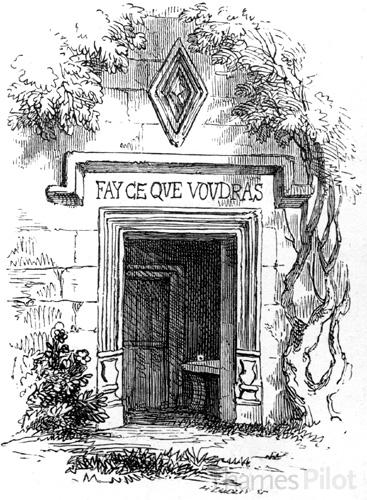
Well as it turns out, one option is to buy an old monastery, expand the cave system underneath, open yourself a well-appointed “garden of lust” with a really cool Latin motto (“Fay Ce Qve Vovdras”…”Do As You Will”), and invite a few of the most powerful men in England…and the Colonies…to join you in heavy drinking and crazy escapades that involve, to give just one example, shipping in prostitutes from London dressed up as nuns for an evening’s entertainment.

Which is exactly what Sir Francis Dashwood did in the village of West Wycombe; just six miles north of London by way of the River Thames.

It was a fabulous situation…the Abbey was secluded, on top of a hill, and shrouded by a grove of trees. The only access to the caves was by boat-and that meant it was possible to hop on a boat in London…and hop off, at the caves, unobserved…and then later, still unobserved, head back home, polite society none the wiser.

The “Monks of Medmenham”, as the group’s members called themselves (they did not call themselves “The Hellfire Club”, legends notwithstanding), did indeed include some of the most important of the English landed gentry (and, it was rumored, some of their wives…): including the Earl of Sandwich, Benjamin Franklin, and the man who will be one of the two focal points of today’s discussion, John Wilkes.

But the thing is, eventually all that romping gets a bit old; and a gentleman again finds himself with time on his hands…

Wilkes was a man with political ambition, and so he set about bribing the local voters to obtain a seat in Parliament…only to find his party tossed out of leadership and into the role of the opposition-which turned out to be perfect for somebody inclined to this sort of humor:

When the Earl of Sandwich, a sometime friend, told him that “you will die either on the gallows, or of the pox,” Wilkes said, “That must depend on whether I embrace your lordship’s principles or your mistress.”

–Jack Lynch, from the article “Wilkes, Liberty, and Number 45“

To take the story further we need to know that King George III (who saw “The Madness of King George“?) chose as his Prime Minister his former “finishing tutor”, John Stuart, the Earl of Bute. The new Earl had quite a personal history of his own; in fact there were questions as to whether the new King’s mother and the new Earl had a personal history of their own.

Another item of shared personal history: the new Earl and Wilkes were both members of the Monks of Medmenham.

The Earl of Bute had a problem getting his program through Parliament, and to overcome his inability to “talk up” his ideas (some suggest he experienced antipathy because he was a Scot…something Gordon Brown might well understand) he published “The Briton“, a newspaper published in London…which saw Wilkes answer with “The North Briton“, which, in a time and place that had no free press, began its very first issue of June 5, 1762,  thusly:

The liberty of the press is the birth-right of a Briton, and is justly esteemed the firmest bulwark of the liberties of this country. It has been the terror of all bad ministers; for their dark and dangerous designs, or their weakness, inability, and duplicity, have thus been detected and threwn to the public, generally in too strong and just colours for them long to bear up against the odium of mankind. Can we then be surpriz’d that so various and infinite arts have been employed, at one time entirely to cast aside, at another to take off the force, and blunt the edge, of this most sacred weapon, given for the defence of truth and liberty?

This shot across the bow having been fired; Wilkes proceeded to lay 44 more broadsides into the hull of Government, including this quote from the final “The North Briton”, No. 45, in reference to the Earl’s resignation from Government, and the rumors that he still pulled the strings from behind the scenes:

The Scottish minister has indeed retired. Is his influence at an end? Or does he still govern by the three wretched tools of his power, who to their indelible infamy, have supported the most odious of his measures, the late ignominious Peace, and the wicked extension of the arbitrary mode of Excise? The North Briton has been steady in his opposition to a single, insolent, incapable, despotic minister, and is equally ready, in the service of his country, to combat the triple-headed, Cerberean administration, if the Scot is to assume that motley form.

You cannot talk about the Government in this way without consequences, and…well, we’ll come back to that in a minute.

Before we do, I want you to meet John Entick. Entick began his professional career as a schoolmaster, then an author. He had a bit of an eclectic taste-his first book being a Latin grammar, then a book on theology…and in an ironic twist, he at one point tried to publish an edition of Chaucer. He was also famous for his dictionary.

Entick was as upset by the political situation as Wilkes, and he found his voice in “The Monitor, or the British Freeholder“, which was where he wrote this:

…Now, although he allows, that “These Mixed constitutions [as opposed to absolute monarchy] are the very best, that human wisdom could ever discover for the regulation of human societies; yet that these, though perhaps productive of fewer evils, than either of the other, must necessarily partake of the evils belonging to both, and be supported by more or less violence, as they more or less approach the despotic; or of corruption, as they come nearer to the democratic principles: for corruption must always increase in due proportion to the decrease of arbitrary power; since where there is less power to command obedience, there must be more bribery to purchase it, or there can be no government at all…”

You’ll recall my saying that there would be consequences for selling this sort of thing in King George’s and the Earl of Bute’s England, and here’s where we start getting to the heart of the story.

But not today.

Instead, in a development worthy of Luke and Laura, we’re employing the cliffhanger…so come back in about 36 hours, and we’ll have the King’s messengers roaming the countryside, a spectacular trial or two-and a guy who gets elected to Parliament from his jail cell four times in four months.

And of course, when it’s all over…the United States will have a Fourth Amendment.

[poll id=”

204

“]

Laguna Beach: A Rather Exquisite Economy of the Arts

“This is the first time we could quantify what the arts means to Laguna Beach,” said Nancy Beverage, chairwoman of the city’s Arts Commission. “It’s important so we don’t kill the goose that laid the egg.”

And what a mighty goose this is. The OC Register is reporting today that Laguna Beach leads the nation in money spent on the arts. People from across the nation and around the world come to Laguna Beach to enjoy the artistic spirit here. And nearly $55 million was pumped into Laguna Beach’s economy in 2005, thanks to its art scene. Art truly is the economic lifeblood of Laguna Beach.

So just how important is art in Laguna Beach? How is the art shaping the local economy? How is it shaping the city?

Follow me after the flip for more…

Laguna Beach has a long history of artistic creativity. Ever since Norman St. Claire first abandoned the San Francisco fog to document Laguna’s natural beauty on canvass in 1903, art has shaped and molded the community in Laguna Beach. In 1918, the town’s first gallery opened (now the Laguna Art Museum). When Laguna Beach became the first community in South Orange County to incorporate as a city in 1927, it did so as an artists’ colony that was already becoming world-renowned.

And in 1932, out of the economic disaster of the Great Depression, the Festival of Arts emerged. The artists in town were just looking for a way to capitalize off the Olympic games in nearby Los Angeles. Instead they started a great tradition, and a real cash cow for the now booming arts colony.

But in the 1960s, a group of hippie artists were getting frustrated with all the rigid tradition and conservative conformity of the Festival of Arts. In 1966, the young artists staged a revolt against the local art extablishment and their jury system that excluded so many talented local artists. They began their own art festival out of protest, and out of this protest the Sawdust Festival was born. And now, this is one of the top five art festivals in the nation.

Clearly, Laguna knows how to capitalize off its art. And the tradition goes on today. From The OC Register:

Today, the 9-square-mile city with about 7 miles of coastline has about 90 art galleries […]

The findings of the study will help provide the city and its residents with a substantial way to measure the value of Laguna Beach’s artistic community, said John Hoover, member of the board of directors for the Laguna Beach Festival of Arts.

According to the report, “Arts and Economic Prosperity III,” art-related spending in Laguna Beach contributes about $2.7 million in tax revenue to the state and about $2.4 million to the city.

In Laguna Beach, a person attending an artistic event spends an average of $55.41, according to the report. That is about twice the national average of $27.79 spent per person.

Most of the money spent in Laguna Beach pays for meals, lodging and souvenirs, the study said.

Wow, so the tradition continues. Laguna Beach has now made its art into a tourist magnet. Laguna is the ultimate destination for people who enjoy some aesthetic pleasure with their travel. But is all this commercial success killing the artistic spirit?

Is the artistic spirit dying in the midst of all the wealth, all the excess, and all the episodes of that MTV reality show? Is Laguna Beach starting to act too much like its snooty sister next door? Maybe Laguna has become too prosperous for its creative well-being?

No wonder why even the Chamber of Commerce President has called for more affordable housing for local artists and their galleries:

As the Laguna continues to grow and tourism thrives, the city must preserve its artistic community, [Mayor Toni] Iseman said.

As housing costs rise, the city should consider providing affordable housing to artists, some of whom are being priced out, said Dave Sanford, president of the Laguna Beach Chamber of Commerce. Galleries also need affordable space.

“When the city decides where to invest money, they need to consider this,” Sanford said.

Yes, perhaps Laguna beach should ensure that the artists are not priced out of the arts colony. Perhaps as the city considers new development downtown, the city should ensure that these artists’ lofts are spaces that young local artists can actually afford. Laguna has been so wise in making a living off its art. The colony certainly cannot afford to ultimately allow past success to choke future artistic endeavors.

After all if the art is gone, then ultimately the economy is dead. And more importantly, the creative spirit dies as the art leaves. Laguna’s history of artistic passion and astounding success is just too precious to be lost forever.