Tag Archives: Nunez

Fabian Nunez Wants Honest Conversation About Single-Payer Health Care

Speaking at a news conference at the state capitol today, both Governor Schwarzenegger and Assembly Speaker Fabian Nunez pledged to regroup with organized labor, consumer, hospital and insurance groups to keep pushing a comprehensive plan that would provide universal coverage.  Nunez even vowed to give SB 840 the type of scrutiny his plan received in the Senate.

While “AHNOLD” wants to figure out why their plan failed, offering no personal suspicions; Nnunez suggested that support for a government-run, “single-payer” system lurked in the background and wound up undermining AB X1 1.

Going even further, Nunez vowed to subject it to the same kind of scrutiny his KOA’d plan received. “I think it’s time, for us to have an honest conversation about single payer,” the Sacramento Bee reports.

Then he made a Clintonesque slight at single-payer supporters saying that lawmakers “cannot create the false sense of hope that we can do something better if it hasn’t been tested and put through the same type of scrutiny that our effort was put through.”

Sounds like fightin’ words to me.  

But we all should remember, Nunez supported Sen. Sheila Kuehl’s single-payer plan in 2006 voting for its passage on August 28th, 2006.  It was vetoed by the governor a short time later.

Did he not engage in an honest conversation about it at that time?

I would like to think he honestly supported universal health care through a single-payer system at that time.  His comments today, at the side of the governor make me wonder if he was not being honest in 2006 and was only playing politics in advance of the Governor’s re-election in November.

You judge, here are his words delivered at a rally urging the governor’s support of SB 840 in September 2006 on the steps of the state capitol.

“Health care is a right and not a privilege….One in five don’t have health insurance in California–that’s 6 ½ million Californians out of the 37 million of us in the state. Three out of four of those who don’t have health insurance are those who work. That, my friends, is unconscionable–not just for employees, but also employers. Just in the past 5 years premiums have increased more than 73%.”

But now he wants an honest conversation about a bill he described in 2006 as “good for business…it’s good for consumers.”

Still, I invite the scrutiny.  While I certainly support SB 840 I am not convinced it is the only option.  I largely agreed with Mayor Antonio Villaraigosa’s assessment about the Schwarzenegger-Nunez plan:

“As a strong supporter of a truly universal health care system, I write to urge you to support AB1x (Nunez) as a significant strategic step toward our shared goal,” Villaraigosa wrote in a letter. “I strongly believe that health reform need not be an “either/or” situation, and that supporting the reforms of AB1x is not inconsistent at all with being a whole-hearted supporter of SB 840 and single-payer health care.”

If Villaraigosa can see AB1x has a forerunner to a truly universal system, than why would Nunez look to heavily scrutinize SB 840?

The politics of retribution will serve no one but unscrupulous profit-driven insurance companies, setting back an entire movement of single-payer supporters who have taken their cause to the grassroots.  

Working with progressive forces gives you a stronger hand at the negotiating table with the governor, fighting progressive forces gives the governor the upper hand.  Be a representative, not a foe.

To be clear, my goal is not to attack the state’s leading Democrat, but rather to urge him to take principled progressive leadership on health care reform that provides affordable, quality health care to all.  

If the insurance companies must be taken on, then lets do it, and lets do it without financing schemes that favor HMO’s at the expense of smokers and tobacco companies.  In light of recent news its hard to imagine the Altria Group is any worse than CIGNA who initially denied a critical surgery for a California teen who eventually died.

As Nunez pays closer attention to SB 840, I certainly hope he recognizes why he supported it in 2006.  This is not a shining endorsement of SB 840, but rather a call for progressive civility, principles and integrity.  
Health Care Reform: Governor, Speaker Can’t Get It Done

Oh my, how the mighty have fallen.  The health care overhaul brokered by the popular Governor Arnold Schwarzenegger and power-wielding Speaker Fabian Nunez could only manage one single vote in a Senate health committee.  How can a bill that is supported by insurance companies, business chambers and organized labor fail?  The politics of backroom deals, that’s how.  The people never supported it.

Not a single public hearing in Sacramento or anywhere else in this state, a rushed negotiation at the end of a special session that produced a compromise the governor initially backed away from and a complete retreat from SB 840 which the Democratically controlled legislature passed and sent to the governor only one year and a half ago.  

On the issues that matter most, our elected officials can’t get it done.  Perhaps this is a shining example of why we need term limit reform, so we may give our leaders the time to make incremental improvements.  Others will argue this is why Prop. 93 should be killed, ridding ourselves of the ineffective incumbents that would otherwise hang on to their posts.

I’d like to reject both arguments.  The real culprit is the poll-driven decision making of politicians who represent no movement.  Both Republicans and Democrats want to improve the health care system.  

Republican conservatives believe in so-called free market principles like limiting medical malpractice suits, defending the rights of HMOs to pick and choose patients, services and cutting off aid to illegal aliens would make health care more affordable, thus more accessible.  They’re winning by blocking all reform ideas and doing nothing which hurts people with and without health insurance.

As for California Democrats, well in 2006 they believed in Single-payer before it was vetoed, now I think they agree with the governor that everyone should share the costs of the broken system we have today.  

Not sure what they’ll support during the next election cycle.  And the polls will continue to shift in the wrong direction so long as the Democrats continue to ignore its base, neglect to change the electorate into a winning coalition and fail to take principled stands on policy positions.

But these politicians, led by the governor and out top Democrat, the State Speaker want very little to do with any of that.  Listening to the base means taking direction from residents who don’t have the contribution power of the special interests.

Actively working to change the voting electorate requires space for new voices and bold action to keep the momentum going.  If you can promise it during the campaign, you can work to pass it in the legislature.  This builds hope that change is possible, and excitement about what we can do next.  

Taking principled stands means that on occasion you have to be unpopular and work to convince others.  It also builds credibility and respect i.e., Muhammad Ali or Dr. King Jr.

But its easier to take advice from the political hacks who work polls and focus groups in exchange for the almighty dollar.  But as long as this brand of self-styled, ego driven politics continues, so will our state’s problems and our leaders’ inability to get anything done.

Take Prop. 93 for example.  Nunez has put everything behind it, still its slipping in the polls and he may have to look for a new position soon.  I haven’t met a soul who wasn’t working for an elected official or political organization that feel the state needs this type of reform.

Prop. 94-97, Schwarzenegger is doing some of his best acting in those commercials for it, but it too is having trouble finding a voting constituency chomping at the bit to make only 4 out of dozens of Indian tribes richer than they already are.

And ABX 1 1, with the might of the Governor and the Speaker couldn’t find its way out of committee, embarrassingly receiving just one vote in favor of it.  And while there are an estimated 6 million Californians without health care, and millions more who are succeptible to the whims of their profit-driven insurance company, you are hard-pressed to find non-Sacramento politician advocates that were willing to lay it all on the line for such a dubious smoke and mirrors package.

Maybe we should blame ourselves, they say we get the government we deserve, and we sure are getting it.

Clean Car Discount bill (AB 493) – up for vote in January!

(AB 493 is an interesting idea. – promoted by Brian Leubitz)

The Clean Car Discount bill — AB 493 (Ruskin) — is alive, and will be up for a vote in the State Assembly at the end of this month. 

  This global warming solutions bill would create an incentive program of clean vehicle rebates and emissions surcharges on the purchase of new vehicles sold in the state.  Cleaner vehicles that have fewer emissions of global warming pollution would earn a rebate–the cleaner the car, the higher the rebate.  These rebates would be funded by one-time surcharges on new dirtier, gas-guzzler vehicles.  The worse the vehicle, the higher the surcharge.  A bunch of vehicles–including several mini-vans–would fall roughly in the middle and receive neither a rebate nor a surcharge. 

  With the Bush Administration continuing to block California's efforts to implement global warming vehicle regulations, this bill becomes that much more important.

Several Legislators who are on the fence need to hear from activists and constituents THIS month!

Several Southern California Democratic Assembly Members remain on the fence:

  Felipe Fuentes  916-319-2039 \ 916-319-2139 (fax) – Northeast San Fernando Valley

  Mike Davis  916-319-2048 \ 916-319-2148 (fax) – Central Los Angeles

  Hector De la Torre  916-319-2050 \ 916-319-2150 (fax) – South Gate, Bellflower, Lynwood, Bell GArdens

  Mervyn Dymally  916-319-2052 \ 916-319-2152 (fax) – South-central L.A., Compton

  Tony Mendoza  916-319-2056 \ 916-319-2156 (fax) – Cerritos, Norwalk, Sante Fe Springs, Artesia

  Dr. Ed Hernandez  916-319-2057 \ 916-319-2157 (fax) – East San Gabriel Valley (West Covina, Baldwin Park, Azuza)

  Jose Solorio  916-319-2069 \ 916-319-2169 (fax) – Santa Ana, Garden Grove, Anaheim

This is an important global warming bill. Calls and faxes into these offices could make a difference. 

For more information, go to:  http://www.ucsusa.org/clean_california/ 


[poll id=”

164

“]

Health Reform and the Year of Magical Thinking

(Absolutely. Pushing a rushed reform compromise in two weeks would be a travesty, and it speaks to how deeply broken the legislative process is, because it creates all of these bottlenecks that, deliberately IMO, stifle debate. Sen. Kuehl makes a ton of sense here. However, I would be open to a special session to get something done if the process were made more open. – promoted by David Dayen)

Health Reform and the Year of Magical Thinking

The Year of Magical Thinking is the title of a memoir by Joan Didion detailing her state of denial, inexplicable behaviors and, finally, coming to grips with, the death of her husband. It’s also an apt description of the Governor’s 2007 approach to reforming our broken healthcare system, with the glaring difference that he still hasn’t come to grips with the truth. (After all, if a complicated movie plot could be resolved in less than two hours, who not fix healthcare in California in nine months?)

Beginning in January, the Governor ordered his health advisors to sketch the outlines of a plan that would magically “cover” all Californians by simply requiring them to buy health insurance.  To this moment, he has refused to negotiate any of his major points with the Legislature.  The language for his plan was finally drafted five months later, and shown, under wraps, to a few, select people.  Not one legislator agreed with it, and no one would carry the bill as legislation. 

More on the flip…

To fill the void raised by the Governor’s magical “we must do something this year” drumbeat, the Democratic leaders began crafting their own reform plan.  To date, however, the Governor and the Legislative leadership have remained oceans apart on the broad policy strokes of health care while public support for the current insurance-company controlled system has plummeted and support for the reforms contained in SB 840, the Medicare-like fix for California, has grown.

Now, with less than two weeks remaining in the first half of the two-year legislative session, there is still no “something” on the table and the Governor, like a Barnum and Bailey’s ring leader, continues to announce that he will, assuredly, pull a rabbit out of a black hat.  Actually, there is no way of knowing if the result would really be a rabbit; it could just as easily be an albatross. 

The Governor has further limited discussion by announcing that he would veto both of the legislative proposals that have actually been introduced as real bills. SB 840, by far the most carefully crafted, transparent and fully vetted bill, will remain in the Legislature until next year, since sending it down to him for a veto would end any consideration of single payer until 2009.  The individual mandate provisions in the Governor’s pronouncement are being emphatically rejected by virtually all stakeholders representing the people who would be forced to pay uncapped premiums.  The percentages to be paid by employers and individuals, hospitals and doctors, people in a “pool” and those outside, those above differing percentages of the poverty scale and those below, are so far apart in the Governor’s pronouncements and the Speaker’s bill, you could drive trucks through the gaps.  The Governor’s lynchpin financial mechanism of a provider tax remains submerged under the very murky water of a 2/3 vote.  What convoluted compromise might be devised in a last-minute attempt is anyone’s guess.

Nonetheless, we are told that, unless we agree to pass a yet-to-be hastily drafted bill that incidentally may be the biggest reform proposal ever attempted in health care, and pass it in two weeks, thus completely bypassing the entire political process and any semblance of open public input, we’ve completely failed and health reform is doomed forever.  Please.

The prospect of legislative staff, sitting behind closed doors, hastily crafting a 100-page health reform “compromise”, to be pushed through the legislature with little or no public input over the course of the next 14 days, is deeply irresponsible.  Frankly, given the example of the energy deregulation bill, we ought to know better.

Moreover, we lose nothing by taking advantage of the fact that the sessions of the California legislature are two year sessions.  Many of our major accomplishments, most recently, AB 32, the bill related to greenhouse gas, took more than one year to achieve.  Next year’s Presidential campaigns will ensure that health reform stays as the top of the agenda.  More importantly, the issue of health reform will continue to dominate because the people need it and want it.  What they want, and deserve, however, is responsible health reform, not a new debacle that benefits the health insurance companies the way the electricity bill benefited Enron.

Finally, we must not forget the reason that we are in this crisis to begin with.  Health care premiums changed by insurance companies continue to grow 3-4 times faster than wages.  A solution is needed that pays attention to adequate funding, affordability, cost controls and quality.

Even if the Legislature should pass a last minute convoluted experiment in health reform, there will still be a need to continue the work to enact a fully vetted, Medicare-like single payer system that replaces the insurance companies with a plan for all Californians, allows each person to choose their own providers, and protects affordability, comprehensive coverage and quality.  Such a solution is the only sensible and tested way to achieve universal health care responsibly.  Whatever happens in the next two weeks, the movement for single payer universal health care is continuing to grow, and SB 840 will continue as its focal point, the only legislation that establishes the kind of truly universal, modern and affordable health care system the people of California need and deserve.

Nunez to Arnold: You Want it? You’ve Got It

(cross-posted from Working Californians)

Gov. Arnold Schwarzenegger and Assembly Speaker Fabian Nunez have been sparring in the press over the relative merits of AB8 (the Democratic plan) and Arnold’s plan, which has never made it into bill form.  Heck, it hasn’t even been fully fleshed out to actually be real legislation, rather than a policy paper.  Since, Arnold never took the steps to find a legislator to carry it as actual legislation, Nunez announced today that he was going to do it for him.  And he is going to put it up to a vote by midweek.  SacBee:

“The governor has threatened to veto the Democratic bill and insists there’s support for his concepts and we’d like to see if there is,” said Steve Maviglio, a spokesman for Núñez. Maviglio said the Assembly would aim for a Thursday or Friday vote next week, with the speaker as a possible author of the legislation.

It should go without saying that there is not a whole lot of support for the governor’s plan.  First of all, it is incomplete.  Secondly, the Democrats rather like their plan and the Republicans don’t particularly want to reform health care.

Assemblyman Roger Niello, R-Fair Oaks, said there would be few, if any, GOP votes for Schwarzenegger’s plan. “There is not a great deal of affection in our caucus for the total package of the governor’s proposals,” Niello said.

Neither Arnold nor the Democrats want to see this followed to it’s logical conclusion: Arnold’s bill fails in the legislature and then he vetoes AB8.  There will be more negotiations.  I am intrigued to see who all votes for Arnold’s plan.

Liveblogging from the Senate Health Committee

(I love me some liveblogging. Just so everyone is clear: SB 840 is Keuhl’s single payer bill and AB 8 is the Nunez/Perata bill that stays within the private insurance model. – promoted by juls)

Things are about to get underway as It’s OUR Healthcare! will be liveblogging from the John L. Burton Hearing Room where the Senate Health Committee chaired by SB 840 author, State Senator Sheila Kuehl (D-Santa Monica), will meet at 1:30pm.

Senator Kuehl is setting the ground rules for the hearing. (No cheering, clapping or booing.)

Scheduled to speak are the Speaker of the Assembly Fabian Nunez (D-Los Angeles) and Senate President Pro Tem Don Perata (D-Oakland).

Check for updates below the fold.

Speaker Nunez has just arrived and will start the discussion on AB 8. Senate Pro Tem seated right beside him.

In front of Senator Kuehl is a white sign with black text: “DO NO HARM.”

Speaker Nunez says that he and Perata are pleased to be here to make a major step in ailing a system that is broken.

Nunez: [Kuehl] You are a champion of healthcare for all Californians.

Nunez: AB 8 built on the idea of shared responsibility between employers, government and individuals. These measures will not fix the entire healthcare market, but improve it. This is a rare opportunity to fundamentally improve our healthcare system. We need to act now; take advantage of this opportunity.

Nunez: All of the uninsured children in California will be covered by this legislation. It will move 3.4 million (of the 6.5 million) under coverage.

Nunez: This is not a perfect plan, but will help pave the way for “real healthcare reform.”

Senator Perata now at the podium.

Perata: “[Bills merged because] we got tired talking to each other. We wanted to talk to the Governor.” Says we should have a national healthcare program. “Scandalous” that the U.S. is “woeful” on healthcare. California must provide the leadership [for the country].

Kuehl: In MA, they just added “affordable” to the name.

Witness: (Speaking of SB 840 support) “It seems like Kuehl’s gang were all over the place.” Kuehl replied jokingly, “Kuehl’s angels, we call them,” and the room chuckled.

Angie Wei, California Labor Fed acknowledged the huge number of IOH supporters that have traveled from across the state today. Provisions supported: Creation of statewide purchasing pool; establishment minimum of healthcare spending requirement; subsidies and discounts for families below 300% poverty level.

Concerns: issue of cost containment (union members have been able to hold on to their healthcare but pay a dear price for that; early retirees face risk of losing their healthcare; current system is unsustainable); affordability (we need to protect families from maximum exposure out of pocket).

Beth Capell, Health Access California: [Legislators] have been receiving healthcare Stories of the Day. Retells her own personal healthcare story involving her husband. “Never once did we worry we whether we could pay for his care. It should be that way for everyone.”

Number of studies released today on employer-based coverage. AB 8 would have a modest, yet positive, impact on California’s economy and not cost jobs.

Capell: We can do something this year that will improve the economy and help with people’s care.

Witness: AB 8 would improve healthcare for low-income Californians.

Mary Hernandez, SEIU: We support AB 8 if amended to control healthcare costs.

Gary Passmore, Congress of California Seniors: Add amendments on two issues for support; truly a work in progress; “we like what we see”

Consumers Union: support if amended; transparency a must;

AFSCME: We want to make sure this bill includes cost controls.

California Medical Association: support if amended; refinement of cost control efforts; inclusion of fiscal transparency

CNA voiced opposition to AB 8, instead favoring SB 840.

Senator Sam Aanestad (R-Grass Valley) suggested to the Speaker that he work with the chair, put a hold on the bill and work on it through the fall.

Kuehl: “I don’t like your bill as much as I like my bill.” (The assembled crowd laughed.)

Kuehl: If we had the right Governor, we’d have it (SB 840). But my responsibility, is to now. Responsibility to push as hard as I can to hammer on the issues at hand. I am going to support this bill today (AB 8). It must keep moving to have a vehicle better than the Governor’s plan.

Nunez: Your bill (SB 840) is not only a bill that I not only support, but enthusiastically support. AB 8 is not perfect but will help a lot of people — 3.4 million.

Kuehl voted in favor of AB 8, vote is currently still open.

Workers Rally for Free Choice Rights

(cross-posted from Working Californians also up at Daily Kos)

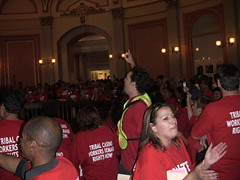
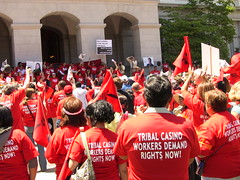
The voices of the casino workers were heard within the Capitol today.  Hundreds of red-shirted workers gathered on the North steps for a rally and then marched inside in an orderly fashion to do some lobbying.  The event culminated as over two hundred UNITE-HERE members chanted from the second story of the rotunda “¡Si, Se Puede!” just steps from the office of Speaker Fabian Nunez.  The dome amplified the chants as staffers poked their heads out of their office doors and the CHP scrambled to ensure the direct action did not get out of control.

The events today were the last big push by the workers to ensure that workers rights were included in the Indian gaming compacts that the legislature is about to vote on.  At issue are the basic workers rights protections that workers have under California law.  In particular, the right to use check cards to indicate the desire of workers to form a union. 

It is that exact right that is actually being heard in the U.S. Senate ironically today, as part of the Employee Free Choice Act.  The Democratic leadership here in the state legislature has been indicating that they are siding with the tribes on the establishment of right to work colonies in the casinos.  Dozens of labor leaders, including Working Californians’ co-chairs Marvin Kropke and Brian D’Arcy signed on to a letter to Senator Perata and Speaker Nunez recently.  Here is an excerpt from that letter:

In contrast to most previous compacts submitted by the Governor in 2004, this compact—and presumably others to come—removes from the Tribal Labor Relations Ordinance the right for tribal casino workers (who are virtually all not tribal members) to freely choose whether they want unionization through card check, and to establish a level playing eld for their pursuit of decent wages, benets and working conditions. Instead, the Governor has reverted to the 1999 procedures for unionization, even though Speaker Núñez and Senate Majority Leader Gloria Romero conducted a detailed study of those procedures and found them severely decient and ineffective.

The U.S. House of Representatives, led by California’s own Nancy Pelosi and George Miller, with the support of every California House Democrat, recently voted to approve the card check procedure of organizing as a reform of the National Labor Relations Act. A super majority of California Assembly and Senate Democrats signed a letter of support for that legislation. Unfortunately, even if this effort should succeed, the enforceable jurisdiction of national labor law will not be settled law at tribal casinos for many years to come, if ever. In contrast, the card check procedure of organizing has become the standard in commercial gaming, and many tribal casinos, throughout our country and Canada. It would be ironic in the extreme for the California legislature, led by Democrats, to reject card check at the same time that California’s congressional delegation is leading the way on the same issue.


It is doubly ironic that the day of the rally is the day as debate begun on S. 1041 (EFCA).  Indeed thousands of fellow brothers and sisters gathered on the National Mall today as Senate Majority Leader Harry Reid and Senators Dick Durbin, Edward M. Kennedy, Hillary Clinton, Sherrod Brown, Bernie Sanders spoke to the crowd about the importance of passing the Employee Free Choice Act. (photo of Sen. Brown speaking from democrats.senate.gov)


Meanwhile, I watched AFL-CIO Labor Fedration head Art Pulaski work hard today to explain to Nanette Mirada of ABC 7 why secrete ballot elections are not fair in practice.  It is clear that there is a real lack of education on the issue.  He used the example of the tribes scheduling several “educational” meetings on unionization, or deliberately making security guards fill out their ballots under video cameras and other intimidation tactics.  He also patiently explained that workers do not have access to workers compensation and other benefits since they are working on the reservation.

Pulaski also went into the politics of the fight and vaguely threatened the Democratic leadership.  Pulaski referred to the gathered workers as the “ground troops” for the election, noting that they would not be particularly motivated in upcoming elections if they lost this battle now.  “Money talks inside the capitol…and the odds are stacked against these workers” he said, referring to the large amount of donations the legislators have received from the gaming tribes.

More from the letter:

It is incomprehensible how California, in a period when the state is relying more and more on service sector jobs for economic development, could enact compacts which will create the largest expansion of gaming in American history with no clear path to the middle class for a work force eclipsing 60,000 workers, soon to be 100,000 workers, who are the engine behind this extraordinarily lucrative industry.

All the workers want is that the new compacts include the same rights as the 2004 Compacts did, nothing more.  Already, 5,000 tribal gaming employees have chosen unionization.  That choice has improved their lives and communities and simultaneously relived the Californian taxpayers of the burden of their health care costs and other social services for the working poor.  If the Democratic Congress can support these basic rights, so should the Democratic State Legislature in California.

More pictures in my flickr set.

“Making an extra mortgage payment when you can’t pay the utility bills.”

(cross-posted from Working Californians)

The May Revised budget was released by Arnold yesterday.  He wants to pay off some bonds early, sell off State assets and make cuts to welfare for children, the blind and elderly.  That prompted John Meyers to ask Arnold if that was like “making an extra mortgage payment when you can’t pay the utility bills.”  Naturally, Arnold did not have a good answer, simply saying it was not an ideal situation, but he wanted to pay off more debt.

Yes, the state is facing a revenue slump for the first time in years, but like Fabian Nunez says, this budget it “mean spirited”.  Its priorities are out of whack.

Lawmakers’ skepticism of the privatization plans is just one obstacle the governor faces. Democrats do not accept Schwarzenegger’s assertion that the state is so deep in the red that it cannot avoid removing thousands of families from the state’s welfare program, freezing cost-of-living adjustments for low-income elderly and disabled and raiding public transportation accounts for more than $1 billion.

“I wish we could fund all of those programs,” Schwarzenegger said at an afternoon news conference. “But I have an obligation, which is a promise to the people of California that I will bring down the structural deficit to zero, that we will be fiscally responsible.”

Your priority is to pay off our debt early, pleasing Wall Street instead of aiding the poor, disabled and elderly.  Where is the sense it that?  Closing the structural deficit is a good thing, but it should not come at the cost of our long term assets and the most vulnerable Californians.

Democratic leaders, who worked relatively harmoniously with Schwarzenegger last year, criticized his proposals, calling them quick fixes that disproportionately hurt the less affluent.

“When it’s all said and done, this is reminiscent of the pre-postpartisanship governor,” said Assembly Speaker Fabian Nuñez (D-Los Angeles), referring to Schwarzenegger’s depiction of his bipartisan leadership style since his fiscally conservative political program was rejected by voters in the 2005 special election.

The governor’s budget “punishes middle-class, working-class and poor Californians,” Nuñez said.

This is not a long term solution to our state’s fiscal problems, in fact it goes the opposite way by selling off our assets for short term gains during a relatively minor budget squeeze.  Sometimes the real Arnold rears his ugly head.  This is one of those times.

For more see Frank Russo’s coverage of Perata’s and Nunez’s press conferences and dday’s post below.

Single Payer Support

(Cross-posted from Working Californians)

There is major public support for single payer health care in California, according to the PPIC poll released today.  Arnold is in the minority with his opposition to this concept.

Think Californians don’t like taxes? Sort of. Sixty-one percent said they would prefer a “universal health care system” where everyone is covered by a government program and “financed by taxpayers,” over the current system. Of course, this is a two-option choice. But 63% supported raising taxes to “guarantee health insurance for all citizens.” And 54% said they would generally favor higher taxes for more services. This is good news for lawmakers such as state Sen. Sheila Kuehl, who is attempting to do just that, but also gives a little breathing room for Schwarzenegger as he attempts to surcharge doctors, hospitals and employers for his universal plan. And even larger number, 71%, said they favored Schwarzenegger’s plan for shared responsibility.

The study shows real viable public support for major health care reform.  Californians are willing to pay more taxes to have government run health care.  They also support Arnold’s plan.  That may sound contradictory, but it makes one thing clear, they want something done about our current health care system.  It is not working.  They live with it on a daily basis and want to see change.

None of the state’s major politicians are pushing for single payer.  This just about sums up their attitudes.  It is Sen. Perata on Sen. Sheilia Kuel’s single payer bill, saying:

“It will receive the same consideration as it did last year when it got to the governor’s desk,” said Perata, an Oakland Democrat. Schwarzenegger vetoed the bill.

(I would give you a link to it, but it is behind the new SacBee pay wall, known as the Capitol Alert.)

Perata is saying that it probably could pass both legislative houses, but it would go no further than Arnold’s desk.  Absent some unbelievable turnaround, that will probably hold true for the remainder of his term.  He is out of step with the majority of Californians, as the PPIC poll makes clear.

This has led Nunez and Perata to push for a deal with Arnold that relies on the private insurance industry, rather than advocate for single-payor.  It is a pragmatic approach, but not revolutionary by any stretch of the imagination.

An Industry of Denial

(cross-posted on Working Californians)

One of the worst parts about our current health care system is the ability of insurance companies to deny people coverage because of preexisting conditions.  They are slowly turning it into a system where only healthy people can get insurance.  I recently had to sign up for health insurance, luckily I am very healthy, young and do not have major hereditary problems.  Others are not so lucky.

Bloggers are starting to share their personal health care stories.  CJ from the Courage Campaign wrote today:

When I moved to Chicago, I stayed at a dead-end job because I was scared of not having health insurance. Finally, I decided I was going to move home to L.A. – and gratefully accepted my parents’ help in paying for Cobra insurance coverage. I don’t know where I’d be right now without my parents’ financial support. Because recently, I was diagnosed with thyroid cancer and if I hadn’t paid for Cobra insurance, my new employer’s insurance would have denied coverage for my treatment.

And here is dday from a few weeks ago:

I want to interject here at this point, because I am in exactly the same position as those in this article. I’m self-employed, living in California, and I have, in fact, a prior history of asthma. I had to practically beg Blue Cross to take me in 2004 (when I fully went free-lance, and dropped the coverage I had with my employer), and since I have had Achilles tendon surgery since then, I pretty much have to stay with the greediest, sneakiest, most depraved insurer in the nation. It seems like it’s only gotten worse since then. As it is, I have high-deductible coverage that doesn’t cover routine things like MRI’s (which I paid completely out of pocket in the summer of ’04). I can certainly afford coverage that’s better, but at this point, nobody would cover me. This is well-known to anyone who has to arrange for their own insurance. I’ve been turned down before, even by so-called “good guys” like Kaiser. It’s this knowledge, that any prior history will cause rejection, that pushes people to fib on their forms, which Blue Cross uses to its advantage later by dropping people after they make a claim. Blue Cross doesn’t mind if you lie a little on your form if you pay them; it’s only when you want something FROM them that they’ll drop you.

We will need more of these stories to be told in the public.  We are talking about life and death here.

There are a few proposals for fixing this problem, which has two distinct parts.

  1. Requiring insurance companies to insure all people regardless of pre-existing conditions
  2. Regulating what variables insurance companies can use to set their price-points

In order to share risk we need to include not just the healthy in insurance pools.  It is completely inefficient to push people who are sick to get their health care from the ER, rather than actually pay for preventative measures and ongoing treatment.  We need to share the costs of coverage and like recent reforms to the car insurance industry, ensure that people are not discriminated against when it comes to fees.

Nunez, Perata and Schwarzeneggers plans deal with this in different ways and level of detail.  Expect these to be more fleshed out as the debate progresses.

Insurance industry. The governor’s plan would require all insurance companies to provide coverage to anyone who applies, regardless of pre-existing conditions. Insurers could charge varying premiums based on age and geography, but not health status. Insurance companies would also be required to spend at least 85 percent of their premium revenue on services to consumers.

Perata’s plan would require insurers who contracted with the state purchasing pool to provide coverage without regard to pre-existing health conditions. Nunez’s plan envisions tighter regulation of issues surrounding pre-existing conditions but has not specified the details.