It is a dirty little secret, but often times the more virulently anti-union employers are religious orders that run health systems. Such is the situation with the Sisters of St. Joseph who run the St. Joseph Health System. They have been resisting the efforts of their service employees to join SEIU-UHW for the past three years.
SEIU-UHW is organizing a series of events this week in support of their organizing efforts. Today Delores Huerta of the United Farm Workers wrote a HuffPost piece on the struggle.
This week I’m joining St. Joseph Health System workers, Attorney General Jerry Brown, Father Eugene Boyle, actor Ed Begley Jr, and community and religious leaders to call upon the Sisters of St. Joseph of Orange to make peace with their workers.
For decades, the Sisters of St. Joseph of Orange have fought for justice for California’s workers. In the summer of 1973, they marched in solidarity with Cesar Chavez and farm workers during the brutal Grape Strike. I witnessed the Sisters putting their personal safety at risk. They walked picket lines and even went to jail with more than 3500 striking farm workers. I was inspired by the Sisters’ commitment to stand with the farm workers, even in the face of violent provocation.
But now, these same sisters are refusing to show their own workers the same justice they once fought for.
Flip it for more and a video.
When I write that the nuns are resisting the organizing, I mean it. They have been using heavy-handed and it appears illegal tactics to stop their employees from forming a union. Workers have been threatened that they will lose their jobs is they continue to push for a union. Delores Huerta writes:
Public records show that SJHS has hired some of the most notorious union-busting firms to fight their employees. Meanwhile, government officials have cited SJHS for violating its employees’ basic labor rights, including illegally firing, spying on, and intimidating workers who want to form a union. These heavy-handed tactics leave workers feeling threatened, intimidated and disregarded.
How can the Sisters support farm workers’ efforts to form a union, but fight their own employees for seeking this same basic right? Is there such a big difference between the people who feed us and the people who heal us? Clearly, there is not.
It is great to see a community coming together to support the workers, including Huerta nad Jerry Brown. More importantly at least IMHO, 20 former members of the Sisters of St. Joseph’s wrote a letter to the current members, urging them to find peace with their service employees. Here is a video of the delivery of that letter to the nuns. No, they did not come receive the letter personally.
Seems about time to have one of these open thread thingys. Some interesting stuff I saw:
Swing State Project upgraded CA-50 (Bilbray-R vs. Liebham-D) from Safe Republican to Likely Republican. Liebham’s fundraising was fairly good, and the district is only R+4.6, certainly not out of the realm of possibilities.
I am not a member of the pro-developer Plan C organization, but I do subscribe to their email list to keep tabs on what’s going on. And if yesterday’s email is any indication, the rumors surrounding a quid pro quo between Assemblywoman Fiona Ma and Board Member Aaron Peskin may be true.
The rumor (and we know how they fly around my beloeved city) is that Fiona Ma has agreed to vote for Aaron Peskin for DCCC Chair in exchange for legislation favorable to a business owned by Ma’s boyfriend (I have no idea who he is). Hence, the below email I received yesterday.
Help re-elect Scott Wiener as DCCC Chair!
This Wednesday, July 23, there will be an election of the chair of the Democratic County Central Committee. This obscure body is one of the most powerful in the city, because it controls the endorsements of the Democratic Party for candidates and ballot measures (including those on this November’s ballot).
Assemblywoman Ma may not vote for Wiener
The current chair, Scott Wiener, a longtime member of Plan C, is being challenged by Aaron Peskin. The vote is extremely close and we expect the deciding vote to be cast by Assemblywoman Fiona Ma. The assemblywoman is undecided, and may cast her vote for Aaron Peskin.
Scott Wiener has been an outstanding DCCC chair – fair, able and open-minded. His ouster from the chair of the DCCC would be a blow to quality of life advocates. Please call and email assemblywoman Ma and ask her to vote for Scott Wiener as chair of the DCCC.
Phone Assemblywoman Ma at: 415 557-2312
Or click here to be taken to her website to send an email (see left side column under “Contact Me” in the yellow bar).
There must be a kernel of truth somewhere for Plan C to hit the panic button like this. I may even try to show up and watch the action for myself. Do you think they allow popcorn?
By my count, we had nine local and federal candidates or elected officials from California joining us in Austin for Netroots Nation. So much for the adage that us dirty hippie bloggers are to be avoided at all costs. These candidates and politicians represent the foundation of a progressive alliance that can transform the party and the state over the next decade. And they all received varying degrees of support at the convention. Here is a brief roundup in alphabetical order:
1) Secretary of State Debra Bowen – Debra apparently accepted the invitation to appear on a panel about election reform by replying on Facebook. She is one of our favorites because of her progressive credentials, her commitment to election reform, and her accessibility. Far from dropping in for the panel and dropping out, she took time to hang out with plenty of us Caliticians. In fact, during the netroots candidate event, she was simply watching the proceedings when Christine Pelosi called her to the stage – it was not her intention to come as a candidate, but to just attend the conference. That said, there was a lot of talk among the California delegation about Bowen’s plans for the future. At least four California convention-goers told me they would quit their jobs to work for Bowen if she sought higher office than the Secretary of State. She has a bright future and, judging from the reception she received, a national profile. She is one of our best hopes to get a real grassroots progressive into a legitimate position of power.
more on the flip…
2) Charlie Brown (CA-04) – Charlie has been to all three Netroots Nation events, including the first two when it was known as Yearly Kos. He is a hero among this community, and he has a lot of support here. In fact, he proved it with a very well-received appearance at the Lurker’s Caucus.
One of the people attending the caucus was Charlie Brown. He was there to do what a great many political candidates came to the convention to do — speak to people, press the flesh, make them aware of his campaign and expand awareness. I was taking a seemingly arbitrary route around the room in calling on people to talk about themselves, and Charlie was one of the first people I called on.
Obviously there was a great interest in him, and there was a lively give and take between the attendants and The Colonel for about 15 minutes. He cheerfully answered questions and gave us all a good measure of him.
Now, there are a couple of things here that make this moment extraordinary to me. First of all, the odds were very slight that there were any people in this caucus who were from his home district. And this was the Lurkers Caucus, a group whose only unifying distinction is that they don’t blog!! But here was Charlie, in a convention filled with bloggers, talking to the very people least likely to blog his appearance. (Yes, I’m blogging it now, but he didn’t know I was going to be there…)
Secondly, after he spoke, we still had about 50 minutes of the caucus and we had resumed moving around the room, giving people opportunities to express themselves. Now, I know that Charlie was not there to share his lurking experiences. He was there to campaign. I fully expected him, and would not have blamed him in the least, to quietly slip out of the room in search of more campaigning opportunities at the convention. In fact, that’s part of the reason I kind of steered the circuit of speakers to allow him to speak early. But Charlie stayed for the entire session, listening to people explain why they don’t blog!
It was indicative of the respect Brown has shown for this entire community, from top to bottom, and it’s what’s going to make him a great Congressman from the 4th District. This is one of the top races in the country from the perspective of the netroots.
3) Debbie Cook (CA-46) – I think Debbie Cook, Annette Taddeo and Alan Grayson were among the most well-received newcomers at the event. Cook’s passion for environmental and energy issues matched up perfectly with the overriding concerns of the entire conference, which helped a lot. At the Energy Panel she sat on, along with Alaska Senate candidate Mark Begich and Oregon Senate candidate Jeff Merkley, people in the room told me she was the most impressive. And Talking Points Memo was similarly taken with Mayor Cook, as can be seen in this interview for the popular site.
Cook switched her flight so she could make the Netroots candidate event on Friday night. I think she served her candidacy a great deal through this appearance, and considering that in-district donations to her campaign passed 70% in Q2, she has a lot of potential to raise her national profile online.
4) Rocky Delgadillo, LA City Attorney – Delgadillo, who lost to Jerry Brown in a primary for the Attorney General in 2006, appeared on a health care panel that I thought was the most interesting of the entire conference. I’m going to do a larger story on it, but Delgadillo’s work in this area, rooting out corruption and illegal acitivity among health insurers, was justly recognized. I didn’t see him walking around the conference. Here’s a great diary from nyceve at Daily Kos about his efforts.
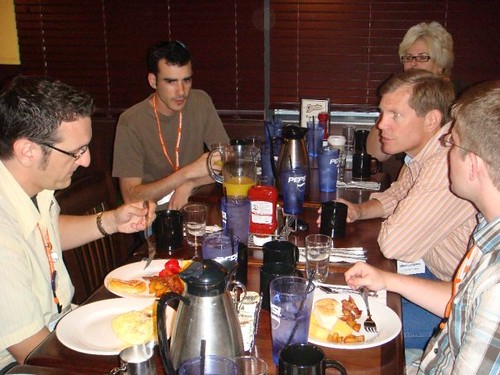
5) Mike Lumpkin (CA-52) – Calitics actually held an extended breakfast conversation with Lumpkin, running in the open seat created by Duncan Hunter’s retirement. Here’s a pic:
That’s me, my subpar breakfast, Brian, Mike Lumpkin, and Lucas. Photo by Matt Lockshin.
I thought Lumpkin was pretty good. He’s a former Navy SEAL with 20 years of experience in counterinsurgency and command techniques, serving in both Afghanistan and Iraq. Notably, his plan for Iraq includes a total withdrawal of all forces, leaving no residual troops. He tends to frame most of the issues in terms of national security, which I guess is to be expected, and he talked about securing the border as well as energy security as two of his major issues on the campaign trail. Duncan Hunter’s son, also named Duncan Hunter, is his opponent, and in the primary polls revealed that a substantial portion of voters thought they were casting a ballot for the incumbent, so this is not really an open seat in the traditional sense. Still, this is a race to watch, and I appreciated Lumpkin taking the time to talk with us.
6) Gavin Newsom, San Francisco Mayor – Mayor Newsom walked around the hall on Saturday, showed up at our Calitics/Alternet Books party, and introduced Van Jones on Sunday morning. Joe Garifoli has a little interview on why he attended:
Newsom is no stranger to online communication. He’s been regularly courting Bay Area bloggers for stories that the uh, ahem, other news poohbahs in town aren’t into. Just this week, he chatted up the city’s wind power project with a handful of local and statewide bloggers. He’s a Daily Kos and Huffington Post regular reader and occasional poster, and he copped to following threads around Facebook. “I really don’t have time to be on there,” he said of the social networking time suck.
“I’m not a convert, I’m one who recognizes the power and extraordinary influence the netroots have. Not just with politics, but it’s about a different interactions with people.” He went to Austin because “I wanted to understand more fully the intensity behind those names. We actually met ‘Bill in Portland Maine.'”
Clearly Newsom was there to build a profile for a statewide run for governor, and I thought that was generally successful. There seemed to be a buzz around his visit as he walked the halls, and the crowd was receptive to his Sunday morning message, which focused on the environment. Some were skeptical of the message, and I hope he clarifies his position, but when I spoke with him, I found him very willing to engage on the issues. I asked about prison policy, one of my hobby horses, and while he wasn’t fully informed on the topic, he expressed a need to drill down and asked me personally to provide him with whatever information I could muster. You bet I’ll do so, and I respect anyone in politics willing to have a two-way conversation.
7) Nancy Pelosi, Speaker of the House – You may recall she had a little discussion with some dude on Saturday morning. That’s been well-covered elsewhere. Speaking to Pelosi’s staffers, I can tell you that she enjoyed the back and forth and expected MORE of a grilling, which may have been a fault of the organization or the perhaps too-respectful commenters themselves.
8) Russ Warner (CA-26) – This was Russ’ second Netroots Nation, and he did his best to focus on meeting as many people as possible. I did tend to see him and his campaign staff just about everywhere. He delivered his passionate message about his son, who was in attendance, at the Netroots candidate event as well.
9) Steve Young (CA-48) – Steve is running for Congress but he’s also a member of the community, and during the California caucus he was as active as anyone in participating in the discussion. The numbers he’s been showing around on his race suggest there is a real chance here, and I hope he got a lot out of the event.
Chicago does not have rent control. In 1997, the Illinois legislature passed – and Republican Governor Jim Edgar signed – SB 531 (the Rent Control Preemption Act), which prohibited local jurisdictions from passing it. At the time, no city in Illinois had rent control – but the real estate lobby had a national effort to quietly stop it in places before it starts. SB 531 passed with little fanfare: the State House voted for it 96-18, and the State Senate approved it 46-6. One of the six senators who voted “no” was Barack Obama – although many liberal Democrats voted with landlords and the Senate’s Republican majority. Obama’s vote – when one considers how few people stood up with him – is an example of his core progressive principles. While it’s valid to say that he should have done more to defeat it, consider that Obama was a freshman in a very hostile climate – and as a community organizer had learned to pick his battles.
Illinois Senate Bill 531 was part of a larger national campaign in the 1990’s by the real estate lobby to defeat tenant protections. Efforts to weaken rent control in California (where Costa-Hawkins passed in 1995) and repeal it in Massachusetts (which the voters narrowly did in 1994) got the lion’s share of public attention. But a more quiet and effective tactic – which also encountered less opposition – was to pass “rent control preemption” in states where it did not exist. The Farm Bureau used a similar tactic in the 1970’s to push anti-farmworker legislation, and in some states it slipped by without the United Farm Workers (UFW) knowing it.
Last month’s defeat of California’s Proposition 98 was a strong mandate for rent control – and the genesis of a renewed tenant movement. But when Los Angeles, San Francisco, Oakland, Berkeley and other cities have had rent control for years, it’s easier to mobilize renters against a landlord attack. Chicago did not have rent control when SB 531 passed – and besides a tenant’s rights ordinance passed in 1986 by Mayor Harold Washington, had few protections. When landlords pushed a bill to ban rent control in Springfield, Democratic legislators did not feel pressured to mount an opposition.
Enter Barack Obama, a freshman legislator in early 1997 from Chicago’s Hyde Park. At the time, the Illinois State Senate had a Republican majority – led by James “Pate” Philip of suburban DuPage County, a powerful figure who said that black people “do not have the work ethics that we have” and opposed raising welfare payments because “they’d probably just buy more lottery tickets.” Obama, who had literally just arrived in Springfield, had to vote on a real estate-funded bill sponsored by Tom Walsh – another DuPage County Republican and an ally of “Pate” Philip.
It goes without saying that Obama did not have much power at the time to stop SB 531. He voted against it, but only five of his colleagues joined him. What’s disconcerting is how many liberal Democrats voted for it – including John Cullerton of Chicago’s Lincoln Park and Donne Trotter from Chicago’s South Side. It’s clear from the roll call vote that there wasn’t much pressure to oppose it, and the Democratic leadership at the time did not prioritize it as an issue. The fact that Obama was one of only six to vote “no” is an encouraging sign about his political convictions.
Obama came to Springfield – and then Washington – with the mind of a community organizer, and it guided much of his early career. But like most seasoned organizers, he understood the art of the possible. Obama was not in the position at the time to defeat SB 531, which was effectively a done deal. Not only did Republicans control the State Senate, but there was no mobilized rent control constituency in Illinois to fight it. It’s a lot harder to motivate renters to protect a right they don’t yet have – than to save a right they have grown to depend on for their own livelihood.
But Obama’s vote in 1997 is instructive for those following his current presidential bid – as they fear his perceived move to the center. Anyone who follows Obama’s record in the State Senate understands his background – where his vote against SB 531 was just one example. As a columnist for the right-wing National Reviewrecently lamented, Obama worked closely in the State Senate with the Illinois chapter of ACORN to pass living wage legislation and curb banking practices. “You begin to wonder whether,” he writes, “in his Springfield days, Obama might have best been characterized as ‘the Senator from ACORN.'”
In 1995, the Chicago Reader wrote an instructive profile of Obama as he made his first bid for office, which offers more clues. “What if a politician were to see his job as that of an organizer,” said Obama, “who does not sell voters short but who educates them about the real choices before them? As an elected official, I could bring church and community leaders together easier than as a community organizer or lawyer. We would form concrete economic development strategies, take advantage of existing laws and structures, and create bridges and bonds within all sectors of the community. We must form grass-root structures that would hold me and other elected officials more accountable for their actions.”
When Obama becomes President, it will be the job of affordable housing activists to work with his Administration and hold him accountable – and to help alter the political reality so that we don’t lose more battles like SB 351. For now, I’m just relieved that he wasn’t on the wrong side of that vote.
EDITOR’S NOTE: Paul Hogarth was an elected Commissioner on the Berkeley Rent Stabilization Board from 2000-2004, and is now a tenant lawyer in San Francisco. He has volunteered on Barack Obama’s presidential campaign, and grew up in Chicago’s Hyde Park – where in the mid-1990’s he lived three doors down from Obama.
The Rev. Rick Warren has persuaded the candidates to attend a forum at his Saddleback Church, in Lake Forest, Calif., on Aug. 16. In an interview, Mr. Warren said over the weekend that the presidential candidates would appear together for a moment but that he would interview them in succession at his megachurch […]
The forum still falls short of the kind of face-to-face, town-hall-style debates that Mr. McCain, of Arizona, has called for this summer before formal debates scheduled for this fall.
Mr. Warren, the author of the best-selling book “The Purpose-Driven Life,” said he had called each man personally to invite him to his event, which will focus on how they make decisions and on some of Mr. Warren’s main areas of focus, like AIDS, poverty and the environment.
Maybe the fact that McCain missed the vote on the global AIDS bill, like he’s missed every vote since April (and here I thought I was being lax with my Netflix movies!), will come up. Then again, don’t expect a grilling:
“Since I’m their friend, I’m not going to give them any gotcha questions,” Mr. Warren said, adding that a typical query would be, “What’s the most difficult decision you’ve had to make, and how did you make it?”
So the first town hall of the 2008 election will basically be a Barbara Walters interview.
I live in Chico, a truly lovely town – nice park, lots of trees, great farmers market, good music. Everything one could ask, except for one thing – our congressman. This is deep red Northern California – the northern Sacramento Valley and a bunch of lightly populated mountain country up to the Oregon border. All represented by Wally Herger. One of the worst of the worst. Far right and stupid besides. The proverbial empty suit. 12 terms in Congress and never written a meaningful piece of legislation -for which we should be thankful, since if he had it would be terrible. Each election the Dems put up a sacrificial lamb. Some nice person, devoted to the party, who allows their name to be put on the ballot so there will be a Democrat there. And each election, they raise no money, get no support and sink without a trace.
This year, things look a bit different. We actually have a candidate who means it. A candidate who has held elective office. A candidate who is campaigning, raising a bit of money. And, in a wave year like this, who knows? There will be big voter registration efforts up here, the Republican brand is in bad shape. Maybe this is the year?
Jeff Morris is a supervisor in Trinity County, – Think Weaverville. I had made a donation to him earlier, but the one reservation holding me back was the question of whether he really planned to run a serious campaign. A couple weeks back I ran into him at our local farmers market and he reassured me on that score. As he said “I’m not doing this for my health”.
Another little anecdote: A few days later, I ran into a patient of mine who is a long time Republican activist, former member of the Republican County Central Committee. he saw my Morris button and said – “Yeah, I’m voting for that guy. Hergers been around too long.” That was a big surprise for me, and I think it may be a hint at the mood of the district up here. Medicine is a big industry in this area too, with hospitals being among the largest employers in several of our cities, and Herger upset a lot of people with his stubborn no vote on the recent Medicare bill – lost a lot of conservative doctors on that one.
So I would not call Jeff a top tier candidate yet, but I think we have a real chance this time. It just may be that some time in my life, I may get to have a representative I can actually feel good about. Now if we could only do something about Rick Keene.
Anyway, take a look at Jeff’s campaign site, and maybe leave a few bucks so one poor Democrat can have hope for the future.
Blackwater may be on shaky ground. Despite official protestations to the contrary, it’s starting to look as though Blackwater’s course might be shifting. Defense Secretary Robert Gates is starting to ask why the government is using so many private contractors, asking “Why have we come to rely on private contractors to provide combat or combat-related security training for our forces?” and going on to wonder “are we comfortable with this practice, and do we fully understand the implications in terms of quality, responsiveness and sustainability?”
These are questions that a competent government would have been asking in 2001 when Donald Rumsfeld declared that privatizing national security would be a good idea because…I don’t know why…his friends would make money? It was Rumsfeld shift away from publicly-guaranteed and provided security that brought about the rise of Blackwater and a litany of other, slightly less infamous private security firms. But in light of the continuing legal proceedings probing Blackwater’s Nusoor Square (17 civilians dead for no reason), Iraqi Prime Minister Nuri al-Maliki’s insistence on eliminating immunity for security contractors in any new Iraq-U.S. security negotiations, and now Gates’ expressed concerns, Blackwater executives have been saying they’ll shift away from private security because it’s causing them too much grief. Blackwater will supposedly “survive with a focus on international training, aviation and construction.”
This has a number of potential implications for the new Blackwater facility in San Diego. If the above list is correct, then Blackwater would be getting out of not only the private security business but also the domestic training business. Which would make their San Diego facility superfluous. They’ve assured the public repeatedly (perhaps protesting too much) that this facility would not be a staging area for aviation surveillance of the border, but we know they’re expanding their fleet of surveillance aircraft and are apparently heading in that direction. We know they’ve received new government contracts to provide training in Latin America and have recently provided security for Sen. John McCain in Mexico. Blackwater officials have sworn up and down that setting up just three blocks from the Mexican border has nothing to do with these other plans to operate multi-million dollar contracts in Mexico and elsewhere in Latin America, but it remains convenient.
Now maybe the public denials are accurate, but if Blackwater is getting out of domestic security training and moving away from the sorts of contracts that send them to Iraq, (aside from being a welcome development) it means they don’t have any use for their San Diego “vocational school.” I look forward to seeing the thread of logic play out for them.
It seems the Bush administration has developed an exit strategy — unfortunately the target is right here on our home soil. The still-in-office Bush administration is trying to kill two birds with one stone, and those birds are named Health Care and Reproductive Rights.
It is proposing a complicatedly worded (the main clause has a triple negative) rule. It would demand that any organization or institution that receives federal aid from the Department of Health and Human Services will not be eligible for aid unless it signs a written certification saying that it will not refuse to hire providers, doctors or nurses that refuse to provide abortion and even many forms of contraception.
This means that hospitals would have to consider hiring people who will deny the full range of choices available to women or they will be denied federal aid. Furthermore, state and local governments will not be allowed to deny grants to hospitals and clinics if they refuse to provide abortion and many forms of oral contraception.
To use their kind of language, this isn’t not bad for women.
It never ceases to amaze me that those without the gift of reproduction, like President Bush, are endlessly trying to regulate those who can. This is the key reason why electing women matters – women legislators are historically champions for the issues that concern women most. In fact, nationally statistics show that the majority of women favor some degree of choice over their reproductive rights. Roe v. Wade is the cornerstone that makes that possible.
Experienced legislative stonecutters know full well that once voters allow the small chipping away at that foundation, it won’t be long before the whole thing is a pile of rubble. You don’t need a magnifying glass to see this is just another veiled attempt to weaken laws protecting our reproductive rights. Consequently, equal representation for women is not born of the desire to merely level the playing field, it is essential to protecting the rights of the feminine sensibility.
We at the CALIFORNIA LIST understand that women legislators are the backbone for feminine liberties. This is why the decline of elected women here in California is so disheartening. Women in the California legislature peaked during the 1996 to 2000 electoral cycle with a total of 46 women in both the Senate and Assembly. Today there are only 28 Democratic women and come November we stand to lose another 2 or 3 women due to term limits.
We must reverse this slow decline, so that women can have a stronger voice in our legislative process.