
All posts by Robert Cruickshank

California Full of Competitive Legislature Races in 2008

I will be on KRXA 540 AM at 8 this morning to discuss this and other California politics issues

In today’s column lambasting state politicians for the budget crisis George Skelton makes a rather startling and, to me, clearly inaccurate claim. After bashing Arnold and the legislature’s leaders for not calling an immediate special session to deal with the budget deficit he uses the situation to argue for Prop 11:

Predictably, the Capitol’s record 85-day tardiness in producing a state budget is not an issue in any competitive legislative race this fall.

That’s because — despite the national political drama, and rock-bottom public approval rating of the Legislature — there are very few competitive legislative races. Blame the Legislature’s gerrymandering of districts to make them safe for incumbents and their parties. No incumbent is in a tight race. No lawmaker is being held accountable for legislative fiscal irresponsibility.

It’s an argument for Proposition 11, a ballot measure sponsored by good government groups that would take redistricting away from the Legislature and hand it to an independent commission.

That is simply not true. California is FULL of competitive legislative races this fall. Look at the assembly, where as David Dayen explained yesterday there are competitive seats all over the place. You’ve got Alyson Huber in AD-10, Joan Buchanan in AD-15, John Eisenhut in AD-26, Fran Florez in AD-30, Ferial Masry in AD-37, Marty Block in AD-78, and Manuel Perez in AD-80 all with a very good chance of winning seats currently held by Republicans or in a competitive race with Republicans.

Linda Jones in AD-36 is running a competitive race and in AD-38 and AD-63 a polls show a tie between Republicans and Democrats in voter preferences. The race for SD-19 is competitive between Hannah-Beth Jackson and Tony Strickland. Here on the Central Coast Abel Maldonado feels the need to blanket the airwaves with TV and radio ads even though he faces independent and underfunded challenger Jim Fitzgerald. Ginny Mayer and Gary Pritchard are likely seeing a boost in their own fortunes in Orange County senate races.

I don’t know how George Skelton can claim that there are no competitive legislative races this year. It is an untrue statement and he’s doing his readers a disservice by saying there aren’t any. He’s so fixated on Prop 11, a pointless reform in search of a problem, that he is blind to the political earthquake that’s about to take place.

Skelton is also wrong that the budget isn’t an issue in these races. True, it does not seem to dominate the campaigns, but it is instead enfolded into a broader public unease with Republicans when it comes to the economy. California’s economy badly needs stimulus and increased government spending, not slash-and-burn like Republicans propose. Barack Obama at last night’s debate dramatically undercut Republican demands for across the board spending cuts, pointing out that’s not what you do in a severe recession, and Californians are smart enough to connect that to our own Republican caucus.

California voters understand full well what is responsible for the budget crisis. Skelton wants us to believe it’s because all legislators regardless of party are either incompetent or scared to face the truth. Never mind the fact that it is foolish to hold a special session while you’re trying to sell revenue anticipation notes – Californians are demonstrating that they clearly understand this is the Republicans’ fault.

By forcing a three month budget delay and demanding spending cuts at the worst possible time, Republicans have shown to Californians that they are irresponsible and not to be trusted with power over California’s basic services and with its tax revenue.

Prop. 11 is a sideshow. It’s time for California’s media to pay attention to the main event – numerous competitive elections across the state that will put 2/3 in our grasp. Something is happening here, but you don’t know what it is, do you Mr. Skelton?!
Progressive Voter Guide – Including Calitics Endorsements

For the last few election cycles Speak Out California has been distributing a progressive voter guide, including recommendations on ballot propositions and a chart of how California progressive groups have endorsed. Their guide was a popular, useful way for California progressives to navigate the sometimes confusing propositions. Speak Out is on hiatus until after the election, but the need for a progressive voter guide remains.

The Courage Campaign Issues Committee (disclosure: I’m proud to work with them) has taken up the task, and put together the 2008 Progressive Voter Guide. It includes Courage Campaign’s positions on the 12 propositions, and includes the ever-useful chart of how prominent California progressive organizations have endorsed on the 2008 propositions.

The chart, of course, includes prominently the Calitics ballot proposition recommendations including Yes on Prop 1A, No on Props 4 and 8, and No on Prop 11.

The guide can be downloaded as a PDF or you can get it for your mobile phone by texting VOTECA to 69866.

We are on the cusp of a major progressive breakthrough in California, and part of that involves the 12 ballot measures. This guide can help California progressive make the right choices.

Below is the email we sent out earlier this afternoon to our members announcing the guide:

Dear Robert,

You asked for it. And here it is.

A few weeks ago, we surveyed our members about whether or not the Courage Campaign should provide recommendations on California ballot measures to our nearly 100,000 members and supporters.

Your overwhelming answer: Yes, absolutely!

So, today, we’re launching our 2008 Progressive Voter Guide for the 12 — that’s right, 12 — propositions on California’s November ballot. Our Voter Guide includes not only Courage Campaign recommendations, but also the recommendations of nine other leading California progressive organizations.

Click here to download and print the Courage Campaign’s 2008 Progressive Voter Guide from our web site:

http://www.couragecampaign.org…

The choices you make on this ballot will impact you, your family and friends for decades to come.

We’ve already talked about why we think you should vote “No” on Proposition 8, which would eliminate equal rights for same-sex couples. We’ve also talked about why we think you should vote “No” on Proposition 4, which would undermine teen safety and abortion rights.

But what about the 10 other propositions on the ballot? To help you make your choices in this momentous election, our printable 2008 Progressive Voter Guide includes:

(1) Short, easy-to-read, recommendations from the Courage Campaign.

(2) A handy chart of recommendations from numerous leading progressive organizations across California.

(3) A mobile phone guide that you can easily take into your polling place and send to your friends.

To download our two-page Voter Guide directly to your computer, please click on the button below for a printable PDF document (click the link above to download it from our web site). Then print the guide and take it to the polls or have it at your side as you fill out your vote-by-mail ballot.

With many vote-by-mail ballots already in the hands of voters, please help us spread the word to as many progressives as possible in California. You can start today by forwarding this email and Voter Guide to your family and friends.

Even better: Print your voter guide right now and pass it out to your friends tonight when you watch the presidential debate.

The November election is about more than who will occupy the White House. It is also about California’s future. Together, we can rescue our state and make 2008 a new era for progressive politics in California.

Rick Jacobs

Chair

Courage Campaign

P.S. You can also get this 2008 Progressive Voter Guide sent to your mobile phone:

Just text VOTECA to 69866.

The Truth About the State Budget and Prop 1A

Crossposted from the California High Speed Rail Blog

All the way back in March I opined that the biggest threat to the passage of the high speed rail bonds was the state budget. If the budget was still in deficit, folks might vote against HSR bonds even though the two are unrelated.

That may well be happening. We haven’t seen new polls on Prop 1A in some time, but when we do I expect it to show a very close race.

The problem is that this thinking is deeply flawed. The state budget’s problems do not – at all – mean that Prop 1A is a bad idea. Prop 1A is not the reason why the state is in deficit. It will not worsen that deficit. Instead Prop 1A is absolutely necessary to getting us OUT of deficit. Anyone telling you otherwise is simply demonstrating their ignorance of economics.

Let’s look at this more closely. First, the state budget deficit. Deficits are NOT a product of natural forces but instead of bad decisions. California’s current deficit stems from two major sources:

  1. $12 billion in tax giveaways since 1993. This includes a $6 billion hole Arnold blew in the budget when he unilaterally cut the vehicle license fee upon coming to office in 2003. That is an annual cost of $6 billion, by the way, since Arnold has since been backfilling the revenues. Restoring that $6 billion would alone close the projected deficit. Prop 1A will create 160,000 infrastructure jobs that will pump income and sales tax revenue into the state’s general fund. We badly need that revenue. We cannot afford to leave that money on the table.

    (Note: California has also cut nearly $10 billion in spending since early 2007. Those who claim that this is a spending problem clearly have no knowledge of the details of the state budget.)

  2. The weakening economy. As I have been arguing almost every day this month, that is an argument FOR Prop 1A. Infrastructure projects are a tried and true part of stabilizing and growing the economy during rough times. The Golden Gate Bridge, Shasta Dam, and the California Aqueduct were all built with voter-approved bonds during a recession, the first two during the deepest part of the Great Depression. Prop 1A will do the same today. We need jobs. Now. California would be crazy to turn down 160,000 jobs right now.

Further, as a recent PBS documentary explained, it was high gas prices that burst the housing bubble. Yes, gas prices have been falling – but that is only because of demand destruction. In other words, people drive less, so the price falls. The ONLY way that can be sustained over the long-term is by building alternatives to oil. If we don’t, demand WILL rise – and so will gas prices.

Finally, numerous economists have argued strongly for infrastructure spending right now as both economic stimulus and a way to ease the financial crisis – which after all is happening because of underlying insolvency here in the United States. These economists include Lawrence Summers, Nouriel Roubini, Duncan Black, Dean Baker and Brad DeLong, and Nobel Laureate Paul Krugman.

Those who claim otherwise – that the state budget deficit means we must reject Prop 1A – are lying to you. They’re trying to prevent a revival of the New Deal. These groups, like the oil company funded, far-right Reason Foundation, or the anti-government Howard Jarvis Association, are primarily interested in drowning government in a bathtub. Their opposition to HSR is part of a broader ideological agenda designed to prevent California from addressing its economic crisis by providing sustainable, non-oil based transportation that we badly need.

If you want to help ease our budget deficit and grow the economy, vote for Prop 1A. If you want to prolong the pain and do nothing to resolve the deficit, vote against Prop 1A. A no vote on Prop 1A is like punching the wall to cure starvation. It’s only going to leave you in more pain and do nothing to solve the immediate problem.

UPDATE: David Dayen makes a similar point, on a much broader scale, about the need to go Keynesian on this crisis and reject neo-Hooverism.

Is Arnold Determined to Bankrupt California?

It’s a question I find myself asking more often, as evidence mounts of his sheer incompetence at managing the state’s finances. Remember that Arnold’s very first act as governor was to blow a $6 billion hole in the budget by repealing the reinstatement of the VLF. Since then Arnold has slowly but steadily argued for budget cuts while holding the line on new spending. His solution to the 2003 budget crisis – massive borrowing – has led to annual costs of $3-$4 billion. The entire current budget deficit can be laid at his feet.

Now Arnold has gone and made it worse. As Matier and Ross explain in today’s column, Arnold’s high-profile “omg we need $7 billion to live” stunt has backfired dramatically. Arnold’s dire warnings have apparently convinced Wall Street that California isn’t a good credit risk:

What began with the governor’s call to arms over the national credit crunch – and fears about whether California would be able to secure a normally routine, $7 billion short-term loan so it could pay its bills – quickly escalated into something even bigger.

That happened when Schwarzenegger went public with California’s dismal money picture, followed by state Senate President Pro Tem Don Perata’s projection that the state’s finances could be more than $5 billion out of whack by the end of the year.

Suddenly, the state’s troubles got played up in the national press, and lenders got the jitters.

Although it’s worth asking why on earth Don Perata still has any role to play in the budget, the real blame here lies again with Arnold. His reckless disregard for California’s budget has now brought us to the brink of serious, crippling budget cuts. The specter of mid-year cuts, which will be especially devastating to education, is growing thanks to his incompetence.

Much of the California media still tries to let Arnold off the hook by painting the budget crisis as somehow the product of natural forces, or the economic downturn. Economic weakness doesn’t help matters, but the fact remains that Arnold’s polices are the direct cause of our state’s financial crisis.

Sacrificing the Future to the Failure of the Present

Or, why the Sac Bee and Modesto Bee are wrong to oppose Prop 1A.

California is staring into the abyss. 30 years of conservative economic policy, including tax cuts, have brought the national and the state economy to the worst economic crisis we have faced since 1933. The state budget is in perennial deficit – caused by those same conservative policies. Since Prop 13 in 1978 the state’s revenue levels have been set artificially and deliberately too low to maintain our core services. The purpose was to force crises like this and tell Californians “either we raise your taxes or we destroy government.”

The budget deficit is a difficult problem. But it can be closed fairly easily by returning to the income tax levels on the wealthy that Ronald Reagan supported, that were in place from 1991 to 1998.  It is a question of political will – our budget deficit is not a force of nature but a deliberate creation of man. What we make, we can unmake.

More importantly, how exactly are we going to close that budget deficit, provide short-term relief and long-term economic growth without infrastructure projects? Many economists argue that government spending on infrastructure must be part of not just an economic stimulus right now but also of any financial rescue plan. These economists understand what we at this blog have understood – that we need stimulus to revive our economy.

Banks aren’t lending just because of the bad assets on their books – they’re not lending because the economy is sliding into recession. To stop that we need government spending on new stimulus. That was conventional wisdom during the Depression and it eventually brought us out of the depths – while also setting up the prosperity of the postwar era.

Unfortunately California newspaper editorial boards remain trapped in the failed conventional wisdom that brought us to this point of crisis. Instead of returning to tried-and-true economic principles of infrastructure stimulus, they argue we should sacrifice the future to the failure of the present. That because we are in crisis now, we cannot act to rescue ourselves from that crisis, and cannot act to provide a more stable future.

Such is the position of the Modesto Bee in its editorial against Prop 1A and of the Sac Bee. They both claim it is “too costly for the state.” In doing so they merely demonstrate their lack of knowledge about high speed rail and their unwillingness to act to reverse the slide into severe recession.

Details over the flip.

From the Modesto Bee:

The annual cost to operate the high-speed rail network would exceed $1 billion. Backers believe they can operate in the black. We’re skeptical. Passenger rail systems throughout the United States require subsidies.

The Modesto Bee should NOT be skeptical. Every single HSR system around the world functions without operational subsidies. In France HSR is so profitable it subsidizes the other systems! Even Taiwan HSR has achieved profitability after just 18 months in operation. Of course we should remind the Modesto Bee that every other form of transportation in America is subsidized – but HSR stands on its merits. Ongoing subsidies are just not likely. The Modesto Bee misleads its readers in not mentioning that.

That aside, our main concern is the price. A review by the independent legislative analyst’s office says that if the bonds are sold at an average interest rate of 5 percent and paid off over 30 years, the cost to the state general fund would be about $19.4 billion. That works out to about $647 million per year.

State legislators struggle to produce a budget year after year, and the current budget, just signed, is expected to be nearly $5 billion in the red unless drastic action is taken. As we noted in opposing Proposition 3, California can ill afford to encumber the general fund with more debt, especially the staggering cost for high-speed rail.

The Modesto Bee and the Sac Bee, which used almost the same argument, would do well to read Pete Stahl’s “semi-biennial lecture on bonds”. Pete reminds us that bonds are a fixed cost over time that become much easier to pay off as general fund revenues increase. Further, HSR construction will actually BOOST the general fund by providing increased income tax and sales tax revenue. Combined with the green dividend from HSR it is likely that it will pay for itself – the benefits to the general fund will equal or outweigh the ongoing bond service costs.

Newspapers like the Modesto and Sacramento Bee are suggesting that we were wrong to build Shasta Dam and the Golden Gate Bridge during the Great Depression. Both required public bond financing to be constructed. Modesto and Sacramento STILL benefits from Shasta Dam water. Instead, according to papers like the Sac and Modesto Bee, we should have waited until the 1950s. Of course that would come at the cost of not only higher unemployment during the Depression – which is the last thing you need – but it would have limited our ability to have postwar growth.

The equation is very simple, people. Prop 1A = jobs now + long-term economic growth. California would be engaging in an act of extreme recklessness if it sacrificed the future because of the failures of the present. The best way to ensure that we continue to have unemployment and a budget deficit is to reject Prop 1A.

Connecticut Supreme Court Overturns Marriage Ban

A significant and hopefully well-timed ruling given the fight against Prop 8:

“Interpreting our state constitutional provisions in accordance with firmly established equal protection principles leads inevitably to the conclusion that gay persons are entitled to marry the otherwise qualified same sex partner of their choice,” Justice Richard N. Palmer wrote in the majority opinion that overturned a lower court finding.

“To decide otherwise would require us to apply one set of constitutional principles to gay persons and another to all others,” Palmer wrote. (NY Times 10/10/08)

That’s what the fight against Prop 8 is all about – the Mormon Church and Yes on 8 campaign want to treat same-sex couples as different and lesser people, with inferior and incomplete rights. The concepts of equal protection and equal rights make it clear that we must recognize their right to marry.

How will Connecticut react?

Gov. M. Jodi Rell said Friday that she disagreed, but will not fight the ruling.

“The Supreme Court has spoken,” Rell said in a statement. “I do not believe their voice reflects the majority of the people of Connecticut. However, I am also firmly convinced that attempts to reverse this decision — either legislatively or by amending the state Constitution — will not meet with success.”

California politicians were saying the same thing back in May, you’ll recall, but here we are on the verge of Prop 8 passing. If you haven’t donated to the No on 8 campaign what are you waiting for?!

The Yes on 8 Campaign: Nothing But Lies and Fear

I will be on KRXA 540 AM at 8 this morning to discuss this and other topics in California politics

It’s a common theme from the right this year – when the public turns on you and your failed ideology, respond with a barrage of lies, fear, and fear-based lies. We’ve seen it from John McCain, from Sarah Palin, and even from high speed rail critics.

But few campaigns are more egregious in their lies than those of the Yes on 8 campaign. And few campaign lies have the potential to do so much damage to civil rights in California as theirs.

Take the newest ad from the Yes on 8 campaign. This one focuses on the lie that if Prop 8 fails, kids might be taught about same-sex marriages in schools, against their parents’ will.

This is complete nonsense. A Sacramento judge ruled that this claim was “false and misleading” in the context of the ballot argument.

More significantly, California law is explicit in prohibiting any school to teach a child anything about health and family issues at school if their parents object.

Because of that crystal-clear provision, the Yes on 8 campaign has had to mention Massachusetts, where the laws are not so protective of family rights and religious freedoms. By citing Massachusetts they are able to mislead voters.

Which is ironic because back when I was in Sunday School, so many years ago, I remember pretty clearly being taught that it’s wrong to lie and mislead.

Still, the Yes on 8 campaign is having improved poll numbers – fear and lies work in politics, especially if we don’t fight back and challenge them.

The Yes on 8 campaign is also pulling far ahead in the money race – at least $7 million ahead of the No on 8 campaign. In response the No on 8 campaign has raised around $1 million over the last few days, but we need to seriously step that up.

More money for No on 8 helps counter the lies with ads like their newest at right, phone banks, and other ways to explain to Californians why it is wrong to eliminate marriage for anyone.

Here’s what you can do to help the No on 8 campaign:

  1. Contribute to the campaign using the Calitics ActBlue page.  If you have the cash to give big give big.  If you only have $5 or $10, give what you can.  Yes, your money will be spent on TV ads, but unfortunately that is the way we win elections here in California.
  2. Volunteer. Show up at a local campaign office.  They are all over the state.  Or stay in the comfort of your own home to phone bank.  We win this by persuading more undecideds to vote No on Prop 8.
  3. Talk to your friends and family about Prop. 8.  Lot’s of people are still confused that supporting marriage equality means voting No. To that end, the Courage Campaign has created what the Politiker is calling“the most humorous TV ad of the fall election season”.  They like it, we think it’s pretty funny, but watch it for yourself.

    It is aimed at straight people, using a privacy, “get the government out of my pants” argument.  The undecided electorate is quirky.  Some of your friends will be swayed by talk about fundamental rights being taken away.  Others with a more libertarian streak may like the video. Tailor your discussion to your friends.

SF Chronicle: Yes on 1A

Crossposted from the California High Speed Rail Blog

This one isn’t really a surprise, since they’ve been supporters of high speed rail for many years now, but today the San Francisco Chronicle endorsed a Yes vote on Prop 1A:

The passage of Prop. 1A would generate an estimated 160,000 construction-related jobs at a time when the state could use an economic stimulus. But its even greater long-term value to the state will be the economic and environmental benefits of connecting urban centers with growing inland cities that don’t have major airports – and providing an alternative to the cattle-call flights between the Bay Area and Southern California.

They’re absolutely right – and even understating the case. The long-term value isn’t just in providing alternatives to cattle-call flights, nice though that will be. The long-term value comes in providing an alternative to oil, period. Our state’s dependence on oil is causing financial and economic havoc. Those who make baseless criticisms of Prop 1A’s financing are ignoring the far more risky and damaging impacts of “staying the course” and doing nothing in the face of a climate and energy crisis that is strangling our economy.

The editors had a good response to those fiscal critics:

Opponents have seized on the understandable anxiety about a venture of this magnitude and have questioned everything from its cost projections to ridership estimates to its environmental benefits. In a meeting with our editorial board this week, they suggested the money would be better spent on relieving gridlock on regional roadways.

However, the fiscal safeguards on Prop. 1A were toughened substantially with the Legislature’s recent passage of AB3034. It limited the amount of money that could be spent on administration or other items unrelated to construction. Also, construction could not begin on any segment of the project until it was certified that the funding for it had been secured. State funding would account for about half of the project; the balance would come from the federal government and private sources.

HSR deniers want Californians to believe that if this passes that we’re going to be DOOMED, doomed  I tell ya, especially in our state budget. But the Chronicle points out this is nonsense. If the feds and private enterprise come through as they have consistently indicated they will then we build it and everyone’s happy. If they don’t come through, we don’t build it, no money spent, no harm done.

They close well:

Prop. 1A presents an ambitious vision that is well tailored to the state’s transportation and environmental needs. We recommend its passage.

We strongly agree.

If It Were Up To Them We’d Still Be In The Depression

Crossposted from the California High Speed Rail Blog

California newspapers, the LA Times excepted, have been using their editorial pages to try to convince Californians that somehow, an economic downturn caused by overdependence on oil should not be addressed by job-creating projects that would provide renewably powered transportation and enable economic growth over the long term. Most recently it’s the Redding Record-Searchlight making the argument that somehow Prop 1A would hurt California’s budget and economy, when in fact it is a necessary part of the solution.

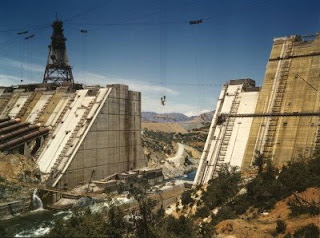
This is Shasta Dam under construction in 1942:

It remains a key part not just of the state of California’s overall water storage and provision system, but was crucial to the Redding economy during the 1930s and in the years since.

It was also a Depression-era project. Built at a time when California barely had enough money to balance its own budget. In 1933 California passed a bond measure allowing money to be spent on the dam – $170 million, a significant sum in those days. By 1935 California had secured federal funds to help begin construction on the dam. The jobs created by the dam project and the long-term value of the Central Valley Project were considerable. Redding got badly needed jobs as well as flood control. California got jobs and a base for long-term agriculture, an industry that remains significant to this day in Redding.

Had California rejected the 1933 Shasta Dam bond, chances are the dam would not have been built for a decade or two. Redding would have lost out on those crucial jobs in the depths of the Depression and California agriculture might not have had the stable water source it needed to be productive for these last 70 years.

We can go on. The Golden Gate Bridge funding fell through after the 1929 stock market crash – so voters in the North Coast counties that comprise the Golden Gate Bridge District had to approve bonds, which they did in November 1930. Similar bonds had to be sold for the San Francisco-Oakland Bay Bridge, also in the depths of the Depression. The two bridge projects not only provided jobs when they were desperately needed but enabled massive economic growth in the Bay Area after World War II.

The argument that we cannot build high speed rail because of the economic crisis or credit crunch simply doesn’t hold water. The economic downturn is an argument FOR high speed rail. Worse, the Redding Record-Searchlight’s reasons for not supporting Prop 1A make little sense:

An alluring investment in 21st-century transportation for a growing state? Yes. It’s also $10 billion that California doesn’t have.

Of course California doesn’t have $10 billion – which is why we’re going to borrow it. The state’s nonpartisan Legislative Analyst has determined we actually can afford Prop 1A. Repayment lasts over a 40-year term. The jobs, tax revenue and economic activity created by high speed rail combined with the savings on oil consumption and carbon emissions are likely to outweigh the annual debt service cost.

If it were up to HSR deniers like the Redding Record-Searchlight we’d still be in the Depression. We wouldn’t have the dams and bridges that made our late 20th century prosperity possible. And if we follow their advice we will have a hard time getting out of whatever we’re going to call this economic crisis.

T Boone Recommits to His Own Bailout

Capitol Alert reports that T. Boone Pickens, who has been pushing his own bailout plan, Prop 10, is sinking another $4 million to the Yes on 10 campaign:

T. Boone Pickens, the billionaire Texas oil tycoon behind Proposition 10, has doubled down on the alternative energy bond, plunging another $4 million into the measure through his company Clean Energy Fuels Corp.

Pickens’ company was already the largest financier of the ballot measure, having given $3.75 million to the campaign. The measure would provide $5 billion in rebates to help promote natural gas vehicles, the types of vehicles that could be Pickens’ company’s customers.

The rebates would be paid for through a general obligation bond, repaid by the state over 30 years.

Just as Goldman Sachs is using the US Treasury to bail itself and its allies out (h/t to jsw), T Boone is seeking to raid an already-stressed California budget to help boost his natural gas business. We’re already – and rightly – going to commit $10 billion in bond funds to Prop 1A, and even that is touch-and-go given public unease at the budget crisis and credit crunch. California cannot afford to give a handout to Oklahoma oil billionaires – we need to give that money to in-state, long-term, sustainable projects like high speed rail.