All posts by Robert Cruickshank

Big Public Support for High Speed Rail – Prop 1

Crossposted from my high speed rail blog

Recent polling data from J. Moore Methods (hat tip to Californians for High Speed Trains) shows a significant amount of public support for Proposition 1.

Q: “Would you support or oppose a statewide $10 billion dollar bond measure to build a high-speed train system linking the major population centers in Southern California with the Central Valley and the Bay Area?”

July 2008: 58% support, 33% oppose, 9% no opinion

May 2008: 53-36-11

Feb. 2008: 54-39-7

Nov. 2007: 52-42-6

That’s big movement in just the last two months. And that’s after the non-issue of the Union Pacific right-of-way letter emerged. And despite the state budget deficit, support has merely grown over the last eight months.

What’s responsible? Gas prices, obviously. As the price of oil rises, and as it dawns on Californians that this is a permanent, long-term shift, they understand instinctively the value of high speed rail. Don’t believe me? Let’s see the numbers:

Voters’ top reasons to support the High Speed Train bond are as follows:

-Providing a safe, affordable transportation alternative (77%),

-Reducing dependence on foreign oil (74%),

-Reducing traffic congestion (69%).

It’s a shame that even though Californians understand the value of high speed rail, Senate Republicans are still trying to kill the project after six years of delay. AB 3034 isn’t necessary to the passage of Proposition 1, which is a sound proposal – but the details of AB 3034 would only make a good plan that much better. Republicans had years to propose changes and improvements, but they suspiciously waited until the 11th hour to raise the objections and try and derail AB 3034. The usual right-wing suspects are ecstatic at this but as the poll numbers above suggest, they are once again swimming against the tide of California public opinion.

Senate Republicans and wingnut editorialists aren’t offering Californians ANY solution to high gas prices. None at all. High speed rail IS a solution. It’s not the only one, not by a longshot. But it would be very helpful to our state. We’ve delayed long enough. We’re going to the voters this November one way or the other, with Prop 1 as-is or with an AB 3034-enhanced plan. Either way, we are going to win.

Republicans Trying to Kill High Speed Rail

Crossposted from my high speed rail blog

AB 3034, a bill which would have made improvements to Proposition 1 (the high speed rail bond), is being held up by Senate Republicans who are using last-minute objections to cover their opposition to the entire project. Just as Republicans are using the 2/3 rule to hold the state budget hostage they are doing the same with AB 3034, which requires a 2/3 vote to pass.

But whereas we have to have a budget sometime, there is no commitment from Republicans to build high speed rail. They still believe, against all available evidence, that an oil-based transportation system is workable. Their real solution to gas prices and the airline crisis is more drilling, not more rail. They continue to believe global warming is a hoax and are willfully blind to the positive economic impact of high speed rail.

Their objections are transparently ridiculous. They’re last-minute concerns that serve as the ostensible purpose fronting their real desire – killing high speed rail.

The Riverside Press-Enterprise reports that TODAY is the printing deadline for the November ballot and that there might be some sort of “supplemental ballot” with a revised Prop 1 while the original Prop 1 would remain on the ballot. Sorry folks, that’s not remotely workable.

The article goes on to detail some of the Republican objections:

Republicans said the bond should be postponed again. Not only does the state face an estimated $15.2 billion shortfall, they said, but there still are questions about the high-speed program’s business plan.

State Sen. Dennis Hollingsworth, R-Murrieta, said the bond measure should be delayed because “it’s not fully cooked yet.”

State Sen. Bob Dutton, R-Rancho Cucamonga, also opposes the bond. The proposed amendments were too little, too late, he said.

These folks have never been strong supporters of the HSR bond. Hollingsworth has been talking down HSR since at least 2007. Dutton is trying to have it both ways, as was Roy Ashburn – they claim the measure needs revisions, but they then vote against the revisions. It’s absurd. If they were truly supportive of the project they’d have backed AB 3034 and wouldn’t be delaying it like this. Obviously their goal is to kill the bond without having overtly done so.

The Sacramento Bee has more details on the “oversight” concern – Ashburn wants to shut down the Authority and replace it with a Department of Rail. Perhaps it’s a good idea, perhaps it’s not. But it’s an 11th-hour objection that should have been raised earlier. Cathleen Galgiani noted that AB 3034 would have strengthened oversight of the Authority and limited their ability to spend money on themselves. Further changes could certainly be made over time.

More below…

It seems to me that Republicans are using niggling objections as an excuse to kill the bill and, therefore, to try and kill the project outright. Republican politicians believe that things like oil drilling are preferable to providing the sort of sustainable transportation that California needs to remain competitive in the 21st century. We can win the Prop 1 vote without AB 3034 – but AB 3034 would have made it easier.

It is a shame that Sacramento Republicans preferred to kill the bill and try and kill the entire project rather than have worked with the bill’s sponsors and supporters from an earlier date to seek changes everybody can live with.

I have also heard that Abel Maldonado, my own State Senator and a moderate Republican whose vote is crucial if AB 3034 is to meet the 2/3 requirement, has voiced concerns that there isn’t much for his district in this bill. That’s nonsense. He has probably forgotten that his Central Coast district includes southern Santa Clara County, which will benefit immensely from high speed rail as San José and Gilroy (just outside his district but close to Morgan Hill and San Martin which ARE in the 15th) will both have stations. Additionally, residents in the Monterey and Santa Cruz County portions of his district will have much faster travel options for getting to the rest of the state, particularly Southern California, and vice-versa – always an important consideration for our tourism-dependent economies. The $1 billion for non-HSR projects will also benefit the 15th district, helping fund the Coast Daylight service from SF to LA via Salinas and San Luis Obispo, potentially helping improve service on the Pacific Surfliners, and helping Santa Cruz and Monterey with our own local rail projects.

We can also look to other Senate Republicans who would be acting against their constituents’ interests in blocking AB 3034. We already explained how Ashburn would be letting down his Bakersfield constituents; the same would be true of Jeff Denham – residents in Merced in particular would see dramatic economic benefits from the HSR station that will be located in their community, and the bill would get Modesto one step closer to a station of their own. Dave Cogdill, Senate Minority Leader, also has constituents who would see major benefits, particularly in Fresno. The same holds true for Dick Ackerman, from Fullerton, and Tom Harman who represents Irvine. Surely they wish to bring economic opportunity, affordable transportation, and development opportunities to their residents.

On my blog on Sunday I quoted a Japanese railroad executive who explained that high speed rail was a strategic necessity for industrialized nations in the 21st century. California cannot hope to be globally competitive without it – as nations like France and Spain, China and Argentina, even Morocco and Iran turn to it to provide affordable and sustainable transportation, California’s elected representatives are unable to get beyond minor issues and unite for high speed rail.

It is a sad commentary on the near-total lack of leadership on environmental and sustainability issues in California. The Legislature fiddles while the state burns, literally and figuratively.

Arnold Bashes Reagan and McCain

Our governor was on This Week this morning and as Arnold has a largely undeserved reputation for being an environmentalist George Stephanopoulos decided to ask him some questions on that topic. The answers were quite revealing, and should give Obama a major opening to attack McCain should he be interested in doing so.

ABC doesn’t yet have a transcript up, so I’m borrowing from John Campanelli’s transcription. First up, he destroys McCain on oil drilling:

Arnold: I have no interest in off-shore drilling off California. People can do it wherever they want…[McCain] can give us the rights to drill offshore but we will say “No thanks, we will not drill because we want to protect our coasts.

Stephanopoulos: That’s more important than bringing down the price of gas, bringing down the price of oil?

Arnold: First of all, let me tell you, anyone who tells you drilling, nuclear power, alternative fuel, fuel cells will bring down the price right now is pulling wool over your eyes because we know that will all take at least 10 years.

Which is of course the point I made when this drilling nonsense first emerged. Offshore drilling will line oil company pockets and contribute absolutely nothing to the easing of gas prices. The “wool over your eyes” comment is priceless – let’s hope the Obama campaign replays that quote often in the days and weeks to come.

Arnold took the opportunity to go further in explaining the need for a sustainable energy policy, praising Jimmy Carter’s approach:

Arnold: But it doesn’t mean we shouldn’t do those things. The problem in America is not that we don’t have ideas. It’s that we aren’t consistent. Jimmy Carter in the late ’70s came in with a great energy policy. He talked about (couldn’t make this out), tax credits for people investing in windmills, and all those things. And then President Reagan came in and scrapped the whole thing because oil prices came down and said it didn’t make sense financially. Well, many countries all over the world  stayed with the program even though oil prices came down. In Germany, with solar, they’ve been working on it for 30 years and they are number one in solar. I think that is what we need to do. We need to stay the course. We got to go and stay, “Here’s the plan: here’s how we get energy independent. We need renewables, we need nuclear power, we need alternative fuels. All of those kind of things. Let’s do research. Let’s never go off course, no matter who the administration is or no matter what the oil prices. Let’s stay on course. That’s the big problem in America.

It’s a great set of points he makes – Carter’s energy policy was smart, but Reagan came to power and promised America a painless return to the cheap oil days of the 1950s and led a conservative attack on sustainable energy and transportation alternatives. America certainly would have been better off had we continued with the late 1970s energy policy instead of abandoning it for cheap political gain.

Stephanopoulos went on to ask Arnold if he’d serve in an Obama cabinet, Arnold said he won’t rule it out. That may be the main media takeaway from the interview, but the more important statements were those quoted above. Arnold does recognize the need for a more sensible energy policy and also admits that McCain isn’t on board with it – instead McCain prefers to continue the failed policies of Reagan and Bush, policies that have caused gas prices to soar and thrown our economy into recession.

Of course we need to not go too far here. Arnold’s own record on energy and the environment is not good. His water bond proposal would ruin the Delta and spend $9 billion on wasteful and damaging dams. He greenwashed himself with AB 32, but continues to target public transportation for crippling cuts. He has endorsed Proposition 1 on high speed rail but hasn’t taken a leading role in campaigning for it. He could help implement a wind and solar strategy in California, along the lines of what Proposition 7 proposes, but prefers to remain silent on the matter.

So ultimately his appearance on This Week is more of the usual environmental grandstanding we’ve come to know and love from our governor. But this time it has political value for Democrats and Obama in particular, who would be smart to exploit these comments for all they’re worth. It would be a good way for Obama in particular to start flipping the script and generating his own news for a change.

In Depth on the Democrats’ Budget Solution

(I added the Speaker’s Web report on the budget. There’s some good information in there. – promoted by Brian Leubitz)

I will be on KRXA 540 at 8 tomorrow morning to discuss this and other California political topics

I’ve been looking over the Democrats’ budget proposal and the more I see it, the more I really like it. It’s a testament to the leadership of Speaker Karen Bass and of Assembly budget wizard John Laird (not his official title but it might as well be) that they put together such a good plan. Of course it will be a starting point for future negotiations, but Californians should rally behind this plan, which provides for the public services this state needs to survive a tough economy without hurting working Californians with a tax increase.

The plan is smart, fair, and above all progressive. It would reverse the trend toward regressive taxation in California by finally making the wealthy pay their fair share. Just as Bush’s tax cuts have blown a hole in the federal budget, so too have the McClintock Republican tax cuts done the same to ours.

The first thing to understand is that, as Speaker Bass explained on a conference call earlier today, that we already have cut the budget. Over the last 3 years some $15 billion in cuts have been made, particularly back in February. We will hear the usual “more cuts!!!” from Republicans – but there really is nothing left to cut. We’ve cut fat, we’ve cut muscle, we’ve cut bone. We’re reduced to sucking out the marrow and leaving a bare rickety skeleton.

Second, the tax increases – some of which are temporary, some of which are permanent – are not designed to be the final solution to the structural revenue shortfall. Speaker Bass made a good point that while the income tax increase is permanent, it can and perhaps should be changed when the tax reform commission unveils its proposals next year.

Third, the increases will hardly hurt the economy. Many of these tools were used in 1991-92 with the severe budget crisis at that time and they did not prevent the state economy from going into recovery by 1993-94. Of course we need to get away from the notion that tax increases by themselves hurt economic growth – firing teachers, cutting public transportation, and closing hospitals are really what produce severe and lasting damage.

That all in mind I discuss the specific plans over the flip.

Going off the SacBee summary:

New income tax brackets

Revenue generated: $5.6 billion

Reinstates 10 percent and 11 percent tax brackets for wealthiest Californians. Income tax rates range in California from 1 percent to 9.3 percent. The new proposal would raise the rate to 10 percent for “taxpayers filing joint returns with taxable income above $321,000 and 11 percent for those with incomes above $642,000.”

This title from the Bee is misleading – the brackets are NOT new. They were created in 1991 and then recklessly cut in 1998 when Tom McClintock insisted on new tax cuts at the height of the dot-com bubble. This tax would be permanent but, as Speaker Bass noted, these wealthy individuals can deduct that amount on their federal income tax return. It’s a wash for them an a boon to the state.

In any event this revenue solution is smart, fair, and desperately needed. Even if the other proposals are abandoned, this one should stay.

Suspend “net operating losses” for corporations

Revenue generated: $1.1 billion

For three years, big business would lose its “net operating loss” deduction. That allows companies to carry forward losses from one year to the next and use them as a deduction in taxes.

This would only apply to businesses making over $5 million in profit, protecting small and medium businesses. Again it is a progressive solution that pushes the tax burden onto the rich to benefit the masses.

Suspend inflation indexing of state income tax brackets

Revenue generated: $815 million

This plan would suspend the adjustment of income tax brackets for inflation. As a result, Democrats say, a single filer with a taxable income of $50,000 a year would pay $34 more, while a taxpayer with income exceeding $97,000 would pay about $180 more.

$34 per person is a very small price to pay. Especially considering that wages are not rising much due to this current inflation – indexing of tax brackets was done in the 1970s in response to the “bracket creep” that stagflation produced.

Eliminate dependent credit for those with incomes above $150,000

Revenue generated: $215 million

The dependent tax credit was $294 last year. The LAO proposed lowering the credit to $94 — the amount of the individual exemption. The legislative Democrats have proposed lowering the tax credit for those taxpayers with adjusted gross income above $150,000.

This is a necessary tax loophole closure, but it is right to protect those middle-income families who have children.

Raising the franchise tax

Revenue generated: $470 million

The top tax rate for corporations is currently 8.84 percent. The proposal returns the tax rate to 9.3 percent, where it was in 1997.

This will finally undo one of McClintock’s reckless 1998 tax cuts that blew a hole in the state budget during the temporary dot-com boom. Republicans cut taxes during the flush times, not leaving Californians with enough during the hard times.

Steps up tax enforcement

Revenue generated: $1.5 billion

This is a plan to collect taxes already owed to the state, to be “modeled after successful tax amnesty efforts in the past,” according to legislative Democrats. They said some of the $1.5 billion in revenue “will be an acceleration of revenues that would be paid in the future.”

A no-brainer.

All in all these are smart and fair solutions that will protect vital state programs and services from radical Republican slashing. We cannot afford more cuts, but we CAN afford new revenues.

Dems’ Income Tax Budget Solution

Sacramento Democrats have unveiled their core tax proposals, and they involve raising $9.7 billion in taxes from the wealthy and from corporations, according to the LA Times:

Most of the new revenue would come from an income tax hike.

A dependent-care credit currently available to all Californians also would be eliminated for families with an income of more than $150,000….

Income taxes on families earning more than $321,000 would go up by 7.5%. Joint filers earning more than $642,000 would see an 18% hike.

The proposal also includes an amnesty intended to entice tax cheats to pay up, the suspension of various tax breaks for corporations and the restoration of a franchise tax on businesses.

These are good moves to deal with the structural  revenue shortfall, especially the closure of tax giveaways that the wealthy do not deserve and do not need. Progressive taxation is exactly what Democrats must stand for and so this is a welcome proposal.

Of course the Yacht Party plans to fight this to death:

Assembly Budget Committee Vice Chairman Roger Niello (R-Fair Oaks) said Republicans are “categorically opposed” to the broad-based tax hikes and predicted they would be defeated in floor votes….

Schwarzenegger spokesman Aaron McLear said that although the governor is opposed to tax increases, he is pleased to see the budget process moving forward.

But this is very smart politics from Democrats. It matches the proposals of Barack Obama and Congressional Democrats, who both plan to raise taxes on the wealthy to pay for new spending and budget balancing, presenting a united front. It puts the Republicans back on their heels here in CA, especially in advance of the fall elections, where Democrats ought to beat Republicans over the head on the budget. “Republicans want to close schools to give the wealthy a tax break” – that is excellent framing given the public mood.

There are signs that Dems are beginning to be smarter about how they defend these proposals:

Democrats defended the tax increases as consistent with action the state has taken in the past.

They noted that raising the tax paid by high earners from the current top rate of 9.3% of income to as much as 11% is exactly what the state did during the budget crisis of the mid-1990s, when Pete Wilson was governor.

“These are really just rolling back tax cuts that have been made,” said Senate Budget Committee Chairwoman Denise Moreno Ducheny (D-San Diego).

Both points are right on. The tax solutions of the early 1990s not only helped close the budget deficit but helped California become poised for the broad economic growth we experienced in the 1990s. Contrary to Republican claims those taxes didn’t induce a flight of the wealthy or of jobs.

Ducheny is also smart to point out that these were tax giveaways – many of them made during the dot com boom when Republicans recklessly demanded wasteful spending, in the form of tax cuts, during a temporary spike in tax receipts.

It’s not clear where this plan is headed. Personally I think it took Dems a little too long to come out with these proposals, and I always worry that they’ll quickly abandon them in order to cut a bad deal with Republicans.

Democrats need to understand they are in the driver’s seat on the budget this year – the 2/3 rule certainly makes things extremely difficult, but on the politics alone, Democrats should have the edge. If they aggressively pursue this tax plan in public, as part of a broad strategy to undermine Republicans, they should reap the rewards.

The Collapse of Federal Firefighting

As my recent diaries have shown there is a shortage of firefighters to meet the unprecedented amount of fires burning across our state. As I began digging into this yesterday I came across the same report highlighted in today’s Monterey Herald – that US Forest Service firefighting efforts have been cut to the bone and left the nation vulnerable to massive fires. Deliberate staffing shortages have left the USFS unable to do vital off-season brush clearance, and left them without the staffing to get a quick jump on fires in their crucial initial stages.

The federal firefighting system is “imploding” in California, due to poor spending decisions and high job vacancy rates, as the region struggles to keep pace with what looks to be a historic fire season, a firefighters’ advocacy group charges.

As a result, the firefighters say, small fires have exploded into extended, multimillion-dollar conflagrations because the U.S. Forest Service has been unable to contain them during the early “initial attack” stage…

As the “sheer number” of California wildfires pushed the nation to its worst measurable level of wildland-fire preparedness last week – Level 5 – a national multiagency coordinating group announced in a memo Monday that firefighter staffing levels in Northern California “cannot be maintained.”

The report, by the FWFSA, has been around for a few months now. Wildland firefighters have been screaming about the issue to anyone who would listen, including Dianne Feinstein:

After facing pressure from California Sen. Dianne Feinstein and other lawmakers last spring, the Forest Service promised it would immediately fill its vacancies and launched a “Fire Hire” campaign to attract firefighters in Sacramento that concluded two weeks ago.

“I believe the agency should have been able to muster a stronger force,” Feinstein said. “All signs indicate that things will only get worse.”

Feinstein said that despite promises of full staffing from [USFS Administrator Mark] Rey, only 186 of the agency’s 276 engines were manned at the start of the 2008 fire season.

Ron Thatcher, president of the union that represents 20,000 Forest Service employees, has estimated that attrition has left the service at 70 percent to 80 percent of its authorized staffing levels, and that up to 39 percent of fire crew leader positions were vacant as the 2008 fire season kicked off.

Rey, Bush’s USFS administrator, has a long background in the timber industry. He blames environmentalists for the problems, but firefighters and those who know the issue are having none of it.

The problem, as the report and the article make clear, is that the USFS is not making an aggressive effort to recruit new hires during the offseason, and particularly their pay is low. The average USFS firefighter makes $56,000 a year whereas Cal Fire averages $64,000 a year. Further, Cal Fire offers better benefits than the USFS, which has resorted to absurd penny pinching to oversee its budget:

Another issue that firefighters say may come back to bite the region is a brand-new budgetary program – called “accountable cost management”- that was just introduced throughout the Forest Service. Judd said it should have been initiated well before the 2008 fire season started….

“The Indians Fire commander had no clue about this program, and they’re looking at (cutting) the least expensive resources. The bean counters are looking at these folks and basically timing them as to how long they spend on dinner. Accountable cost management is you’re looking at minutiae and ignoring the real costs,” Judd said.

The Herald article does not explain what the underlying reason is, but the FWFSA and its members aren’t shy about calling it out – privatization:

I recently had the opportunity to sit and chat with an old friend of mine who is an SFR2 with CALFIRE. He is no stranger to interagency response and the inherent problems that sometimes arise. We got on the subject of the USFS retention issue and he shed some light that I thought was interesting. In his dealings with the R-5 admin’s, the common thread, vocally expressed behind office doors, is that upper level USFS is purposefully and intentionally “gutting” the agency. The Washington folks are being pressured to eliminate the “fire” responsibility from the USFS and cover it up with budget cuts and the “we are fine” statements. There are plans in the works for a general privatization in R-5 in the near future.

According to him, CALFIRE is not happy to be in a position to accommodate any private contractors that will come along should there be a hardcore failure of the USFS, nor are they prepared to assume responsibility for the expanded response area that would be created. Sound’s like CATCH 22 to me.

Color me shocked. Bush is trying to destroy a government agency in order to turn it over to private contractors. As I explained last fall, destroying public firefighting and leaving folks to fend for themselves on the private market is a core conservative goal. Private military contractors rightly scare us, but private firefighting should be even more frightening – what incentive would they have to protect the homes of the poor?

The immediate effect of the intentional gutting of federal firefighting, however, is fires that burn hotter, larger, and longer. And in the absence of sufficient firefighting resources, some individuals take matters into their own hands, as with the family that set their own backfires in Big Sur over the weekend. In Mendocino County and other parts of our state volunteers are trying to pick up the slack but as hard as they work there’s no way volunteers can be a long-term substitute for professional full-time firefighters.

The situation is about to get worse in California. Many of the firefighters in our state are on loan from other states, especially USFS staffs from other Western states. They are due to be rotated out soon, and aren’t likely to return, as the fire season across the West is about to begin in earnest.

Here in California we face another problem: conservatives who oppose new firefighting revenues, preferring to close schools and hospitals to provide enough firefighters. We’re being squeezed between those California conservatives and the conservatives and timber interests in the federal government that have destroyed the USFS’ firefighting capacity.

We are in for a long, hot, destructive summer. Unless we beat back conservative anti-government philosophies and begin restoring federal firefighting to its past staffing levels, more homes will be destroyed, more lives ruined.

The End of Suburbia – As We Know It

Center-right urban theorist Joel Kotkin has an op-ed in today’s LA Times arguing that “Suburbia’s not dead yet.” Of course it’s not, and nobody has said it is. But suburbia as we know it – characterized by car-dependent urban sprawl – surely is vanishing. Kotkin argues that our future isn’t going to involve everyone living in high-rise condos and though I would agree there, his notion that SoCal suburbia as it currently exists is not going to undergo significant change is a deep misreading of reality. Suburbs will continue to exist, but the line between urb and suburb, between dense city and low-density periphery, will be obliterated.

Kotkin’s article starts off trying to claim that the suburban status quo is just fine:

Yes, high gas prices and rising sub-prime mortgage defaults are hurting some suburban communities, particularly newly built ones on the periphery. But the suburbs remain home to a majority of Americans and a larger proportion of U.S. families — and people aren’t leaving those communities in droves to live in cities. Even with economic growth slowing, many suburbs, exurbs and smaller towns, especially those whose economies are tied to energy, are continuing to do better than most cities in terms of job creation and population growth.

Of course, with politicians like Zev Yaroslavsky blocking urban density in LA it’s not exactly easy to find affordable places to live in the city centers. Most Southern Californians still live in suburbs because they can’t afford anything else. Kotkin takes a market failure, a class stratification, and reads it as some kind of free choice.

And the notion that the suburbs are doing better than the cities is simply wrong. Last month the New York Times demonstrated that home values are falling faster in the suburbs than in the city centers. Office parks are experiencing high vacancy rates, especially in ’00s suburbs like Elk Grove.

But being wrong doesn’t stop Kotkin. More below…

Contrary to pundits’ forecasts, during this decade of high energy prices, the country’s urban populations, for only the first time in recent history, actually fell, according to a census analysis by economist Jordan Rappaport at the Federal Reserve Bank of Kansas City.

This stat has several flaws. First, from 2000 to 2006 the suburban model still seemed viable in many metro areas. $3 gas was the tipping point – when gas prices hit that mark for a sustained period in 2006, the housing bubble burst. When this decade is finished in December 2009, the stats from the last half will look rather different from the first half.

Kotkin’s entire argument rests on numbers like these, and he digs his hole deeper:

Nevertheless, since 2003, when gas prices began their climb, suburban population growth has continued to outstrip that of the central cities, with about 90% of all metropolitan growth occurring in suburban communities, according to the 2000 to 2006 census. And the most recent statistics from the annual American Community Survey, which is conducted by the U.S. Census Bureau, show no sign of a significant shift of the population to urban counties, at least through 2007.

Again, this periodization almost totally misses the rapid collapse of the newest suburbs. Yes, a lot of growth occurred there from 2000 to 2006 – and by mid-2008 much of it has been given back. Here again his argument is shot down by recent events.

The flat condominium markets in most large urban markets are another sign that people are not streaming into cities from the suburbs and buying. Many condo projects in such cities as Los Angeles, Chicago, Miami and San Diego have either been canceled or converted into rentals, with many units remaining vacant. As a Southern California condo developer told me recently, lower house prices are not going to make people more disposed to buying apartments.

The flat condo markets are a direct casualty of the housing bubble bursting and particularly of the credit crunch. Condos saw spectacular price appreciation in those cities, overshooting what was normal and reasonable. Of course, people shouldn’t have to buy apartments – in a post-peak credit era, long-term rents or other arrangements can substitute for the high costs of ownership. In any case, the market for urban density is there and will continue to exist as long as prices are affordable and wage levels are supported.

But the biggest reason the suburb-to-city narrative is not following the script of the urban boosters and theorists has to do with employment. Living close to your workplace makes sense, not only because it cuts commuting costs and reduces greenhouse-gas emissions — by saving time, it also gives people more time for family and leisure activities.

The problem for many cities is that they lack the jobs for people to move close to. Since the 1970s, the suburbs have been the home for most high-tech jobs and now the majority of office space. By 2000, only 22% of people worked within three miles of a city center in the nation’s 100 largest metro areas.And from 2001 to 2006, job growth in suburbia expanded at six times the rate of that in urban cores, according to an analysis of Bureau of Labor Statistics by the Praxis Strategy Group, a consulting firm with which I work.

This is a real issue. Living in Monterey, where most of the jobs I want are in the Bay Area, a 1-2 hour commute each way, it bites especially hard. It is true in Southern California as well.

But Kotkin assumes that this pattern will continue to exist. It won’t, because the cheap oil that enabled it is gone. Again he relies on 2000-06 as the era that supposedly proves his point, despite the unraveling of that era.

Suburban office parks are a classic example of massive waste. As long as oil was cheap that waste was hidden or not relevant. But expensive oil means the waste of sprawling office parks with too many parking spaces far from nodes of housing, shopping and transit now presents immediate and unavoidable costs. Urban office vacancy rates are rising, but not nearly as fast as suburban vacancy rates. Jobs will start relocating to more dense areas even of the SoCal megalopolis. Kotkin is nuts to assume that the pre-2007 patterns will continue for much longer.

A desire to live closer to their jobs doesn’t mean that people have to move to the inner core, particularly if that’s not where the jobs are. Of the 20 leading job centers in Southern California by ZIP Code, none are downtown. The central core does remain an important job center, but it accounts for barely 3% of regional employment. Among those who work downtown, some may shift from cars to public transit, although many will simply buy a more fuel-efficient car and stay put in the suburbs.

For residents who live in suburban areas with large concentrations of employment — Burbank, Ontario and West L.A. — commutes to work can be shorter than those experienced by their inner-city counterparts, according to Ali Modarres, a professor of geography at Cal State Los Angeles. Commutes in these communities, on average, are less than 25 minutes, while in high-density areas, such as Pico-Union, they average 35 minutes.

Kotkin initially argues that SoCal urban density is to judged solely by downtown LA, a model that doesn’t fit SoCal realities – as he then acknowledges in his next paragraph. Forgive my skepticism.

Burbank and West LA are not suburban in the way Ontario is – and as the Ontario tent city demonstrated, Ontario isn’t exactly a great example to use to prove suburban robustness. Burbank, West LA, Pico-Union, Santa Monica, Sherman Oaks, Long Beach, and Santa Ana are perfect examples of how dense nodes are the key to SoCal’s future.

The suburb-to-the-city narrative faces other obstacles. By the early part of the next decade, the large millennial generation born since the early 1980s will begin to form families, and they will, as have previous generations, probably seek open space and good schools for their children — and that means they will settle in the suburbs. And there is no census evidence suggesting that immigrants have reversed their decade-old pattern of moving to the suburbs.

This is perhaps the most ridiculous and unsupported part of Kotkin’s op-ed. He’s basically arguing that Californians like the suburban lifestyle and that we Millennials are going to choose it, as if only the suburbs will provide open space and good schools. Most Millennials in California aren’t able to afford to buy a home at all, and likely never will at current rates. Those who have started families have begun gravitating toward city centers or dense nodes, where housing can be found that is near transportation and that doesn’t require a lot of driving.

Kotkin assumes that we can still afford sprawl, when it is clear we cannot. Millennials have experienced a generation of inequality so it’s not clear how exactly they’re going to afford to live in sprawling suburbs, if any continue to exist. The millennial future is a dense future.

Continuing high energy prices will likely change the nation’s geography, but not in ways some urban theorists are predicting. Rather than cramming more people and families into cities, they may instead foster a more dispersed, diverse archipelago of self-sufficient communities. From here, that looks like a far more pleasant scenario not only for suburban and exurbanites but for urban dwellers who don’t want to live under dense conditions reminiscent of 19th century industrial cities or the teeming metropolises of the contemporary Third World.

This is pretty much a fantasy unmoored from reality. California suburbs are difficult to make self-sufficient, as SoCal long ago paved over its highly productive farmland and overshot its water capacity decades back.

However, the basic concept that suburbs won’t vanish is correct. What will happen is that they will grow less dense as they are adapted for the 21st century. Rather than trying in vain to defend the 20th century, as Kotkin attempts, the answer instead is to retrofit suburbia. Encourage the construction of light rail, solar and wind power, bicycle facilities, and urban gardening. In some of the pre-1980 suburbs this is not going to be as difficult as it might initially seem.

The classic city centers of SF, Oakland, and LA have a vibrant future. But so do “suburbs” like Santa Ana. In fact, it’s my belief that Santa Ana has one of the brightest futures of any city in SoCal. It sits at the center of Orange County, close to job centers and at the node of the transit network that does exist in the county. An Orange County mass transit system would use Santa Ana as its centerpiece, and the existing concentration of government and financial buildings can be a magnet bringing more jobs to the area.

But all of that requires significant public investment and government action – which Kotkin opposes. He instead things suburbs will somehow naturally evolve into a happy land of sustainable societies. Without government action, the more likely outcome really is the kind of class stratification we see in a place like Brazil – and are already beginning to see here in California.

California’s Fires and Katrina’s Legacy

As David Dayen notes in the story just below this one, fires continue to burn across California, with the massive blazes in Goleta and Big Sur getting the focus of the state’s attention. And as he and other outlets have mentioned, California’s firefighting capacities have been strained beyond their limits.

More and more residents, especially in Big Sur, have noticed just how many fewer firefighters there seem to be for this blaze, as compared to previous fires in the area. As conservative demands for low taxes and budget cuts have helped slash available fire protection, residents in Big Sur increasingly feel they are on their own, though they appreciate the fire protection they have received. The legacy of Hurricane Katrina – when nobody came to help New Orleans – has led some residents to refuse to evacuate out of a belief that if they don’t protect their homes, nobody will.

It’s a frustrating and sometimes chaotic situation that is the direct product of conservative attacks on basic government services – they want people to fend for themselves, and often that is extremely difficult to do.

One of the most high profile Big Sur residents who has stayed behind to protect his property is Kirk Gafill, whose family opened the famous Nepenthe restaurant in 1949. As he and his employees stayed behind to put out burning embers themselves, he explained to a reporter why he stayed:

“We know fire officials don’t have the manpower to secure our properties,” Gafill said. “There are a lot of people in this community not following evacuation orders. Based on what we saw during Katrina and other disasters, we know we can only rely on ourselves and our neighbors.”

Such do-it-yourself firefighting led one Big Sur resident to be arrested for setting his own backfires. Another resident defended that person’s actions on the Ventana Wilderness Society’s forums, one of the main sources of community information on the fire:

We have been working on defending Apple Pie from this fire day and night since it started. We watched it grow over the coast ridge, down to the Big Sur River and up over Post Summit. The gov was not going to help defend the ranch even when our homes were about to burn. We didn’t think they would either. But they didn’t have any problem sending someone to arrest us. Our comminity just can’t accept actions like this. If we didn’t do what we did the ranch would be nothing but ashes. I say thank you to everyone who helped us and a thank you for all the firefighters, and pilots who TRIED to stop it from crossing the firebreaks to our homes.

Setting one’s own backfires is a desperate and even reckless act – but those who do not believe their government will or wants to help them are likely to resort to desperate measures.

Meanwhile California does not have enough money saved for firefighting efforts. Almost every year for the last ten years California has had to dip into reserves to pay for firefighting, but this year the SF Chronicle reports the gap is much wider:

But in the just-completed fiscal year, there was a big gap between the actual cost of firefighting and the budgeted amount. The state had set aside just $82 million for such emergencies, forcing it to spend more than $310 million from the state’s general fund cash reserves of $858 million.

California will have to continue dipping into its reserves until the Legislature and the governor approve a new budget for the fiscal year that began Tuesday…

But Assembly Republican Rick Keene from Chico said he opposes the fee proposal, arguing that fire protection is a basic service that the state should cover in its current budget.

“It’s something that our government system is already supposed to be paying for and we’re asking taxpayers to pay for it?” he said. “We’re hoping that our Democratic friends would just stop ringing the bell of raising taxes, raising taxes and raising taxes.”

And so California comes full circle. Hurricane Katrina became such a human catastrophe because conservative budget and spending cuts left New Orleans residents without adequate protection and aid. Californians in places like Big Sur, mindful of that experience and aware that firefighting is currently understaffed, are making increasingly risky efforts to try and protect themselves. Efforts to provide funding for adequate fire protection are opposed by conservatives who prioritize tax cuts over fire protection and who think schools and hospitals should be closed instead to pay for it.

California firefighting has already been badly neglected by decades of conservatism. It’s time we rebuilt our public services so that individuals do not feel the need to risk their lives to defend their property – at least not in these numbers.

Feds Say California’s Fires Aren’t a Disaster

The numbers are staggering – 1,400 wildfires burning around the state. Over 70 homes destroyed and 7,800 under threat. President Bush has declared the fires a federal emergency and released $50 million in federal aid, announced by FEMA administrator David Paulison – surely a sign that the feds are fully engaged in the fire aid effort, right?

Not so fast. There is a difference between an “emergency,” which frees up something like the $50 million in firefighting funds, and a “federal disaster” declaration, which frees up the full range of FEMA assistance to fire victims, including relocation shelters and financial assistance.

According to the Monterey Herald the federal government has refused to declare the California fires a disaster:

But assistance from FEMA for fire victims has not been approved because the fires have not been declared a federal disaster.

Paulison said a preliminary damage evaluation will be done to determine if more declarations are needed.

Rep. Sam Farr, D-Carmel, said he was told it does not appear California’s wildfires qualify as a federal disaster because the level of destruction has not been great enough.

It’s conservative government in action – the stingy nature of FEMA assistance that was revealed to the world during Hurricane Katrina continues to dominate the Bush Administration’s approach to disaster relief. As a Daily Kos diarist has explained FEMA is screwing around with Midwest flood disaster relief and of course, FEMA’s initial reaction to last fall’s fires here in California was to host a news conference where its employees posed as actual reporters and lobbed softball questions at FEMA administrators.

California’s fire season is going to be long and difficult. As the Big Sur and Goleta fires show, a rapid response by firefighters is necessary to saving homes and lives. Unfortunately a combination of drought and a lack of firefighting resources is intensifying the fires.

Understaffing is one of the main issues facing firefighters, as the Firefighter Blog makes clear:

“Fire has jumped a southern containment lines and crews are attempting to hold a secondary dozer line with limited resources. Structures, heavy fuel loads due to sudden oak death, . Active fire behavior on the southern end and north of Pfeiffer State Park is becoming a challenge to containment actions. East Zone: Numerous structures and improvements located in the proximity to Carmel Valley Road and Tassajara Road areas. Limited access. Extremely steep and rugged terrain with continuous heavy fuel loading. HEBM is needed for military assets.”

It seems improbable this fire could move that far north but Commander Deitrech has a tired army under his watch. Under “normal” conditions he would already have the necessary resources to mount a proper attack. Like all the other fire commanders statewide he is simply understaffed.

If this is a problem now, one shudders to think of what will happen this fall when the Santa Ana winds kick up across a bone-dry Southern California. FEMA’s stinginess and the lack of adequate firefighting resources are both the product of conservative opposition to government – the only body in our society that’s capable of managing a response to disasters of this magnitude.

Big Sur Ablaze

Programming Note: I will be on KRXA 540 AM at 8 tomorrow morning, as usual, to discuss this and other topics in California politics

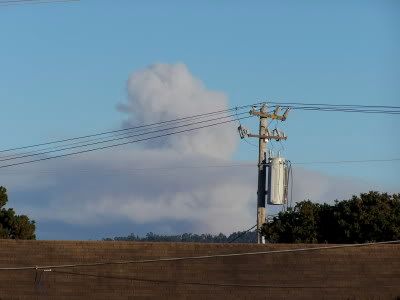
I took that picture 30 minutes ago, of the Basin Complex Fire that is raging on the Big Sur coast about 20 miles south. The fire jumped a containment line last night and is now threatening the village of Big Sur. The entire area is now under an evacuation order, and the 850 or so residents are now gathered at Carmel Middle School or with friends and family in the area.

The Big Sur community has always been tight-knit, and grew even moreso in the late 1990s after El Niño rains washed out Highway 1, closing it for months. One result is a rich online network of sites providing information and resources about the fire, such as Xasáuan Today’s fire news and Sur Fire 2008’s community information.

The Carmel chapter of the Red Cross is taking donations for the shelter and other needs.

Arnold Schwarzenegger was here earlier today surveying the fire damage, and John Laird had this to say:

Governor Schwarzenegger’s visit to Big Sur today is a significant indicator of the impact the Basin Complex fire is having on the people of the Central Coast and California. The people and businesses of the Big Sur community have shown courage, resourcefulness and generosity as this difficult fire has unfolded.

Today and in the weeks ahead, as I continue to work hard on the budget in Sacramento, I will stay focused on ensuring funds are available to fight this fire. And as we consider next year’s budget, I’ll continue to advocate for the funding increases for air attack resources, as approved by the Assembly Budget Committee.

California’s firefighters are stretched thin by the fires, and Arnold has called the National Guard to help relieve the burden. Another example of how we need to be nation-building here at home, not using the National Guard to occupy Iraq.

Finally, it may be an individual home fire, but you’ve probably heard by now about the fire that destroyed Darcy Burner’s house east of Seattle. $60,000 has been raised so far to help her meet her $150,000 goal for July, so that she can attend to her family needs this month instead of worrying about raising money for her campaign for Congress in WA-08.

Darcy Burner has been there for the netroots – on net neutrality, on the Responsible Plan (which she initiated), and will be there for us on many other issues. I had the pleasure to meet her and do some volunteering for her campaign in 2006, and it was a bitter disappointment that she did not win. Certainly the loss of her home is a bigger disappointment – but just as she came back from the 2006 loss, so too will she come back from this one. Let’s give her some help in doing so.