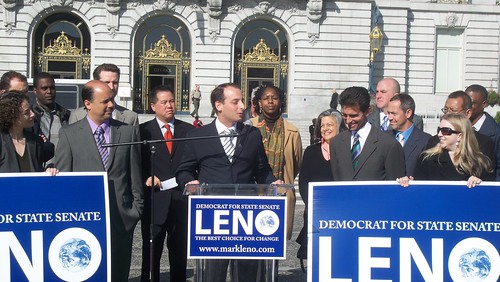
Tag Archives: Mark Leno

Elected Leaders’ Reactions

SF marriage noon celebrationOver the flip, I’ll be posting some legislator’s remarks on the marriage decision.  I’ll only get a few now, so any editors should feel free to add some or throw them in the comments.

Senator Barack Obama:

“Barack Obama has always believed that same-sex couples should enjoy equal rights under the law, and he will continue to fight for civil unions as President.  He respects the decision of the California Supreme Court, and continues to believe that states should make their own decisions when it comes to the issue of marriage.”

On the issue of constitutional amendments, Senator Obama has been on record for some time: He opposes all divisive and discriminatory constitutional amendments, state or federal.  That includes the proposed amendments in California and Florida.

Mark Leno:

“Today’s ruling is a supreme affirmation of the sanctity of the love that two people share with one another without regard to their gender, and a victory for all Californians who believe that people should have the opportunity to pursue their dreams on equal footing.

I applaud the Supreme Court today for erasing hundreds of years of unconstitutional discrimination against loving and committed same sex couples. I also congratulate the brave couples who brought the case to court, as well as Mayor Newsom, City Attorney Herrera and the amazing legal team that successfully argued this historic case.

I will continue to review the legal implications of today’s ruling and, if it is determined to be necessary, draft any implementing legislation that may be needed or appropriate.

With the conviction of its highest court and its legislature, California continues to lead the way in favor of the conservative principle that society is best served when loving couples who want to settle down with one another are all able to do so through the civil institution of marriage.”

Lloyd Levine:

“I am absolutely elated by the California Supreme Court’s decision. We live in 2008 and there is no place for discrimination in any way, shape or form,” Assemblymember Lloyd Levine said. “All people in California have equal rights under the law. I look forward to the day when all people can marry the person they love. This is a great day for equality in California.”

Leland Yee:

“Today our state’s supreme court reaffirmed the highest ideals of our republic.  I am proud to be a Californian today as we stand on the right side of history.  This is a victory for all people committed to equal justice and equal opportunity.  For far too long, our nation has unfairly denied fundamental rights to individuals simply because of their sexual orientation.  Today, we finally begin to heal those wounds and end state-sanctioned discrimination.   At last, we fully recognize and honor all loving relationships and all families with the rights, privileges, and joys of marriage.  We also celebrate the perseverance and courage shown by so many in this latest march towards equality, justice and happiness.”

Speaker Nancy Pelosi:

On the California Supreme Court’s decision today to strike the state ban on gay marriage

I welcome the California Supreme Court’s historic decision. I have long fought against discrimination and believe that the State Constitution provides for equal treatment for all of California’s citizens and families, which today’s decision recognizes.

I commend the plaintiffs from San Francisco for their courage and commitment. I encourage California citizens to respect the Court’s decision, and I continue to strongly oppose any ballot measure that would write discrimination into the State Constitution.

Today is a significant milestone for which all Californians can take pride.

Governor Arnold Schwarzenegger:

I respect the Court’s decision and as Governor, I will uphold its ruling. Also, as I have said in the past, I will not support an amendment to the constitution that would overturn this state Supreme Court ruling.

Mayor Gavin Newsom:

Today, the California Supreme Court took a bold and important step forward to end discrimination in California. The Court’s ruling to grant same-sex couples the right to marry affirms the very best of what California stands for – and proudly continues our state’s long-standing commitment to equality and justice.

As San Franciscans, we have taken an irrevocable step toward resolving one of the most important civil rights issues of our generation, and the state’s highest court has done the right thing with their ruling. San Francisco is the first government entity in American history to challenge the constitutionality of state marriage laws that discriminate against gay and lesbian couples. I believe that the path San Francisco pursued was not merely right – it was inevitable.  It is America’s path – the road to true freedom and equality.

The rights afforded by California’s Constitution have triumphed, as they must, over laws restricting marriage to opposite-sex couples.  In the late 1940s, California courts were among the nation’s first to strike down laws banning inter-racial marriage.  The state’s Supreme Court has once again distinguished itself as a leading defender of our civil rights.

Pettis for CA 80th Assembly District: Receives Endorsements From Every LGBT Caucus Member

Greg Pettis, in his 14th year as Cathedral City Councilman, former-Mayor Pro-Tem of Cathedral City, and Candidate for the CA 80th Assembly District, has now received the endorsements from every member of the California Legislative Lesbian, Gay, Bisexual and Transgender (LGBT) Caucus in Sacramento.  Pettis has widespread support in the LGBT community Nationally, State-wide, and locally because of his progressive stands on issues important to the LGBT communities: Pettis fully supports the HIV/AIDS communities, universal healthcare, a strong local economy, good local schools and responsible academic oversight, a healthy environment, equality and justice for all Californians, and mentoring other members of the LGBT community.

More below the flip…

Pettis’ support in the National, State, and local LGBT communities includes but is not limited to:

National:

U.S. Representative Barney Frank (D-MA)

U.S. Representative Tammy Baldwin (D-WI)

State:

Every LGBT Caucus Member in Sacramento:

CA State Senator Christine Kehoe

CA State Senator Sheila Kuehl

CA State Senator Carol Migden

CA State Assemblyman John Laird

CA State Assemblyman Mark Leno

Local:

Palm Springs City Councilmember Ginny Foat

Palm Springs City Councilmember Rick Hutcheson

Cathedral City City Councilmember Paul Marchand

Desert Hot Springs City Councilmember Karl Baker

LGBT Organizations and LGBT Community Leaders:

Desert Stonewall Democratic Club

Vice-President Desert Stonewall Democrats Roger Tansey

Treasurer Desert Stonewall Democrats Bob Silverman

Secretary Desert Stonewall Democrats James Reynolds

Membership Chair Desert Stonewall Democrats Lynn Worley

Public Relations Chair Desert Stonewall Democrats Donald W. Grimm, Ph.D.

Steering Committee Member Desert Stonewall Democrats Bob Mahlowitz

Steering Committee Member Desert Stonewall Democrats Richard Oberhaus

Steering Committee Member Desert Stonewall Democrats Greg Rodriguez

Steering Committee Member Desert Stonewall Democrats Robert Lee Thomas

Steering Committee Member Desert Stonewall Democrats Lynn Worley

Political Action Committee Member Desert Stonewall Democrats Bond Shands

Desert Stonewall Democrats Member Bill Cain-Gonzales

Equality California

HRC Board Member Andy Linsky

Inland Stonewall Democratic Club

Co-Chair Palm Springs Democratic Club Sandy Eldridge

Co-Chair Palm Springs Democratic Club David Pye

Secretary Palm Springs Democratic Club Peter East

San Diego Democratic Club

Victory Fund

Pettis is the only Democratic candidate who has indicated publically and consistently that he fully supports issues important to the LGBT community, including Marriage Equality.  In fact, two of his opponents, Rick Gonzales and Richard Gutierrez, have indicated publically that they will vote ‘nay’ on any Marriage Equality bill if elected as Assemblymember to represent the 80th AD.  Victor Manuel Perez has stated publically that he supports equality for all, but consistently avoids stating whether he will or will not vote for Marriage Equality.

Thus, Pettis is not only most qualified to represent the Coachella and Imperial Valleys as per The Desert Sun, but is also the most committed and will most represent all of their interests in Sacramento as Assemblyman (forty percent of the population in Palm Springs are members of the LGBT community, sixty percent of the population is LGBT-identified during the ‘season’).  Recently, most of the major electeds in the West Valley have been openly-gay or openly-lesbian, including former Mayor of Palm Springs Ron Oden, Mayor of Palm Springs and former-Palm Springs City Councilmember Steve Pougnet, Palm Springs City Councilmember Ginny Foat, Palm Springs City Councilmember Rick Hutcheson, Palm Springs Unified School District Trustee Justin Blake, Desert Hot Springs City Councilmember Karl Baker, Cathedral City Councilmember Greg Pettis, and Cathedral City Councilmember Paul Marchand.  Other electeds in the West Valley have endorsed Pettis for the 80th AD, including Palm Springs Unified School District Trustee Meredy Schoenberger and Cathedral City Clerk Pat Hammers.  The only ones of these mentioned not endorsing Pettis for 80th AD are Oden and Blake, the latter not endorsing anyone thus far.

Also, unlike other campaigns for the 80th AD, Pettis is reaching out to all communities in the Coachella and Imperial Valleys, not deigning to divide the communities along race, class, sexual orientation or other lines of distinction.  In fact, Pettis has widespread support in the wealthier cities in the District including Palm Springs, Palm Desert, and Rancho Mirage as well as in the less advantaged communities like Cathedral City, Desert Hot Springs, Coachella, Brawley, and El Centro.

Members of the LGBT Caucus endorsing Pettis include Assemblymember John Laird (D-Santa Cruz), chair of the caucus,

According to a press release from LGBT Caucus chair Assemblyman John Laird (D-Santa Cruz):

Formed in June 2002, the role of the LGBT Caucus is to present a forum for the California Legislature to discuss issues that affect LGBT Californians and to further the goal of equality and justice for all Californians.  Formation of the LGBT Caucus made California the first state in the country to recognize an official caucus of openly-LGBT state legislators.

Members of the LGBT Caucus endorsing Pettis include Assemblymember John Laird (D-Santa Cruz), chair, Senator Christine Kehoe (San Diego), Senator Sheila Kuehl (D-Los Angeles), Senator Carole Migden, and Assemblymember Mark Leno (D-San Francisco).

Accomplishments and activities of the LGBT Caucus that Pettis is committed to help to further and to accomplish as a State Assemblymember representing the Coachella and Imperial Valleys:

Champion and prioritize laws/legislation that promote equality for LGBT Californians:

Equal rights and responsibilities for same-sex couples and their families

Prohibit discrimination based on sexual orientation and gender in employment, housing, and business establishments / public accommodations

Prohibit discrimination in state government

Prohibit discrimination and harassment in public school

Promote fair policies and adequate funding for HIV/AIDS and LGBT-related health and human services

Promote prevention programs and policies against hate-crimes and bias-motivated violence

Sponsor annually the LGBT Pride Exhibit every June, celebrating Pride Month.

Present before the California State Legislature the LGBT Pride Recognition Awards, which are given to outstanding individuals in recognition of their extraordinary accomplishments and leadership in their respective fields of endeavors.

Assemblymember John Laird (D-Santa Cruz) was first elected to the California State Assembly in 2002, and re-elected in 2004, and in 2006,  Laird represents the 27th Assembly District, which includes portions of Santa Cruz, Monterey, and Santa Clara Counties.  Prior to being elected to the State Assembly, Laird served two terms on the Santa Cruz City Council, two terms as Mayor of Santa Cruz, and eight years as a Cabrillo College Trustee.

In his role as Budget Committee Chair, Mr. Laird helped deliver the first on-time budget since 2000-a budget that reduced community college fees, restored funding for transportation and K-12 education, dramatically increased funding for deferred park maintenance and foster care, and increased the budget reserve while reducing the so-called “out year” deficit. Along with the Budget Committee, Mr. Laird also serves as a member the Labor and Employment, Judiciary, and Natural Resources Committees.

Raised in Vallejo and educated in Vallejo public schools, Mr. Laird’s parents were both educators. He graduated from UCSC’s Adlai Stevenson College. In 1981, Assemblymember Laird was elected to the Santa Cruz City Council. He was elected by the City Council to one-year mayor’s terms in 1983 and 1987, becoming one of the first openly gay mayors in the United States.

Assemblymember Mark Leno (D-San Francisco) was first elected to the Assembly in 2002,  Assemblyman Leno represents the 13th District, which encompasses the eastern portion of San Francisco.  He is one of the first two openly-gay men ever elected to the State Assembly.  He currently chairs the Assembly Appropriations Committee, which oversees all bills with a fiscal impact on the state of California.  Leno also serves on the Election & Redistricting and Labor Committees.  Leno was also chair of the Public Safety Committee from 2003 to 2006.  Prior to his election to the State Assembly, Leno served on the San Francisco Board of Supervisors from April 1998 to November 2002.  Leno has also been in the forefront of Marriage Equality battle with the recacitrant Governor Arnold Schwarzenegger in sending the Governor Marriage Equality bills each year which Schwarzenegger then terminates with a veto:

While in the Assembly, Leno has fought for better schools and access to higher education, a cleaner and sustainable environment, universal affordable and quality health care, improved transportation, renewable energy, safer streets and equal rights for all Californians.  In 2007, Leno is continuing his pioneering battle for LGBT couples and their families by authoring AB 43, the Religious Freedom and Civil Marriage Protection Act. This historic civil rights legislation would allow same sex couples to marry in California . In 2005, Leno’s nearly identical AB 849 was the first marriage equality bill in United States history to be approved by both houses of a state legislature.

A native of Wisconsin, Leno attended the University of Colorado at Boulder, then went on to become valedictorian of his graduating class at the American College of Jerusalem, where he earned his Bachelor of Arts Degree. Leno also spent two years in Rabbinical Studies at The Hebrew Union College in New York . He is the owner of Budget Signs, Inc., a small business he founded in 1978 and operated with his life partner, Douglas Jackson. Together the two entrepreneurs steadily grew their sign business until Jackson passed away from complications relating to HIV/AIDS in 1990. This deep loss would not deter Leno. Instead, he redoubled his efforts in community service.

Senator Christine Kehoe (D-San Diego) was first elected to the State Senate in 2004, to represent the 39th Senate District,  Senator Kehoe chairs the State Senate’s Energy, Utilities and Communications Committee.  In 2006, Kehoe chaired the Senate’s Local Government Committee where she sponsored the most important redevelopment reform bill in more than a decade:

Senator Kehoe is a member of the Senate Committee on Budget & Fiscal Review; Natural Resources & Water; Transportation & Housing; Local Government, the Governor’s Broadband Task Force, the California Cultural and Historical Endowment; and the Sea Grant Advisory Panel.  

She also serves on the Select Committees on Defense and Aerospace Industry; the Natural Resources and Water’s Subcommittee on Delta Resources; the Joint Committee on the Arts; and the Select Committee on Coastal Protection and Watershed Conservation.

Prior to being elected to the Senate, Kehoe served two terms as a California State Assemblymember representing the 76th District (2000-04).  

During her first term in the State Assembly, Kehoe distinguished herself by becoming the second woman ever – and the first woman from San Diego, to be elected Assembly Speaker pro Tempore, the Assembly’s second highest-ranking position.  In her first year in the State Assembly, she carried the largest energy conservation bill package in the state’s history.  

Prior to being elected to serve California’s 76th Assembly District, Kehoe served seven years as City Council Member representing San Diego’s Third District. As a Council Member, Christine was at the forefront on environmental issues, serving as chair of the Public Safety and Neighborhood Services Committee. She led efforts to improve and beautify San Diego, reduce street crime, and improve recreational opportunities for families.

State Senator Sheila James Kuehl (D-Los Angeles) was first elected to the State Senate in 2000, and again in 2004, after serving for six years in the State Assembly. During the 1997-98 legislative session, Senator Kuehl was the first woman in California history to be named Speaker pro Tempore of the Assembly. Kuehl is also the first openly-gay or lesbian person to be elected to the California Legislature.  A former civil rights attorney and law professor, Kuehl represents the 23rd Senate District in Los Angeles and Ventura Counties.  She is the chair of the Senate Health Committee and serves as a member of the Agriculture, Appropriations, Environmental Quality, Joint Rules, Judiciary, Labor and Employment, and Natural Resources and Water Committees.  Kuehl is also chair of the Select Committee on School Safety and Chair of the Select Committee on the Health Effects of Radioactive and Chemical Contamination.  Kuehl previously served as chair of the Senate Natural Resources and Water Committee from 2000-2006:

In her thirteen years in the State Legislature, Sen. Kuehl has authored 171 bills that have been signed into law, including legislation to establish paid family leave, establish the rights contained in Roe vs. Wade in California statute, overhaul California’s child support services system; establish nurse to patient ratios in every hospital; require that housing developments of more than 500 units have identified sources of water; further protect domestic violence victims and their children; prohibit discrimination on the basis of gender and disability in the workplace and sexual orientation in education; increase the rights of crime victims; safeguard the environment and drinking water; many, many others.  Since 2003, she has led the fight in the legislature to achieve true universal health care in California, and, in 2006, brought SB 840, the California Universal Healthcare Act,  to the Governor’s desk, the first time in U.S. history a single-payer healthcare bill had gone so far. Undaunted by its veto, Senator Kuehl continues to work to bring universal, affordable, quality health care to all Californians.

She was selected to address the 1996 Democratic National Convention on the issue of family violence and the 2000 Democratic National Convention on the issue of diversity.  In 1996, George magazine selected her as one of the 20 most fascinating women in politics and the California Journal named her “Rookie of the Year.”  In 1998 and, again, in 2000, the California Journal chose her as the Assembly member with the greatest intelligence and the most integrity.  In 2006, the Capitol Weekly picked her as the most intelligent member of the California Legislature.

Prior to her election to the Legislature, Senator Kuehl drafted and fought to get into California law more than 40 pieces of legislation relating to children, families, women, and domestic violence.  She was a law professor at Loyola, UCLA and USC Law Schools and co-founded and served as managing attorney of the California Women’s Law Center.

Senator Kuehl graduated from Harvard Law School in 1978 where she was the second woman in the school’s history to win the Moot Court competition.  She served on the Harvard University Board of Overseers from 1998 to 2005.

Senator Carole Migden (D-San Francisco) represents the 3rd District in the California State Senate, which includes the eastern half of the City and County of San Francisco, all of Marin County, and portions of Sonoma County.  Senator Migden was first elected to the Senate in November of 2004.

Currently, Senator Migden is chair of the Senate Democratic Caucus and also serves as Chair of the Senate Labor and Industrial Relations Committee.  In 2004, she began serving as Chair of the Appropriations Committee:

Prior to being elected to the Senate, Carole Migden served as Chairwoman of the California Board of Equalization (BOE); the nation’s only publicly elected tax commission; represented San Francisco’s 13th District in the California State Assembly; and for five years served as a member of the San Francisco Board of Supervisors.

During her tenure at the BOE Senator Migden worked to modernize the state’s outdated tax system and manage taxpayers’ money responsibly. Her accomplishments at the BOE included strengthening domestic partners’ property rights, leveling the playing field between Main Street and on-line retailers, protecting California’s precious open space, and advocating for increased revenues to fund vital services by eliminating obsolete tax breaks.

In the State Assembly, Migden served for five years as Chairwoman of the Assembly Committee on Appropriations. She was the first woman and the first freshman legislator to chair that influential committee. For four years she also served as a conferee on the state’s Joint Budget Conference Committee, which writes the final version of California’s state budget.In that time Carole Migden authored legislation to create California’s landmark domestic partner registry, promote children’s health, preserve the old growth Headwaters Forrest, increase accountability in K-12 schools, protect borrowers from predatory and deceptive lending practices, protect consumers from manipulation by energy generators, and promote the use of emergency contraception.

Senator Migden has received numerous awards for her service. California Journal named her among California’s power elite of women elected officials and awarded her with their “Rookie of the Year” award in 1998, taking top honors in the categories of most integrity, most intelligence, hardest working, most ambitious, and most influential. She received “Legislator of the Year” honors in 1999 from the California School Employees Association and in 2001 from the California National Organization for Women (NOW), as well as leadership awards from prominent environmental and civil rights organizations. She continues to receive high honors in California Journal’s annual rankings, including “Quick Study” in 2002.

Carole Migden is a longtime member of, and current super-delegate to, the Democratic National Committee. She also served as chair of the San Francisco Democratic Party for eight years.

Will There Be an LGBT Legislative Caucus after November? Yes!

Although there have been reports that the California LGBT Legislative Caucus is in danger of extinction the truth is that in January 2009 it is very likely that it will be as large as ever.

The only current members of the LGBT Caucus who are not termed out are State Senators Christine Kehoe and Carole Migden. However, Migden is facing a tough primary fight which she is very likely to lose.

Here is a table showing the members of the LGBT caucus for the current legislative sessiob and a projection of what the caucus will look like after being sworn in in January 2009.

January 2007                       January 2009
Assembly                         
Mark Leno (AD-13)                  Tom Ammiano (AD-13)
John Laird (AD-27)                 John Perez (AD-46)
                                   Chris Cabaldon (AD-8)
State Senate
Christine Kehoe (SD-39)            Christine Kehoe (SD-39)
Carole Migden (SD-3)               Mark Leno (SD-3)
Sheila Kuehl (SD-23)

In addition, there’s the possibility that Laurette Healey may win her primary to replace

Assemblymember Lloyd Levine in the 40th Assembly District and it’s possible that Greg Pettis will win his primary in the 80th district (but it’s unlikely he will win the general election in this Republican-leaning district).

Mark Leno, Marin Firefighters, & Tri-Tip

The Marin Firefighters joined volunteers this weekend as they took to the streets and phone lines to help elect Mark Leno to the State Senate.  Phone bankers and precinct walkers enjoyed barbeque tri-tip, curtsey of the Marin Firefighters, as well as delicious homemade chili.  Mark Leno fired up the crowd of more than 50 energized volunteers before they talked to voters about his unparalleled legislative record— fighting for universal single-payer health care, better schools, a cleaner and sustainable environment, improved transportation and renewable energy.  Thank you to the Marin Firefighters and our dedicated volunteers!

Will Somebody Douse Me In Chemicals Already?

Light Brown Apple MothOk, so last week, I thought all this hubub about the Light Brown Apple Moth was much ado about nothing. I hadn't even seen one, and they didn't seem to be bugging me.  So, I didn't get what Arnold's big rush to spray pheremones or what not on to the Bay Area.

Things have changed. Last week a friend of ours was over at our house. It was a fine afternoon, the weather was nice, so we spent the time chatting outside.  We get to the conversation of this little moth. Turns out that our friend, a big shot lawyer at a video game company to remain nameless, is the patient zero of the Light Brown Apple Moth scourge upon her city.  She claimed they were all over her apartment, and sure enough, we went down there, and there they were. Sneaking around her place. I put the pieces together, she travels all over the world for work, and she has tons of them in her house.  How much more evidence do we need? Well, how much more was answered the next day when we saw some of the little buggers around our house.  Now the things are all over our house.  Apparently the've really taken to the Bay Area, and I'm pretty sure she's the vector.

Now, they don't seem to be really bothering me at this point here in SF, they're just annoying. But, I say, get some helicopters or bush planes, or whatever it takes, in the air, and let's get to dumping all sorts of chemicals on my fair city. What's a little caplet of inhaled pseudo-moth pheremones compared to some bugs in my house? What could possibly go wrong when we drop a chemical on to heavily populated urban areas? Really, I can't think of anything. Sure, some judge said the state can't spray, but whatever, let's do it anyway. 

Ok, I kid, but follow me over the flip..

The LBAM is an interesting parable of our increasingly globalized society. Bugs from other parts of the world are here. Some are annoying, and some are real problems. The problem with the LBAM isn't necessarily what it does or doesn't eat at this point, the damage totals are mere guesses.  But from most reports that I've read, it seems that the LBAM is a bad thing, but it is no MedFly. But what's more disturbing is the failure of the state and federal governments to have early warning systems and clear protocols that allow for public comment and discussion.

The LBAM was found by a retired UC-Berkeley entimoligist in his backyard, but nobody was actively looking. Nobody.  The next great super-pest could be reaching our shores today, and we likely wouldn't know for years. With the food supply getting tighter and tighter as the world's population grows, we need to learn how to better manage non-native pests. We need to be vigilant from a planning perspective at the front.  Because an ounce of prevention is worth a few tons of cure here:

The light brown apple moth, the ravenous crop-eating Australian pest detected in at least 11 California counties since mid-March, “was probably here a very long time prior to its discovery and it’s probably far more widespread than currently delineated.”

***

“However, once a pest has a major foothold, it’s very difficult to eradicate it,” said [UC-Davis entomologist James R. Carey]. “While state and federal agricultural officials often talk about eradicating a ‘population,’ in reality, this requires eradication of thousands, perhaps tens of thousands of mini-populations/pockets. Thus, anything short of 100 percent elimination of these thousands of pockets is control, not eradication.”

From the perspective of a city-dweller, we need to be prepared to explain, and back up with hard evidence, any proposed or actual treatments for the pests. It's not that urban residents are distincty opposed to measures against these species, it's that, in the case of the LBAM, nobody bothered to explain to us what was about to be dumped on to our cities.  That's why the residents (and elected leaders) of the County of Santa Cruz and other localities fought the spray so hard. It's not that the name sounded a bit scary (which it did…Checkmate, yikes!), it's that there were no conclusive studies showing the safety and efficacy of these synthetic pheremones.  It's that nobody bothered to mention until a few days that we would soon be inhaling Checkmate into our systems. Heck, in SD-03, all three candidates, Leno, Migden, and Nation, are talking about this little moth more than you could possibly imagine.

Thus there are competing forces here, because eradication requires speed, and due process requires a deliberate, uh, process. Of course, we can gain extra time through better advance detection, but we also need to improve our preparation for future pests. So, better research, but also a streamlined system that will allow public debate over whether the ends justify the means for each insect. 

SF Bay Guardian Endorsements: Leno, Hancock, Ammiano, No on 98 and more

The SF Bay Guardian released their endorsements for local races and state propositions. These tend to be some of the most influential endorsements in the City, and to a lesser extent, in the region. As always, they do a laudable job presenting a thorough analysis of each race and the relative merits of each position. Hats off to Tim Redmond and the crew at the SFBG.  Here’s a summary of their positions, and I’ll discuss some of them over the flip.

Prop 98: No, No, No

Prop 99: Yes, Yes, Yes

SD-03: Mark Leno

SD-09: Loni Hancock

AD-13: Tom Ammiano

AD-14: Kriss Worthington

CA-08 (Pelosi): No Endorsement

Let’s start with Props 98 and 99. (I work for No on 98) They state the position that progressives across the state have come to, whether Jon Coupal thought the opposite might be true, Prop 98 is a disaster for California. And they even give us a nice little way to remember which is the good one: “We hate 98, but 99 is fine.” Cute.

On to the Senate Races, surely the most watched position in this endorsement slate was the issue of SD-03 (aka Rumble in the Bubble, that’s mine, I want royalties for that, even though I do work for Mark Leno.)  The BG has endorsed both Leno and Migden in the past, but they haven’t been so into Joe Nation. (I don’t know if they ever endorsed him in a primary…he ran unopposed for at least one term in the Assembly.) So, this came down to a decision between the two San Francisco gay candidates.

The BG sees strengths and weaknesses in both candidates. Migden has passed some good pieces of legislation like community choice and toxics legislation, and Leno has a record of protecting vulnerable populations from evictions and passing the marriage bill. But they also disliked Leno’s close ties to Mayor Newsom and Migden’s connections to Gap Founder Don Fischer who is a huge “school choice advocate.”

The BG, like me, is a fan of primary challenges in this one-party town., and they laud the attention the mostly absentee Migden has now paid to the district. But toss Migden’s “imperious and arrogant” ways to her campaign finance troubles, and the BG tilted towards Leno. “In the end, we’ve decided – with much enthusiasm and some reservations – to endorse Assemblymember Mark Leno.”

SD-09: Loni Hancock. I’m a fan of both Hancock and Chan. Whomever wins will be a great Senator to replace the, shall we say “imperious,” Don Perata. The BG went with Hancock based upon her work on the budget.

AD-13: Ammiano. He’s running unopposed, but that is, in and of itself, is a testament to Ammiano. People in SF love the guy, for good reason. He’s great personally as well as politically.

AD-14: Kriss Worthington. There are some great candidates here, but Kriss Worthington, the openly gay Berkeley Councilman that has been the heart of Berkeley’s progressive movement, for years will be a great legislator. He’s willing to stand alone for progressive values, if need be.  And, in Sacramento, need exists. Often.

CA-08: The Guardian chose not to endorse Speaker Pelosi, stating that she no longer represents San Francisco’s progressive values.

I’ll leave the other races to the Guardian’s excellent endorsement editorial, save one where I think they got it wrong. That is the SF DCCC endorsement of the so-called HOPE Slate. Besides the obvious play off of Obama’s campaign, my issue is with a few members of the slate.  Specifically, the inclusion of two San Francisco supervisors on the slate. Now, I understand that the Supervisors want to ensure that their political positions get into the Party’s apparatus, but frankly, the point of the DCCC should be less about policy positions and grandstanding and more about organizing Democrats in San Francisco to ensure turnout.

I understand that the endorsements of the party have a very strong impact upon the vote for local issues here in San Francisco. But it is hard to argue that the SF Democratic Party has been anything other than progressive in the last two years. And furthermore, while hope is terrific and all, after all I am an Obama supporter, the results of elections depends on the hard work of registering voters and turning them out. Under the leadership of Scott Wiener, the SF DCCC has done just that. SF is one of the few counties to increase Democratic percentages during 2007. Fighting the battle against increased apathy and DTS registrations, we’ve been winning.

Scott has been an enormous part of that success and deserves re-election to the DCCC and to the chair.

SD-03: Joe Nation’s Environmental Problems

With today being Earth Day, I thought readers would enjoy reading my article about Joe Nation’s environmental record.

Ex-Marin Assemblyman and State Senate candidate Joe Nation is working to stay above the fray between Mark Leno and Carole Migden.  Despite his moderate record on other issues, he speaks earnestly about the environment and climate change.  But why hasn’t the Sierra Club endorsed him, and why is he not popular with environmentalists in Marin County?  It may be because when Nation was on the Marin Municipal Water District in the late 1990’s, he proposed bottling water from Mount Tamalpais, voted for a pipeline to siphon water from the Russian River and supported widening the US-101.  Today, Nation is a climate change consultant for ENVIRON, where he primarily advises Coca-Cola – whose environmental record has spawned protests across the globe.  Now Coca-Cola runs a corporate green-washing campaign that pushes “water stewardship” – which is code for privatization of a natural resource, while running bottled water plants in California.

As a newcomer to the very contentious Senate race (and a relative unknown to San Francisco voters), Nation has campaigned on his environmental record in the Assembly – and touts the work that he currently does on climate change.  “I would not be in this race if it wasn’t for that issue,” he said at a candidates’ forum last month.  Therefore, it is helpful to hear what local environmentalists think about him.

The Sierra Club has not endorsed in the race – which is interesting, because Joe Nation has made climate change such a top priority in his campaign.  Nobody on their Board would talk to me on the record (the Club is still deciding what to do), but it was clear from learning about Nation’s history in Marin that he is not well liked among many environmentalists.

After losing an open Congressional race in June 1992, Nation was elected later that year to the Marin Municipal Water District – a very powerful stepping stone for higher office.  Three of Marin’s last 4 Assembly members have served on that board, including Nation – who ran for an open Assembly seat in March 2000.  The Sierra Club did not endorse him in that race, and when two progressive opponents split their votes, Nation eked out a victory.

In 1999, Nation angered environmentalists by sponsoring a proposal that the Marin Water District sell bottled water from Mount Tamalpais.  Activists opposed it because draining water from Redwood Creek (which flows from Mount Tam) would endanger a salmon run.  At a time when Marin residents were being asked to conserve water, they opposed having the District sell off such natural resources.  Bottled water, they said, is also a very wasteful practice – as it consumes large amounts of plastic.

After much community opposition, the Marin Water District shot down Nation’s idea.  Shortly afterwards, they passed an ordinance prohibiting such a proposal in the future.

In 2000, the Marin Water District (with Nation’s support) agreed to move ahead with plans for a new multimillion-dollar pipeline to siphon water from the Russian River.  Again, environmentalists opposed the idea – as it involved extracting natural resources when they urged the need for more conservation.  As he ran for the Assembly that same year, Nation supported widening the US-101 to relax gridlock – a reason why the Sierra Club did not endorse him (as their chosen candidate opposed it.)

Nation did get support from the League of Conservation Voters in his initial Assembly bid – prompting environmental legend David Brower to write an angry press release.  “Industry and pro-development politicians grow increasingly skilled at adopting green camouflage,” said Brower, as he accused Nation of being “the candidate favored by developers.”  At the time, Nation replied that he was a “realist” – not a “purist.”

In the Assembly, Nation’s voting record was solidly pro-environment (the Sierra Club endorsed him when he faced token opposition) – but some complained that he was more of a follower than a leader.  His signature bill was AB 32, the Global Warming Solutions Act of 2006, that Governor Arnold Schwarzenegger signed – which capped carbon emissions, but most environmentalists agree is not enough.

Since leaving the Assembly in 2006 (after a second bid for Congress against Lynn Woolsey), Nation now works as a Climate Change Consultant for ENVIRON — which has a global staff of over 1,000 and helps corporations become more environmentally sound.  Most of Nation’s consulting work at ENVIRON, he says, is on behalf of Coca-Cola.

“We do a range of work for Coke,” he said, “and have lots of very smart people who count carbon molecules and do carbon footprints.  We’ll go in their facility and measure their energy use (CO2), and look at ways on how they can reduce it.  We give them recommendations on alternative technologies that they can use.  My expertise is in the area of off-sets and carbon emissions trading.”

Coca-Cola does not have the best environmental record.   The company manages bottling plants throughout the world – and its water-pumping in India has drained the wells of the country’s most impoverished villages.  Students on over 20 college campuses in the U.S. and Great Britain have succeeded in getting their schools to divest from Coke due to its repeated violations of environmental law.

Of course, Nation can argue that he’s helping Coke fix its environmental problems.  But even the company’s “green” improvements are under scrutiny.  “Coca-Cola has done a lot to greenwash their corporate image,” said Nick Guroff of Corporate Accountability, a non-profit organization that monitors corporate violations.  On its website, Coca-Cola features an environmental report that touts its “water stewardship” plan – which critics say is really just an effort to privatize a natural resource that people need in order to survive.

Coca-Cola says it’s doing what it can to reduce waste – as it makes less wasteful plastic bottles and plans to build a plant that will recycle 100 million pounds of plastic every year.  But activists – including Rev. Renee Rico from San Anselmo in Marin County – aren’t buying it.  “Don’t make the [water] bottles in the first place, and you won’t have to waste even more energy to recycle them,” she said.

An online campaign by Corporate Accountability is currently underway – urging consumers to drink tap water rather than buy bottled water from Coca-Cola and other companies.  The group recently convinced S.F. Mayor Gavin Newsom to ban plastic water bottles in all City government buildings.

Nation’s work for Coca-Cola is consistent with his advocacy for bottled water nine years ago on the Marin Municipal Water District.  Today, bottled water is a growing industry – and Coke runs a plant near Mount Shasta despite opposition from the environmental community.  It would help Coke to have someone like Joe Nation in the California State Senate – especially a Democrat who touts his green credentials.

EDITOR’S NOTE: As a private citizen, Paul Hogarth has endorsed Mark Leno for State Senate. He plays no role for the Leno campaign, nor did anyone on that campaign assist in  this story.

Another Step towards Employment Rights for Medical Marijuana Patients

(Crossposted from Medical Cannabis: Voices from the Frontlines, the blog of Americans for Safe Access. I work for Americans for Safe Acces.)

Yesterday, ASA’s chief counsel, Joe Elford, and I traveled to Sacramento to attend the Assembly Labor Committee hearing on AB 2279, ASA’s medical marijuana employment rights bill. AB2279, which protects the rights of hundreds of thousands of medical marijuana patients in California from employment discrimination, was introduced in February by Mark Leno (D-San Francisco) and co-authored by Assemblymembers Patty Berg (D-Eureka), Loni Hancock (D-Berkeley) and Lori Saldaña (D-San Diego). The bill reverses a January California Supreme Court decision in Ross v. RagingWire. Joe argued argued the case before the court.

We met Gary Ross, the plaintiff in Ross v. RagingWire, outside the hearing room in the Capitol. We were all excited about the hearing and felt good about our chances of passage. Last week, we passed a major hurdle by clearing the Judiciary Committee on a 6-3 vote. We’ve also secured the support of several prominent groups, including the Service Employees International Union (SEIU), the American Federation of State, County and Municipal Employees (AFSCME), the National Lawyers Guild, and several HIV/AIDS advocacy organizations.

After sitting through discussions of several other labor bills, Chairman Sandre Swanson called for AB 2279 to be heard. Assemblymember Leno stepped down from his committee seat to speak about the merits of the bill. He spoke about the intent of the voters when passing Proposition 215 and the intent of the legislature when passing SB 420 – clearly, they intended for patients to have the right to work. Mr. Leno also clarified that AB 2279 does not cause employers to violate federal law and preserves the rights of employers to take action against employees that come to work impaired or consume medical marijuana at the workplace.

Gary Ross spoke next, focusing on his injury sustained while serving our country in the military and how medical marijuana has helped him deal with continuing pain and spasms. He also explained that marijuana has made him a better employee – since it relieves his pain, he is absent from work less frequently. Gary urged the committee to vote yes to spare other California patients the ordeal he has gone through.

Joe Elford followed, explaining the decision in the Ross case and why he thought the Supreme Court had made the wrong decision. He also explained that hundreds of thousands of patients rely on medical marijuana and should be allowed to work, an opinion shared by SEIU and AFSCME, which represent nearly a million workers in the state. Lastly, Lanette Davies, who is an executive member of the California Chamber of Commerce and is involved with the League of Women Voters, voiced her support for the bill as an employer who has employed medical marijuana patients.

Our opposition followed, spouting the same misinformation we heard from them at the Judiciary Committee hearing. A representative from the Chamber of Commerce explained that while the Chamber was not opposed to medical marijuana, the medical use of marijuana is still illegal under federal law. She also said that employers currently are allowed to employee medical marijuana patients, but they should have the choice of whether they want to do so based on whether this fits with their “workplace culture”.

Next, a representative from the National Federation of Independent Business voiced his concerns about the bill. He stated that testing for impairment on the job would be difficult and employees could still come to work impaired. He argued that if a medical marijuana patient was impaired and caused an accident, the employer would be held liable and would have to provide worker’s compensation. After he spoke, a representative from the California Manufacturing and Technology Association briefly voiced his opposition to the bill.

After the testimony was heard, Chairman Swanson asked committee members if they had any questions. Ira Ruskin asked a brief question about the amended language from Judiciary Committee, and John Laird (who sits on both the Judiciary and Labor committees) responded that it was his proposed amendment and the new language satisfied his previous concerns.

Swanson then took his turn to grill the opponents. He asked the rep from the National Federation of Independent Business whether he had any statistics or examples of accidents medical marijuana patients had caused. Our opponents could not even come up with one example. (As a side note, this interchange made me proud that Swanson represents me and my district in the Assembly.)

In his closing testimony, Leno hammered this point home even further. He told the opponents that they needed to be more proactive if they were to continue opposing the bill (his staff has been open to meeting with them and negotiating language), and that the opponents’ reasoning had become circular. Proposition 215 was passed in 1996, and the opponents still couldn’t come up with even one example of a workplace accident caused by a medical marijuana patient. Leno concluded by asking the committee members to consider the intent of Prop 215 and urged them to vote for the bill because the alternative is that medical marijuana patients could become unemployed and wards of the state.

The committee passed the bill, on a 6-2 party line vote. The next stop is the Assembly Floor. We have a ways to go before securing employment rights for California medical marijuana patients, but at least now, we’re one step closer.

Joe Alioto Veronese Endorses and San Francisco Unites for Mark Leno

( – promoted by Lucas O’Connor)

Joe Alioto Veronse Ensdorses Mark LenoAt a press conference this morning, San Francisco Police Commissioner and former Democratic candidate Joe Alioto Veronese threw his support to Mark Leno for State Senate.

Veronese was joined by Mayor Gavin Newsom, Assessor Recorder Phil Ting, School Board President Mark Sanchez, Supervisors Bevan Dufty and Sean Elsbernd, former Treasurer Susan Leal, and Firefighters Union President John Hanley.

Leno also announced the weekend endorsements of the California Nurses Association and the California Teachers Association. Leno spoke on how this is clearly a two person race between Leno and former Assemblyman Joe Nation. The campaign’s momentum since the CDP convention highlights how the progressive community is uniting to keep this seat from falling into the hands of a candidate who doesn’t even support single-payer health insurance and voted against Sheila Kuehl’s bill.

“As we look forward to the election of former State Senator Jackie Speier to congress tomorrow — fingers are crossed, we think she’ll do very well — I’m reminded that when Senator Speier was moving forward her landmark privacy legislation, consumer privacy legislation, that Joe Nation again not only would not support it, but was carrying legislative water for the banking and credit card industry that Jackie was trying to reform.”

Leno went on to remind people of Nation telling the papers that it was a “mistake” for Mayor Newsom to courageously advance marriage equality. As the sponsor of the first resolution in the country opposing invading Iraq, Leno also reminded voters of Nation’s opposition to a timetable for withdraw.

Video and more pics after the jump.

Mayor Gavin Newsom

San Francisco Mayor Gavin Newsom Supports Mark Leno

Assessor Recorder Phil Ting

Assessor-Recorder Phil Ting Supports Mark Leno

Mark Sanchez, who pointed out that he’s a Green Party member and they don’t usually support Democrats but he’s supporting Mark Leno.

School Board President Mark Sanchez Supports Mark Leno

You too can Mark Leno.

Migden Gets Injunction Against FPPC

Campaign finance reform has been bubbling as an issue for a number of years.  And any time someone manages even a small step forward, you know you’re going to have the big money corporations, the Club for Growth, and all other manner of rich righties lining up to defend their right to freely spend their money on as much questionable propaganda as they can muster.  Normally the battle lines are pretty clear on this, ideologically speaking.  That is, of course, unless you subscribe to Sen. Carole Migden’s particular brand of “progressivism”.

After the Fair Political Practices Commission barred her from accessing more than $640,000 from an old campaign account because, well…she didn’t transfer it out of her Assembly campaign account before she left the Assembly (whoops), she sued to get it back.  Free political speech, her argument goes, trumps playing by the rules.

And today, a District Court judge agreed.  U.S. District Court Judge Edmund Brennan granted a temporary injunction against the FPPC’s locking of the account:

“I think serious questions have been demonstrated here as to the constitutionality, as to the manner in which the statute is being applied” by the FPPC, Brennan said at the end of an hour-long hearing.

Migden’s attorneys claim the regulation is to prevent termed-out legislators from plundering their campaign funds for personal use, saying “Migden ‘is not here asking the court, ‘Please allow me to use campaign funds on a new car.'”  (Nevermind that you never know when she might need a new car)

The FPPC claims that she still won’t get her mitts on the money because she’s violated other regulations too (specifically, multiple bank accounts for one campaign committee).  Migden’s lawyers shot back that they’ll just keep suing until they get the money, a plan which, I’m sure, won’t add any motivation to the FPPC’s $9 million countersuit against Migden for assorted sketchy (and allegedly not allowed) finance issues.

So our saga continues.  After getting her CDP endorsement shot down convincingly (71.3% of the floor) on Sunday, Migden has a brief glimpse of a recovery thanks to throwing campaign finance regulation under the bus for her personal benefit.  One thing that struck me about her, ahem, perplexing implosion over the weekend was that it was the worst possible time for it.  2,000 delegates trapped together in San Jose for two days is not the time to give people something to talk about.  Right after being repudiated by those same people seems an odd time to throw progressive principles by the wayside in the name of political survival.