Tag Archives: bailout

Bailout Binging Bainster TV Ad

We at AmericanLP have created a new ad to spotlight Mitt Romney’s hypocrisy on the issue of bailouts. By now, most observers have learned that Mitt Romney was against a bailout for Detroit. But what even many political insiders don’t realize is that Mitt Romney has been the beneficiary of a Federal bailout of sorts. As head of Bain and Co in the early 90s (he had been brought back from Bain Capital to sort out the mess at the mother company), Romney was in charge of keeping Bain from imploding under a huge mountain of debt. In addition to firing lots of people (naturally), Romney also squeezed suppliers and other creditors. What’s more, Bain had a $38 million loan from the Bank of New England, and that the Bank of New England had its own problems and had been taken over by the FDIC.

Romney shrewdly re-negotiated the Bain loan from $38 million to $28 million. So what does that mean, exactly? Well, since the FDIC is an arm of the Federal government, that means, essentially, that the FDIC (ahem, taxpayers) ate the difference. In other words, Romney conned the government into giving him and his cronies a $10 million bailout.

Yes, this was legal for Romney to do-other business people do it all the time. But it was a bailout to the tune of $10 million, Romney did personally benefit, and it’s a bit rich for Romney to be so sanctimonious about other people getting bailouts. Critics of our ad would suggest that it is unfair to imply that Romney benefited personally from the $10, million write-offs. While the money went to Bain and Co, Romney actually benefited to a much greater degree than $10 million. If Bain and Co had not gotten the bailout, it would have likely imploded. If Bain and Co had imploded, it would have likely tainted Bain Capital to such a degree that it would have been destroyed. If Bain Capital had been dismantled, Romney would have never been able to make his quarter billion that has allowed him the life of the perpetual candidate. Yes, this stuff is complicated-but that’s why rich finance guys like Romney are able to play the system to their advantage.

We start the ad with images of Ronald Reagan talking about the Chicago welfare queen in a Cadillac. This was a story Reagan told over and over again in the 1976 and 1980 campaigns. Even though Reagan never specified it was a black woman, it was widely assumed by most observers across the spectrum that Reagan was in fact talking about a black woman from Chicago with 80 different fake names. (It turns out that Reagan didn’t have his facts straight on this-surprise, surprise)

By showing Reagan at the beginning of the ad, we are trying to evoke the warm feelings conservative Republicans have toward Reagan and his beliefs about “welfare queens.” That is why we are literally showing what appears to be a woman driving a pink Cadillac in an inner city. We then show that in fact the “woman” is none other than Mitt Romney in drag. Romney should actually be seen as a modern day welfare queen who ripped off the government for more than any “welfare queen” from the inner city could ever imagine.

By portraying Romney this way, we are attempting to turn ugly racist beliefs on their head and make people realize that the biggest freeloaders on the government system are actually people who look like Mitt Romney.

At the end of the ad, we show Mitt Romney’s vacation mansion worth $10 million. We aren’t suggesting that Romney criminally stole tax dollars to buy his house illegally. But money is fungible, so any money that benefits Romney in one account can be used to purchase luxuries from any other account.

The point is that Romney and his colleagues at Bain were already wealthy by the early 1990s when the difficulties with the loan arose. Because, as we know, “corporations are people,” Romney and his cronies weren’t personally liable for the full $38 million. Instead, just the corporate entity of Bain and Company was liable. But there was nothing stopping Romney or his wealthy colleagues at Bain from paying back the full $10 million out of their own pocket at the time. For that matter, Romney and his colleagues could have paid the Government back in later years, after they’d all become super, super rich.

The bottom line is Romney got the best deal he could, just because he could. And yet he belongs to a political party that says people who do that are evil parasites for not being “rugged individuals” and succeeding on their own merits.

Finally, our goal here is to make conservatives sickened by the hypocrisy of Romney taking bailouts and for moderates and independents to be disgusted by Romney for making himself richer at the expense of average taxpayers. This bailout for Romney is a perfect window into why Romney should be seen as an utterly detestable and phony candidate regardless of one’s ideological position. Please take a look at the ad below.

http://youtu.be/-L8oCg_pM2M

More info at www.americanlp.org

On Punishing The Job Creators, Or, “The Poor Have It So Good Today”

You know what the problem is with America?

The poor don’t get just how great they have it.

I’ve hear this a lot lately; the basic thrust of the discussion is that all those cars, TVs, DVD players, refrigerators, and stoves that have found their way into the homes of the economic underclass are proof there’s really no such thing as “poor” in America.

If they were truly poor, the argument goes, well…think recycled corn.

And if the poor want things to get better, let ’em pull themselves up by their own bootstraps – and if they can’t, then let ’em rot, because that’s the best thing for the economy.

But I don’t buy all that, and by the time we’re done today, I hope to have given you a whole new perspective on how jobs get created in this country.

There isn’t a rich man in your vast city who doesn’t perjure himself every year before the tax board. They are all caked with perjury, many layers thick. Iron-clad, so to speak. If there is one that isn’t, I desire to acquire him for my museum, and will pay Dinosaur rates.

–From the letter “A Humane Word From Satan“, by Sam Clemens

We must have completely misjudged how many Americans live here about 15 years ago, because everywhere I go I see vacant buildings.

Empty retail space, empty office buildings, empty factories, and all of it apparently just thrown up for no reason whatsoever.

But then I recently saw some historical pictures from the 1990s, and it turns out a lot of those buildings used to have businesses operating within their now-abandoned walls – businesses which have since gone away.

And that’s when I began to get confused.

You see I’ve always known, just as you have, that it’s all about capital; that’s why it’s only the very wealthiest people who can create jobs in this country.

And I’ve always known that they can only do that when they are 100% certain that nothing was going to hurt their current economic condition, and that any sacrifice on our part, no matter how large, was crucially important to keep this very special source of economic vitality full and happy and creating jobs for America’s future.

And when I look at the statistics, I know we’ve been doing our part: the wealthy have been getting wealthier, faster, over the past 30 years than at any time in memory…and yet, for some reason, all those businesses were closing down.

So many, in fact, that I began to question whether America actually understands how jobs get created. It even began to cross my mind that maybe we’ve been coddling the wrong people.

I mean, what if the actual job creators…are the people who no longer work in those empty buildings?

It makes sense, if you think about it.

The common argument is that those with capital make investments, which creates jobs.

But why would anyone invest capital unless there was perceived demand for a product, or a need to do research to meet perceived future demands?

That seems to suggest demand drives investment; a good way to “prove” the point would be to consider what happens to capital without demand: building factories and ships and warehouses does no good if there are no buyers at the store.

Of course, I’m not the first to think workers drive demand: Henry Ford famously paid his workers double the prevailing wage; part of the idea was to create demand for all those Model Ts he was cranking out in his new factories.

So now that we know who the job creators really are, and we established years ago that we have to do every single possible thing on the face of the Earth to keep the job creators happy, happy, happy…how do we get started?

Well, here’s an idea: the Fed willingly gave more than $1.5 trillion to banks for bailouts, mostly by simply “creating” money; now I’m proposing we do the same for homeowners.

If you have a loan backed by Fannie Mae or Freddy Mac, let’s allow you to apply for a one-time $200,000 markdown on your mortgage – and let’s allow the first “tranche” of any markdown to apply to any back-due loan payments.

The amount of “haircut” (fancy technical term) you might impose on each loan could vary, but $1.5 trillion would allow 7.5 million writedowns at $200,000 each; if you limited the haircut to 50% of the loan value many would be less than $200,000. (It’s estimated that 11 million homes in the USA from are underwater; $2.5 trillion or less would cover all underwater loans.)

Since Fannie and Freddy back $10 trillion or so in mortgages, and you probably won’t be able to write down every loan, how would you decide who gets writedowns?

One way would be to create a “triage score” that incorporates things like the odds an applicant/borrower can pay off a restructured loan and the amount of foreclosed or underwater homes in any given community; the 7.5 million highest (or lowest) scores get the writedowns.

(One caveat: many who are having trouble today with home loans are also laid off; unless we can find ways to keep those folks in homes until they can find work, we’ll still have a substantial foreclosure problem.)

Writing down mortgages does several things: it quickly applies a “moral hazard cost” to those who deliberately lent to unqualified borrowers, it turns millions of “underwater” loans into homes with equity, it turns millions of “nonperforming” loans into “performing” loans, keeping millions out of foreclosure, it gives communities a chance to either stabilize or recover from “mass foreclosure-itis”, and it finally breaks the deadlock between banks and regulators over who will blink first on loan “haircuts” versus bank recapitalizations.

Wait? What was that last one?

Banks are scared to death that if they write down all these loans they will have to find new capital to make up the losses – and they probably won’t be able to raise that new capital by charging a $5 fee to have a debit card.

That could mean a few things: it could mean big banks are going to have to more sneakily raise lots of other fees and sell things to raise capital, or, perhaps, the Feds ease back a bit on capital requirements.

Or…it may mean that the banks end up having to get smaller. Consider this scenario: a forced haircut of significant size, followed by regulators who stand firm on capital requirements, followed by a less-than-stellar round of stock offerings or asset sales; next thing you know, “too big to fail” becomes “we have to spin off some part of the retail business for reasons related to the rules governing capital requirements”.

This could happen without the passage of new regulations or legislation beyond the initial bailout authorization – and even that might be within the power of Federal regulators already, since Fannie and Freddy, as the owners of many of these loans, have the power to forgive some or all of that debt, and capital requirements are not set by legislation.

And where does all that leave you?

Well, you’d have 7.5 million families that could more easily afford to make house payments than before, and those folks will probably take that money and spend it on things they haven’t been buying for several years: home improvements, cars, appliances, and the travel and entertainment markets could all see substantial bumps in sales.

Many, if not most of those families, would immediately go from being “underwater” to having equity, which always helps turn reluctant consumers into willing consumers.

Cities could begin to recover as well, as the number of foreclosures bottoms out; once banks are forced to write those properties down from “2006 value” to today’s market value they’ll be looking to sell ’em at bargain prices; that’ll help soak up today’s housing supply “overhang”. All of this is good for beleaguered new home builders, who are today in a holding pattern.

And here’s the best part: if you get a handle on foreclosures, and put some cash back in some pockets, and start selling stuff…well, that looks like a bit of a jobs program, even if Congress might not be willing to sign up for one just at the moment.

So how about that?

If we make an effort to give to the actual job creators the same level of incentives that we gave to the “demand responders” since November of ’08, we could actually find ourselves creating actual jobs with our money – and doing it by the millions, just when we need ’em.

Considering how fast we were able to find ways to create TARP, QE1, QE2, an alternative auto industry bailout, and anything else a banker could ask for, including, I’m sure, partridges in pear trees…well, we should be able to knock this out over a weekend, assuming we can either make a really convincing argument – or do like the banks do, and lay out a million a day for lobbyists until it gets convincing enough to get things done.

Of course, if we have to we could also start Occupying the Offices of reluctant Members of Congress to help make the point; as long as the end result is some serious pampering of the real job creators, I’m all good.  

[poll id=”

475

“]

California Bailout Talk Ramps Up

As we prepare for the inevitable yet welcome defeat of at least 5 of the 6 propositions on today’s ballot (come on No on 1F!) talk is growing of federal aid for California’s budget mess. Of course, had the US Senate not gutted the state stabilization funds in the stimulus bill we might not be in this mess, but hey, Olympia Snowe and Arlen Specter had to be appeased! Ezra Klein, himself an Orange County native, offered his take on a “bailout”:

As a Californian, I find this argument comforting. But as a Californian, I find the need for this argument extremely troubling.

California, which like many other state and local governments is still experiencing extreme budget problems, has an economy larger than all but about 10 countries. Even without the actions that the federal government has already taken to provide corporate bailouts, there is little likelihood that Washington, D.C., could or will allow a default in the municipal bond market to occur in the current economic and financial environment. In fact, through the stimulus bill and other actions, the federal government has already taken a number of steps to make that less likely.

…That said, a lot of companies that proved too big to fail weren’t too big to change. Wall Street was given compensation caps. GM had to renegotiate its labor contracts. If Washington is going to bail out the Golden State, it should make the money contingent on structural reforms that leave the state better able to balance budgets in the future. This should be like an IMF intervention (maybe Simon Johnson has some thoughts?).

California’s legislature is in a strange position: It needs a two-thirds vote to raise taxes but also has to fund ballot propositions that require a simple majority of an uninterested public. The majority party in the legislature, in other words, can neither control how much money it raises nor how much money it spends. That’s not a sustainable state of affairs.

As I’ve been writing about here at Calitics recently, this is not a far-fetched possibility. It is entirely possible that DC could use this as leverage to force Arnold to accept a majority vote budget. There’s no legal way for the federal government to force our Constitution to change, but as with most forms of federalism post-1933, the power of the purse is usually sufficient.

What concerns me much more is Ezra’s comment “this should be like an IMF intervention.” The sad irony is “IMF interventions” themselves were invented to deal with a default of an American government – in this case New York City in 1975. Lots of folks remember Gerald Ford’s famous “Ford to City: Drop Dead” moment where he refused a federal bailout for NYC. Few know the follow-up to that story, where the bondholders took Milton Friedman’s theories for a test drive. They demanded and received massive cuts to social services in exchange for renegotiating the city’s debt. The successful model was then used on Mexico, Argentina, and many other countries.

We’ve seen workers crammed down in the auto bailout and seen homeowners get screwed in the bank bailout. I am not confident that a federal bailout of CA would avoid similarly nasty outcomes.

From what I can tell the most likely outcome is something less than an outright “bailout” that could stabilize things for a little while, but not solve the deeper problem. Congress is likely to come up with some solution by which the Treasury backs California’s short-term Revenue Anticipation Notes. That might be enough to avert a near-term cash crisis. It won’t be enough to right the ship.

Of equal importance is the upcoming fight over the stimulus rules. It is critically important that the Obama Administration refuse to bend those rules. Republicans are already demanding that we be given a waiver from the rules in order to make massive cuts to social services and education, cuts that were forbade as a condition of accepting the stimulus.

Otherwise Arnold Schwarzenegger’s efforts to play the role of Fernando de la Rúa will come to fruition. And that’s the last thing we want.

A Slow Motion California Bailout?

I’ve been wondering what the federal government plans to do if California really cannot pay our bills any more? Will they allow us to descend into further cuts to already bottom dwelling public services? Will we be forced into it by the Republican minority in the state Legislature?  And more importantly, if we cannot come to an agreement, and we actually see the Republicans pull the trigger on the gun they have had to pointing at California for years, what will the feds do? Will there be a bailout? Must our state leaders crawl on glass or something to prove our desperate we really are?

Well, perhaps there is an indication in the situation with our revenue anticipation notes (RANs).  There is indication that the feds might help out.

“We’re going to need cash-flow borrowing the likes of which California has never seen, at a time when market and economic forces are stacked against us,” said Tom Dresslar, spokesman for state Treasurer Bill Lockyer. “That’s a recipe for calamity.”

*  *  *

A spokesman for the House Financial Services Committee, chaired by Rep. Barney Frank, D-Mass., confirmed that Lockyer had met with Frank in late March, and that Frank was in the process of drafting legislation designed to aid states and local governments with problems similar to California’s.

“There is something in the works,” said spokesman Steve Adamske, “and that should be drafted by the end of this month … there are several ideas being considered.”(SacBee 4/15/09)

RANs are the state’s version of commercial paper. The money that the state needs to operate comes in unevenly throughout the year, so we have to sell bonds based upon our expected revenues. Usually it works quite smoothly, but because of the credit squeeze and our poor credit rating, things aren’t expected to be as easy this summer.

So, we go a-calling on the feds to guarantee our loans or something else to get our credit moving.  Perhaps this is revealing as to what will happen the next time we come a-calling.  If the feds don’t back us now, well, our day of reckoning will come sooner rather than later.  If they do help us out, perhaps the pattern, co-dependent as it may be, will continue.

Either way, it is important that we get this loans, but the tea leaves aren’t quite clear as to the future.

The Next Economic Stimulus Should Help Those Who Need it Most

First the banks were bailed out.  Then it was the insurance companies.  The auto industry will be next.

When will the those who really need it get their bailout?

There will be another economic stimulus package in the next few months.  President-elect Obama made it clear at his first press conference last week:  “If it does not get done in a lame-duck session, it will be the first thing I do as president of the United States.” A glance at headlines from the past few days drives the seriousness of the situation home:

L.A. Times:  Unemployment rate hits 6.5%, a 14-year high

Postal Service Looks To Cut 40,000 Jobs In First Layoff In History

Working Poor and Young Hit Hard in Downturn

McDonald’s same-store sales rise 8.2 percent

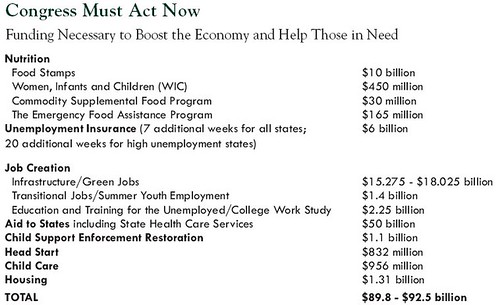
If the Coalition on Human Needs gets their way the answer to the question above will be sooner than you might think.  The Coalition’s new report, Towards Shared Recovery (pdf), makes the case for an economic stimulus package for boosting the economy by providing assistance to those who need it most.

Here are the specifics of what the report proposes:

The report:

presents Congress with key items that should be part of an effective stimulus package, including an increase in nutrition assistance, an expansion of unemployment insurance, investments in infrastructure and job creation, additional aid for states, help for victims of home foreclosure, and increased funding for Head Start, child care and child support programs.

Deborah Weinstein, Executive Director of CHN, explains: “Economists tell us that providing aid to low- and moderate-income people is the most effective way to boost the economy.”  The need for an additional economic stimulus package is well understood.  Others are calling for it from throughout the political spectrum…

Federal Reserve Chair Ben Bernanke:

“with the economy likely to be weak for several quarters, and with some risk of a protracted slowdown, consideration of a fiscal package by the Congress at this juncture seems appropriate.”

Brian Bethune, chief U.S. financial economist for the research firm Global Insight:

“Effectively, the Fed chairman is giving Congress a green light to go ahead with an additional fiscal stimulus package”

Douglas W. Elmendorf, former Treasury and Federal Reserve Board economist and fellow at the Brookings Institution:

“We need fiscal stimulus. The outlook is much darker than it was even a few months ago.”

Plenty of great work is being done in the private sector, but it is not enough.

A foundation driven effort called Spotlight on Poverty and Opportunity is pushing President-elect Obama to make poverty reduction a hallmark of his administration.  The Open Society Institute (Baltimore Chapter) has just awarded $450,000 in fellowships to eight creative individuals who are working to support underserved communities in Baltimore.  These types of programs are extremely valuable, and I applaud them.

But the fact remains that the private sector alone can not provide the types of supports and investments the American people right now.  Only a broad economic stimulus, targeted to help lower-income Americans, can get our country back on the right track.  Towards Shared Prosperity provides an excellent framework for such a stimulus program.  

Congressional Lemmings & The Paulson bailout Scheme

This is a letter sent to our Congressman, Adam Schiff.

*

We are in a cold fury one week after your hasty vote. You Congressional lemmings are wrecking the country. Those who created our financial crisis can’t fix it. Paulson called for self-regulation of investment banks for years. Greenspan extolled the value of derivatives and adjustable rate mortgages; Bernanke had no contingency plans. You didn’t read that 450 page bailout bill, full of pork and deception.

YOU AND THE LEMMINGS PRETENDED TO GIVE US A QUICK AND EASY FIX. . .YOU LIED. Congress pretended to oversee the Treasury. Paulson hires Wall Street cronies, like Morgan Stanley, to buy  securities at above market value- if they don’t pay above market value, the banks lose.  Congressional oversight? No way that after the fact hearings can change anything. What can you do if you don’t like the prices that the insiders paid? The British took a much wiser step to help their banks. They bought shares and fired the bosses, instead of buying worthless securities. Their plan is much better than the Paulson plan. Paulson now talks about buying shares, but nonvoting shares. Why let a drunk or incompetent driver stay at the wheel?  

YOU LIED when you said that executives of failed companies wouldn’t profit. The bailout bill is toothless. What about the AIG execs and their fancy St. Regis resort party? They cam back and got more money from Megapredator Paulson.

Bubbles Greenspan. Helicopter Bernanke and Megapredator Paulson caused this problem. They don’t understand. Letting New Orleans and Galveston rebuild in the old way is crazy. Wall Street ruined us by insisting that corporate earnings must rise 15% per year. That’s fine during a boom, but it’s unsustainable, even after offshoring jobs, cutting all benefits and screwing the workers. This fixation on stock prices and Greenspan’s excess liquidity increased income inequality and destroyed our infrastructure.  The Gulf Coast and the banking system must be ready for hard times, and reject gimmicks to control risk. We must spur demand and create jobs with a WPA to fix broken roads, bridges and disaster preparations. States aren’t prepared for a bird flu epidemic or major disaster, they are broke. You claim to be fiscally prudent but voted for earmarks for racetracks, arrows and movies. That’s outrageous.

You botched two critical votes. You voted for the Iraq War and the mindless bailout. You and Congressional lemmings rush to do something, anything, if the President says that it’s urgent. We will vote against you in every future election. The world has changed.  America is nearing bankruptcy. We can’t afford to send armies all over the world, killing, bombing from the air, with much collateral damage, paying Sunnis $300 every month to behave in Iraq.  We need the National Guard at home. Brad Sherman got it right, you lacked the guts to stand up for the country. Don’t send us mailers, excuses or any communications. We won’t read them.

[poll id=”

233

“]

The Bush Economic Black Hole Is Pulling California Under

As Congress passed the $700 billion handout bailout of Congress, news broke here in California of a $7 billion problem that has immediate and massive impact on regular working folks.

According to Reuters:

California may need an emergency loan of up to $7 billion from the federal government within weeks, the Los Angeles Times on Friday quoted Gov. Arnold Schwarzenegger as saying in a letter to U.S. Treasury Secretary Henry Paulson.

…

On Wednesday, California Treasurer Bill Lockyer said the most populous U.S. state’s cash reserves may be exhausted near the end of October, and various state-funded services are at risk of grinding to a halt.

…

In the letter, Schwarzenegger noted California’s plans to issue $7 billion in revenue anticipation notes in the coming days to fund short-tern cash needs — now put in doubt by the crisis in the credit markets.

Even a broken clock is right twice a day and Governator AHnold may actually understand what a dire situation this economic climate is becoming for the states:

“The economic fallout from this national credit crisis continues to drain state tax coffers, making it even more difficult to weather the continuation of frozen credit markets for any length of time.”

Sean-Paul Kelley over at The Agonist spells out the implications:

Look, if the States can’t function we’re all hosed. And the so-called Congressional bailout does nothing to address these issues. It’s not even remotely close to a ‘clear resolution.’ Even Krugman says as much, “Aid to cash-strapped state and local governments, which are slashing spending at precisely the worst moment, is also a priority.”

Remember Jefferson County and the City of Vallejo in California? We mentioned them here, as proverbial canaries in the coal mines and where was our government? Pretty much saying, “it’s contained.”

Here’s a question for Paulson and others: how do you contain Armageddon?

More from Paul Krugman:

How bad is it? Normally sober people are sounding apocalyptic. On Thursday, the bond trader and blogger John Jansen declared that current conditions are “the financial equivalent of the Reign of Terror during the French Revolution,” while Joel Prakken of Macroeconomic Advisers says that the economy seems to be on “the edge of the abyss.”

As Congress and the President argue over exactly how many zeroes to add to the Wall Street bailout, California teeters on the brink.

If “across the board bailouts” are going to be the safe bet with the current leadership then lets make sure we apply this standard across the board. Because I don’t trust Bush and Paulson not to gamble that California can be allowed to fail too. And Paulson’s bets have been going bad lately:

The wave of bad news began on Sept. 14. Henry Paulson, the Treasury secretary, thought he could get away with letting Lehman Brothers, the investment bank, fail; he was wrong.

For a fifth of the cost of the Bear Stearns bailout, a tenth of the cost of the Fannie Mae/Freddie Mac bailout, and one one hundredth of the cost of the Wall Street bailout, we can keep California state government from going under.

Bear Stearns, Fannie Mae and Freddie Mac, Lehman Brothers, and now California. The Bush economy is turning into a black hole and threatens to suck us all in.

CA-26: David Dreier Votes Yes On Bailout

(cross-posted from BushRubberStamp.com)

Today, for the second time this week, David Dreier voted YES on the House version of the bailout bill. While many smart people on both sides of the aisle might disagree on the merits of this bill and the urgency of doing something now even if it’s bad, it’s worth exploring why Dreier supported this bill.

David Dreier will tell you that he hates the position we find ourselves in. He’ll tell you that he supported this bill “reluctantly” and today on the House floor he even called the bill a “necessary evil.”

But here are a few things Dreier won’t tell you:

  • David Dreier received $254,000 in donations from the finance sector this cycle and $590,000 two years ago. Both times, this amount has represented more than two and a half times the donations he received from any other industry.
  • The American Bankers Association was the top donor to David Dreier’s American Success PAC this cycle.
  • David Dreier continues to vote against bills that would have curbed this crisis. In May of 2008, Dreier voted with Bush against measures designed to impose “increased oversight and regulation of housing-related government sponsored entities.” Sound familiar?

More…

So let’s get this straight. David Dreier takes hundreds of thousands of dollars from the people who got us into this mess, votes to obstruct government regulation of their industry and when they get in trouble he votes to give them a $700 billion taxpayer bailout?

Sure looks like they got their money’s worth.

Open Secrets explored the connection between House members’ votes on the first version of the bill on Monday and the level of donations they received from the financial sector:

Members of the House of Representatives who supported bailing out the financial sector with $700 billion in taxpayer money have received 51 percent more in campaign contributions from the finance, insurance and real estate sector in their congressional careers than those who opposed the emergency legislation, the nonpartisan Center for Responsive Politics calculated following the 228-205 vote on Monday that defeated the House bill. […]

The 65 Republicans who backed the bill have collected $1,078,533 from the finance sector in their careers and an average of $185,461 toward this election. The 133 Republicans who led the opposition to the bailout have collected, on average, $705,297 over their careers in Congress and $150,381 in this election cycle alone. That translates into a difference of about 23 percent in this cycle and 53 percent over time.

Since Open Secrets has been keeping track of donations in 1998, David Dreier has received more than $2 million from the finance sector, more than $800,000 of which was from the last 4 years alone.

Clearly, George W. Bush isn’t the only one whose agenda David Dreier rubber stamps in Congress.

The Fight for Main Street

Yesterday I voted against H.R. 3997, the Emergency Economic Stabilization Act (EESA), compromise legislation to bailout financial institutions saddled with large debts.

While the Bush Administration worked with Congressional leaders to fast-track this legislation, it was indifferent to the needs of Main Street. I cannot, in good conscience, vote for legislation that gives $700 billion to the same firms that helped cause the current financial crisis through irresponsible lending without providing meaningful help for homeowners who are in danger of foreclosure.

The economic crisis facing our nation began with bad mortgage and lending practices, including the use of predatory and sub-prime mortgages. It was these sub-prime mortgages which were then transformed by the market into securities and sold around the world. In the 32nd Congressional District of California which I represent, housing foreclosures have nearly tripled in the past few months. Over 1,500 families have lost their homes and over 2,300 are going through the foreclosure process.

The impact of such widespread foreclosures on our local economy and community is devastating. Homeowners living near foreclosed properties could see their property values decrease by an average of $5,000. It is expected that nationwide more than $100 billion in housing wealth will be lost through 2009 in foreclosures and their effects on neighboring properties. $166 billion in gross domestic product could be lost as a result of foreclosures, a loss that will lead to 524,000 fewer jobs being created.

Homeownership is a foundation that strengthens our families, stabilizes our communities, and boosts our economy. Yet, this bill lacked needed reform of bankruptcy laws to allow consumers to renegotiate the terms of their mortgage in bankruptcy courts to help keep their homes. Without addressing bankruptcy, provisions in the bill aimed at stemming foreclosures are not enough to provide real relief to struggling homeowners.

Homeowners on Main Streets should have the same rights to renegotiate their loans, especially those for their primary residence, as Wall Street. That is why it is critical that any solution to this financial crisis address the underlying instability in the housing market and provide relief for homeowners struggling under the burden of excessive mortgage debt. In addition to changes in the bankruptcy laws, I believe there should also be a mandatory moratorium on foreclosures for the limited period of time before the rescue plan takes effect.  If we are going to help keep banks solvent, we should also consider creating a fund to help families facing foreclosure stay in their homes.

I agree with civil rights organizations which today called on the leadership to also include an aggressive approach that will allow parties to modify the terms of their loans before these loans are purchased by the federal government. This approach would not only help keep families in their homes but would keep taxpayers from acquiring unnecessary debt.

I also believe working families deserve enactment of the Main Street Economic Stimulus Package, which I was proud to vote for last week. This bill would have extended unemployment benefits for the growing number of Americans looking for work for an additional seven weeks. It would have helped to sustain the safety net of services for our country’s neediest families by providing additional Food Stamp and Medicaid assistance.  It is incredibly disappointing that in the face of skyrocketing unemployment and increased need for food and healthcare assistance, the Bush Administration is instead prioritizing a huge cash infusion for Wall Street instead of needed investments for our country’s working families.

Congress and the Administration need to focus on real regulatory reform on Wall Street and real help for homeowners who face foreclosure.  We must enact bankruptcy court protections for foreclosures on primary residences.  We must pass comprehensive financial sector reform to restore integrity and stability to our financial system.  We must address the root of this financial crisis in order to prevent future problems. And we must grow jobs by investing in our nation’s infrastructure and funding green collar jobs training.

These are the actions that Congress must take to produce widespread and meaningful reform in our financial sector, provide a lifeboat for the thousands of families facing foreclosure, and provide economic security for families across our nation. These are the actions that I will support.

Bailout Fails in the House – California Progressives Organizing for a Better Solution

Goal ThermometerCalifornia needs more progressives in DC – contribute to the Calitics Match to make it happen!

While the traditional media is focusing on the spat between the House Republicans and Nancy Pelosi, credit also goes to progressive Democrats who refused to go along with a huge giveaway to Wall Street that lacked accountability and repayment guarantees. Some of them have given statements explaining their votes.

Hilda Solis:

Today, I voted against H.R. 3997, the Emergency Economic Stabilization Act (EESA), compromise legislation to bailout financial institutions saddled with large debts. I am very concerned about the credit crisis created by the housing market meltdown and while I appreciate efforts of the Democratic leadership to work in a bipartisan fashion to improve the Bush Administration’s proposal, this legislation lacks needed taxpayer protections and assistance for Main Street families like those in the Congressional District I represent.

“I cannot in good conscience, vote for legislation that gives $700 billion to the same firms that helped cause the current financial crisis through irresponsible lending without providing meaningful help for homeowners who are in danger of foreclosure. In the 32nd Congressional District, housing foreclosures have nearly tripled in the past few months, with over 2,300 homeowners currently going through the foreclosure process. The impact of such widespread foreclosures on our local economy and community is devastating.

“Unfortunately, this legislation will not help the families who are stretching paychecks and trying to hold onto jobs without additional steps to stabilize our housing market. It lacks needed reform of bankruptcy laws to allow consumers to renegotiate the terms of their mortgage in bankruptcy courts to help keep their homes. Homeowners on Main Streets should have the same rights to renegotiate their loans, especially those for their primary residence, as Wall Street.

Pete Stark:

President Bush tells us that we face unparalleled financial doom if this $700 billion bailout is not approved today.  He and his Treasury Secretary – a former Wall Street fat cat – tell us that we have reached the point of “crisis.” That is a familiar line from this President.  It sounds like the disastrous rush to war in Iraq and the subsequent stampede to enact the Patriot Act.   As I opposed the Iraq War and the Patriot Act, I stand in opposition to his latest rush to judgment.

“We are not in a sudden crisis.  It has been building over the past 8 years of the Bush Administration. Lax oversight of the financial industry ballooned into a house of cards….

“The bill before us today is basically the same three-page Wall Street give away first put forth by President Bush.  The fig leaf adjustments are not enough to outweigh the fact that no one knows if this bill is what’s needed.  I’m not willing to make a $700 billion gamble that President Bush is right after 8 years of seeing all that he’s done wrong.

Matt Stoller has the progressive bailout plan authored by Barbara Lee and Lynn Woolsey, which I blogged about a few days ago. The key points of their plan:

  • A 0.25% tax on all stock trades and “exotic transactions” such as derivatives trading as a kind of “progressive PAYGO” to ensure that the taxpayers won’t be paying the costs of the bailout.
  • Equity shares in any companies that benefit from the bailout
  • “Major bankruptcy reform” including homeowner renegotiation of mortgages. Obama undercut progressives on this when he said bankruptcy reform didn’t need to be part of the package, perhaps a telltale sign of how unprogressive an Obama administration might be. But it’s still a necessary part of any financial solution.
  • A detailed list of new regulations to protect consumers and provide more stable, responsible regulation of the financial industry to prevent a recurrence of this crisis.

If we want to ensure that we have more and better Democrats to push progressive economic policy in the Congress next year, we need to help them win this November. Join our Calitics Match and help send Charlie Brown and Debbie Cook to Congress, and Hannah Beth Jackson, Manuel Perez and Alyson Huber to Sacramento.

UPDATE by Dave: On the flip, a list of the ayes and nays among out Congressional delegation.

Democrats:

Aye

Berman, Capps, Cardoza, Costa, Davis, Eshoo, Farr, Harman, Honda, Lofgren, Matsui, McNerney, George Miller, Pelosi, Richardson, Speier, Tauscher, Waters, Waxman

No

Baca, Becerra, Filner, Lee, Napolitano, Roybal-Allard, Linda Sanchez, Loretta Sanchez, Schiff, Sherman, Solis, Stark, Thompson, Watson, Woolsey

There’s almost no rhyme or reason to this.  The CW is that No was an easier vote in close races, but the only close race on the Dem side in California, Jerry McNerney, resulted in a yes vote.  You have progressives on both sides of this.  You have Bush Dogs on both sides (Costa and Baca, for example).

Republicans

Aye

Bono Mack, Calvert, Campbell, Dreier, Herger, Lewis, Lungren, McKeon, Gary Miller, Radanovich

No

Bilbray, Doolittle, Gallegly, Hunter, Issa, McCarthy, Nunes, Rohrabacher, Royce

Paging Russ Warner… this is a gift for you.  Dan Lungren and Mary Bono Mack might have some trouble, too.  At the same time, depending on the short-term economic circumstances, this could rebound back on those intransigent Republicans.  So the political fallout is completely unclear to me.