Tag Archives: bailout

California Progressive Members of Congress Seek Bailout Improvements

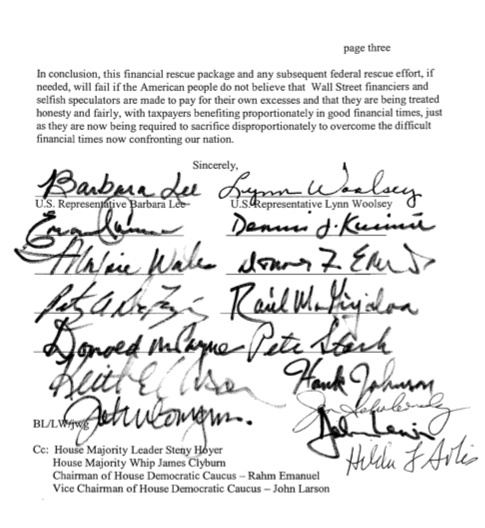
Matt Stoller at Open Left has reproduced a letter from progressive Democrats in the Congress demanding changes to the proposed bailout package. Barbara Lee and Lynn Woolsey are the two lead authors, and other California members of Congress who have signed it include Hilda Solis and Pete Stark.

The letter insists that 4 kinds of reform be included in any bailout:

  • A 0.25% tax on all stock trades and “exotic transactions” such as derivatives trading as a kind of “progressive PAYGO” to ensure that the taxpayers won’t be paying the costs of the bailout.
  • Equity shares in any companies that benefit from the bailout
  • “Major bankruptcy reform” including homeowner renegotiation of mortgages. Obama undercut progressives on this when he said bankruptcy reform didn’t need to be part of the package, perhaps a telltale sign of how unprogressive an Obama administration might be. But it’s still a necessary part of any financial solution.
  • A detailed list of new regulations to protect consumers and provide more stable, responsible regulation of the financial industry to prevent a recurrence of this crisis.

The progressives’ move in Congress comes as more economic observers question the need for a bailout. It’s possible that this represents the first move by the 74 members of the Progressive Caucus to block a bill that in particular lacks bankruptcy reform. Even so, an axis of Bush Dogs, House Republicans, and timid/weak/complicit House Democratic leadership may prove to be too much for the Progressive Caucus to overcome.

Still, this letter is a welcome move by California progressives like Barbara Lee and Lynn Woolsey. The bailout needs to be either made a fundamentally progressive policy move or stopped entirely. If a progressive coalition is to come together to stop it leadership from the Progressive Caucus is a necessary component. Even if it is too little too late, it potentially marks the beginning of a push for truly progressive solutions to our economic crisis – the kind that FDR and the Democratic Party stood for 75 years ago, but that current Democratic leaders from Obama on down have now eschewed.

UPDATE: A deal has been announced, although the details have been slow to materialize – a likely sign that the deal isn’t exactly set in stone. More significantly Republicans are being pressured to deliver 70-100 votes which suggests that Congressional progressives, especially those from California, do have leverage to stop this train wreck. Universal health care, green infrastructure, a jobs-and-wages economic recovery – all those things are imperilled by this bailout. Better to deal with this after January 20.

Want to End Giveaways to the Wealthy? Ask the Governor to Sign AB 583!

The current plan to give $700 billion away to Wall Street – the same ones who got us into this mess – is a sign we need Clean Money public financing of campaigns more than ever.  Finance, insurance, and real estate firms have poured over $5 billion in contributions into politicians’ hands since 1990.  They’ve already been paid back by special interest giveaways many times over, and now they’re asking for over $2,000 from every man, woman, and child in the country.

Clean Money is the Only Way to Stop this Madness From Happening Again and Again!

Urge Governor Schwarzenegger to sign AB 583, the California Fair Elections Act, to start ending special interest dominance of politics by sending him a fax right now:

www.CAclean.org/letters

By providing for Clean Money for Secretary of State candidates, AB 583 would let California show the rest of the nation that there’s a much better way, not to mention making sure that the elected official responsible for the very integrity of our elections doesn’t have to fundraise.

Once you’ve sent your fax, please make a call to the Governor as well.  It’s quick because AB 583 has already gotten so many calls that they had to make it one of only five bills (out of 875!) that have their own automated response option.

CALL 916-445-2841 NOW!

You’ll get an automated system when you call so won’t need to even talk to anybody. Do the following:

> Press 1 for English

> Press 2 to “Voice your opinion on legislation”

> Press 5 “about AB 583, regarding the Political Reform Act”

> Press 1 “to register your support”

The line may be busy at first because so many people are calling.  Keep trying until you get through – you should after a few tries.

The Governor said it best:  Special interests have a stranglehold on Sacramento.  Here’s how it works.  Money comes in.  Favors go out.  The people lose..

Remind the Governor of his chance to change that by sending the fax and making the call:

www.CAclean.org/letters

California Clean Money Campaign

www.CAclean.org  

Prop 10: The T Boone Bailout

I will be on KRXA 540 AM at 8 this morning to discuss this and other California politics issues

One of the defining features of capitalism in the 21st century has been the arrogance of its most wealthy practitioners, now manifested by their belief that they’ll be bailed out and not forced to suffer any consequence for their criminally reckless bad judgment.

So it’s not just coincidence that as the financial robber barons of our time are demanding a massively unpopular bailout, another wealthy baron who made his money at the expense of Americans is seeking a bailout from California voters this November.

T. Boone Pickens is worth about $3 billion, a fortune amassed from his years as a corporate raider during the 1980s and his large stake in oil companies like ExxonMobil and Occidental.

Along the way he became a leading funder of right-wing causes, and was the primary backer of the notorious Swift Boat veterans, whose lie-filled ad against John Kerry helped swing the 2004 election to Bush. T. Boone promised he’d pay $1 million to anyone who could disprove the allegations, but reneged when John Kerry himself took him up on the offer.

T. Boone is seeing the handwriting on the wall for the oil economy, and wants to build up his natural gas business. Problem is, he wants to build up that business at our expense. He put Proposition 10 on the ballot and is spending his own money to run ads for it. Essentially he wants California taxpayers to bail him out to the tune of $5 billion.

The LA Times last week editorialized against Prop 10, explaining it and why it is such a bad idea. They call it a “reprehensible scam“:


This measure asks taxpayers to fund $5 billion in bonds — at a time when the state is in desperate financial straits and may be approaching a dangerous level of indebtedness — for a scheme disguised as an effort to benefit the environment. Yet its true aim is to subsidize vehicles powered by natural gas, which would build a customer base for its sponsor: Clean Energy Fuels Corp., a company Pickens co-founded that operates natural gas filling stations throughout the U.S. and Canada.

The measure generously doles out taxpayer money for a variety of green-sounding initiatives: $200 million for alternative energy demonstration projects at eight California cities, none of which are clamoring to perform them; $1.5 billion in grants and incentives for research and development of clean energy technologies and alternative fuel vehicles, a field that venture capitalists are already shoveling cash into; $250 million for renewable energy generation equipment. But the lion’s share of the bond money, $2.875 billion worth, goes for rebates on purchases of alternative fuel vehicles.

The rebates are structured so that only a small amount of money goes to truly environmentally beneficial vehicles, while most would subsidize those that run on natural gas.

The American public rightly opposes the Bush Bailout for Wall Street crooks. Why should Californians support a bailout for an already-wealthy oilman, one responsible for some of the most disgusting political lies of our time?

On Crying Wolf, Or, Why I Don’t Want To Give You $700 Billion

As this is being written we are in the midst of the second day of testimony before Congress by Ben Bernanke and Henry Paulson in support of the Administration’s proposed financial rescue package.

The basic sales pitch is that the Nation’s financial problems are at this moment so severe that the only solution is to expose to risk $700 billion dollars of taxpayer money to buy assets with a currently unknown price…and to give the absolute and total power over what those valuations are, what should and should not be bought, what repayment terms will be sought-and additionally, what happens to any money recovered–to one man, Henry Paulson.

There are those who are not on board. They have critics, who continue to stress the dire consequences of inaction.

With all due respect to those critics…we have been down this road before with this Administration-and last time, they weren’t so big on telling the truth…or getting the job done effectively.

We’ll cover that ground, we’ll talk a bit about “mark to market” issues-and on a positive note, we’ll address the role of “warrants”, the negotiating power of Warren Buffett, and how the taxpayer could actually see substantial recoveries of money down the road.

So let’s start with the biggest elephant standing in the Plan’s way:

Weapons Of Mass Destruction.

This Administration flat-out lied to the American people to justify the current Iraq adventure. “Just trust us” was the basic message at the time, followed by “we absolutely know that Saddam is an imminent threat because of his Weapons Of Mass Destruction”, followed by “this will cost maybe $50, 60 billion…maybe as much as $200 billion”–which turned out to be possibly the worst estimate in the history of budgeting–followed by variations on The “I’m not the Commander-in Chief, General Petraeus is” Theme…followed by flag-draped caskets that the Administration still hides from public view.

All of this to find not one single operable WMD.

Now comes before us Federal Reserve Chairman Henry Paulson and Treasury Secretary Ben Bernanke, who tell us of imminent threat, who tell us to just trust them…who tell us that they are the most qualified people to understand the issues and take the appropriate action…and who, to top it off, must be left to the task unsupervised and uncontrolled, otherwise the plan will fail.

We are also being told that if we were just economically sophisticated enough we would understand why this plan must be put into place, and that our objections must be related to our economic ignorance.

To which I pose a question to the Joe Kernans of the world (well, one of them anyway): what if the public fully understands that the system is at risk…but we don’t trust the leadership?

(Ever watch “Sex And The City“? This would be the part where they would cut to Carrie’s laptop screen and we would see the words appear as she types them…)

…What if we think the Administration is lying?

I have heard so many lies from the President and his advisors that if Jesus Christ was Treasury Secretary and Mohammed (PBUH) was Chairman of the Federal Reserve I would have doubts about this proposal.

Back in March, Paulson (who, it turns out, is not a Deity) was telling us that “the worst is behind us“…meaning he either does not really understand what is going on here-or that somebody is trying to blow smoke up some unpleasant places, using Paulson as a sort of economic “General Petraeus” who is intended to divert attention from the real economic Commander-in-Chief.

So can this Administration be trusted to handle this without outside supervision?

“Trust, but verify”, Ronald Reagan used to say, and without outside oversight this proposal should be instantly dead on arrival to the Congress.

This might be the most critical issue surrounding this entire plan…and we must demand Congressional oversight. This is far too big a process for any single individual to manage-and too big for any single branch of Government, as well.

Go watch this satirical slap at Bernanke from a wannabe Bernanke.

It’s hilarious-and revealing.

That issue resolved, some economic education is in order:

What, you may ask, is “mark to market”?

Holders of assets are required, for accounting purposes, to report the value of those assets based on what they are worth at the current time. Normally you do this by seeing what “the market” thinks your asset is worth-something that is fairly easily done if the asset is, for example, your house.

On a larger, corporate scale, this marking to market each accounting period can cause the state of your company’s balance sheet to lurch around and gyrate from time to time-sometimes violently…which is the source of much complaint from corporate interests, but for the most part, it all works out. Recently, it has not.

The challenge in today’s economic environment is to figure out what an asset is worth when no market exists for that asset.

Banks are holding quibzillions © of dollars worth of paper that represent streams of mortgage payments that will continue for years into the future…but some unknown number of those mortgages will not be repaid.

The concerns about what can be repaid (or not) and who is holding how many of these “nonperforming” loans has caused virtually all the normal buyers of these kinds of assets to run away in fear, which is the simplest way to explain the “credit crunch” we hear so much about.

The Paulson proposal is based on you and I buying some portion of those assets, today, from the current holders and reselling the assets later. This will allow banks and other institutions to begin making loans, and will hopefully create the confidence needed to induce investors to again buy “pools” of those loans from those banks…after which, the lending cycle begins anew.

The hoped-for outcome, from the perspective of ordinary mortals such as you and I, is to minimize any losses to the taxpayer…or maybe, if we get lucky, generate a profit.

The hoped for outcome, for the current holders of these assets, is to minimize their loss.

So how do you decide what price the taxpayer will pay for these assets?

Picture, if you will, a $100 US Savings Bond. If you bought that bond today, it would cost you $50, and in 17 years the US Treasury will pay you $100, representing the interest income to you from that loan to the Treasury.

The “hold until original maturity” value of that bond is $100.

The “mark to market” value, if you’re “marking” it the day you bought it, is $50.

If you became convinced the Treasury might not pay back the loan, or all the interest, you might sell the bond for less than the original $50, just to recover something from the deal.

That process will work as long as someone else is willing to believe the bond will be repaid, and is willing to put up enough money on that bet to get you to sell.

If no buyer can be found, your bond’s value becomes either “unknown” or “zero”, your personal assets decline-and maybe, down the line, your credit score is affected by some small amount.

Picture that on a massive, quibzillion © dollar scale, and you can see what is happening in the mortgage market today-and to the investors, all over the world, that hold the debt from our collective mortgages.

When the Treasury prepares to buy a CDO or some other mortgaged-backed security from an investor in the near future, Paulson will have to decide, with no help from any market mechanism, if that paper is worth the “hold to maturity” value, zero, or somewhere in the middle…and he has no way to know if the pool of mortgages he’s buying with our money will be 100% repaid, 0% repaid, or something in between.

This issue will be one of the most contentious parts of the entire deal (and the most ripe for abuse…as it would be very easy indeed to reward friends and punish enemies in a system with no oversight), so watch carefully to see how it plays out.

Hint: when asked about this today, I heard Bernanke answer that he expected the Treasury to pay prices similar to what are seen “…in a more normal market…”.

Another satirical video: “Damn, it feels good to be a Banka”.

What’s a warrant?

It sounds all technical and tricky, but actually it’s not.

Warren Buffet invested $5 billion dollars this morning in Goldman Sachs, and as part of the deal he got the right to purchase up to $5 billion in Goldman Sachs stock, at a time in the future of his choosing, for $115 a share (roughly 43.5 million shares). That right is referred to as a warrant.

At this moment, the stock’s last trade was at $130.48. The difference between $115 and $130 is the current available profit to Buffett if he were to “execute” this warrant right now (which is just over $650 million profit in less than 12 hours)…but it’s not the maximum potential profit executing this warrant might bring.

In November of ’07 Goldman Sachs traded at $250 a share…and if Buffett is able to someday execute the warrant at that “strike price” (fancy technical term) the profit on his 43.5 million available shares would be $5.8 billion.

When we take assets from banks and other investors with depressed stock prices, we as taxpayers need to make the same deal Warren Buffet made-we need to demand warrants, and later, sell that stock back to the market, reducing the cost to the taxpayer over the long term…and maybe even making us actual profit….which could help to repay some national debt, perhaps?

There is precedent here. In the 1980’s the US did a bailout deal with Chrysler that involved issuing warrants…and the profit to the Treasury was substantial.

This is an additional huge part of the deal…and you can bet that there will be investor stockholder groups that will lobby-and lobby hard–to stop us from getting warrants.

We need to demand that we get our cut of the profit our tax dollars create…and to do that we need to get warrants as part of these deals…so bug your Member of Congress loudly and quickly on this one.

So, for the moment, let’s recap:

If the Administration wants to sell this plan they better acknowledge that it isn’t economic ignorance that’s the issue…that, instead, the problem is the basic element of distrust that they previously created by lying about matters of war and peace and Katrina…and if you want any plan at all, this is the issue you need to fix first.

Next, we need confidence that the prices paid for bad assets are not going to be excessive, we need oversight that allows us to be confident this isn’t another typical “reward and punish with taxpayer dollars” operation; and finally, we need to demand warrants, the tool that could make this something that turns the transactions, for a change, to the advantage of the taxpayer.

If we insist on these sorts of protections we have the chance to make this at least a fair deal for the taxpayer-and maybe even a good one. After all, if Warren Buffet can get good terms for a mere $5 billion investment…imagine the negotiating power $700 billion should be able to get us.

Even without the Priceline Negotiator, we should still demand the best deal possible…and if the currently frozen financial services industry doesn’t like that, perhaps they should borrow $700 billion somewhere else.

[poll id=”

226

“]

On A Way Forward, Or, Practical “Subprime Crisis” Solutions

AUTHOR’S NOTE: This was originally published on February 14th of this year, but it seems to be exceptionally timely today.

We had a lively discussion last week regarding the causes and possible future of the “subprime crisis” that is on everyone’s lips these days.

Having examined the sources of the problem, and noting the lack of holistic thinking about how things might be resolved, I’ve taken it upon myself to come forward with an idea that can actually get at the root causes of today’s difficulties…and do it in a way that offers a potential “win-win-win” outcome for homeowners, investors-and the taxpayer.  

Paying attention, Presidential candidates?

Good-because time is short, and we need to get to work.

For today’s solution to make sense, we, like Sherman and Peabody, need to make use of the “WABAC Machine”. We’ll set the time dial to the late 1980s, and we’ll set the location as the headquarters of the Resolution Trust Corporation.

What we’d find is a governmental organization established at the height of the “savings and loan crisis” of the 1980s. The savings and loan companies had made a series of bad real estate investments (much like today), and many had already entered or were in danger of bankruptcy.

Perhaps not surprisingly, many of the same names we recognize today from the world of politics were also to be found “doing bidness” at the time of the birth of the RTC…and if you look it up, you’ll find such luminaries as John McCain, Barney Frank, and even Neil Bush doing things that they today wish we would forget.

In fact, there were so many people doing things they wish we would forget that the RTC was needed to find buyers for all the bankrupt savings and loans that had piled up across the nation. The way this was accomplished was to use regulatory pressure to politely force the bankrupt to accept offers from the more solvent.

As a result, the Silverados of the world vanished, and Keating Five became part of the lexicon.

And with the history lesson complete, let’s scoot on back to the “WABAC” machine and return to the present day, shall we?

Those who participated in our bond insurance discussion (and many who didn’t) may recognize that the biggest problem currently affecting the American financial sector (and beyond) is an inability to accurately determine the exact value of various financial assets.

As you may recall, we noted that one form of these assets are “collateralized debt obligations” (CDOs), which are fundamentally income streams from loans backed by real estate collateral. The original debt was incurred in the form of mortgages or equity loans. The current owners of these assets are not the originating lenders; but instead investors scattered across the planet which have purchased bundles of these loans, a process known as “securitization”.

Because there is a disconnect between an investor in Singapore who purchased a CDO and the borrowers back in the USA who are supposed to be making the payments; it is at the moment impossible to determine with any accuracy the actual value of any particular CDO. In other words, if you invested in loans and you don’t know who might fail to pay, how can you know what your investment is worth?

Lenders, regulators, and investors prefer clarity above all else. In a perfect world, borrowers who might be in trouble would promptly contact lenders to initiate a “workout”. Then everybody would know the status of every individual CUSIP, and life would again return to a state of near normality. (CUSIP is a fancy technical term: each individual loan that makes up a CDO is known colloquially as a CUSIP, and has a CUSIP registration number. Other types of debt instruments, such as bonds, also use the CUSIP registration process.)

But how is that supposed to happen when neither the borrower nor the investor know each other?

That’s where this proposal comes in.

Imagine, if you will, a new Resolution Trust Company that would be chartered with the purpose of creating a “clearinghouse” where investors and borrowers could reach accommodation-and where the status of individual CUSIPs could be determined, registered, made known to participating investors, and, in a privacy protected form, to the public at large.

On the investor side, the process would begin with each investor voluntarily “registering” their CDOs with the new RTC. The registration process would determine exactly which CUSIPs are associated with every registered CDO, and this data would be maintained in a public database.

On the borrower side, an advertising campaign that might look like the ads you see for “credit counseling” services would be run by the RTC…something like: “Are you facing foreclosure? We can help to keep you in your home. Call 800 NO FORECLOSE today”.

The RTC would be empowered to act under a limited power of attorney on behalf of the registered investors and would have the authority to negotiate payment arrangements that might include extending the term of the loans at lower payments, some form of delay on “teaser rate” ARM adjustments, or converting the ARM to a fixed-rate loan-or any combination of the above, as warranted.

In extraordinary cases, the RTC could facilitate direct negotiations between homeowners and investors-and in cases where the home is “under water” (the amount owed is greater than the home’s value) such negotiations will be needed.

Every day, as more and more homeowners call in and the status of their loans is determined (“current-no issues”, “default”, “in processing”, “resolution unsuccessful”, “unknown”, and “resolved” are examples of categories to which the loans might be assigned) they can be matched to their registered CUSIP. As the database fills, this creates the clarity that allows more accurate valuation of the CDOs associated with the CUSIPs…which should be the necessary first step in resolving the valuation issue that’s currently choking up the financial markets.

By publicly posting the loan status and the CUSIP number-without other personally identifiable information-it would be possible, to some degree, to protect the homeowner’s personal credit information from public view, while still offering an “open and public” assessment by an independent third party of the CDO to which the CUSIPs are associated…which means private financing can return to the mortgage market with renewed confidence in what they’re buying…which should also have a positive affect on the stock prices of some of the most beaten down companies in today’s market.  

At the same time, as the foreclosure rate declines (if this proposal were successful, that could happen rather quickly) less surplus real estate appears on the market…making investment in land and homebuilding once again a reasonable business proposition. Fewer foreclosures also means less decline in the value of affected neighborhoods, which means the neighbors benefit as well.

All of this could be funded by a registration fee per CUSIP (or based on the amount of the loan) charged to the investors that covers the cost of the RTC’s operations.

You might have noticed that I have not referenced what might be the most daunting problem a new RTC might face: the problem of large loans for large projects. How does the $30,000,000 loan to the Florida land developer who has a half-finished condo complex as collateral get worked out?

I have no idea, but it seems to me that the role of the RTC might be best served by doing the high-volume, “cookie-cutter”, single-family home resolutions (and similar duplex, triplex, and other “small unit” properties), leaving the most complex solutions to be negotiated directly between borrower and investor, with loan servicers and bond insurers charged with facilitating resolutions of these problems on their own.

If solutions can’t be found, the bond insurers are on the hook for the income stream, but if the bond insurers default the investors will get nothing (even when they do get paid the cross-ownership is so convoluted that as we move through the process some of the investors will potentially have to work out deals with themselves), so everyone involved should already-or soon will-have what R. Lee Ermey once famously referred to as “the proper motivation“.

So with all that said, what do we have?

We have a proposal that creates a new RTC for the purpose of “clearing” CUSIPs, which allows CDOs associated with those CUSIPs to be valuated, which creates the conditions for private investment to return to the mortgage market.

We do this with the only cost to the taxpayer being limited to incidental costs (registration fees not collectable, and the cost of enacting the legislation, for example) and the burden of bearing the upfront costs of establishing the RTC and launching the ad campaign-which presumably will be recovered as the process moves along to conclusion.

We also do this without changing the “risk profile” of the loan portfolios held by Fannie Mae and Freddie Mac-a potentially huge benefit to the taxpayer.

The investors, bond insurers and loan servicers win because it suddenly becomes possible to credibly and independently valuate the CDOs, communities win if foreclosures return to normal levels, and homeowners get to keep their homes and credit ratings…and the larger economy benefits as the CDO market, for the first time, feels the “cleansing effect of sunshine” brought on by greater disclosure.

And to top it all off, the “moral cost” of the bad choices made are borne by the involved parties, rather than the American taxpayer: homeowners who made bad loan choices still have to pay off the loans, even if it takes longer than they originally thought…investors will lose or have delayed some portion of their interest income…and the best part-investors and “predatory lenders” who foolishly participated in sketchy loans to currently “under water” borrowers will probably lose some or all of the value of those investments as the true state of their CDO portfolio becomes known to the market at large.

[poll id=”

225

“]

Nancy Pelosi vs. Charles Schumer

As the discussion over the horrific bailout plan unfolds – you know, the one that gives Henry Paulson the powers of a Caesar – it is becoming clear that the biggest risk to our nation’s future is the usual political formulations that have crippled the Democratic Party these last eight years, and turned Nancy Pelosi’s speakership into one of the most ineffective of the modern era.

Specifically, the problem is the ongoing ability of the Blue Dogs – and one Charles Schumer, Senator from New York – to frustrate anything that is not pro-corporate and ultimately pro-Bush. They have succeeded in neutering the Democratic Congress that was elected in 2006, and if they aren’t stopped this week, they may succeed in crippling an Obama Administration before it can even get started.

Schumer is emerging as Paulson’s key water carrier in the Congress. On Fox News Sunday Schumer gave cover to conservative arguments about not attaching strings to the bailout:

Schumer…said that legislators would not imperil the proposal by adding too many extras. “We will not Christmas-tree this bill,” he said Sunday on Fox. “The times are too urgent.”

A stimulus package, he added, “doesn’t necessarily have to be part of the bailout.”

“Christmas tree” is conservative framing designed to equate any efforts at accountability,  reregulation and economic recovery as a kind of pork. Schumer shows his true colors in repeating this framing.

This is partly an attack on Speaker Nancy Pelosi. Pelosi has long been pushing a “second stimulus” package that would include infrastructure projects, aid to state budgets for Medicare (especially important for us in California), and other common-sense policies. Pelosi has started to suggest that the bailout should be linked to something like a second stimulus, if not the second stimulus itself:

She says the bailout should include provisions to help families facing foreclosure to stay in their homes, as well as create jobs, extend unemployment benefits and prevent CEOs of failed companies to leave with multimillion-dollar “golden parachutes.”

Schumer is here signaling his intention to prevent any of that from being attached to the bailout. But as the “second stimulus” and its affiliated concepts have not been able to break through the Republican working majority in the House (that is GOP + Blue Dogs), attaching it to a bailout seems the best chance of putting it into action.

Schumer is also undercutting Barack Obama, who today listed six conditions that must be met for him to support any bailout, conditions that are not unlike those Pelosi has been pushing.

It’s not hyperbole to say this is a crossroads moment for America, California, the Democratic Party, and for Nancy Pelosi’s speakership. It’s time for her to show the leadership she has not yet been willing to show in this Congress, and flatly refuse to support any bill that does not include meaningful stimulus and reforms. Sen. Bernie Sanders has a great list of ideas that should be the baseline.

And it’s time for we Californians to pressure our elected officials to support Pelosi and Obama, and to categorically reject the failed policies of Schumer, the Blue Dogs, and the Bush Administration. Now is the time to call your representatives and our senators – especially the unreliable Dianne Feinstein – and insist that they support Pelosi, Obama and Sanders and ensure that any bailout helps Main Street, not Wall Street, and punishes failure, instead of rewarding incompetence.

The Biggest Bailout Ever

( – promoted by Robert in Monterey)

Cross posted on myDD

Like the proverbial thief in the night, the US federal government snuck in Friday night and bailed out Fannie Mae and Freddie Mac. I hate to say I told you so, but I wasn’t surprised. They didn’t really have a choice

The Ministry of Finance and the Federal Reserve had no choice but to intervene due to one single reason: The collapse of Fannie Mae and Freddie Mac could have precipitated a core meltdown of the American bank and stock market systems, dragging the rest of the world with it into the abyss.

That is because these two banks are responsible for $5.3 billion (3.7 billion euros) of America’s $12 billion (8.4 billion euro) total mortgage debt. That corresponds to one third of America’s gross domestic product.

But never fear, the CEOs of the collapsing companies are safe:

Under the terms of his employment contract, Daniel H. Mudd, the departing head of Fannie Mae, stands to collect $9.3 million in severance pay, retirement benefits and deferred compensation, provided his dismissal is deemed to be “without cause,” according to an analysis by the consulting firm James F. Reda & Associates. Mr. Mudd has already taken home $12.4 million in cash compensation and stock option gains since becoming chief executive in 2004, according to an analysis by Equilar, an executive pay research firm.

Richard F. Syron, the departing chief executive of Freddie Mac, could receive an exit package of at least $14.1 million, largely because of a clause added to his employment contract in mid-July as his company’s troubles deepened. He has taken home $17.1 million in pay and stock option gains since becoming chief executive in 2003.

Meanwhile more than one half of the state governments in the U.S. are running massive deficits too, but no bailout is in store for them.

As I’ve been posting for a while, the money being spent on bail outs for financial entities is larger than the combined deficit of all the states. This report from the Center on Budget & Policy Priorities shows that the states are now being hit hard by the same hard economic times that dropped Bear Sterns and now Fannie and Freddie:

At least twenty-seven states, including several of the nation’s largest, face budget shortfalls in fiscal year 2009. Of these 27 states, specific estimates are available for 22 states and the District of Columbia; the combined deficits of these 22 states plus the District of Columbia are expected to total at least $39 billion for fiscal 2009 — which begins July 2008 in most states. Another 3 states expect budget problems in fiscal year 2010, although some of those gaps may occur earlier than expected.

…

The 22 states in which revenues are expected to fall short of the amount needed to support current services in fiscal year 2009 are Alabama, Arizona, California, Florida, Illinois, Iowa, Kentucky, Maine, Maryland, Massachusetts, Minnesota, Nevada, New Hampshire, New Jersey, New York, Ohio, Oklahoma, Rhode Island, South Carolina, Vermont, Virginia, and Wisconsin. In addition, the District of Columbia is expecting a shortfall in fiscal year 2009. The budget gaps total $39.1 to $40.8 billion, averaging 8.9 – 9.3 percent of these states’ general fund budgets.