
All posts by Robert Cruickshank

Embracing California’s Urban Future

Dan Walters has an interesting column in today’s SacBee on SB 375 and the shift away from sprawl. His argument is that it may be the landmark moment in a shift away from locally-controlled land use policies favoring sprawl toward state-controlled policies favoring density – but that this could cause a political backlash.

He’s not entirely wrong about this, but neither is he entirely right. Before we assess land use policy and its utterly central role in California politics we need to understand just what it is we’re talking about – otherwise our political actions may wind up changing little.

Walters writes:

Although critics frequently denounced the model as wasteful and inefficient “sprawl” that encouraged cultural and racial segregation, it appealed to newcomers because it offered opportunity to acquire real estate they could call their own.

Cultural and racial segregation were important factors in the production of sprawl. Many who moved there already owned property in the urban cores. It’s not that they needed property of their own – but that they wanted a community of “their own” – as in white and middle class. If segregation wasn’t so central to the suburban project then why were so many suburban developments off-limits to people of color? Why did Californians reject Prop 14 in 1964, which would have outlawed the continued segregation of the suburbs?

The derisive term “sprawl” was really just “a decentralized community” in the words of Mark Pisano, who headed the Southern California Association of Governments, a regional planning agency, for three decades – or so he said in the mid-1980s. “This is the way people want their community,” Pisano was quoted in a 1986 book about California development patterns. “The individual’s mobility and freedom is where people want to go.”

This is the Tom McClintock fiction of suburban life. In fact suburbia has very little freedom of mobility. Suburbs like those in Orange County, where I was born and raised, are car-only. For decades they actively resisted providing mobility choices. Bikes and pedestrians were discouraged. Rail was flatly rejected, and even though dozens of passenger trains now ply OC’s rails they recently killed a light rail project. There is no mobility freedom in California suburbs – only the tyranny of the car.

And those actions were the result of deliberate governmental choices, including on the state level. Even at a time when everybody and their brother knows we need to provide more mass transit, Sacramento politicians continue to gut the transit budget.

Walters goes on to paint a picture of cities making local decisions outside state guidelines:

The state could have theoretically affected land use by wielding its latent power, such as control of transportation projects and water supplies. Local officials, however, guarded land use authority jealously, not only for financial reasons, but because their voters wanted to control their communities’ socioeconomic ambience. And with the exception of coastal development, the state largely left land use alone.

This is not entirely true. California has not mandated a statewide urban growth management plan the way Washington and Oregon have. But California has greased the skids for sprawl for decades. An important and often overlooked factor in the passage of Prop 13 was a desire to stop Jerry Brown’s urban density program and starve the cities of tax dollars to provide economic opportunity and the resources for urban growth. It gave sprawling suburbs a massive tax break. The state legislature further obliged the suburbs in 1982 by passing the Mello-Roos Act, which allowed developers to pass fees onto buyers for schools – but did nothing for urban school districts.

Walters suggests that Darrell Steinberg’s SB 375, which Arnold signed this week and finally links land use planning to global warming – 38% of California carbon emissions are from transportation, which sprawl helps produce – could lead to a political backlash:

It’s a momentous step, but also one that could create a backlash among cultural traditionalists and create even more political fault lines in an already highly fragmented state.

“Cultural traditionalists?” Sorry Dan. California’s sprawling suburbs aren’t a cultural choice. That’s a myth. They are the product of decades of favorable land use policy.

How else to explain the fact that so many young people from the suburbs – myself included – make a beeline for the urban cores as soon as we are able? Or the desire among many suburbanites for more transportation choices and a less auto-oriented lifestyle? Or the fact that urban property is holding its value while suburban and exurban property values are in free fall?

California’s future is an urban future. Only by encouraging urban density and providing the transit infrastructure to serve it can we have a California Dream for the 21st century – sprawl can no longer provide affordable housing or economic security, and it comes at a massive environmental and climatic cost. Californians are already coming to understand and embrace this future. The only political backlash to worry about is the backlash from the landless millions who demand a dense, sustainable, affordable life in the California of the 21st century.

California Welcomes Sarah Palin – With Protest

Disclosure: I work for the Courage Campaign

Sarah Palin, fresh off the Vice-Presidential debate that Joe Biden handily won, is coming to California this weekend, including a rally at the Home Depot Center in Carson. California progressives are ready for her and are going to roll out our own welcome mat, letting Palin and the public know that California does not support her or the far-right beliefs she espouses.

The Courage Campaign is going to greet her with an airplane banner over the Home Depot Center tomorrow that will read “Sarah Palin, Thanks But No Thanks: No on Prop 4!” Proposition 4 is the return of parental notification, and Californians deserve to know what Palin’s stance is on Prop 4 and parental notification. In her interview with Katie Couric:

Katie Couric, CBS News: “If a 15-year-old is raped by her father, you believe it should be illegal for her to get an abortion. Why?”

Governor Sarah Palin: “I am pro-life. And I’m unapologetic about my position…”

In 2007 the Alaska Supreme Court declared a parental consent law as unconstitutional, a decision Palin called “outrageous.” Her response was to appoint another conservative to the court, giving it a conservative majority.

Californians need to know that Prop 4 is an attempt by social conservatives like Sarah Palin to write their extremist beliefs into our state’s laws. Especially as Prop 4 holds a narrow lead in the polls, it is important that Californians are educated about Prop 4’s Palin-esque goals.

Courage Campaign members are helping to fund the banner – it’s a people-powered action, as are all these protest actions. Donate $33 to help get the banner in the air tomorrow!

The California Democratic Party will be there as well. They’ll be bringing a projection screen to a rally outside the Home Depot Center that will display questions for Palin – tough questions that the McCain-Palin campaign doesn’t want asked – that Californians have sent via text message. For more info and to sign up go to www.cadem.org/palin.

California progressives are also organizing protests for tomorrow’s Palin events. Community organizers are helping put together a protest at Home Depot Center, appropriately enough. Click here for more information. LA Indymedia has information on how to get tickets for the event. Orange County activists will be holding a rally at the OC Performing Arts Center near South Coast Plaza from 3:30 to 6 tomorrow afternoon.

Credit Crisis Causes California Cash Crunch

One of the bigger news stories circulating this morning is Arnold’s letter to Treasury Secretary Paulson warning that California might run out of cash if the credit markets don’t unfreeze. The state needs to borrow $7 billion but is having trouble finding a willing lender. The gist of the problem, according to the LA Times:

It’s customary for California to borrow billions of dollars at the start of the fiscal year to fill its coffers until the usual flood of sales tax receipts comes in after Christmas and income tax receipts arrive in the spring.

“California is so large that our short cash-flow needs exceed the entire budget of some states,” Schwarzenegger wrote.

The cash needs to be in the state’s bank account by Oct. 28 to be available to fund a scheduled $3-billion payment to more than 1,000 school districts.

Said Matt David, Schwarzenegger’s communications director: “California faces the potential of a perfect storm created by the financial crisis’ effect on liquidity, lower-than-anticipated revenues currently coming into the state, and our late budget. The governor is taking steps to prepare for this scenario to ensure that the state can make critical payments.”

The SacBee clarifies the role the late budget played in bringing about this mess, by quoting California Treasurer Bill Lockyer:

“More urgently, because the state budget was so late, we have only four short weeks to complete what otherwise would be a routine revenue anticipation note sale to meet the state’s cash-flow needs,” he said.

Had the budget been on time the revenue anticipation note sale would have been completed earlier, before the credit markets seized up. We have Sacramento Republicans to thank for this, who put their own ideological agenda above basic financial principles and the needs of the state.

It’s also likely that this letter is not just designed to publicize California’s cash flow problem, but to help grease the skids for the Paulson bailout that is being debated right now on the floor of the House. Arnold supports the bailout but believes it was “mismarketed”:

What was wrong right from the beginning was the way it was marketed. I mean, you can’t talk about a Wall Street bailout. No one in America is interested in bailing out Wall Street [laughter] because those are the guys that are making the billions of dollars. So who is going to help that? But if you go and explain to people this is going to be a bailout for the ordinary citizens and for businesses, small and large, for everyone, the economy and everyone will be affected all the way down to Main Street, not Wall Street, that is then a different ball game.

This letter is certainly much better marketing for the bailout than anything we’ve seen out of Capitol Hill. That’s not to say the cash crunch isn’t real here in California – it is. And we should remember who and what we have to thank for it – Republicans, and the 2/3 rule.

Amidst the Insane Vetoes, Arnold Revolutionizes Land Use Law

Arnold has been making some rather shocking vetoes of important legislation this week, including a cave-in to Sarah Palin on port air quality and the veto of the anti-rescission bill. On balance his record on bills this week is atrocious.

But there are a few bright spots, including a bill that has the potential to revolutionize land use in California. Arnold has signed Sen. Darrell Steinberg’s SB 375, a bill that links land-use planning to the AB 32 global warming targets. The intent is to eliminate sprawl by limiting sprawl and favoring infill development.

The logic is clear – sprawl creates more auto traffic, and more auto emissions, which worsens global warming. 38% of greenhouse gas emissions in California come from transportation. The obvious solution is to crack down on sprawl and encourage infill development – urban density served by mass transit. SB 375 includes language streamlining CEQA review for infill development that meets carbon emissions reduction goals.

That’s an important element of an anti-sprawl, anti-global warming effort. It’s the Portland model – you can’t stop sprawl merely by limiting growth on the edge of a metro area. You must also encourage infill, dense development and provide the mass transit to serve it.

It’s also vital to California’s economic recovery. As I have argued before, we must redefine the California Dream by using urban density to provide for affordable living and economic security.

There are still some outstanding issues regarding SB 375 – business groups were lobbying to have urban commercial projects given the same CEQA streamlining as residential projects:

Some business groups remained critical because the bill did not allow commercial development to benefit from CEQA changes. And some local officials said it overreached by allowing the state to dictate greenhouse-gas reduction goals for each region.

Steinberg said he promised the governor that next year he will clarify that projects funded by the 2006 voter-approved transportation bonds will be exempt. But Steinberg said he agreed only to have “good-faith” discussions about the commercial development issue.

“The balance we struck was so precarious, we couldn’t pile anything more on top of the bill,” Steinberg said.

California cannot afford sprawl. SB 375 is a big step forward in our efforts to redefine the California Dream and follow Portland’s successful model into a prosperous 21st century future.

Arnold Vetoes Anti-Rescission Bill

Hector De La Torre’s bill, AB 1945, which would have forced health plans to seek approval from a third party before rescinding health insurance – a VERY common practice, unfortunately – was vetoed by Arnold today. Interestingly, Arnold was for it before he was against it as De La Torre noted:

Having the governor not engage in any discussions or negotiations for months, and then just veto the bill is astonishing,” he said. “The issue was good enough to use as an applause line in his State of the State Address in January, but not to sign a good piece of legislation that would protect insured people in the individual market.

It’s another sop to the HMOs, whose business model relies on preventing people from getting the health care they need. This is especially true on the individual health insurance market (the one John McCain wants you to rely on) – if you get sick, the insurance company is going to comb over your application, your policy, and your life with a fine toothed comb to find a reason to cut you off and watch you suffer.

Arnold has vetoed a lot of bills this session, but few vetoes will hurt more Californians than this one.  

Bailout Fails in the House – California Progressives Organizing for a Better Solution

Goal ThermometerCalifornia needs more progressives in DC – contribute to the Calitics Match to make it happen!

While the traditional media is focusing on the spat between the House Republicans and Nancy Pelosi, credit also goes to progressive Democrats who refused to go along with a huge giveaway to Wall Street that lacked accountability and repayment guarantees. Some of them have given statements explaining their votes.

Hilda Solis:

Today, I voted against H.R. 3997, the Emergency Economic Stabilization Act (EESA), compromise legislation to bailout financial institutions saddled with large debts. I am very concerned about the credit crisis created by the housing market meltdown and while I appreciate efforts of the Democratic leadership to work in a bipartisan fashion to improve the Bush Administration’s proposal, this legislation lacks needed taxpayer protections and assistance for Main Street families like those in the Congressional District I represent.

“I cannot in good conscience, vote for legislation that gives $700 billion to the same firms that helped cause the current financial crisis through irresponsible lending without providing meaningful help for homeowners who are in danger of foreclosure. In the 32nd Congressional District, housing foreclosures have nearly tripled in the past few months, with over 2,300 homeowners currently going through the foreclosure process. The impact of such widespread foreclosures on our local economy and community is devastating.

“Unfortunately, this legislation will not help the families who are stretching paychecks and trying to hold onto jobs without additional steps to stabilize our housing market. It lacks needed reform of bankruptcy laws to allow consumers to renegotiate the terms of their mortgage in bankruptcy courts to help keep their homes. Homeowners on Main Streets should have the same rights to renegotiate their loans, especially those for their primary residence, as Wall Street.

Pete Stark:

President Bush tells us that we face unparalleled financial doom if this $700 billion bailout is not approved today.  He and his Treasury Secretary – a former Wall Street fat cat – tell us that we have reached the point of “crisis.” That is a familiar line from this President.  It sounds like the disastrous rush to war in Iraq and the subsequent stampede to enact the Patriot Act.   As I opposed the Iraq War and the Patriot Act, I stand in opposition to his latest rush to judgment.

“We are not in a sudden crisis.  It has been building over the past 8 years of the Bush Administration. Lax oversight of the financial industry ballooned into a house of cards….

“The bill before us today is basically the same three-page Wall Street give away first put forth by President Bush.  The fig leaf adjustments are not enough to outweigh the fact that no one knows if this bill is what’s needed.  I’m not willing to make a $700 billion gamble that President Bush is right after 8 years of seeing all that he’s done wrong.

Matt Stoller has the progressive bailout plan authored by Barbara Lee and Lynn Woolsey, which I blogged about a few days ago. The key points of their plan:

  • A 0.25% tax on all stock trades and “exotic transactions” such as derivatives trading as a kind of “progressive PAYGO” to ensure that the taxpayers won’t be paying the costs of the bailout.
  • Equity shares in any companies that benefit from the bailout
  • “Major bankruptcy reform” including homeowner renegotiation of mortgages. Obama undercut progressives on this when he said bankruptcy reform didn’t need to be part of the package, perhaps a telltale sign of how unprogressive an Obama administration might be. But it’s still a necessary part of any financial solution.
  • A detailed list of new regulations to protect consumers and provide more stable, responsible regulation of the financial industry to prevent a recurrence of this crisis.

If we want to ensure that we have more and better Democrats to push progressive economic policy in the Congress next year, we need to help them win this November. Join our Calitics Match and help send Charlie Brown and Debbie Cook to Congress, and Hannah Beth Jackson, Manuel Perez and Alyson Huber to Sacramento.

UPDATE by Dave: On the flip, a list of the ayes and nays among out Congressional delegation.

Democrats:

Aye

Berman, Capps, Cardoza, Costa, Davis, Eshoo, Farr, Harman, Honda, Lofgren, Matsui, McNerney, George Miller, Pelosi, Richardson, Speier, Tauscher, Waters, Waxman

No

Baca, Becerra, Filner, Lee, Napolitano, Roybal-Allard, Linda Sanchez, Loretta Sanchez, Schiff, Sherman, Solis, Stark, Thompson, Watson, Woolsey

There’s almost no rhyme or reason to this.  The CW is that No was an easier vote in close races, but the only close race on the Dem side in California, Jerry McNerney, resulted in a yes vote.  You have progressives on both sides of this.  You have Bush Dogs on both sides (Costa and Baca, for example).

Republicans

Aye

Bono Mack, Calvert, Campbell, Dreier, Herger, Lewis, Lungren, McKeon, Gary Miller, Radanovich

No

Bilbray, Doolittle, Gallegly, Hunter, Issa, McCarthy, Nunes, Rohrabacher, Royce

Paging Russ Warner… this is a gift for you.  Dan Lungren and Mary Bono Mack might have some trouble, too.  At the same time, depending on the short-term economic circumstances, this could rebound back on those intransigent Republicans.  So the political fallout is completely unclear to me.

California Progressive Members of Congress Seek Bailout Improvements

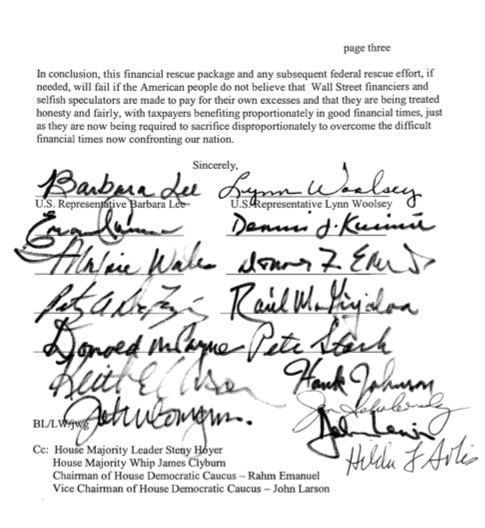
Matt Stoller at Open Left has reproduced a letter from progressive Democrats in the Congress demanding changes to the proposed bailout package. Barbara Lee and Lynn Woolsey are the two lead authors, and other California members of Congress who have signed it include Hilda Solis and Pete Stark.

The letter insists that 4 kinds of reform be included in any bailout:

  • A 0.25% tax on all stock trades and “exotic transactions” such as derivatives trading as a kind of “progressive PAYGO” to ensure that the taxpayers won’t be paying the costs of the bailout.
  • Equity shares in any companies that benefit from the bailout
  • “Major bankruptcy reform” including homeowner renegotiation of mortgages. Obama undercut progressives on this when he said bankruptcy reform didn’t need to be part of the package, perhaps a telltale sign of how unprogressive an Obama administration might be. But it’s still a necessary part of any financial solution.
  • A detailed list of new regulations to protect consumers and provide more stable, responsible regulation of the financial industry to prevent a recurrence of this crisis.

The progressives’ move in Congress comes as more economic observers question the need for a bailout. It’s possible that this represents the first move by the 74 members of the Progressive Caucus to block a bill that in particular lacks bankruptcy reform. Even so, an axis of Bush Dogs, House Republicans, and timid/weak/complicit House Democratic leadership may prove to be too much for the Progressive Caucus to overcome.

Still, this letter is a welcome move by California progressives like Barbara Lee and Lynn Woolsey. The bailout needs to be either made a fundamentally progressive policy move or stopped entirely. If a progressive coalition is to come together to stop it leadership from the Progressive Caucus is a necessary component. Even if it is too little too late, it potentially marks the beginning of a push for truly progressive solutions to our economic crisis – the kind that FDR and the Democratic Party stood for 75 years ago, but that current Democratic leaders from Obama on down have now eschewed.

UPDATE: A deal has been announced, although the details have been slow to materialize – a likely sign that the deal isn’t exactly set in stone. More significantly Republicans are being pressured to deliver 70-100 votes which suggests that Congressional progressives, especially those from California, do have leverage to stop this train wreck. Universal health care, green infrastructure, a jobs-and-wages economic recovery – all those things are imperilled by this bailout. Better to deal with this after January 20.

Live from the SEIU-UHW Trusteeship Hearing

Things are hopping here in San Mateo. There are around 3,000 UHW members here now, and they estimate about 6,000 will have come through by the end of the day tomorrow. The hearing hall is apparently packed to the rafters – only SEIU members are allowed in. Buses are arriving every few minutes to disgorge more members. First thing that happens is they go to a teach-in, then get signs and participate in rallies.
UHW has also set up a phonebank which is hopping right now – not an empty seat to be found. Currently they’re calling other union members to explain the situation here. They plan to call union members in swing states for Obama later today but SEIU hasn’t yet delivered the call lists.

You have to see this to really understand how the members are thinking and reacting. I saw this at the UHW Leadership Convention in San José but it’s been confirmed here in San Mateo: the UHW membership has NO interest whatsoever in being trusteed. They don’t trust the International’s leaders, owing to several years of conflict over contract negotiations, including allegations that SEIU International monitors have been trying to go around elected bargaining teams.

I know that many progressives are understandably trying to stay neutral or stay out of this. SEIU International and Andy Stern have been valuable patrons of progressive bloggers and have given valuable support to progressive candidates like Donna Edwards. I get why many progressives want to stay out of it.

But this just doesn’t feel right. At the core of progressive values is democracy. Whether it’s Americans or union members we progressives understand that democracy is the only way the people’s needs will be met, because people have the power to do it themselves. When democracy is undermined needs go unmet. In other SEIU locals run by appointed leaders, like Tyrone Freeman, significant financial scandals have resulted. These discourage members from becoming active and seeking the change we all know we need. Progressive bloggers need to be as wary of this as are the nation’s leading labor scholars, who full well understand the long-term costs of undermining democracy.

This is a very diverse crowd where we white men are not just a minority, but stick out like sore thumbs. UHW is doing revolutionary work in mobilizing the very Californians who will be the base and the activists and the leaders of progressive change. If the International destroys their union it’s going to take a LONG time to get back to this moment of incipient, transformative change.

Prop 10: The T Boone Bailout

I will be on KRXA 540 AM at 8 this morning to discuss this and other California politics issues

One of the defining features of capitalism in the 21st century has been the arrogance of its most wealthy practitioners, now manifested by their belief that they’ll be bailed out and not forced to suffer any consequence for their criminally reckless bad judgment.

So it’s not just coincidence that as the financial robber barons of our time are demanding a massively unpopular bailout, another wealthy baron who made his money at the expense of Americans is seeking a bailout from California voters this November.

T. Boone Pickens is worth about $3 billion, a fortune amassed from his years as a corporate raider during the 1980s and his large stake in oil companies like ExxonMobil and Occidental.

Along the way he became a leading funder of right-wing causes, and was the primary backer of the notorious Swift Boat veterans, whose lie-filled ad against John Kerry helped swing the 2004 election to Bush. T. Boone promised he’d pay $1 million to anyone who could disprove the allegations, but reneged when John Kerry himself took him up on the offer.

T. Boone is seeing the handwriting on the wall for the oil economy, and wants to build up his natural gas business. Problem is, he wants to build up that business at our expense. He put Proposition 10 on the ballot and is spending his own money to run ads for it. Essentially he wants California taxpayers to bail him out to the tune of $5 billion.

The LA Times last week editorialized against Prop 10, explaining it and why it is such a bad idea. They call it a “reprehensible scam“:


This measure asks taxpayers to fund $5 billion in bonds — at a time when the state is in desperate financial straits and may be approaching a dangerous level of indebtedness — for a scheme disguised as an effort to benefit the environment. Yet its true aim is to subsidize vehicles powered by natural gas, which would build a customer base for its sponsor: Clean Energy Fuels Corp., a company Pickens co-founded that operates natural gas filling stations throughout the U.S. and Canada.

The measure generously doles out taxpayer money for a variety of green-sounding initiatives: $200 million for alternative energy demonstration projects at eight California cities, none of which are clamoring to perform them; $1.5 billion in grants and incentives for research and development of clean energy technologies and alternative fuel vehicles, a field that venture capitalists are already shoveling cash into; $250 million for renewable energy generation equipment. But the lion’s share of the bond money, $2.875 billion worth, goes for rebates on purchases of alternative fuel vehicles.

The rebates are structured so that only a small amount of money goes to truly environmentally beneficial vehicles, while most would subsidize those that run on natural gas.

The American public rightly opposes the Bush Bailout for Wall Street crooks. Why should Californians support a bailout for an already-wealthy oilman, one responsible for some of the most disgusting political lies of our time?

Dems Surrender on Offshore Drilling

I yearn for the day I no longer have to write titles like that:

Democrats have decided to allow a quarter-century ban on drilling for oil off the Atlantic and Pacific coasts to expire next week, conceding defeat in a months-long battle with the White House and Republicans set off by $4 a gallon gasoline prices this summer.

House Appropriations Committee Chairman David Obey, D-Wis., told reporters Tuesday that a provision continuing the moratorium will be dropped this year from a stopgap spending bill to keep the government running after Congress recesses for the election.

Republicans have made lifting the ban a key campaign issue after gasoline prices spiked this summer and public opinion turned in favor of more drilling. President Bush lifted an executive ban on offshore drilling in July.

“If true, this capitulation by Democrats following months of Republican pressure is a big victory for Americans struggling with record gasoline prices,” said House GOP leader John Boehner of Ohio. (AP via SFGate)

To her credit Dianne Feinstein is outraged, sending out this statement a few minutes ago:

I think it’s awful. This battle is not over.  We will come back and fight another day – that’s for sure.

I regret the House appropriations committee didn’t see fit to go with a better, more widely accepted alternative, which would have kept in place a moratorium 50 miles or more off shore.  In my view, there were better options than this.

Once again the Democratic Congress caves to Republicans who say “boo!” Drilling had faded from public consciousness and Democrats would have done well to insist it not happen.

Especially as bailouts are being discussed, you’d think Democrats would not want to be sending any signals that they can wave the white flag if pressured to do so.

Dems would have done well to listen to Van Jones, who at Netroots Nation in July explained the need to move from opposition to proposition – that the only way we will beat back the drilling push is to aggressively propose a more sensible and sustainable alternative. Dems didn’t do that, and once again they’ve failed at politics and failed America.

Sure, they might restore the ban next year – but it’s not clear if it will be a total moratorium, or if this will have opened a door that can’t be closed again. And if McCain wins, Congress will have a very difficult time reimposing a moratorium.

Otherwise they’ve signed a death warrant for California’s oceans and those who depend on them for a living.