
Tag Archives: Middle Class

A Labor Day Reflection

By CTA President Dean E. Vogel

Labor Day is the one day of the year when we celebrate the historical achievements of the labor movement and honor those who contributed to the social and economic achievement of workers and the middle class. For me, though, this Labor Day is not only a chance to acknowledge what the labor movement has done in the past, but to reflect on what it can do in the present.

Last year at this time, teachers, firefighters, nurses and public servants came together to do something that had been unthinkable for 20 years. We persuaded voters to pass Proposition 30, a temporary tax increase to prevent drastic budget cuts to students and public schools and to keep our economy strong.

That vote was no fluke, because in the same election, voters also rejected Proposition 32, a third try at a ballot proposal that would have silenced middle-class workers and immobilized unions while strengthening the power of billionaire businessmen.

Working families may not have the billions of dollars and deep pockets of big tobacco, oil companies or Wall Street brokers, but last November, we showed that Californians want to invest in public education, their communities and their future. They want to see our economy restored so that more can work their way into the middle class, not fall out of it.

As an educator I know that reinvesting in our state means reinvesting in the education of our students. I’ve seen on a personal level what a quality public education can do. As the son of a farmhand and a waitress who moved around the state a lot, I was able to make that leap into the Middle Class because I had access to a quality education. I’ve seen that happen to the students whom I’ve taught as well.

This state’s prosperity goes hand-in-hand with the guarantee of free quality education for every student, and in 2013 that includes the children of immigrants.  In fact, it has always included children of immigrants. California, after all, is a state built by immigrants.  Providing all students equal access to quality public schools and colleges is why the California Teachers Association supports a pathway to citizenship for children of immigrants – the “Dreamers.” It would be disingenuous not to.

CTA’s commitment to the principle of educating all children goes back to our founding 150 years ago by John Swett, California’s fourth superintendent of public instruction. When leaving office in 1867, Swett said, “If one state in the union needs a system of free schools more than any other, that state is California. Her population is drawn from all nations… Nothing can Americanize these chaotic elements and breathe into them the spirit of our institutions but the public schools.” How prophetic was that?

One can look at Proposition 30 solely as a temporary tax increase, but I see it as so much more.  The passage of Prop. 30 opens the door, at least a little, to the possibility of restoring California’s  great middle class and expanding it to a new generation, of renewing our commitment to tax fairness and of taking a step toward achieving economic justice for all.

Dean Vogel is president of the 325,000-member California Teachers Association.
As Middle Class Dwindles, Corporations Continue To Pay Low Tax Rates

Two new reports shed light on income inequality and who is paying for California’s government

by Brian Leubitz

It is probably just happenstance that these two reports came out on top of each other, but it weaves a narrative that has been out there for years.  The middle class is hurting, and the corporations, who need and require a strong middle class of consumers, is doing little to help.  In fact, they are actively working to strangle their own customers.

First, let’s start with our shrinking middle class.  The Public Policy Institute of California is out with a new report focusing on California’s increasing income inequality.  The statistics on the middle class from the report fairly summarize what has happened to our economy over the past thirty years.  In 1980, 60 percent of California families were middle income. By 2010, 47.9 percent of Californians lived in families considered middle income, after adjusting for the state’s cost of living. These are families with incomes between $44,000 and $155,000.  

Now, that’s a pretty broad swath of income levels, and it could be argued that a family earning $44,000 isn’t really middle class, but bright lines are always difficult in situations like these.  But the underlying truth remains the same, California’s (and the nation’s) middle class is disappearing.

California has always been somewhat exceptional, however. And such is the case for income inequality.  As a state, we tend to have a richer top income bracket and poorer bottom income bracket.  During the so-called Great Recession, income levels of the bottom 10% of earners fell more than 21 percent between 2007 and 2010. While the top 10% didn’t increase their fortunes, they only fell 5%. The gap between California’s upper- and lower-income families-which has been larger than in the rest of the nation for decades-grew twice as wide as it was in 1980. High-income families earn nearly $12 for every $1 earned by the lowest income families.

While this is going on, corporations are maintaining pay ratios of CEO to average workers of somewhere in the neighborhood of 200 to 1.  Unfortunately, not all of their customers, you know, the average worker, are doing so well.  Many of these customers are slipping further behind and finding that the California social safety net wasn’t really that robust after all.  But, losing their customer base still isn’t enough to get the Chamber of Commerce on board with tax increases or helping to fix our state’s economic situation.  After, all, it’s a pretty sweet deal they get now; many major California corporations pay little to no taxes:

California’s major corporations have rung up hundreds of billions of dollars in profits in recent years, but have paid only a few percentage points of those profits in income taxes here and in other states, according to a new nationwide study by several liberal organizations.

The compilation of corporate profits and state taxes … covered 265 of the Fortune 500 corporations that reported profits for three straight years, 2008-2010, including 33 based in California. Nationwide, the 265 firms had a combined $1.33 trillion in profits during the three-year period but on average, paid just 3 percent of those earnings in state corporate income taxes.

The 33 California corporations’ tax bills ranged from minus-1.5 percent (McKesson Corp.) to 8 percent (Apple). The California corporation with the largest profits during the period, Wells Fargo Bank at $49.7 billion, paid $344 million or 0.7 percent in state taxes. Second-place Intel Corp., with $23.3 billion in profits paid no state income taxes, the study found.(SacBee)

Now, all this isn’t to say that these companies did not pay taxes, after all, their shareholders paid capital gains taxes on any realized profits, and their employees paid taxes, and so on.  Nor did they do anything illegal.  They followed the letter of the law, which was largely written by their corporate lobbyists, but it is the law of the land nonetheless.  It isn’t really a California issue either, it is an issue of how we are going to fund state governments and balancing our priorities.

Our tax laws are generally a good way of offering incentives to taxpayers, but there is such thing as over incentivizing as well.  As we look at overhauling our tax code, which seems to be coming up at all levels of government, we need to ensure that both the federal and state governments have the resources they need to provide their services.

And as we are seeing with the increasing income inequality, those services are going to be more necessary than ever.

This Labor Day, Let’s Unite to Fight for the Middle Class

 by California Labor Federation Executive Secretary-Treasurer Art Pulaski

There’s a threat to America’s economic future that’s so overlooked it’s gone almost unnoticed amid the endless debate over the debt ceiling and federal spending: massive income inequality.

This Labor Day, the gap that separates the very wealthy from the rest of us is as wide as it was in the Great Depression. Since the economic collapse of 2008, workers have suffered through joblessness, home foreclosures, reduced wages and benefits and a sustained assault on our right to collectively bargain. Did you notice that corporate profits are soaring and Wall Street bankers are receiving fatter bonuses than ever? And we wonder why our middle class is disappearing before our eyes.

When FDR gave workers the right to bargain collectively amidst the Great Depression, he did so because he believed strong unions would create a strong middle class. History proved him right. It’s a fact that when union membership increases, so do wages and benefits for ALL workers, not just union members. Unions raise the bar for everyone – which means even non-union employers offer better wages and benefits in order to stay competitive.

But the opposite is also true. Weakened unions lead to a weak middle class. As union membership has declined over the past 40 years, so have workers’ wages, benefits and working conditions. According to a new study published in the August issue of the American Sociological Review, the decline of union membership since the 1970s explains about a fifth of the increase in wage inequality among women and about a third among men.

In other words, the corporate assault on unions is dragging down the entire economy.

For more than 100 years, unions have been the primary counter-force to corporate greed and excess, pushing for common-sense labor standards like the minimum wage, weekends, health care and retirement security. But without strong unions, corporations have no counterbalance. It’s not a surprise that as union membership has declined, corporations have grown more and more powerful, and workers’ share of the pie has been reduced to crumbs.

The corporate CEO crowd still isn’t satisfied. Anti-union forces – both across the country and in California – are hell-bent on crushing workers’ rights, unions and the middle class. It’s not just in Wisconsin.

From San Jose to Costa Mesa, attacks on unions and workers’ rights are happening right here, in towns and cities across California. And now, right-wing extremists have launched an all-out assault on all of us by once again pushing for a “paycheck deception” ballot measure to silence our voice in political campaigns. If they succeed, Big Business execs will have cleared the field of any opposition, and income inequality will grow, wiping out any hope of the American Dream for most families.

Every generation has its fight for justice. The fight to rebuild the middle class and create a fair economy is ours. If ever there was a time to unite around our shared ideals, the time is now.

That’s why, this Labor Day, we all must come together– union members and non-union members, public sector and private sector – to beat back these attacks. Talk to your friends and neighbors. Join together with your co-workers. Volunteer with your union. Corporations may have the money, but that can never match our grassroots power.

Dr. Martin Luther King Jr. taught us that “the arc of history bends toward justice.” But sometimes, even history needs some help. It’s up to us to give it that boost so that we can create a brighter future for our families, children and grandchildren.

Why Wisconsin Matters to ALL Workers

by Executive Secretary-Treasurer Art Pulaski

I recall vividly my first union job. At the age of 16, I joined the Amalgamated Meat Cutters Union as a supermarket clerk. I remember the good wages in my first paycheck and the sense of pride I felt when I received my first union card.

Back then, about a quarter of all private sector workers were union members. Collective bargaining allowed us a path to a better life. The standard of living rose, not just for those of us in a union, but even for those who weren’t.

But today, too few workers have the right to bargain for better wages, benefits and working conditions. Years of assaults by corporations on the freedom to join unions have taken a terrible toll.

As the protests rage on over Gov. Scott Walker’s politically motivated attempt to strip Wisconsin’s public workers of collective bargaining, there’s too little discussion in the media about the decline in bargaining rights for private sector workers. Instead, opportunistic politicians like Walker have used the current economic crisis to help further their agenda to divide the middle class.

As private sector unionization declined from 25 percent to about 7 percent today, a gargantuan share of our nation’s wealth has left the middle class and gone to the very wealthy. Today, the wealthiest 1 percent of Americans receives 25 percent of our nation’s total share of income, up from 8.9 percent in the 1970s. CEOs, who once made 40 times what rank and file workers made, now rake in 350 times that of the average worker.

Meanwhile, wages for most of us have stagnated or declined over the last decade. Big corporations and Wall Street are profiting off an economic meltdown they largely created while middle-class families suffer. Corporations made record profits in 2010, while doing nothing to create jobs or boost workers. Wall Street bonuses and compensation are up too. Last year, Wall Street firms – including those bailed out by taxpayers — gave out more than $20 billion in executive bonuses.

The attack on unions has a direct correlation to the massive income inequality we face today. Big corporations have turned their back on their workers by reducing wages, cutting benefits and union busting. It used to be that CEOs had a stake in their workers’ economic security. Now it’s all about corporate profit, which the vast majority of workers never benefit from.

The real issue in Wisconsin, Ohio and other states where workers’ rights are under assault isn’t state budgets. Public servants like teachers, nurses, bus drivers and firefighters are in no way responsible for the economic crisis battering our families. These attacks are all about the extreme right-wing and their corporate backers furthering their goal of destroying ALL unions and the middle class we advocate for.

If more workers had the freedom to join unions and bargain collectively, there’d be more wealth in the hands of the middle class. And we’d have a healthier society as a result.

That’s why what’s happening in Wisconsin and other states matters to all workers. If the right-wing extremists succeed in these attacks, corporate CEOs and the politicians they control will forever alter the playing field in their favor, and our once-thriving middle class will become just a footnote in the history of America’s decline.

That’s why every worker must join this fight. This is our moment to stand united to defend our values, and beat back these vicious attacks on our unions, our families and our ideals. Click here for more information and ways you can get involved.

The Latvia Option: Let’s Regress the Regressivity!

Calbuzz continues shilling for the California Commission on the 21st Century, or as I’ve called it the Latvia option, the plan to craete a flat income tax and massively transfer wealth upward from the middle class to the ultra-rich.  Apparently,there are two packages on the table, which I’ll label CRAP and CRAAAAAP.

The first package to be considered has these key elements:

• Flattening the progressive, steeply-stepped state income tax rate system to a structure with essentially one rate of about six percent.

• Eliminating the state sales tax (local sales tax levies that have been approved for special purposes like transportation would remain in effect).

• Eliminating the corporation tax.

• Imposing the business receipts tax. It would be assessed on nearly every business in the state as a percentage of its gross revenue – minus the cost of goods and services that it purchases from other companies.

• Charging a “carbon tax” on gasoline, diesel and jet fuel, calculated at the refinery at $20 per ton of carbon emissions. This would amount to about 18 cents-per-gallon of gas.

The second scenario would flatten the income tax structure, but not include the receipts tax.

It’s comical to hear Calbuzz call our state income tax “steeply stepped.”  There are NO tax brackets between $47,500 and $1,000,000.  That’s a ridiculous statement.  Progressives may appreciate the carbon tax, but clearly this proposal – especially if the business receipts tax gets excised, which considering the influence of Big Business on the process is almost assured – would make the overall tax structure in California MASSIVELY regressive, probably canceling out the progressivity of the federal tax structure.

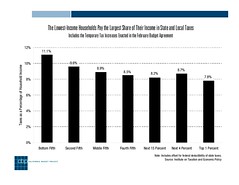
090617_CBB_Share_of_Income_for_taxes

We already have a totally regressive tax system in California when you look at the effective tax rate – what people actually pay.  The lowest 1/5 pay 11.7% of their income in taxes to the state, while the richest 1/5 pay 7.1%.  And recent budget deals have only made the system more regressive.  Now we’re planning to completely shift the tax burden to the poor and the middle class.

For example, one option would – among other things – establish a 6 percent “flat tax” that would apply to taxpayers whether they had incomes of $10,000 or $10 million. Under this scenario, the share of taxes paid by middle-income Californians – those with incomes between $20,000 and $50,000 – would more than double, while the share paid by taxpayers with incomes of $200,000 or more would drop by almost one-third. Flattening personal income tax rates also would increase the share of income that California’s low- and middle-income households would pay in taxes – exacerbating an already regressive tax structure […]

By increasing the share of taxes paid by low- and middle-income Californians, the tax packages under consideration would widen after-tax income gaps. Yet the level of inequality in California is already large and growing larger. The average taxpayer in the top 1 percent had an adjusted gross income (AGI) – income reported for tax purposes – of $1,832,123 in 2007 – 50.7 times that of the average middle-income taxpayer ($36,115). California’s income gap has been widening for years. The latest Franchise Tax Board data show that one-quarter (25.2 percent) of total AGI went to the wealthiest 1 percent of taxpayers in 2007, nearly twice the share (13.8 percent) in 1993, which is the earliest year for which data are available. In contrast, taxpayers with incomes in the middle of the distribution had just 10.0 percent of AGI in 2007, down from 13.0 percent in 1993. This means that the top 1 percent of taxpayers received approximately 25 times their proportionate share of AGI in 2007, while middle-income taxpayers received half their share. These disproportionate gains translate into a substantial concentration of income at the very top of the distribution. If the share of income going to the wealthiest 1 percent of taxpayers had remained the same since 1993, the bottom 99 percent of taxpayers would have an additional $123 billion in income – equal to $8,388 for each taxpayer.

To the extent that ordinary Californians are overtaxed, it’s because the system is completely unfair and designed to support the rich getting richer.  And Calbuzz thinks that’s dandy, calling it a “major accomplishment” for the Governor, which of course it is – for his wealthy pals and contributors.

The May 19 election’s intent from the voters is obscure, although I agree with the leading pollsters in the state that “no new taxes” was certainly not the message.  But I want to know what majority you can find out there that, as a result of the election, endorsed eliminating the corporate tax rate and delivering a Steve Forbes-style flat tax that has destroyed almost all of Eastern Europe.  You can’t.  This is a shocking power grab and people had better wake up to it.

As a postscript on Latvia, I noticed yesterday that their health minister quit in the face of having to accept severe budget cuts imposed by the IMF as a condition of providing loans.  Food for thought.

Fair taxation

This diary is all about the fairtax. A tax system with very few rules, compared to the the current 67,000 page monstrosity we currently have. It replaces all income taxes with a 23% sales tax, which almost completely gets rid of the IRS. Says goodbye to tax lobbyists, accountants, and lawyers. And puts ALL the hard earned money of all who work for it, into THEIR pockets. Plus, everyone, EVERYONE(the fairtax does not recognize the terms that class warfare has setup), gets a $516 check each month for necessities.

There are governments out there that was to implement this source of revenue for themselves. As a nation that desperately needs the income and jobs that this reform would bring, we cannot allow any other nation to use this against us.

I, like many others, am a supporter of the fairtax, and i’m fed up with the way our government uses taxes against us. If you know about the fairtax, and want to talk about it with me, or if you don’t know about it, and want to know more, just add comments to this entry.

I’M GLAD TO TALK, CONVERSATE, OR JUST OUT AND OUT GO TO PUNCHES OVER THIS ISSUE.

[poll id=”

293

“]

How well does your Congress member stack up for the middle class?

The Drumm Major Institute released their annual scorecard for Congress based not on a few bills related to a single issue, but on a wide range of bills that affect the middle class.  They range from immunity for telcos on violating FISA to SCHIP to consumer protection. You could say it’s ideologically tilted to the left, but it’s not outright partisanship.  They make a note that Republicans have “closed the gap” this year on the Democrats.  As most Democrats voted for the bailout, they got at least one strike there.

On the plus side, California Democrats had a wealth of A+ ratings. They are Reps. Becerra, Roybal-Allard, Sherman, and both Sanchez sisters,  Many of our generally progressive members do not get an A+ because of the bailout votes. For example, former Rep. Solis, the current Labor secretary, got a B. On the Senate side, Boxer got an 89% and DiFi got 80%.

On the flip side, most of the California Republicans hovered around the 30-40% mark.  The lowest Republican House member was a tie between our very own Dan Lungren and the irrepressible Ron Paul. Mary Bono Mack had a 56% to lead the Republicans.

The full scorecard is worth a read to find out just how your critter is voting on the items of interest to the middle class.

P.s. If you have a local blog, they have a widget you can put on your site.

LA Times Reinforces Right-Wing Tax Frames

Today’s LA Times contains a “news analysis” by Evan Halper that seeks to explain why taxpayers seem to be getting less for their tax dollars. But the most obvious point goes almost totally ignored – that tax cuts have reduced the ability of government to provide for basic services. Since that isn’t part of this article, the effect is to mislead readers into thinking government is misusing tax dollars, and thus winds up reinforcing right-wing frames.

Reporting from Sacramento — Middle-class Californians have long griped about paying more taxes than they might pay elsewhere, but for decades this state could boast that it gave them quite a bit in return. Now that contract is in doubt.

A modern freeway system, easy access to superior universities and progressive health programs used to be part of the compact. Even local schools plagued with financial problems continued to offer small classes, innovative after-school programs and advanced arts and music curricula.

These opening paragraphs set the tone for a flawed article. That “social compact” has not really functioned as Halper suggests since 1978. Our freeway system was largely in place by that time. Additional freeways were mostly paid for by higher taxes – even Orange County has voted to tax itself twice since 1990 to build and expand freeways. The “innovative after-school programs” were created by ballot-box budgeting. Advanced arts and music curricula have been absent from most districts in the state since the 1980s.

In short, Halper starts from a flawed premise.

But at a time when taxes are about to rise substantially, the services that have long set this state apart are deteriorating. The latest budget cuts hit public programs prized by California’s middle class particularly hard — in some cases at the expense of preserving a tattered safety net for the poor — following years of what analysts characterize as under-investment….

“Twenty years ago, you could go to Texas, where they had very low taxes, and you would see the difference between there and California,” said Joel Kotkin, a presidential fellow in urban futures at Chapman University in Orange. “Today, you go to Texas, the roads are no worse, the public schools are not great but are better than or equal to ours, and their universities are good. The bargain between California’s government and the middle class is constantly being renegotiated to the disadvantage of the middle class.”

And here you see the right-wing framing – in some cases made explicit, that programs benefiting the middle-class have been cut to “preserve a tattered safety net for the poor.” Kotkin, a high-profile conservative think tank figure who has blamed “greens” for the state’s current crisis is never going to explain how tax cuts have caused California to fall behind in maintaining its once-great systems of education and health care.

The closest Halper gets to acknowledging the true nature of the problem is here:

The reasons are varied. The cost of services continues to outpace inflation. Programs are being squeezed out by things the government was not providing in the halcyon 1950s and early 1960s, including Medi-Cal and some welfare programs. And the state has been reluctant to embrace new ways of funding services while holding back state money to plug other holes in the budget.

In fact Medi-Cal’s earliest origins lie in the 1959 legislative session, as do some welfare programs. Halper gingerly discusses a state “reluctant to embrace new ways of funding services” but this is the closest his article will ever get to the truth, which is that the conservative veto has prevented California from raising taxes to keep the services flowing to the middle class. Even Ronald Reagan did this in 1967 but you would never know it from Halper’s article.

Nor does Halper explain, anywhere, the billions in tax cuts that have been made since 1978 – a structural revenue shortfall that costs California at least $12 billion a year. Halper does a good job of showing how our basic services are underfunded but totally fails to explain the reasons why. As a result he closes his article with comments from conservatives like Mitt Romney and Joel Kotkin that not only go unanswered by any progressive voices, but go unanswered by reality:

Former presidential candidate Mitt Romney spoke to the frustrations of many California parents during a speech at last weekend’s state GOP convention in Sacramento. Pointing out all the taxes Californians are now paying, he asked, according to the Sacramento Bee: “With all that money, how are your schools?”

The simple answer is: Not what they used to be. And now the state is cutting billions more out of them, including money set aside to keep classes small and to fund arts and music electives.

“The social compact is: I pay taxes and good things happen,” Kotkin said. “But I pay a lot of taxes and can’t send my kid to our local public schools because they are terrible.”

Conservatives broke that social compact by telling Californians “you can pay less taxes and good things will happen.” It’s wrong for conservatives to turn around and say “oh gee the system’s screwed up” when they are responsible for the mess.

And it’s inexcusable for the LA Times to reinforce such right-wing sentiments with such an article that refuses to point out what actually went wrong, and who is responsible for it.

Regressive Tax Burdens – Brought To You By The California Legislature

With the unemployment rate soaring to double digits and less revenue flowing to the state, it was clear that some taxes would have to be raised in the last budget.  To the extent I have criticized those taxes, it’s because they are flat or regressive, increasing burdens on those with the least ability to pay.  Via California Budget Bites, it turns out that it’s even worse than I thought:

One of the last-minute changes to the budget agreement substituted a 0.25 percentage point increase in each of the state’s basic income tax rates in place of a 5.0 percent income tax surtax. The enacted change would increase each of the tax rates for two or four years, depending on whether the spending cap that will appear on the May special election ballot is approved by the voters. For example, the 4 percent tax rate would be 4.25 percent under the new law and the 9.3 percent rate would go to 9.55 percent. As discussed in yesterday’s blog post, the increase would be cut in half – to 0.125 percentage points – if the Treasurer and Director of Finance certify that the state will receive at least $10.0 billion in “flexible” funds from the federal economic recovery bill. In contrast, the proposal under consideration until the final night of budget negotiations would have required all personal income taxpayers to add an amount equal to 5.0 percent of their tax liability for the two- or four-year period.

Because of this seemingly minor change, lower-income households will experience a much larger tax increase than under the previously considered proposal. The tax liability of a married couple with a taxable income of $40,000 will rise by 12.9 percent under the enacted policy, as opposed to 5.0 percent under the proposal previously under consideration. In contrast, the tax liability of a married couple with a taxable income of $150,000 will rise by 4.0 percent under the final agreement, instead of 5.0 percent under the original surcharge proposal. High-income earners will experience the most significant change – their tax liability will only rise by 2.9 percent under the enacted policy.

It is somewhat likely that the stimulus trigger will be reached – we will know around April 1 when the Governor’s Finance Director and Treasurer Lockyer make the decision.  Still, this is an outrageous undermining of the public trust.  We are essentially reacting to a yawning budget gap with taxes that mostly hit the middle class and below.  That’s true of the penny increase in the sales tax (which will now reach close to 10% in LA County) and it’s true of this income tax increase.  This is the conservative veto in action, folks.  And it’s not going to change until it’s eliminated.

Committee Will Work with Obama-Biden Administration to Rebuild and Strengthen the Middle Class

(Well, education is as good of a place to start digging ourselves out the Bush whole as anywhere. – promoted by Brian Leubitz)

Yesterday's historic election of Senators Barack Obama and Joe Biden as our next President and Vice President was a true victory for every child, student, worker and family in America. I congratulate Senators Obama and Biden, and I look forward to working closely with them to change the direction of our country and get our economy moving forward again.

During the past two years, the U.S. House Education and Labor Committee has focused on strengthening our nation's middle class – a priority that Senators Obama and Biden clearly share, as demonstrated by their careers and the focus of their historic campaign.

With our country facing the worst economic crisis since the Great Depression and our global leadership at risk, this mission is more important than ever.

In the next Congress, this committee will be dedicated to working with the new Obama-Biden administration and members of both parties of Congress to rescue our economy by rebuilding and strengthening America's middle class. We must get started right away by passing a Main Street recovery plan that will get Americans back to work and provide immediate relief to families and workers struggling with long-term unemployment and depleted state budgets.

We will dedicate ourselves to improving our nation's schools and continue our efforts to make college more affordable and accessible, so that every student has the opportunity to succeed. We are committed to rebuilding our country's roads, bridges and schools, and to green retrofitting and other modern energy programs that will create millions of good-paying jobs and reestablish America's technological leadership.

We will fight to restore workers' rights, so that every American can benefit from economic opportunity. And we will make the preservation and strengthening of retirement savings a priority, so that all Americans can enjoy a secure retirement after a lifetime of hard work.

Today marks a new beginning. Together, we can rescue our economy, restore the promise of the American Dream, and ensure that, in a nation as great as ours, the interests of students, workers, families and retirees are at the heart of our nation's priorities.

More information on recent hearings on the economy and the committee's work over the past two years.

(Cross-posted at the EdLabor Journal.)