
Tag Archives: Mark Leno

Thank You — and Plea For More Help on Toxics Bill

(An action item over the flip, call your assembly member. – promoted by Brian Leubitz)

Hi all,

I just want to thank this community for its support of Sen. Mark Leno’s bill (SB 772) to get rid of a state de facto rule requiring toxic flame retardants in baby products. (Thank you, Brian, for promoting the diary!)

Unfortunately, that bill died in the Assembly Appropriations Committee — by a mere 2 votes. Despite intense lobbying by the chemical industry and its front group “Citizens for Fire Safety” we lasted 5 rounds to that point.

Nonetheless, many of us have dusted ourselves off and we are intensely working on the same Assemblymembers to pass another bill, SB 797 sponsored by Sen. Fran Pavley, that would ban the toxic chemical bisphenol A (BPA) in baby products like bottles and formula cans. Other states like Minnesota and Connecticut already have passed similar bills.

EDIT by Brian: Take Action over the flip.

Today is the last day to pass this important piece of legislation in the California State Assembly. As the Los Angeles Times noted today, the formula and packaging industry have launched a ferocious campaign against this bill even though there are 200 peer-reviewed studies linking BPA with heart disease, diabetes, liver problems, brain damage, cancer and hormone disruption.

We are currently six votes shy of passing this important piece of legislation. CA parents, can you help us protect our children from BPA by making a few quick phone calls? Please encourage the following legislators who voted against the bill to vote YES on SB 797:

Wilmer Amina – Carter 916-319-2062

Alyson Huber- 916-319-2010

Norma Torres- 916-319-2061

We have even provided a script to help you out:

“Hello, My name is ___________________ and I am calling on behalf of parents in California in favor of supporting SB 797 to get the chemical bisphenol-A out of baby bottles and formula cans.

I know that the Assemblymember has one last chance to support this bill today through an “aye” vote when it is up for reconsideration. I am greatly concerned that as a parent, Assemblymember __________ is unwilling to protect the state’s children herself. I am urging her support of SB 797 today.

Thank you for your time!”

While Republicans overwhelmingly voted against this bill and Democrats overwhelmingly supported it, there are some Democrats — especially in southern California — who abstained from voting altogether. Why not put in a phone call to your Assemblymember while you are at it? Here is a list of Assemblymembers’ offices.

Thank YOU for taking the time to save this bill and protect our children from toxic products. Please help spread the word to all your family and friends in California!
Are the Line Item Vetoes Illegal?

The Governor clearly has the power of the line-item veto, but that power is far from absolute. In fact, many of them might actually be illegal under the California Constitution, and a good claim could be made by somebody who is injured by the cuts.  First, here is the relevant section of the California Constitution, Art. IV, Sec. 10(e):

The Governor may reduce or eliminate one or more items of appropriation while approving other portions of a bill.  The Governor shall append to the bill a statement of the items reduced or eliminated with the reasons for the action.  The Governor shall transmit to the house originating the bill a copy of the statement and reasons.  Items reduced or eliminated shall be separately reconsidered and may be passed over the Governor’s veto in the same manner as bills.

Importantly, this is a budget revision, not a budget.  There weren’t any appropriations to the health and human services, only cuts in spending. The Legislature may cut funding for anything with a majority vote, and these majority vote changes to the budget do not allow for line item vetoes.  On something of a side note, the cuts are implemented immediately with a 2/3 vote, or in 90 days with a majority vote. Yes, this is a fantastic process, huh?

Either way, these cuts were not part of the budget. That was passed back in February.  A very strong argument could be made to the state courts that the line item veto isn’t applicable to these cuts in services. Take this from Senator Mark Leno:

We believe there are strong legal grounds to fight many of these vetoes. California’s constitution empowers the Governor to veto or reduce appropriations, but our budget agreement doesn’t make new appropriations, it makes spending reductions. In the end, my colleagues and I will fight these devastating cuts with everything we have.

There are all sorts of reasons as to why this isn’t really a budget that can be cut by the line item veto.  I won’t go into all of the details, but suffice it to say that this isn’t the last you’ve heard of the line-item veto.

Incidentally, the Legislature also has the power to override a veto.  It would involve the Legislators coming back for an override session, which hasn’t happened for over 25 years, but it certainly is high time that the Governor get a little pushback on this.

Budget Town Hall at 6PM: Are we about to get a cuts-only budget?

More to come on this post, but as we are rapidly approaching 6 pm, I wanted to get the word out about the Budget town hall with Senators Leno and Steinberg.  Here’s the link for that:

http://democrats.sen.ca.gov/to…

More details on the budget shortly in an update to this post…

OK, moving it over the fold…

UPDATE 1: As we are about to begin, there are a few things to point out. Today, the budget conference committee approved a “first pass” of their budget, that was focused primarily on cuts. it wasn’t the full $24 Billion, so we will see where the rest comes from.

UPDATE 2: Steinberg addressed shifting some of the funding decisions to the locals and then Sen. Leno discussed the Vehicle License Fee, and the fact that the backfill from the state to the counties that Arnold created when he cut the “car tax” is now the largest area of spending growth.

UPDATE 3: Why is just the Big5 making the decisions? Steinberg says that he is not just using the Big5 in this round of the budget mess, Leno then addresses the current process. The Big5 grew out of some hard bargaining between Willie Brown and the Governor at the time. This time they are doing a more public process. This time they held 3 weeks of hearings in the joint committee.

In the comments, it is noted that there were over 700 questions for this event. I’m not sure if they are going to release the questions.

UPDATE 4: Why not have the Legislature go part-time? paraphrases here, not quotes.

Steinberg: California is a “nation-state.”  Trying to govern the state part-time would be disastrous. Steinberg sticks up for his colleagues, talking about the hard work that the Legislators do. Having legislators have other jobs would harm the public interest, as the legislators would have to have other jobs, and not dedicate their full attention to the job.

Leno: The complexity of this job is amazing. If we are in a committee for two hours, we’ve prepared for at least 2 hours before hand.  The amount of work is amazing. Do we want to abrogate all of our responsibilities to state staff, who are unelected?

UPDATE 5: Is it time to Split the corporate rolls from the personal Prop 13 rolls?

Public education are short billions of dollars because we have not adequately established the difference between corporate and personal property. We need to go to the ballot

Leno: We are subsidizing corporations by not reassessing the properties. We should go to the ballot.

UPDATE 6: We need to end that corporate tax cut?

Leno: I agree, we shouldn’t include that tax cut. It is going to the biggest companies. That 2.5billion should be used for some of the important priorities of the state.

Steinberg: Governing is a matter of choices. Would the people of California rather decimate CalGrants or suspend the corporate tax cuts. This is an important debate. 2/3 or no 2/3, we are going to have that debate.

Mac Taylor is joining the conversation next…

UPDATE 7: 2/3 Vote on Budget Taxes?

Steinberg

UPDATE 8: Why aren’t you bringing in more revenue?

Leno: We need 2/3. Almost all of the Republicans who joined us are facing recalls. They are putting their careers on the line. There were some real profiles in courage in the February deal. We don’t think they will be willing to do that again. We should ask Californians if they want to really go down these paths?

UPDATE 9: Blame the immigrants?

Leno: It would be disastrous for public health and welfare if we simply stop treating all immigrants. We don’t live in a bubble, and ignoring one segment exists doesn’t actually make things better?

UPDATE 10: Are in-home support services cheaper than institutionalizing people?

Mac Taylor: In certain circumstances, it is cheaper to have IHSS right.

UPDATE 11: Why are the budget projections always wrong?

Mac Taylor: We have tried to get this right, but the problems is that we have to predict the economy. That’s hard. Also, the revenue structure is crrraaaazzzy, and unpredictable.

UPDATE 12: Schools?

Leno: It is heartbreaking that we are going to have to cut schools, but it is the largest chunk of the budget. We are going to spend more on corrections than higher education next year. that is disturbing, we need to fix that.

Steinberg: If we want to build an economy of high wage workers, we need to increase education. We will do our best to hold the line, but this crisis is real.

UPDATE 13: This is getting a bit long now, as even I am struggling to keep up with this. I will provide links to the archived video shortly…

UPDATE 14: Marijuana?

Leno says he supports at least changing possession to an infraction. Steinberg is a bit hesitant, open to discussion.

Creating Will in a Body Politic Gone Mad

There are some moments when you just notice the absurdity of some of the arguments we are stuck on. Let’s try this one from the servants of Howard Jarvis’ Corpse that appeared in the Bee today:

“You still have more revenue coming in than any other state in the union,” David Wolf of the Howard Jarvis Taxpayers Association told the committee. “You just can’t justify continuing to raise taxes.” (SacBee 6/9/09)

Really? This is what they are going with? California is a vastly larger economy than any other state. Of course we have more revenue than any other state. What exactly is the point of this statement, and why was it published in the story. We cannot pretend that this is merely a spending problem. making revenue untouchable.

“I get the politics of this,” Sen. Mark Leno, D-San Francisco, said, “but I don’t think we as legislators should be silent and feel we can’t talk about certain things when it’s the big elephant in the room.”

If we don’t talk about revenue, then quite simply the will just won’t materialize.  It’s not going to come from simple Republican mistakes or something crazy like that. We have to actually create the will through serious messaging work. Mark Leno and other progressives are doing that, but so far the greater conversation has been played on right-wing terms

And instead of actually being “post-partisan”, Arnold is simply playing old-school special interest politics and rejecting all calls for additional revenue. No taxes on Chevron when they pull oil from the ground. No taxes on sports tickets, nothing new on tobacco or alcohol.  Guess what the common thread is in that list? Yup, those would be the donors to his special election campaign.

The Governor and the Legislative Leaders need to be honest here, if everything is on the table, then everything must really be on the table. No more of this third rail politics shit, where people can’t discuss the real problems.  Let’s have an honest debate, you know this time with facts that are actually relevant.

Block That Recovery

The real tragedy of the proposed cuts in the state budget comes when you recognize that some of them would cancel out federal stimulus dollars.  A perfect example would be the elimination of the welfare-to-work program Cal Works.  In Los Angeles County, the stimulus funds a program through Cal Works that provides jobs.  Without Cal Works, the program gets eliminated, and $200 million in federal dollars cease to flow to the state.  Funny how the welfare goes but the corporate welfare remains, ay?  And that’s really just one example.

We see the same cross purposes when assessing social services programs for the elderly.

“Advocates for the elderly in California say recent budget cuts are dramatically affecting the ability of social service programs to keep up with demand” at a time when “the state’s elderly population – and the incidents of elder abuse – are exploding,” NPR reports. One example is Contra Costa County, where the Aging and Adult Services Program laid off two-thirds of the staff who “investigate abuse complaints of elderly and dependent adults.” The county is now “turning over virtually all of its self-neglect cases to some other agency – often, the police.” The Contra Costa situation is “so severe that the county grand jury recently concluded that Adult Protective Services no longer has the resources to carry out its legal mandate to investigate physical and financial abuse complaints.” This comes at a time when complaints of elder abuse are on the rise. According to “national studies,” only “1 in 5 elder abuse cases is reported” (Siler, 6/3).

Needless to say, this threatens the ability for Contra Costa county to qualify for stimulus funds to backfill those cuts, thanks to “maintenance of effort” rules.  The Feds giveth, the state taketh away and taketh away what the Feds giveth.  And that undermines the goals of the stimulus and damages economic recovery, given that we are the nation’s largest state.

Some would say that the state’s “runaway spending” brought this on, but Sen. Mark Leno argues persuasively against this, detailing the nature of the spending over the past decade and where that money has actually gone – tax cuts (the vehicle license fee), prisons, debt service, and the rapid cost growth in health care and fire protection.  This is familiar to most of us but ought to be shared with those friends who don’t know the facts.  Same with this.

What truly brought this on is a dysfunctional process that requires serious structural reform.

Random Bill Blogging: Bill Monning’s AB 1279 Salmon Restoration

I haven’t done my random bill blogging for a while, so I fired up the ol’ (and by ol’, I mean circa 1996) Senate website.  I tried to be as random as I could be and chose 1279.  Of course, that was too high to get a Senate bill, so I was stuck with only one choice: AB 1279 by Assembly  member Bill Monning (D-Monterey).

AB 1279 is a short bill.  So short, in fact, that it is likely just a placeholder bill for a program to be later defined.  Here’s the entirety of it as it currently stands:

THE PEOPLE OF THE STATE OF CALIFORNIA DO ENACT AS FOLLOWS:

 SECTION 1.  It is the intent of the Legislature to enact legislation that would fund salmon restoration projects.

I suppose I agree with the merits of the sentence, despite any issues with the budget.  Both the environmental and financial impacts of the death of the salmon are enormous. So, go salmon restoration.

If anything, I suppose this can be a testament on some legislative principles. First, there’s the gut and amend process.  Basically this allows one house to pass an innocuous measure like this, and then either stick in a real bill in its place on the subject matter at hand or an entirely new bill. It’s not necessarily the most transparent process, and shouldn’t be used on a regular basis.  However, it can be used to help with some important legislation.  Marriage equality comes to mind.  When the Assembly did not have the votes to pass then Asm. Leno’s marriage equality bill, a bill passed by Asm. Yee was gutted on the Senate side and replaced with the civil marriage language.

While this could, in theory, be a holding bill for some legislation to be passed in the normal course of business, the bill deadline for all policy committees in the Legislature to pass out bills that will have a fiscal impact on the state is this Friday.  If Asm. Monning really wants to fund salmon restoration, he would need a real bill pronto.  

Pro-LGBT bills moving forward in CA legislature

I am thrilled to report that EQCA-sponsored legislation is moving right along, with two bills passing their first key committee votes yesterday, one to establish Harvey Milk Day, and one to protect LGBT victims of domestic violence.

SB 572, the Harvey Milk Day Bill, passed the Senate Governmental Organization Committee by a 9-4 margin. Introduced last month by Senator Mark Leno (D — San Francisco), it calls for a “day of special significance” to recognize slain civil rights leader Harvey Milk.

The far-right wants to stop this bill. The Traditional Values Coalition and Capitol Resource Institute lobbied against it in the hearing, saying it would teach youth about a “controversial lifestyle.”

Sen. Dean Florez from Bakersfield countered by asking where the opposition witnesses were from – they responded Inland Empire, Roseville and Sacramento. He then requested to become a co-author of the bill to demonstrate that people living in more conservative parts of the state also support the measure.

Debra Jones, who served alongside Cleve Jones as an intern for then Supervisor Milk in 1978, also testified: “There are some who say that Harvey's contributions to the civil rights movement should merely be acknowledged locally. With that perspective, Dr. Martin Luther King's legacy would not be known outside of Atlanta, and the legacy of Cesar Chavez would not be known outside of the Central Valley. Hope doesn't know geographic boundaries.”

I couldn’t agree more.

The legislation was originally introduced last year by then Assemblymember Leno, but Governor Arnold Schwarzenegger vetoed it, claiming Harvey Milk was not well known enough beyond San Francisco. Since that time, however, Harvey Milk has become a focal point of national conversation following the release of the successful biographical film Milk, for which both Penn and screenwriter Dustin Lance Black received an Academy Award. You can use EQCA’s Action Center to urge the governor sign it this time once it reaches his desk.

AB 1003, the LGBT Domestic Violence Services Bill, introduced last month by Assemblymember John A. Pérez (D-Los Angeles), passed the Assembly Public Safety Committee by a 5-2 margin.

The rates of domestic violence in same-sex relationships are equivalent to the rates in opposite-sex relationships. Unfortunately, though, service and support for LGBT survivors of violence still lags far behind that provided for their non-gay counterparts. The LGBT Domestic Violence Services bill corrects this inequity by expanding access for LGBT service providers to funding within a state agency responsible for responding to domestic violence. This bill will both support innovative, proven program models assisting survivors and will also help decrease the overall rate of domestic violence within the LGBT community.

We’re also waiting on bills to protect LGBT prisoner safety, provide accurate ID documents to transgender individuals (possibly a moot point after a recent court victory), make mental health treatment more accessible for LGBT youth, prevent unfair property tax increases and end discrimination against gay men in blood donations. More information can be found at EQCA’s Legislative Center.

Stay tuned for the unveiling of our full 2009 legislative package, coming soon…  

–Alice

Alice Kessler is the director of government affairs for Equality California.  She blogs for the California Ripple Effect. 

Single Payer Push Begins Anew in California

While thousands of activists step up efforts to make single payer a part of the national debate on healthcare reform, similar efforts are underway in many state capitals as well.

With a dual purpose. Single payer might end up enacted in a few states first, then spread like a prairie fire across the nation — the approach that worked for Canada. And the grassroots campaigns in states should reinforce the national push.  

California is a case in point. Twice in the last few years, a single payer, Medicare for all style bill has passed the state legislature, only to be vetoed by the insurance companies’ ever loyal Gov. Arnold Schwarzenegger.  

But the campaign to pass the bills has brought together dozens of healthcare, labor, and community organizations across California who have subsequently become a central component of national coalitions for single payer, and an impressive army of activists who have made their voices heard on healthcare.

Just ask the insurance trade lobby association which hosted a national convention in San Francisco last June, only to be greeted by 3,000 people surrounding the conference center and resonating it with chants that were heard throughout the conference hall.

Fast forward to today, and the re-introduction of a single payer bill in Sacramento in a press conference jammed with dozens of nurses, health care activists, doctors, medical students, union members, seniors, and many others.

As bill author State Sen. Mark Leno of San Francisco, put it, the new bill, SB 810, “is not just legislation. It’s one of the fastest growing social movements in California.”

0309_SB810_PC_2131

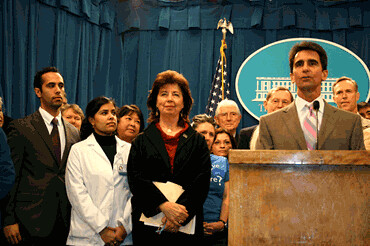
California State Sen. Mark Leno with California Nurses Association/NNOC Executive Director Rose Ann DeMoro to his right and community activists at Sacramento press conference.

Despite the political pragmatists or cynical policy wonks or legislators who have tried to shut single payer out of the healthcare reform debate, the movement itself has taken on a life of its own.

“We’re not going away — and our ranks are building,” said Rose Ann DeMoro, executive director of the California Nurses Association/National Nurses Organizing Committee, principal sponsor of the bill, said at the press conference.  

Among the many others represented were the California School Employees Association, One Care Now (a coalition of many other community and senior groups), Los Angeles Unified School District, California Physicians Alliance, medical students, and about a dozen other legislators.

“What we are doing here will influence and impact the debate nationally,” Leno pointed out, adding that it just might be passed in California — or any number of other states — first.

And he used a national example, the banking meltdown, to emphasize part of the argument for the single payer. “In health care, it is the industry who decides who they will insure and who takes the profit, and we the public who take all the risk. Just as in the banking system, the private banks took the profits, and now we the public are taking the risk.

Anticipating the expected opposition of Schwarzenegger again, Leno noted, “we intend to keep the debate alive through the facts” of the bill, place it on the governor’s desk again, said Leno, and, if needed, “work hard to elect a governor in 2010 who will sign our bill.”

SB 810 is an successor to SB 840, the single payer valiantly carried for years by now retired State Sen. Sheila Kuehl.  From both a health care policy and economic perspective the bill is more critical than ever.

As if any more reminders were needed, one came with a Gallup-Healthways Well-Being Index survey reported today in USA Today which found that 21 percent of Americans have difficulty paying for needed medical care or medications, with great disparities based on race and class. And the numbers facing that financial stress grew rapidly in 2008. http://www.usatoday.com/news/h…

Single payer remains the most cost-effective, comprehensive way to fix the broken system.

Cost effective by removing the bloated private insurers with their high administrative costs and financial incentives to continually raise premiums, co-pays, deductibles, and other fees that are the primary cause of rising costs.

Comprehensive in guaranteeing choice of provider, all you lose is your claims adjustor and utilization review team blocking care recommended by your doctor.

And, as a CNA/NNOC study has demonstrated, DeMoro added,  single payer “not only saves lives and people’s health, it is also an economic stimulus.”

Nationally, the study found, implementation of a single payer system would create 2.6 million new jobs, infuse $317 billion in new business and public revenues, and inject another $100 billion in wages into the U.S. economy. The jobs, through increased spending on health care delivery, ripple through the economy, creating employment in retail, manufacturing, and other sectors in addition to healthcare. But in healthcare alone, DeMoro noted, the impact would be especially great in California where an estimated 15 percent of the new jobs would be generated. http://www.calnurses.org/resea…

A large part of the task of the coalition, several emphasized, is public education. The campaign has begun.  

SB810, Single-Payer Healthcare for All Californians, Reintroduced

Single-payer healthcare reform has a new bill number and a new sponsor.  With my former State Senator Sheila Kuehl termed out, Mark Leno has stepped up to carry SB810, which in the past was known as SB840.  The bill would, in the words of the press release, “guarantee comprehensive health care benefits to every California resident and streamline claims and reimbursements, which will save billions of dollars in health care administrative costs.”  Here’s Sen. Leno:

“As a nation, we spend twice as much per person on health care as other wealthy countries, with the hope that our families will be protected from illnesses, yet most insured Americans still worry about how they will afford critical care if they become sick,” said Senator Leno. “In California, 7 million people do not have health insurance. Wasteful health care spending is crushing our economy and forcing families to forego basic medical care. With the money we spend today on health care, California can have a modern, universal health care system that provides high quality care for everyone,” he said.

A version of this bill has basically already passed the California Legislature, only to be vetoed by the Governor.  So it shouldn’t be a surprise that 43 lawmakers, including both leaders in the Assembly and Senate, have already signed on as co-sponsors.

Given the conservative veto and the 2/3 rule for revenue, SB810 lacks a funding source, so even if it were signed at some point – and realistically, Governor Schwarzenegger won’t be the one to sign it – supporters wold have to go to the ballot to raise the necessary revenue to fund the bill.  

There is no question that our health care delivery system is grossly inefficient, and insurance company profit and overhead is a pool of money that does little to provide quality care.  As a nation we spend an extreme amount on health care – $2.4 trillion dollars in 2008, closing in on 20% of GDP – without a proportional increase in health care outcomes over the rest of the industrialized world.  In fact, we pay more for care while ranking below dozens of nations in quality.  Single-payer care, while varied in different nations across the world, has generally been proven to offer the best quality at the most reduced cost.

But of course, that is on a national level.  And even though with 38 million people we have as many citizens as several other nations which have implemented single-payer, universal health care, what we lack is a printing press to coin our own money.  Given the constraints of a balanced budget, given the far more onerous constraints of the conservative veto, and given that states have little control over the boom and bust cycles of the national economy, universal health plans have largely come ashore and beached when they are done at the state level.  There are certainly reforms that can take place here, but we need the structural reform to set the table for them, and even with that, I am highly dubious (though willing to be convinced) that any state can manage UHC on their own without the tool of deficit spending that would occasionally be needed.  And history bears this out.

Tuesday Open Thread

While Arnold is putting the moves on President-Elect Obama in Philadelphia, there’s some stuff going on here. So, here are some links:

• Senator Steinberg has named the committee chairs. Of particular note, Fran Pavley was named as chair of the Natural Resources & Water Committee. This is important because Pavley has not been particularly outspoken against the peripheral canal, something the SoCal water nerds were worried about.  Apparently they think there’s a better shot to get the canal through a Pavley led committee. I kind of doubt it.

• Following in the classy footsteps of his father, newly elected Rep. Duncan D. Hunter has decided that Tijuana is more dangerous than Iraq or Afghanistan.  He’s been to all three so we’re supposed to believe him.  Sadly for Hunter, anecdote is not data.  And false assertions are not evidence.

• It’s a good thing the OC Board of Supes has all this money to throw around to lawyers. Oh, right, they have a $32 million deficit. I bet they would love to have this 1.1 mil free to spend.

• It appears that Arnold wants to star in a new version of A Christmas Carol.  At least that’s how I can reconcile his desire to lay off state workers during the holidays.

• The SEIU State Council put out a budget plan of their own. Well, that’s more than the Republicans have done. Peter Shrag also has a (sarcastic) plan: completely de-fund higher ed and the prisons until June. Seems about as reasonable as anything GOP has.

• Another rising cost: Free lunch enrollment at schools has risen dramatically during the current recession.

• The LGBT Legislative caucus is pushing a resolution opposing Prop 8, introduced by SF Legislators Leno and Ammiano.  Sure, it would have been more helpful a few months ago, but it won’t hurt now.