Category Archives: education

NCLB: Teachers and a garage size sign pay Pelosi a visit

(full disclosure: CTA has hired me to do blog outreach on NCLB)  cross-posted on DailyKos

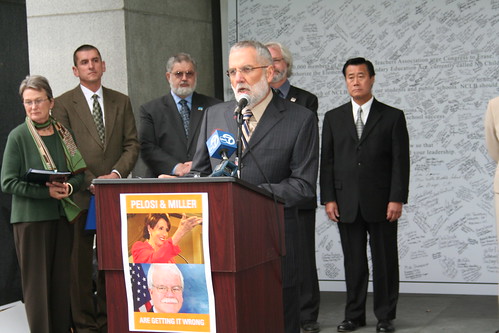
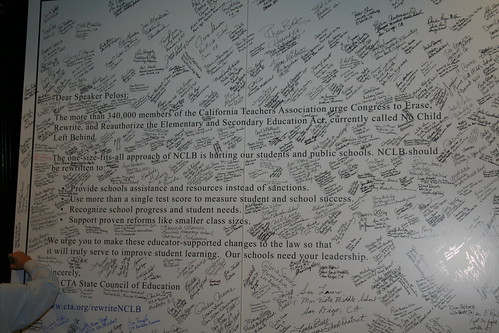
Teachers, lawmakers and San Francisco labor leaders came together today to present House Speaker Nancy Pelosi with a garage door-sized CTA postcard about the current NCLB re-authorization draft.  The 8-foot by 12-foot postcard was signed by nearly 1,000 teachers.  Since the big one would not fit in the door, they dropped off a off a poster-sized picture of the big postcard to her 14th floor office.  Unfortunately, Speaker Pelosi was not in her office to receive her visitors and their gift.

Teacher's Postcard to Nancy Pelosi

(sorry for the size, but wanted people to be able to read the text)

CTA Vice President Dean Vogel:

The Miller-Pelosi NCLB reauthorization plan will make it harder to attract and retain quality teachers in California classrooms. It continues to rely on testing as the measurement of student and school success. It creates a new federal mandate to pay and evaluate teachers based on student test scores. Test scores don’t fairly measure student achievement and cannot be used to accurately evaluate and pay teachers.

Here is Dean at the press conference.  He is the sweetest man, the kind of guy I wish I had as a teacher.

A few state politicians joined the teachers in speaking out against this NCLB draft.  Sen. Leland Yee, with his unique credentials said:

Leland Yee

Tying a student test score to a teacher evaluation or merit pay is an improper use of student assessment.  As a child psychologist, I understand that there are many factors that contribute to a student’s performance. I support the efforts of CTA to stop this latest version of NCLB, which only makes a bad law even worse.

There is a letter circulating the state capitol that many Democrats in the legislature have signed on to, calling on Pelosi to oppose the merit pay and other harmful one-size fits all education proposals in the reauthorization plan.  Here is an excerpt:

We urge you instead to help reshape this measure into one that would empower districts and local associations,” the letter states, in part. “Together, teachers and district administrators can develop proposals that include workable and productive means for recognizing teachers while improving the professional development of all teachers.

The event today is getting notice in the education community.  David Hoff over at the excellent NCLB blog at Education Weekly said:

In San Francisco today, the California Teachers Association will hold a news conference outside the office of Speaker of the House Nancy Pelosi. The NEA affiliate will unveil a postcard opposing the House draft that 1,000 California teachers signed. The news advisory, which is not online, says the postcard is the size of a garage door. The CTA has its own legislative alert.
This is quite a public display of the union’s power, and it’s over a discussion draft. What’s going to be next?

The answer is whatever it takes to get this thing right.  It is too important not to be pulling out all the stops.  California’s children are counting on us to make sure that NCLB is fixed.  The quality of their education is at stake.  That is why you see the blog ads, state politicians speaking out, and postcards signed by a thousand teachers.

Find out more on the CTA NCLB website.

——

6th in a series.  See earlier posts:

Nancy Pelosi and George Miller are getting it wrong: NO on NCLB

Getting George Miller’s Attention and the Bad Miller/Pelosi NCLB Bill

Merit Pay and NCLB: George Miller Still Getting it Wrong

School Progress Assessment: George Miller and NCLB

More Reasons to Oppose the George Miller/Pelosi NCLB Proposal

About that $56 Billion for NCLB George Miller…

(full disclosure, I have been hired by CTA to do blog outreach on NCLB)

One of the dirty little secrets, at least for most people is the exact price tag of the massive underfunding of NCLB.  Conservatively, it is now at $56 billion, an astronomical sum.  That is the amount of money promised states and schools for reimbursement for the costs of implementing NCLB.  This includes money to actually run the test, and for states to actually put together the data tracking systems so that schools can be evaluated.

Here in California, our underfunding is now over $7.3 billion.  This chart shows the amount that was authorized and the actual amount California received (click the link for a larger version).  The cumulative NCLB funding gap just kept on growing over seven years, thus the $7.3 billion total.  It is not like the state is going to step up and cover for the federal government.  The feds are the ones who placed these demands/mandates on the schools.  Thus, NCLB implementation has been cutting directly into actual education funding for learning.  It is a bad situation that only gets worse each year.

One would think that the current draft for re-authorizing NCLB by Rep. George Miller would include a way to start paying that back.  But no, it does not even guarantee that there will be money for all of the new demands they have placed on our schools that they added to the new bill, let alone cover the $56 billion.  It is just one of many reasons why California’s teachers are saying to to the Miller/Pelosi proposal.

For more information on NCLB see the CTA website.

More Reasons to Oppose the George Miller/Pelosi NCLB Proposal

(full disclosure CTA has hired me do to online outreach on NCLB)

It is well known that the current focus of NCLB on testing forces teachers to teach to the test. In fact, according to a recent national study by the Center on Education Policy, a majority of the nation’s school districts report that while increasing time for test preparation they have decreased class time for science, social studies, art, music, and physical education. In some elementary schools time for student lunches has also been cut to spend more time to prepare for the standardized tests mandated by the feds.  How depressing is that, kids forced to eat quickly and lose out on valuable social time to cram for a test.

The Miller/Pelosi reauthorization proposal continues to punish lower-performing schools, rather than providing assistance and resources to help all students and schools succeed. Their proposal creates four new levels of sanctions for struggling schools. This year NCLB labeled one out of every four California public schools as failing.  As an example of how ridiculous NCLB’s school rating system is, a California distinguished school, after successfully passing 45 of the 46 components of the NCLB rating system, was labeled a failure because ten English language learners did not score high enough on one test.

This relates directly to what I wrote about on Friday on the problematic usage of benchmarks rather than progress to assess school’s performance.  By California standards they were achieving, but missing just one benchmark, in this case 10 kids just learning English did not score high enough on one test taken on one day.

Remember that the Miller/Pelosi reauthorization proposal creates a new federal mandate to pay and evaluate teachers based on student test scores.

We know that test scores by themselves don’t fairly measure student achievement and they certainly will not be able to accurately evaluate a teacher’s effectiveness.  At a time when California will need more than 100,000 new teachers in the next 10 years, this proposal will discourage the quality teachers our schools so desperately need from ever entering the profession.

Call, write and fax your Congresscritter.  Plus contact Pelosi and George Miller.  Find out more at CTA’s NCLB page.

School Progress Assessment: George Miller and NCLB

(full disclosure CTA has hired me to do blog outreach on NCLB) (also in orange: Miller and NCLB)

One of the many problems with the current Miller/Pelosi draft of the re-authorization of NCLB is how it assesses schools.  The feds require schools get assessed with an Adequate Yearly Progress (AYP) report.  It sets benchmarks.  If you do not meet them, you fail.  It is a very rigid system.  They mandated this program, yet never provided the money for states to actually track schools and students. Thus states have had to cough up the money on their own for data programs.

Here in California we already have a great assessment program called the Academic Performance Index (API).  (Get that AYP (feds) API (Cali)).  The API sets goals based on progress over time.  So if a school is way behind, but they show significant percentage improvement (say 20% or so gains), they don’t get on the failing list and get punished.  Many schools who were really far behind under NCLB were classified as failing and punished, even though they were showing dramatic gains under API.  It was a vicious and disheartening cycle.

California really likes its system.  It still puts a heavy emphasis on improvement, but schools that start out severely underperforming don’t get punished while they are making huge improvements. 

Since NCLB passed, California has put a lot of money into a system to track students under the AYP.  We still are not there yet, years later.  One of the many fixes to NCLB that education advocates both here in CA and across the country have been pushing for is for states to be able to assess students on the API model.  Jack O’Connell, State Superintendent of Schools, wrote a letter to George Miller, where he addressed this problem (sorry no cite, came via email):

After reviewing the discussion draft, I am pleased to see that the Committee recognizes the limitations of the current law’s status model for measuring AYP.  However, I am disappointed to not that the draft does not allow states to use valid improvement measures to hold districts and schools accountable. [snip]

Provisions in the draft would increase technical complexity while reducing academic accountability at the cost of existing, proven and reliable state systems.

Got that.  They are putting more mandates on the schools, thus making the reporting mechanisms even more complicated.  That costs money.  And they are not increasing flexibility so schools can be assessed using other, superior models like the API.

As noted in the reauthorization recommendations I issued earlier this year, the API has been a successful agent of change for our schools and districts.  It is a publicly recognized and understood tool for holding schools accountable for improvement.  Using the notion of “earned autonomy,” the reauthorized law should recognize the authority of states to measure AYP with their own state system, so long as that system meets conditions of peer-reviewed rigor, demonstrated progress and approval by the ED (Education Department).  The federal government would retain the authority to hold states accountable for their results according to an agreed metric.  Our shared focus should be on the academic objectives and not the restricted methodology.

I know it is a bit weird for progressives to be arguing for states rights, but in this case we really do have a better, fairer system and the federal government is forcing us to use a rigid inferior one.

Fourth in a series.
Previous posts:

Nancy Pelosi and George Miller are getting it wrong: NO on NCLB

Getting George Miller’s Attention and the Bad Miller/Pelosi NCLB Bill

Merit Pay and NCLB: George Miller Still Getting it Wrong
—————-

Take Action, contact Miller and Pelosi.  More information on the CTA website.

The Case for Bill Richardson: Leadership for America

This diary is part of the candidate series on MyDD for Bill Richardson.  I am Californian supporter of Richardson.  I am not part of his campaign.

Congressman, U.S. Ambassador to the United Nations, Secretary of Energy and in his second term as Governor of New Mexico after a landslide victory in November 2006, Governor Bill Richardson is running for President to heal America and restore our place in the world. He possesses the experience, vision and leadership skills to be a great President.

Richardson is goal-oriented, assertive and confident. He has the ability to quickly evaluate a situation but is not rigid in his thinking and will modify policy when necessary. He takes a practical approach to governing, focusing on solutions to problems rather than ideology.

Richardson has been called a “force of nature.” When he served in Congress, he was regarded as one of the hardest working members, respected for his intelligence and detailed knowledge of the issues. In a profile earlier this year, Democratic state Senator Mary Jane Garcia stated, “It just never stops; it’s busy, busy, busy. He’s got an agenda like you can’t believe.”  New Mexican Republican Representative Dan Foley added, “People shouldn’t count him out. You won’t find a person who works harder.”

Richardson fights for the principals he believes in. I offer two of many examples:

First, while Secretary of Energy, against opposition in Congress and even criticism from within the Clinton Administration, Richardson acknowledged the Energy Department’s long history of denying responsibility for workers’ injuries at the nation’s nuclear weapons plants. He stated, “We need to right this wrong.”

Richardson successfully lobbied Congress to enact legislation providing payments and medical benefits to the workers that developed cancer and other serious diseases.

Second, in April 2007, Richardson spoke at Rally to Save the People of Darfur in San Francisco. He was the only Presidential candidate that attended, even though they were all in California that weekend for the California Democratic Party Convention.  Prior to speaking, a reporter asked Richardson why he was there. Richardson’s response was an inspiration to all fighting for social change: “You have to be part of the causes you believe in.”

Richardson has been to Sudan three times visiting refugee camps and negotiating the release of American aid workers and journalists. He has never given up on Africa.

Richardson has had an outstanding record as Governor of New Mexico.  He increased school funding, expanded health care coverage, extended civil rights protections to include sexual orientation, made New Mexico a model for the rest of nation in promoting clean energy and fighting global warming, while cutting taxes to promote sustainable growth and balancing the state budget. For his commitment to protecting the state’s environment, the Conversation Voters of New Mexico gave Richardson “a solid A.”

Richardson understands that the Democratic Party must be the party of economic progress.  He has assisted the private sector in New Mexico in creating new, high paying jobs. He calls on Democrats to “stand for policies that encourage innovation and expand economic opportunity.”

On education policy, Richardson understands that No Child Left Behind sets up our public schools for failure.  Unlike the other major candidates that want to somehow fix and preserve NCLB, Richardson’s approach is simple and clear:  scrap it.  Richardson writes::

NCLB has failed. It has failed our schools, it has failed our teachers and it has failed our children. The Bush administration claims victories, but upon closer scrutiny it becomes clear that the White House is simply dressing up ugly data with fancy political spin. Far from leaving no child behind, President Bush seems to have left reality behind. 

On global warming and energy policy, Richardson has set forth the most detailed and aggressive plan of all candidates – calling for a 90% decrease in greenhouse emissions by 2050.  Dave Hamilton, the Sierra Club’s Director of Energy and Global Warming program, stated Richardson’s “18-page energy policy is much more aggressive than anything we’ve seen so far from the candidates.  It is also significantly better-elaborated in theory with regard to where we end up.” 

Richardson is the product of two nations, Mexico and the United States. His childhood friends included many of the poor in the neighborhood where his family lived in Mexico City.  He saw first hand the devastating impact of poverty on families and children. His bi-national upbringing necessitated understanding and then bridging two cultures. This laid the foundation for Richardson as an adult to become a peacemaker among nations and an expert in the art of diplomacy.

Richardson has articulated a new foreign policy for America which starts by recognizing the new challenges we face in the 21st century:

Jihadists and environmental crises have replaced armies and missiles as the greatest threats, and globalization has eroded the significance of national borders. Many problems that were once national are now global, and dangers that once came only from states now come also from societies-not from hostile governments, but from hostile individuals or from impersonal social trends, such as the consumption of fossil fuels.

Richardson calls on the U.S. to foster “the cooperation needed to solve the issues that face the modern world. The U.S. government needs to see the world as it really is – so that the United States can lead others to make it a better, safer place.”

On Iraq, Richardson has eloquently stated:

The War in Iraq is not the disease. Iraq is a symptom. The disease is arrogance. The next President must be able to repair the damage that’s been done to our country’s reputation over the last six years. It’s why experience in foreign affairs has never been more important.

Richardson has the best plan for ending the war in Iraq. He is only major candidate that has repeatedly and unequivocally called for the complete withdrawal of ALL American forces from Iraq.

The others candidates lack the confidence to stand up to the military and political establishment and follow the will of the American people.  They accept the argument that a complete withdrawal of all American forces would be “irresponsible.”  As Richardson wrote wrote in a recent Op Ed, “On the contrary, the facts suggest that a rapid, complete withdrawal — not a drawn-out, Vietnam-like process — would be the most responsible and effective course of action.”

The fundamental difference between Obama, Edwards and HRC verse Richardson on Iraq is that Richardson understands that by the U.S. remaining in Iraq, we unwittingly perpetuate the war.  Our troops have become the targets in a civil war.  The Iraqi government has become dependent on the U.S. for security the Iraqis should provide.  Richardson notes: “The Iraqis won’t take the necessary steps toward political reconciliation until the U.S. makes it clear that it will leave the country for good.”

Likewise, without the direct and committed action by the President of the United States, Iraq will remain in chaos. Richardson is the only candidate with a track record of foreign policy success.  Richardson will lead a diplomatic offensive to bring peace and stability to the region.

That we must exit Iraq now is a message Richardson constantly delivers to voters.  He doesn’t tailor his message to the audience. Yesterday, Richardson spoke on ending the war at two town halls in Iowa.  The first was at the National Guard Armory in Council Bluffs and second at the Veterans of Foreign Wars Post in Sioux City.

In closing, with Richardson we get two for the price of one: an energetic, can-do leader on domestic issues and an experienced diplomat on foreign affairs.

Merit Pay and NCLB: George Miller Still Getting it Wrong

(full disclosure: California Teacher’s Association has hired me to do online outreach on NCLB)

x-posted on dkos

There are a lot of things wrong with NCLB, so why are George Miller and Nancy Pelosi insisting on adding new problems.  More specifically, adding a federal merit pay program for teachers.  First of all, studies have shown that merit pay just does not work.  It leads to divisiveness in the teaching ranks, makes hiring more difficult and tends to go to teachers in affluent school districts, despite promises to the contrary.  Just about every school that implements merit pay repeals it down the road.

This is not an isolated problem:

Merit pay comes in many forms and flavors — including extra bonuses for student achievement gains, satisfactory evaluations by principals or committees, acquiring additional duties, gaining new skills and knowledge, and serving in hard-to-staff schools. We’ve looked at dozens of plans in North America, South America, Asia, Europe, and the Middle East. Guess what? None of them, past and present, has ever had a successful track record. None has ever produced its intended results. Any gains have been minimal, short-lived, and expensive to achieve.

That was from an article in the Boston Globe by two education experts.  Yet, still Miller persists on pushing this federal program.

Take for example what is going on in Florida.  They passed a merit pay program and promised that there would be no imbalances along racial or income lines.  That was the problem with a now defunct earlier problem and the problems are still the same with this new program.

At Palm Lake Elementary, two out of three teachers earned a bonus through Orange County Public Schools’ merit-pay plan.

At Richmond Heights Elementary, the number was zero.

Palm Lake is a predominantly white school in the affluent Dr. Phillips area.

Richmond Heights is a predominantly black school in a poverty-stricken pocket of Orlando.

The two schools illustrate a marked disparity in the distribution of merit bonuses to 3,911 Orange County teachers and administrators uncovered in an Orlando Sentinel analysis of the program.

The Sentinel’s review showed that teachers at predominantly white and affluent schools were twice as likely to get a bonus as teachers from schools that are predominantly black and poor.

The merit pay program in the Miller/Pelosi program was the topic of some controversy during Monday’s hearing.  Miller accused teachers, in specific NEA, of reversing themselves on merit pay.  At issue was an earlier bill, which NEA reluctantly supported back in 2005 called the TEACH Act.

Toward the end of the almost seven-hour session, NEA President Reg Weaver and AFT Executive Vice President Antonia Cortese objected to proposed alternative pay programs for teachers, which are included in the section addressing teacher quality.

In the Q&A that followed, Chairman George Miller, D-Calif., reminded the union reps that that the pay proposals came from the Teacher Excellence for All Children Act, which the unions endorsed after extensive talks with Rep. Miller and a host of education groups.

“This language was mutually arrived at by various parties,” Rep. Miller said.

In response NEA President Reg Weaver sent a letter to the members of the Education Committe, Nancy Pelosi and George Miller.  This is an excerpt from the Miller letter:

In May 2005, prior to the introduction of the TEACH Act, we expressed our concerns in writing to your staff about performance-pay provisions contained in the draft bill, calling for them to be subject to collective bargaining or a 75 percent majority support vote of teachers where bargaining does not exist. Ultimately, the introduced bill did include some labor protections. However, as we stated in our letter of June 2005, we looked forward to continued work with you on making improvements to the bill. We offered your TEACH Act legislation general support because the bulk of the bill was aimed at providing teachers with the kinds of supports they need to be successful, such as high quality professional development, mentoring and induction programs, and incentives to become certified by the National Board for Professional Teaching Standards. You are an experienced legislator who understands that “general support” does not translate to support for each and every provision of a particular bill. If that were the case, we would never see passage of most pieces of legislation and legislators would never receive letters of support from interested parties.

They supported the bill at the time, with reservations, with the understanding that they would work on improvements because the larger goals were important.  That does not mean that they endorsed the concept of merit pay, particularly as laid out in the current Miller/Pelosi proposal.

After that initial support and earlier this year when Miller’s staff informed them that they would be re-introducing the TEACH act and making it the basis for the re-authorization of NCLB/ESEA, NEA re-informed Miller of their opposition in discussions with his staff.  They sent letters and continued discussions.  More from the letter:

On August 8 and again on August 16, NEA sent letters (attached) to convey very clearly our position about performance pay plans. At the end of August and over the Labor Day weekend, NEA staff submitted additional legislative language to remedy the serious problems in your draft language; however, those proposals were rejected. Your discussion draft released on September 6 reflects neither the specifications set forth in our letters, nor the legislative language suggestions we have proposed to protect educators’ rights. Furthermore, the Title II discussion draft now contains additional performance pay provisions that were not a part of the TEACH Act (such as in the Teacher Corps program).

Miller knew full well that they opposed the merit pay provisions.  Any suggestions to the contrary are just silly.  Did they need to take out ads to make it clearer?

To reiterate, we do not support mandating any evaluation or compensation term as an element of a federal program, voluntary or not. We are particularly opposed to any provisions that would require that student test scores be a mandatory element. Therefore, we are simply asking again for labor protections to ensure that a school district cannot impose on teachers without their consent the use of test scores or student learning gains as part of any evaluation or compensation system. As several of your witnesses testified yesterday, educator buy-in is essential to the success of any compensation plan.

We are determined to obtain clear and comprehensive protections in ESEA concerning any aspect of teacher compensation, evaluation, or other employment terms. As I indicated yesterday, our members are hired by school districts, not the federal government. As such, employment contracts must be negotiated and agreed to at the local-not federal-level. This issue, more broadly, is about protecting public employees’ collective bargaining rights under federal law. We will not support any legislation that undermines those rights and sets a dangerous precedent for our colleagues in the labor community.

It is not that teachers oppose any and all pay-for-performance legislation.  The crux of it is that it doesn’t happen with out their approval, it should be one of several options for using federal funding and it does not undermine local bargaining agreements. 

New federally mandated programs, especially those that are proven not to work are not what we want from the new NCLB bill.  We need to fix the problems that currently exist, not create new ones, especially ones that are based on test scores.  George Miller needs to stop playing dumb on this one.  Teachers do not support this merit pay program, they never have.  They have not reversed themselves.  It was always a bad idea and it will always continue to be a bad one.

Take Action, contact Miller and Pelosi.  More information on the CTA website.

September 12, 2007 Blog Roundup

Today’s Blog Roundup is on the flip. Let me know what I missed.

To subscribe by email, click
here and do what comes naturally
.

When I was a student, we
called this cramming — didn’t work very well then either

The Librul Academy: or
how the taxpayers of California still employ John Yoo as a law
professor at UC Berkeley

Big fish, smaller ponds

Candidates are people too

Everything else

Getting George Miller’s Attention and the Bad Miller/Pelosi NCLB Bill

(full disclosure: CTA has hired me to do blog outreach on NCLB)

Well, CTA sure got George Miller’s attention yesterday with the blog ads.  He actually responded with a statement to Education Weekly:

The CTA claimed today that the legislation would judge teachers’ performance solely on the basis of their students’ achievement gains, even though the organization knows this isn’t true. Contrary to the CTA’s assertions, the legislation would consider achievement gains along with other measures, like principal and master teacher evaluations. The CTA also wrongly implies that I don’t support things like class size reduction, teacher professional development, and mentoring programs for teachers. I do support those things, which is why they are included in the bipartisan discussion draft of NCLB reauthorization legislation that we have circulated. From the very beginning, I sought the input of teacher organizations to craft the legislation.

Actually, Rep. Miller knows full well that the Miller/Pelosi proposal still bases achievement gains predominantly on test scores.  It counts for something like 85% of the scoring and indeed states could choose just to base it on test scores.  Perhaps he needs to read the press release over again.

Notice that he only responded on a limited number of topics and was quite defensive.  Just because he included teachers in the discussions, does not mean that he totally heard them.  Take the issue of data.  I know boring right, but stick with me below the fold.  It’s an important lesson about the failings of the first version and how this Miller/Pelosi proposal fails to fix them.

When NCLB was first passed it demanded assessments of student achievement, measured by tests scores.  The goal was laudatory, to close the achievement gap, however we don’t have the data to make honest assessments.  Those that have tried to come to conclusions have used various methods to try to take scores and use regression analysis or other efforts, but have always pointed out that any conclusions are limited by the lack of available data.

In California, which is not atypical, the biggest roadblock is that we don’t have a statewide student identifier – or a way to track a specific individual student as she/he progresses from grade to grade.  That’s the only real way to know if things are working.  Instead, researchers, bureaucrats and politicians are taking snapshots of group performance at any time, and comparing it to snapshots of a different group a year later.  There are obvious flaws in this from the research standpoint.  That issue has also complicated things like tracking graduation and dropout rates.

The other problem comes in when you try to compare states to each other.  Each state has its own standards and its own method of testing how students measure up to them.  Now states had to have their testing processes approved by the Dept. of Education to meet NCLB requirements, but the Dept. of Ed. accepted very few of them, especially at first.  California has one of the oldest and most widely-respected accountability systems that began back in 1999.  Since NCLB, the state has attempted to mold the exams to also use them for federal purposes.  But it’s difficult.  And CA’s system is a growth model – tracking progress over time, rather than setting benchmarks that schools either meet or don’t in any given year, as is the case with NCLB.

The draft legislation, tries to mandate the data system requirements for the states, including linking teacher data to student data, which is opposed by CTA.  And, again, there’s never any money for any of it.  Creating complex data systems, integrating them, converting data to them, etc. all takes money – especially in a state as large as ours with around 9,500 schools and nearly 1,100 districts feeding in data for 6.3 million kids.

That is what we mean by including new mandates and failing to ensure there is funding.  Having data and tracking students is a great thing, but you can’t mandate that it happens and then not provide the funding.  The California legislature will not provide the money to meet federal requirements, nor should they.  The feds need to provide the resources to meet their mandates.

The Miller/Pelosi proposal is unacceptable as currently written.  Many problems with NCLB have not been fixed, nor has funding for things like the data programs been provided.

Keep the pressure on Miller and Pelosi.  Take action.  Blog it up on your own sites.

September 11, 2007 Blog Roundup

Today’s Blog Roundup is on the flip. Let me know what I missed.

To subscribe by email, click
here and do what comes naturally
.

Things to Read Today

Health Care (AB 8)

Environment &
Energy

Reform Efforts and
“Reform” Efforts

Education

Republicans

Homes

Electoral Politics
Generally

All the Rest

Nancy Pelosi and George Miller are getting it wrong: No on NCLB

(full disclosure, CTA has hired me to work on blog outreach about NCLB)

The main flaws of NCLB have been known for years.

  1. The program is woefully underfunded to the tune of a whopping $56 billion
  2. It relies too heavily on one measurement of student achievement,: standardized testing.

Luckily this bill comes up for re-authorization this year and we have a great chance to get it right.  Unfortunately, the current NCLB bill from Miller and Pelosi is more like something we would expect from the Bush Dogs.  It fails to fix the above, and in some respects goes backwards.  The California Teachers Association (CTA) is urging people contact their Members of Congress and ask them to Vote NO on NCLB, saying this proposal “does nothing to improve the law”.  A series of blog ads are now up (Calitics ad is coming) on a whole host of Californian and national blogs, calling out Pelosi and Miller on their insistence on punishing teachers and students.

Urban education expert and author Jonathan Kozol has been fasting for 67 days as a “personal act of protest at the vicious damage being done to inner-city children” by NCLB.  Kozol has a powerful piece up today on HuffPo:

The poisonous essence of this law lies in the mania of obsessive testing it has forced upon our nation’s schools and, in the case of underfunded, overcrowded inner-city schools, the miserable drill-and-kill curriculum of robotic “teaching to the test” it has imposed on teachers, the best of whom are fleeing from these schools because they know that this debased curriculum would never have been tolerated in the good suburban schools that they, themselves, attended.

The current proposal still relies on just test scores, instead of multiple measures of student and school success like attendance/graduation rates, a rigorous curriculum and the number of students taking honors and AP classes.  It adds a merit pay program (a truly bad idea, more on that later this week), creates four new levels of sanctions on schools and does not guarantee that there will be funding.  more on the flip…

Here is NEA on the current proposal:

We are also concerned that this Title imposes many additional mandates and requirements on schools and states (such as the longitudinal data system and student mobility audit) without any guarantee that additional funding will be provided to meet both new mandates and help states and schools overcome the cumulative $56 billion shortfall that occurred since 2002 between the NCLB authorized and actual funding levels.

More restrictions and no guarantee of funding.  Great….

Kozol again:

The justification for this law was the presumptuous and ignorant determination by the White House that our urban schools are, for the most part, staffed by mediocre drones who will suddenly become terrific teachers if we place a sword of terror just above their heads and threaten them with penalties if they do not pump their students’ scores by using proto-military methods of instruction — scripted texts and hand-held timers — that will rescue them from doing any thinking of their own. There are some mediocre teachers in our schools (there are mediocre lawyers, mediocre senators, and mediocre presidents as well), but hopelessly dull and unimaginative teachers do not suddenly turn into classroom wizards under a regimen that transforms their classrooms into test-prep factories.

The real effect of No Child Left Behind is to drive away the tens of thousands of exciting and high-spirited, superbly educated teachers whom our urban districts struggle to attract into these schools. There are more remarkable young teachers like this coming into inner-city education than at any time I’ve seen in more than 40 years. The challenge isn’t to recruit them; it’s to keep them. But 50 percent of the glowing young idealists I have been recruiting from the nation’s most respected colleges and universities are throwing up their hands and giving up their jobs within three years.

When I ask them why they’ve grown demoralized, they routinely tell me it’s the feeling of continual anxiety, the sense of being in a kind of “state of siege,” as well as the pressure to conform to teaching methods that drain every bit of joy out of the hours that their children spend with them in school.

My sister is getting close to getting her teaching credential.  How are we going to keep people like herself in the profession, when we are going backwards with this law?  California needs to hire 100,000 teachers in the next ten years.  The law would make it more difficult to hire and retain the teachers we need to improve California’s schools.

The Democrats were elected to Congress with a mandate for change.  NCLB was on their lists of things to fix.  Why do we have a Bush Dog bill instead of a real bill?  Are we saving gunpowder on this issue too?

We can’t let the past repeat itself. This law is too important for the future of our public schools.  Find out more on the NCLB page.  And take action.